






 Watch Full Show

Guests
- Salah Sarsourpresident of the Islamic Society of Milwaukee, the largest mosque in Wisconsin, and a national board member of American Muslims for Palestine.
We speak with Salah Sarsour, a Palestinian community leader in Wisconsin, president of the Islamic Society of Milwaukee and a legal permanent resident of the United States for over 30 years. He faces possible deportation after being arrested in March and detained in an ICE jail for 80 days. The Department of Homeland Security claims Sarsour was arrested for lying on his 1993 green card application about a conviction in Israeli military courts when he was a teenager in the occupied West Bank, but Sarsour’s lawyers say he is being targeted by the federal government over his advocacy for Palestinian human rights. Although a judge ordered Sarsour’s release from detention in June, he still faces deportation proceedings set to resume next week.
“In ICE detention,” says Sarsour, “it brought to me these bad memories from my childhood, when I was under the Israeli military occupation and Israeli military rules in Palestine.”
Related Story
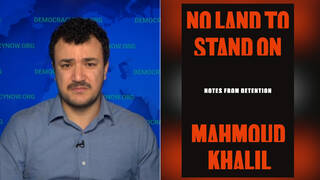
 StorySep 30, 2026“No Land to Stand On”: Mahmoud Khalil on His Memoir, Palestine, Fighting Deportation & Suing Columbia
Transcript
NERMEEN SHAIKH: “On March 30, on a morning like any other in my hometown of Milwaukee, a man in plain clothes emerged from a car speeding toward me, a handgun visible at his side, and asked, 'Are you Salah Sarsour?'
“Within minutes, nearly a dozen cars and some 20 agents — masked, plainclothes, one flashing a U.S. Immigration and Customs Enforcement badge — converged on me and informed me that I was under arrest.”
These are the words of Salah Sarsour, president of the Milwaukee Islamic Society, published by USA [Today] earlier this week. Sarsour, who is Palestinian, has been in a protracted deportation battle since that day, despite being a legal permanent resident of the United States for over 30 years. Following his arrest, Sarsour was detained in an ICE jail for 80 days.
Sarsour’s lawyers say he’s being targeted for deportation by the federal government over his advocacy for Palestinian human rights. Attorneys for DHS, the Department of Homeland Security, are claiming Sarsour was arrested for allegedly lying on his 1993 green card application about a conviction in Israeli military courts when he was a teenager in the occupied West Bank.
In June, a district judge appointed by President Trump agreed with Sarsour’s attorneys, saying they had, quote, “presented a substantial claim of First Amendment retaliation” and that Sarsour’s detention was unlawful. He was released and reunited with his family, which includes six children and nine grandchildren, all of whom are U.S. citizens.
AMY GOODMAN: But that ruling has no bearing on his deportation case. On Wednesday, a federal immigration judge heard arguments in deportation proceedings for Salah Sarsour. Those proceedings continue next week.
In a USA Today op-ed, Salah Sarsour wrote, quote, “As a national leader supporting some of the largest and longest-standing grassroots organizations for Palestinian rights, my arrest marked a serious escalation in the Trump administration’s repression agenda. This is not just an attack against me and others working for Palestinian freedom; it is an attempt to dismantle the very values we profess as a nation.”
For more, we go to Wisconsin, where we’re joined by Salah Sarsour himself.
Thanks so much for being with us. When we were in Milwaukee on Mother’s Day, one person after another came up to us to say, “Do you know about Salah Sarsour?” You had been jailed for more than a month at that point. Can you describe further what happened to you, how you were approached and what your detention was like?
SALAH SARSOUR: Good morning. Thank you very much for having me this morning with you guys. I really appreciate that.
Actually, as you mentioned in your report, in March 30th, it was the day when I was very surprised when ICE agents came toward me with guns, and they asked to arrest me in that day, and they took me immediately to Chicago, then to a Indiana facility. In that day, by the way, this morning, I was supposed to take my mom to her doctor appointment. And honestly, I thought they are mistaken. They just — they’re supposed to take someone else, and they came toward me. But, unfortunately, after a while, I felt like I was targeted, as you mentioned in the report, because my activism and because I’m standing with just causes and I’m practicing my free speech. And I felt the Trump administration targeting me for that.
NERMEEN SHAIKH: And, Salah, could you just lay out what exactly is the U.S. government alleging?
SALAH SARSOUR: Actually, they came after me for some very old accusations. Even the federal judge clearly released me from all those accusations. It’s just like — again, as I mentioned, it’s just like it was a very tough experience and a kind of a bad memory journey with the ICE detention for no reason but my activism and my freedom of speech. And I really felt like if it happened to me, it could happen to anyone, because, as you mentioned even in your report, I’m a businessman, family man, someone who builds bridges with faiths and other communities and working to build a society. So, I was asking all the time why the government targets me and and why I’m here in this inmate facility in Indiana. There is no reason for that.
NERMEEN SHAIKH: And you also wrote, Salah, in your USA Today piece, quote, “Aspects of my confinement were hauntingly reminiscent of my experience growing up under a brutal Israeli military occupation in the West Bank, where we became accustomed to violent, humiliating treatment at the hands of Israeli soldiers. As a child of 15, I was imprisoned for two years on charges that included throwing stones and was subjected to intimidation, coercive interrogation tactics and threats of rape.” So, could you elaborate on that and the fact that you felt this was reminiscent to your time in Israeli custody, your time here in ICE detention?
SALAH SARSOUR: Yes, actually, in ICE detention, as you mentioned, it brought to me this bad memories in my childhood, when I was under the Israeli, actually, military occupation and Israeli military rules in Palestine, in West Bank. So, I never thought in my life that I will see such facility in the United States here with all this kind of bad treatment. So, immediately, as I mentioned, it brought me this memories, what I went through as a child when they arrested me from my house, when the Israeli soldiers came and arrested me and make me go through two years, at least, in prison for one reason: that I’m a Palestinian. That’s all.
AMY GOODMAN: And you also — talk about what you had to sign when you were held. You were held for almost two years by the Israeli authorities when you were a teenager?
SALAH SARSOUR: Yes, I went through two experiences in prison in Palestine, one of them two years, actually. And this is not only me. As you know, as Palestinian, we live under Israeli occupation, military occupation, and there is no equal rights there. So, thousands and thousands of Palestinian children, they went through this experience, actually.
AMY GOODMAN: When I was in Milwaukee, as I mentioned, in May, I spoke to Jodi Melamed, a member of Jewish Voice for Peace–Milwaukee. She talked about how many in the Jewish community organized for your release. This is what she said.
JODI MELAMED: As Jewish Voice for Peace, we know him to be an amazing human being, a doer of mitzvahs. He’s like the Papa Bear of our Palestinian solidarity movement. We love him. We need him back. His case also represents Jews really standing against the weaponizing of the immigration system in the name of antisemitism. We have 8,000 signatures on a Bend the Arc letter. We have hundreds of signatures from Wisconsin Jews. So, Jews for whom the red line is the First Amendment are really coming together, and we’re going to have a big vigil for him.
AMY GOODMAN: So, that was Jodi Melamed of Jewish Voice for Peace–Milwaukee. When you got out of ICE detention, you thanked, among others, JVP, Jewish Voice for Peace. You also greeted your newest grandchild, who was born while you were jailed. You’re the father of six, grandfather of nine. Can you talk about what the solidarity meant and what it meant to be apart from your family?
SALAH SARSOUR: I mean, thanks God, there is many great people, people of values, like Jewish Voice of Peace, other people of faith, Christian, Muslims, Jewish, who worked together like always to stand with justice. And this means a lot to me, and especially for someone who’s going through a unjust situation.
And as you mentioned, like, I’m a family man living with my children. And all my children, by the way, my six children, they finished colleges here in Wisconsin. And I have nine grandchildren. All of them are American citizens. I have my mother. She’s 85 years old. She really needs me for her support, daily support. So, someone living this kind of life, I never imagined myself living, like, in a prison in the States. It was never like even an idea in my mind to think about it. And as you mentioned, like, my daughter Sundos, actually, she had my number nine grandchildren, which is her fourth child, coming while I was in Indiana prison, and it was a very difficult timing for me, actually.
NERMEEN SHAIKH: So, Salah, can you explain what comes next now?
SALAH SARSOUR: I mean, first of all, I really like to thank all media outlets and all community members, leaders, organizations, people of faith, people of values, who standing with me. And this is what give me support, and this make me continue the fight to stay with my family, with my children, with people I love.
So, I have a great, actually, legal team who’s working hard to keep me here and to win this fight. And I have a big hope after the federal judge actually released me from the prison, and clearly he highlighted that, as you mentioned, I’m a community person, a family person, a legal resident of 32 years, someone who stands with just causes, and he highlighted my freedom of speech. So, this gave me hope in the system, and this gave me hope that I will go through like a fair treatment, and it will end me free and back working to my family and my community who relies on me.
AMY GOODMAN: Well, Salah Sarsour, we will continue to follow your case, president of the Islamic Society of Milwaukee, the largest mosque community in Wisconsin, and a national board member of American Muslims for Palestine. We’ll link to your op-ed in USA Today, headlined ”ICE detained me for 80 days. America’s silence is no longer an option.”
Coming up, Palestinian rights activist, Columbia University graduate student Mohsen Mahdawi. He is also facing deportation. A three-judge federal appeals panel has just overturned a lower court ruling that freed him from ICE detention last year just before his Columbia graduation. Stay with us.
[break]
AMY GOODMAN: “Inside My Head” by Sove The Second from Boise, Idaho.



 Top
Top
Media Options