













 Watch Full Show

Guests
- John Washingtonstaff writer for the queer news outlet Lookout and author who focuses on immigration.
A protest camp in the small border town of Lochiel, Arizona, is seeking to stop federal contractors from building another portion of President Trump’s border barrier with Mexico. At the center of the protest camp is a 200-year-old cottonwood known as a “grandmother” tree, with activists sitting in the tree to physically stop its destruction.
“People are successfully forcing the government to stop, to slow down, or at least change course on border wall construction,” says journalist John Washington, a staff writer for the queer news outlet Lookout and author of multiple books about immigration. “They’ve been very clear that this is both an environmental and a political fight.”
Related Story
 StoryMay 08, 2026“They Don’t Care”: Trump’s Border Wall Construction Damages 1,000-Year-Old Sacred Indigenous Site
Transcript
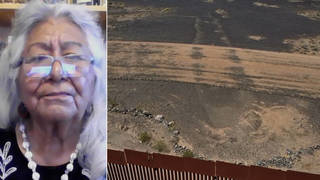
AMY GOODMAN: We go now to southern Arizona, where protests against another section of border wall construction are ongoing. A protest camp, predominantly led by queer and fem activists in the small town of Lochiel, is seeking to protect ancient cottonwood trees from demolition by federal contractors. At the center of the protest camp is a 200-year-old cottonwood known as a “grandmother” tree. Democracy Now! spoke with one of the activists last evening. This is Refugio.
REFUGIO: We are here protecting a 200-year-old grandmother cottonwood tree. They are sacred to the Tohono O’odham and Yaqui people, who are some of the original stewards of this land. The San Rafael Valley, where these cottonwood trees sit, is one of the most beautiful, most important places for migration of animals, wildlife. It’s one of the freest places, I think, in my heart, that exists still along these borderlands. …
There is a binational tree-sit happening. We have folks on the other side of what has not been constructed yet. They’re on the — they’re on the México side, La Noria side. And right now we have this zone, this stretch where the wall has not appeared, has not been constructed, and it’s because we’ve been halting it by being here.
We are being surveilled by private security, which ironically is called VisionQuest. We are being surveilled by Border Patrol. We are being surveilled by the Army. They’re the 101st post. And we’re being surveilled by the sheriff’s office, the Santa Cruz Sheriff’s Office.
AMY GOODMAN: Shortly after Refugio spoke to Democracy Now!, another activist, as well as Refugio, were temporarily detained by Mexican state police. In a statement released afterwards, the protesters said they had seen the tree-sit on the Mexican side of the border, quote, “attacked by Mexican state police” and that they had mobilized to support their Mexican comrades. They were released without arrest.
For more, we go to Tucson, Arizona, where we’re joined by John Washington, journalist, staff writer for Lookout. Washington is the author of a number of books, his latest, How to Close a Camp: Dispatches from the Fight Against Immigrant Detention.
John, if you can talk about the significance of this tree-sit, as we move from Big Bend in Texas, like 600 miles away, to grandmother, to this tree, what people are so concerned about on the border?
JOHN WASHINGTON: Good morning.
Yeah, I think what we’re seeing is that the story right now is becoming increasingly not where the Trump administration is building a border wall, but where people are successfully forcing the government to stop, to slow down, or at least change course on border wall construction.
So, the activists on the ground in Lochiel that we just heard from a moment ago, they’ve been very clear that this is both an environmental and a political fight. They remind people that the border wall is a tool that deliberately inflicts suffering and death, and they cite the government’s own policies in that claim through the 1994 policy of Prevention Through Deterrence.
Right now the Trump administration, in attempts to make the border wall and the border line more rigid, what we’re seeing, it’s becoming, because of the resistance, more binational, multinational and transborder. So, for now more than three weeks, someone has been up tree-sitting in this ancient cottonwood, what they’re calling a grandmother. And just last night, for the first time, just across the border in northern Sonora, a Mexican activist joined that person in a tree on the Mexican side. And they strung a rope briefly between the two trees, hanging from it a banner that says — that read, “From Minnesota to Mexico, resistance is fertile.” And they have been pushing back. And we see that there are now these connections between the Big Bend, between Lochiel, between further west in Arizona the fight to stop border wall construction on the Tohono O’odham Nation.
You know, right where the people are right now in Lochiel is just about a dozen miles from another huge standoff in 2022, where some of the same activists pushed back against the former Arizona Governor Doug Ducey’s border wall, constructing — constructed out of these old shipping containers, and they successfully pushed back. The state of Arizona was forced to remove those shipping containers, costing taxpayers here about $200 million. And, you know, historians and activists I talked to at the time, when I was covering that, told me that it was the first time since the fall of the Berlin Wall that a border wall, an international barrier, has actually been removed.
And right now this is what the activists are again pushing for. Another sign in Lochiel reads, “All walls fall.” And while that may seem like a hard thing to achieve at the moment, they, in response to the arrests, brief arrests last night, are calling for more people to come down and support these and other movements.
AMY GOODMAN: Do the Mexican police and the U.S. police, the Border Patrol — are they working together?
JOHN WASHINGTON: That is unclear. I think that we have certainly seen — that is unclear in this exact moment, but we have seen certainly many instances in the past in different parts of the border wall where they absolutely collaborate.
AMY GOODMAN: The Tohono O’odham Nation recently issued a no-trespassing order to block wall construction in its tribal land. Can you talk about the significance of this?
JOHN WASHINGTON: That’s right. So, they filed a lawsuit. So, they have always been opposed, or long been opposed, to the border wall that is being constructed on their ancestral homeland. Right now the government is trying to build, as in Lochiel, a double barrier, so two giant border walls, threatening both, you know, pristine, beautiful deserts, fragile ecosystems, archaeological sites, graveyards, etc. They filed a lawsuit to try to stop this.
Just last week, a federal judge ordered the — ruled that the construction can continue, saying that the Tohono O’odham Nation should defer to the federal government, which is a little bit galling, given the long history of incursions into ancestral homelands here. They have also posted — the Tohono O’odham have also posted, as you mentioned, no-trespassing signs on their land, and this is pretty explicitly targeting people who are going to be engaged in any sort of construction.
Right now one of the most threatened sites is the Quitobaquito Spring, which is this stunning oasis in the desert where a number of species live only right there. And so, right now people trying to protect this land understand that there’s, you know, the Sonoran — the mudfish, the — sorry, the pupfish, the Quitobaquito spring snail, that these things, if the border wall construction continues, may be wiped off the face of this Earth. So, this is a —
AMY GOODMAN: I just —
JOHN WASHINGTON: — very high-stakes fight.
AMY GOODMAN: I just have one last question. We have 30 seconds. You’ve documented the Prevention Through Deterrence strategy implemented in the ’90s that funnel migrants deliberately into deadly corridors. How does the Lochiel border project fit into that historical pattern of lethal border enforcement?
JOHN WASHINGTON: Well, at this point, there’s very few areas in Arizona that are not walled off. But it is an ongoing attempt to further punish and inflict suffering and death on migrants, absolutely. However, like in Big Bend, very, very few people cross in this corridor. I mean, people, I think, are right to point out that this very much smells of a boondoggle, that no one is crossing here, and yet they are spending maybe a half a billion dollars on just this about 27-mile segment of wall to devastate the local ecosystem.
AMY GOODMAN: Well, John Washington, I want to thank you so much for being with us, staff writer for Lookout, Washington speaking to us from Arizona, author of the new book How to Close a Camp: Dispatches from the Fight Against Immigrant Detention.
That does it for our show. I’ll be in Middlebury, Vermont, on August 28th to speak at the Q&A after the screening of the film about Democracy Now!, Steal This Story, Please! I’m Amy Goodman. Thanks for joining us.




 Top
Top
Media Options