








 Watch Full Show

We look at major media news with Jessica González, co-CEO of the advocacy organization Free Press. She discusses the landmark lawsuit against Meta for making its social media platforms addictive for young people, efforts to halt the Paramount-Warner Bros. megamerger, and Disney’s lawsuit against the Federal Communications Commission over what it calls the Trump administration’s “retaliatory campaign” against the ABC television network.
González says President Donald Trump’s “authoritarian takeover attempt of our media system” must be opposed.
Related Story
 Web ExclusiveMay 23, 2018Malkia Cyril on Facebook’s Civil Rights Audit & How Amazon Sells Facial Recognition Tools to Police
Transcript
AMY GOODMAN: A landmark trial against Facebook’s parent company Meta has begun in Oakland, California. Meta is accused of designing Facebook and Instagram to addict kids, despite clear risks. The case was brought by attorneys general from four states: California, Colorado, Kentucky and New Jersey. In total, 29 states have sued Meta over its practices.
Outside the federal courthouse in Oakland, parents spoke out about the impact of social media platforms on their children’s well-being. This is Shannon Heacock, whose son Elijah died by suicide at the age of 16.
SHANNON HEACOCK: This wasn’t an accident. My son did not take his life. My son was killed. It’s a design choice, a company that builds its platforms to maximize a child’s engagement, click after click, at the cost of the child’s safety. They knew what they were doing.
AMY GOODMAN: In other major media news, ABC has sued the Federal Communications Commission, after FCC Chair Brendan Carr ordered an early review of eight local ABC TV licenses. Carr had ordered the review one day after President Trump and first lady Melania Trump publicly demanded ABC fire late-night host Jimmy Kimmel for a joke about the first lady. The FCC is also investigating ABC over its corporate diversity programs, as well as alleged political bias on the morning show The View. In its lawsuit, ABC states, quote, “Acting through the Federal Communications Commission, the Administration has waged a retaliatory campaign against ABC for a single reason: it disapproves of what ABC broadcasts.”
For more on these two stories, as well as other major media news, we go to California, where we’re joined by Jessica González, co-CEO of Free Press and a member of the Big Tech Oversight Board.
Jessica, welcome back to Democracy Now! Let’s start with the opening arguments in the Meta trial in Oakland. Talk about the significance of this case.
JESSICA GONZÁLEZ: Good morning, Amy.
Listen, for years, many of us have been pointing out that platforms like Facebook are making design choices that are harmful. The business model of Facebook and other social media platforms is selling us, our attention, our eyeballs and our kids’ attention, to advertisers. The business model is predicated on getting us addicted, on essentially having us spend as much time as possible on these platforms.
It’s really interesting to see a case finally make it to trial and to actually have these issues litigated. But the truth is that Facebook knew a lot about the impacts of its platform on children and on others, and the business model really is about collecting a lot of data about us and using that data to microtarget us with the type of content that makes us keep coming back.
AMY GOODMAN: You’re a member of the Big Tech Oversight Board. What is that?
JESSICA GONZÁLEZ: This is a collection of people who came together after Facebook appointed its own “oversight” board, which was a list of folks who were on the Facebook payroll who were meant to provide some oversight over what the company was doing. In reality, they didn’t have any authority to hold the platform accountable. And so, a collection of folks from around the world, led by Carole Cadwalladr, who broke the Cambridge Analytica story, Maria Ressa, Nobel Peace Prize winner, and others came together to really try to provide some critique about what Facebook was doing, the design choices it was making, and the hate and disinformation that they were spreading all throughout the world.
AMY GOODMAN: Now, your organization, Free Press, and hundreds of journalists are demanding USA Today end their Palantir partnership. Nearly 800 journalists at USA Today newspapers signed statements urging the company to end this newly announced partnership with the software company Palantir, whose products have been used by the U.S. government to assist with immigration raids. Talk about what they and you are calling for.
JESSICA GONZÁLEZ: Listen, journalistic entities have no business making special deals and having special relationships like with companies like Palantir, which the U.S. government is using to assist in crimes against humanity. We need to have editorial independence from big companies that deserve oversight from journalistic institutions. And so, I support the call. We support the call from the USA Today journalists, because this is going to impinge upon independent reporting that holds this company and this administration accountable.
AMY GOODMAN: Let’s turn to ABC’s lawsuit against the FCC. I want to read more from the lawsuit, quote: “This case boils down to a simple question: can the Administration use its control over the federal regulatory apparatus to punish a media organization for editorial decisions and news coverage it dislikes? Because the First Amendment provides a clear answer — of course not — this Court’s intervention is necessary to stop the Federal Communications Commission’s extraordinary assault on free speech,” the lawsuit states. Explain what is at stake. This lawsuit came down right about the time we were broadcasting yesterday, it was announced.
JESSICA GONZÁLEZ: Well, I’m so thrilled that finally a major media company is sticking up for itself to the administration. We have seen Brendan Carr, the FCC chairman, relentlessly jawbone at broadcasters over which he has regulatory authority. He has — he has threatened them with investigations. We don’t even know the full extent of the investigations that the FCC has ongoing against ABC and other licensees. He has called ABC’s licenses in for early renewal. That comment process just closed, and so, at any time now, the FCC can do what’s called designate those licenses, the only eight broadcast licenses that ABC still holds, for a hearing. And that is the next step in revoking broadcast licenses.
And there has been every indication that the reason that Brendan Carr is going after ABC is because Donald Trump wants him to, because Donald Trump doesn’t like what ABC is airing. He doesn’t like it when they bring on his political opponents for conversations. He doesn’t like it when Jimmy Kimmel makes jokes at his expense. But see, this is what the First Amendment protects. The First Amendment protects us from government intrusion into the editorial decisions of our media.
And we’ve seen them, time and again, go after broadcasters. ABC isn’t the only one. They’re just the first one to say, “Enough already,” because the Trump administration has elevated this risk to the point that it’s going to do serious damage to their business. In fact, if you look into the filing that went into the court yesterday, they cite numerous examples of how they’ve already altered their news coverage to keep the president happy. For instance, they aired a speech that they didn’t want to air on their live stream. They said they felt pressured to do so. They haven’t brought anyone — any political guests onto The View, out of fear that the president would retaliate against them. I mean, the list goes on and on.
And this is just what’s happening inside of ABC. We know this is happening at other broadcasters, other regulated entities, as well. But they’re all just kind of trying to duck and cover and not catch the president’s attention. So, it’s really a good move on ABC’s part that they’re finally sticking up for themselves. I think they’ve finally learned that when bullies go after you, you can’t just cower in a corner, because they keep coming.
AMY GOODMAN: I mean, it was amazing. ABC settled for — what was it? $15 million, gave the president, when —
JESSICA GONZÁLEZ: Fifteen million.
AMY GOODMAN: — when many felt they could have gone to court and won. Then, the whole kerfuffle over Jimmy Kimmel and the outcry across the country that led these organization — these licensees to restore Jimmy Kimmel’s late-night show, because President Trump doesn’t like him. So, this is a new approach here: Don’t bend the knee.
JESSICA GONZÁLEZ: This is — this is a new approach. And listen, when ABC yanked Jimmy Kimmel off the air, Free Press immediately launched into action. We set up a tool, and thousands of people called their local ABC stations and demanded that he be reinstated. Of course, there was a tremendous uproar from the public, above and beyond. People canceled their Disney+ subscriptions.
And so, the actions we take as regular people make a difference. If we mass protest, we can make a difference. And I think, in a lot of ways, that that was encouraging to ABC, because they saw there was going to be business impacts if they didn’t stand up for free speech.
AMY GOODMAN: And they’re admitting in this lawsuit that, for example, in The View and also in Jimmy Kimmel’s show, they are changing the way they choose guests because of administration pressure.
JESSICA GONZÁLEZ: Yes. And in fact, they are not the only ones. We hosted two events with FCC Commissioner Anna Gomez over the past year. She is the lone Democrat left on the FCC. And we had folks come in, journalists, here in Los Angeles, as well as in Camden, New Jersey, and the ripple effects across the industry are widely felt. We are hearing from local radio stations that they’re nervous about airing things online that are critical of the administration. We’ve heard from so many independent journalists the type of retaliation they are facing.
And so, it’s not often that Free Press is standing up for ABC/Disney. They’re a corporate outlet that, in many ways, is flawed. But if we don’t stand up for — if we can’t stand up for Jimmy Kimmel and ABC, we’re recognizing — like, those are wealthy outlets. Jimmy Kimmel is a famous white man. Like, the impacts on folks who aren’t rich and famous and privileged are really rippling downwards.
AMY GOODMAN: And, of course —
JESSICA GONZÁLEZ: And so, this is bigger than just Kimmel. This is bigger than just Disney.
AMY GOODMAN: And, Jessica González, your Free Press is not to be confused with Bari Weiss’s Free Press, Bari Weiss who became head of CBS News and has gutted, eviscerated 60 Minutes. And I want to stay on the issue of that Paramount-owned entity. In other major news, Paramount Skydance is asking a U.S. judge to require the states challenging its acquisition of Warner Bros. Discovery to post a nearly $2 billion bond to cover the costs of delaying the deal. Paramount Skydance is run by David Ellison, whose father Larry Ellison is the billionaire founder of Oracle. They are prominent allies of President Trump. Under the proposed deal, CNN and CBS News, streaming services HBO Max and Paramount+, as well as film and television studios Universal and Paramount, would all be combined under a single entity controlled by the Ellisons. You’re sitting there, Jessica, in California. He’s threatening the attorney general there, Rob Bonta, who’s leading this lawsuit against this merger. Talk about this stage of the lawsuit and the threats of the Ellisons.
JESSICA GONZÁLEZ: I thought Rob Bonta had a great line to this yesterday, which is that the Ellisons went into this deal knowing what they were bargaining for. These companies are sophisticated entities. They agreed to a ticking fee. They agreed — they, Paramount, agreed to pay Warner Bros. $7 million a day after a certain date if the deal hadn’t closed yet. They understood that this was a complex regulatory landscape, that there are federal regulators, state regulators and, in fact, regulators abroad that have an interest in this massive, massive combination of media outlets, and they made the deal anyways.
Look, California and our taxpayers here, we don’t owe Paramount anything. They’re pulling out all the stops, trying to threaten our state with leaving. But the truth of the matter is, they knew what this deal was about. They knew what they were giving up. They were so desperate to get a hold of Warner Bros., because, remember, at the time when they made this deal, they were in a bidding war with Netflix. They went into this with eyes wide open, and they made a deal. If they don’t — if they don’t like it, they can — they can leave the deal. They can pay the breakup fee.
But the truth is, they are trying to threaten. They are trying to — they just started a new fake grassroots campaign a couple days ago, where they’re trying to buy constituency. But hundreds of thousands of people have come out to say, “Block the merger, no concessions,” including 5,600 creatives who have thrown down with activists and consumers to say, “This is bad. This is going to result in massive job loss.” Given what the Ellisons have already done to Paramount and to CBS News, we have every reason to believe that they are going to use their perch to censor and to interfere with the editorial independence of CNN, as well. And the truth is, the people don’t want this merger, and David Ellison and his daddy can’t buy their way out of this.
AMY GOODMAN: I just saw Jane Fonda this weekend in Los Angeles, and, of course, she revived her father’s Committee to Protect the First Amendment, and she is one of those leading the charge against this merger. But in this last minute we have, Jessica, I wanted to ask you about the FCC rewriting TV station ownership rules to allow for even more corporate consolidation. Can you just simply summarize this?
JESSICA GONZÁLEZ: It’s remarkable. The FCC is trying to repeal a statute, which it does not have authority to do. It voted that out a couple weeks ago. We’re waiting for that order to drop in the Federal Register, and once it does, we’ll be suing the FCC with our partners, because the FCC does not have authority to overrule a statute.
In sum, what they want to do is make it easier for people like Larry Ellison and David Ellison and other oligarchs who are aligned with Trump to gobble up more media. This is the authoritarian takeover attempt of our media system, and we’re not going to let it happen.
AMY GOODMAN: Jessica González, co-CEO of the media advocacy group Free Press — they had the name first. She’s also a member of the Big Tech Oversight Board.
Coming up, we talk more about media news. We look at how President Trump will personally profit by selling early access to his Truth Social posts about government policy for $100,000 a month. Back in 30 seconds.
[break]
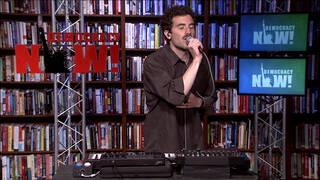
AMY GOODMAN: “Mirror Monster” by Deerhoof, performing in our Democracy Now! studio.



 Top
Top
Media Options