







 Watch Full Show

Topics
Guests
- Tim Goldennational security reporter at ProPublica.
- Terry Stradanational chair of 9/11 Families United.
Did Saudi Arabia play a role in the planning and execution of the September 11 attacks of 2001? That question was raised immediately after the attack, when 15 of the 19 hijackers were revealed to be Saudi citizens, and it has only grown louder in the 25 years since as more evidence emerged of the attackers’ connections to Saudi figures inside the United States.
We speak with ProPublica journalist Tim Golden, who reports that the FBI failed to fully investigate Omar al-Bayoumi, a Saudi intelligence asset who helped two of the hijackers as they arrived in California in early 2000. Key evidence, including a handwritten note by al-Bayoumi calculating an airplane’s trajectory to a point on the horizon, was not fully disclosed to investigators.
“Al-Bayoumi was incredibly important, but this evidence … sort of went missing for more than 20 years,” says Golden. “If the Saudi government is indirectly responsible, or even if this was some rogue cell of Saudis within the religious bureaucracy, we would hope that that should come out.”
Related Story
 StorySep 14, 2026“One Betrayal After Another”: 9/11 Widow Blasts U.S. Cover-Up of Saudi Role in Attacks
Transcript
AMY GOODMAN: This is Democracy Now!, democracynow.org. I’m Amy Goodman.
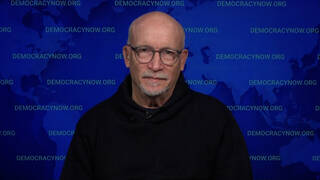
To look more at the Saudi role in the 9/11 attacks, we’re joined by Tim Golden, a reporter at ProPublica. His latest piece is headlined “25 Years After 9/11, Questions About the FBI’s Pursuit of Saudi Suspects in the Case Have Only Grown.” Tim Golden has reported for years on the Saudi connection.
Tim, this is very difficult to tease out and for people to understand. But if you can lay out your findings in this report about the questions of the FBI’s pursuit of the Saudi suspects and how the questions have only grown? Go back to the beginning. Go back to San Diego, California. Talk about the hijackers and who handled them.
TIM GOLDEN: Sure. Good morning.
The first two hijackers who came to the United States — Nawaf al-Hazmi and Khalid al-Mihdhar — got on Flight 77 at Dulles Airport and left behind an old Toyota Corolla sedan in the parking lot. That led the FBI almost immediately to San Diego, where they had settled in February of 2000, more than a year before the attacks. And they were really interesting from the beginning, because unlike some of the other European-educated hijackers, they really were fish out of water in sunny Southern California, where they came in January of 2000 from Malaysia and Thailand. But they were jihadis. They were Saudis who had really only been outside their country to go to Afghanistan and Bosnia and fight in the wars there. They spoke no English. They knew no one.
And somehow they connected immediately with a middle-aged Saudi man named Omar al-Bayoumi, to whom Terry Strada referred. Al-Bayoumi said he met them by chance in a halal cafe in Culver City, California, just down the street from Sony Pictures Studios but also very close to a big Saudi mosque that the Saudi kingdom had built there a couple of years before as part of its big global outreach and its push to spread Wahhabi Islam around the world.
And Omar al-Bayoumi helped these hijackers to move to San Diego a couple days after he met them, to settle and get a — rent an apartment in the building where he lived with his family, to set up a bank account. And he introduced them to a couple dozen men who went on to help them with everything that they needed and help them survive in Southern California.
So, Omar al-Bayoumi was on the radar of the FBI from the very beginning. And when he was arrested — he had moved on to Birmingham, England, and was arrested there 10 days after the attacks — there was a big search of his property, his home and his office, that yielded some extraordinary evidence — more than 80 videotapes, that included one of him showing an audience the Capitol building of the United States, where he refers to “the plan” that they were talking about and kind of presents various details of the Capitol. There’s another piece of evidence that was a flight diagram that showed the calculations of an airplane to reach a point on the horizon, that could have been perhaps something connected to the attacks. And it showed him with a couple of men who were later identified as really quite notable Islamist militants within the Saudi religious bureaucracy, who sort of went around San Diego more than a year before the hijackers got there, and were in many of the same places, including the same rooming house where they lived.
So, al-Bayoumi was incredibly important, but this evidence that was taken from his home and his office and given to the FBI immediately sort of went missing for more than 20 years. Important pieces of it were never presented to the 9/11 Commission, to the joint inquiry. They weren’t even given to the FBI agents in San Diego who were investigating the case. And finally, the families, as part of their litigation and part of the investigation of their lawsuit, went to the British police and got that information directly. And, you know, it was extraordinary that this material came out almost 23 years later, having never been seen by all these other people.
AMY GOODMAN: The 9/11 attacks happened under the Bush administration, the George W. Bush administration, George W. Bush extremely close to the Saudi ambassador to the United States, referred to as — Prince Bandar bin Sultan Al Saud, but he was referred to as “Bandar Bush.” And famously, a few days later, he and President Bush, Vice President Cheney, I think it was Condoleezza Rice, sat on the Truman Balcony — Bush and Bandar Bush, as he was referred to — having cigars together. This was at a time when the U.S. airspace, the FAA had closed it for the first time in U.S. history after the hijackings.
I want to turn to a famous clip from Michael Moore’s film Fahrenheit 9/11 about how the Bush administration allowed 140 Saudis to fly out of the United States in the days after the 9/11 attacks at a time, again, when U.S. airspace was closed. The clip begins with former North Dakota Senator Byron Dorgan.
SEN. BYRON DORGAN: We had some airplanes authorized at the highest levels of our government to fly to pick up Osama bin Laden’s family members and others from Saudi Arabia and transport them out of this country.
MICHAEL MOORE: It turns out that the White House approved planes to pick up the bin Ladens and numerous other Saudis. At least six private jets and nearly two dozen commercial planes carried the Saudis and the bin Ladens out of the U.S. after September 13th. In all, 142 Saudis, including 24 members of the bin Laden family, were allowed to leave the country.
AMY GOODMAN: So, that was a clip from Michael Moore’s Fahrenheit 9/11. Tim Golden, if you can talk about that close relationship? Then, of course, we see this has been a bipartisan sort of affair for the 25 years since. But talk about that moment and how you feel it led to a cover-up of the Saudi-U.S. relationship and what happened on that day.
TIM GOLDEN: Well, I think first you have to say that the Saudi royal family, the kingdom, considered Osama bin Laden an enemy, and the CIA and FBI and other U.S. agencies have pointed that out and emphasized that. And I don’t know that you’re necessarily talking about a top-down effort by the Saudi government at all here. But the Saudi government, the royal family, also empowered and funded a large religious bureaucracy to spread Wahhabi Islam around the world, and they had a huge amount of autonomy. Omar al-Bayoumi, although he was supposedly a graduate student, was also a part-time intelligence asset, supposedly, according to the FBI or an FBI memo, reporting to Prince Bandar in Washington. But he was clearly in extensive touch with figures in the Saudi religious structure that were in Washington and in Los Angeles and in Saudi Arabia.
I do think it’s a bipartisan effort. The Bush family had close ties. President Obama, who was trying to secure Saudi support for the Iran nuclear deal, turned his back on the families and vetoed JASTA. It was actually President Biden, under threat of being boycotted by the families at the 20th anniversary of the 9/11 attacks, who finally declassified a lot of material. President Trump in his first administration asserted that this material was state secrets in order to withhold it from the families.
But I think what you can see now emerging is the possibility that al-Bayoumi, who provided a lot of this help and who provided — who had a lot of relationships with Islamists in the Saudi religious bureaucracy and around Southern California, may have been part of a cell that was helpful to al-Qaeda. It was also true that the Saudi religious bureaucracy and wealthy Saudis gave a lot of money to charities that then gave money to militant groups like al-Qaeda.
So, you sort of have to separate these two things. There was a relationship between the United States and the Saudi royal family that may be the reason why the FBI and others have been jealous in safeguarding this information and keeping a lot of the facts from the American public and from the 9/11 families. That doesn’t necessarily mean that you had a plot driven by the Saudi government. So, I think there are those two things happening at the same time.
AMY GOODMAN: Can you talk more about the largest criminal investigation in U.S. history? And that was the FBI — what is it? — PENTTBOM inquiry?
TIM GOLDEN: PENTTBOM was the acronym for Pentagon/Twin Towers Bombings. And it was, in fact, the biggest investigation the FBI has ever undertaken. It involved thousands of agents and hours of time. And the FBI, Robert Muller, from the beginning, said, “We will leave no stone unturned.” It was a huge effort that was documented quite extensively in the 9/11 Commission report.
But the group of agents that were involved in the San Diego piece that were looking at Omar al-Bayoumi were not really listened to very carefully or very well in terms of what they were finding. And the FBI said from the beginning and insisted to the 9/11 Commission that they believed that Omar al-Bayoumi’s meeting with the hijackers had been accidental, that his help for them had been unwitting, and that he was just a genial, happy-go-lucky, pro-American Saudi man, you know, an exchange student who had no idea what the hijackers were up to.
That portrayal has really come apart. It has been proved now from an FBI — a couple of FBI memos that he was, in fact, a Saudi intelligence agent. He didn’t study; he was being paid by the Saudi government in San Diego. And that the main work he did was really for the Saudi religious bureaucracy and the Saudi religious network in the United States. And he also was giving out a lot of money to further that effort in Southern California. So, you had a lot of suspicion around this from the beginning.
Those agents continued after the PENTTBOM investigation was done. A group of — small group of those agents formed what was called Operation Encore to continue looking at the Saudi investigation. And that effort went on for 10 years, between about 2007 and 2016. It met with enormous resistance and skepticism from the FBI, and it was basically discounted not only to the 9/11 Commission but to a review commission that was done 10 years later to look back at the sort of threads that remained, of questions that remained from the original investigation of the plot.
And to this day, the FBI has not accounted for what happened to all this evidence that was gathered in the U.K., for why the Justice Department did not try to extradite Omar al-Bayoumi on material support charges, and for why this evidence basically disappeared from the FBI files in this largest, supposedly most exhaustive investigation that it had ever conducted.
AMY GOODMAN: And at the same time, you have the high-profile defendants accused of organizing the 9/11 attacks, including Khalid Sheikh Mohammed, spending over two decades at Guantánamo without completing a trial. Why?
TIM GOLDEN: Well, the military commissions in Guantánamo have been a unique disaster that you can trace back to the whole effort to try to impose military justice, tough justice, led obviously by Vice President Cheney and Donald Rumsfeld, in the aftermath of 9/11. That was a flawed project that has brought enormous disrepute to the United States over time, that is wallpaper for Islamist militants around the world. You know, these people are still being held without trial and very much against the values of the U.S. justice system.
But I think you had an opportunity here to proceed with a case in the U.S. criminal justice system where we’ve obviously been able to try terrorists many times, and that opportunity was dreadfully missed. And I think there’s answers that are waiting, that we’re still waiting to hear. And I think it was quite brave of Terry Strada to call out — she didn’t want to use this term, but to call out all those former presidents and the Trump administration, which has also blocked the families repeatedly from getting a lot of this information.
AMY GOODMAN: And —
TIM GOLDEN: Howard Lutnick, the — sorry, I was going to say, Howard Lutnick, the secretary, powerful secretary of commerce, was the CEO of Cantor Fitzgerald, the company that her husband worked for and that lost hundreds of its employees on 9/11.
AMY GOODMAN: And let me ask you the same question I asked Terry Strada, and then I’d like Terry to weigh in at the end of this conversation. And that is — I mean, Tim Golden, you have been reporting on this for years, comprehensive reporting. You did a piece in New York Times Magazine. You’ve got the ProPublica pieces. Why do you believe the U.S. is covering up for Saudi Arabia? What’s its — what does it gain? I mean, we see this right through to Mohammed bin Salman, the crown prince, his close relationship with Jared Kushner, with President Trump, and the U.S. intelligence agencies across the board believing that he was responsible for the dismemberment and murder of Khashoggi, The Washington Post reporter — columnist.
TIM GOLDEN: Well, I think it’s hard to — I don’t want to get into conspiracy theories about why they’re doing this. But we know that there’s a close relationship, and we know that the FBI has stuck to its story, has stuck to the story that Robert Mueller, from within months after 9/11, came out and said publicly to the joint inquiry, “We have not detected any kind of support network in the United States for these hijackers.” The FBI continued to repeat that line.
And the weak link in that story was Omar al-Bayoumi and the people around Omar al-Bayoumi, also a Saudi imam at that mosque in Los Angles, Fahad al-Thumairy, with whom Bayoumi worked closely to help the hijackers. And I think it’s clear that successive U.S. governments have had these relationships with the Saudi government. They have been concerned enormously about securing Saudi support for counterterrorism efforts after 9/11 to protect the American people. You know, those reasons are all there, the fact that they may be trying to cover up their own missteps.
But whatever the reasons, you know, I think it’s incumbent upon the American government to give this information to people who have suffered enormous loss and tragedy and to make clear what happened. And if the Saudi government is indirectly responsible, or even if this was some rogue cell of Saudis within the religious bureaucracy, you know, we would hope that that should come out.
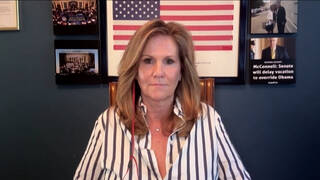
AMY GOODMAN: Terry Strada, we just have 30 seconds. You’re national chair of 9/11 Families United, lost your husband Tom at the World Trade Center, worked for Cantor Fitzgerald, which Lutnick was the head of. Your final comments?
TERRY STRADA: [inaudible] and he was thrilled with what I did. So, he is on our side.
AMY GOODMAN: Can you repeat what you said, Terry?
TERRY STRADA: Yes. I met with Secretary Lutnick after my comments were made Friday morning, and he is thrilled with the comments that I made, and he congratulated me on doing that. But I’d like to really quickly, since I only have 30 seconds, is to let everyone know that that evidence was ready to be burned and destroyed. Because one of the agents that was doing the reporting for Operation Encore got a phone call from somebody in the warehouse that said, “Aren’t you investigating somebody by the name of Omar al-Bayoumi?” And he said, “Yes, I am.” And he said, “Well, we have a lot here that’s getting ready to be destroyed.” And he said, “Send it to me, please.” And they did. He took that — it was all in Arabic — to his supervisor’s desk. He put it on her desk, and he said she — I’m saying “she” now; maybe everybody can figure out who it was — she said, “No, we don’t.” And she put it aside. So, that evidence was buried. It was going to be destroyed. It was found, and it was buried again. All of this is intentional. Yes, it will be very embarrassing for the kingdom, but that is not a reason to keep everything a secret.
AMY GOODMAN: Terry Strada, national chair of 9/11 Families United, I want to thank you for being with us, and Tim Golden, reporter at ProPublica. We’ll link to your latest piece, “25 Years After 9/11, Questions About the FBI’s Pursuit of Saudi Suspects in the Case Have Only Grown,” as well as your previous pieces.
Coming up, we look at Yemen, close to all-out war again as fighting escalates between the Houthis and Saudi Arabia? Back in 20 seconds.
[break]
AMY GOODMAN: “Bofou Safou,” Amadou & Mariam, in our Democracy Now! studio.



 Top
Top
Media Options