







 Watch Full Show

Four years ago today, the Woman, Life, Freedom uprising erupted in Iran after the death in custody of Zhina Mahsa Amini, a 22-year-old Kurdish woman who had been arrested by Iran’s “morality police.” Over the next three months, hundreds of thousands of people took to the streets protesting against Iran’s discriminatory compulsory veiling laws.
Amnesty International has released a new report concluding that the repressive measures used by Iranian authorities to crush the Woman, Life, Freedom protests in 2022 constitute crimes against humanity. Investigating the killings of 377 protesters and bystanders in 2022, Amnesty International’s report calls for international criminal investigations into 87 Iranian officials.
“Crimes against humanity are system crimes. This means that they require resources, organization, structures, and state policy,” says Raha Bahreini, a human rights lawyer and researcher on Iran for Amnesty International, which also recently condemned the U.S-Israeli war on Iran. “We’ve been very clear that the suffering of victims of crimes against humanity must not be instrumentalized or weaponized by actors such as [the] U.S. and Israel,” she adds.
Related Story
 StoryMay 20, 2026Amnesty: Executions Spike in Iran as Gov’t Intensifies Domestic Repression Amid U.S./Israeli Attacks
Transcript
AMY GOODMAN: This is Democracy Now!, Democracynow.org, the War and Peace Report. I’m Amy Goodman with Anjali Kamat.
ANJALI KAMAT: Four years ago today, the Woman, Life, Freedom uprising erupted in Iran after the death in custody of a 22-year-old Kurdish woman named Jina Mahsa Amini who had been arrested by the morality police. For the next three months, hundreds of thousands took to the streets protesting against Iran’s discriminatory compulsory veiling laws.
In a new report, Amnesty International has concluded that the repressive measures used by Iranian authorities to crush the Woman, Life, Freedom protests in 2022 constitute crimes against humanity. Investigating the killings of 377 protesters and bystanders in 2022, Amnesty International’s 1,000-plus-page new report calls for international criminal investigations into 87 Iranian officials. Amnesty interviewed 270 people for its investigation, most of whom participated in the protests. This is the testimony of Niaz Akh, who was 14 at the time of the protests and living in Iran’s Kurdistan Province.
NIAZ AKH: [translated] On October 8, 2022, I was at school. When the last bell rang, we went outside school. The protest started. One of the plainclothes agents came with a shotgun and tear gas. They fired tear gas and we all ran away. Agents fired metal pellets at two girls and they fell to the ground. All we could do was run. We fell to the ground. An agent pulled our hair. He was pulling us into a car to take us away. But somehow, we managed to escape from him. When I got home, I saw that he had pulled my hair so hard that all of it was stuck inside my headscarf. After that day, I didn’t feel normal and didn’t go to school anymore. We couldn’t stay in Iran anymore. Since then, we haven’t seen our home nor our family, no one.
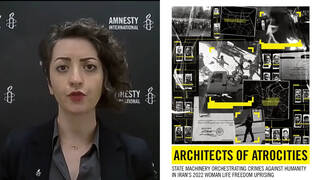
AMY GOODMAN: Niaz Akh, again 14 at the time of the 2022 protests. Amnesty International released its new report at a time when the organization is also calling for an enduring ceasefire and accountability for the ongoing illegal U.S.–Israeli bombing of Iran that has killed nearly 1,500 civilians. For more, we’re joined by Raha Bahreini, Amnesty International’s Iran researcher. Their new report out today is titled Architects of Atrocities: State Machinery Orchestrating Crimes Against Humanity in Iran’s 2022 Woman, Life, Freedom Uprising. Joining us from London. Raha, if you can lay out the findings of this massive 1,000-plus-page report? And then also releasing it at this time when Amnesty has come out against the U.S.-Israeli war on Iran?
RAHA BAHREINI: Hello, Amy. Thank you very much for having me. Amnesty International is launching this landmark report to send a central message to the international community. Repeated protest killings in Iran have become normalized. Impunity is leading to the loss of thousands of lives. And it is beyond time for the international community to end the crisis of impunity that is fueling repeated cycles of protest killings in Iran.
Our research included interviews with 270 people, extensive analysis of documentary evidence, and analysis of over 2,000 videos. The evidence leaves no doubt—the Iranian authorities committed crimes against humanity—the crimes against humanity of murder, torture, rape and sexual violence, enforced disappearance, and imprisonment and persecution on political gender, ethnic, and religious grounds—to crush the Woman, Life, Freedom uprising. And impunity for these crimes paved the way for further atrocities at even a more horrific level in January 2026.
We are urging the international community to pursue justice because domestically there is no prospect for justice. We have explained in immense detail how the judiciary of the Islamic Republic of Iran is complicit in crimes against humanity. So the international community is kind of disconnected from reality by directing calls to accountability for the very atrocities that are part of the security apparatus committing crimes in the country.
We have named 87 officials who must face criminal investigations but this is not an exhaustive list. It however shows how crimes against humanity are planned, coordinated, and waged across the country, terrorizing entire communities to crush dissent. And as you noted, we are launching this support because we think that it’s important that the crimes against humanity committed against protesters demanding dignity, freedom, and human rights are not overshadowed by the current new round of crises that has also opened a new front of crimes under international law against people in Iran, this time due to the unlawful airstrikes of the U.S. and Israel, which violate the U.N. charter.
We’ve been very clear that the suffering of victims of crimes against humanity must not be instrumentalized or weaponized by actors such as U.S. and Israel. At the same time, we are clear that we need people-centered strategies, and crimes against humanity must also not be forgotten or overshadowed because of the current crisis. Because people in Iran are at risk of further massacres if global action on justice is not taken.
ANJALI KAMAT: Raha, you identify 87 officials from different levels of the Iranian government. How high does the responsibility go? And can you just say a little bit about how Iranian authorities justified the crackdown when it happened in 2022 and what their response has been to your report? You just released it this morning.
RAHA BAHREINI: The responsibility goes all the way to the top of the chain of command. The 87 officials we have named include the Supreme Leader—the late Supreme Leader—who is the commander of the security forces. It includes the head of the General Staff of the Armed Forces and commanders of the security forces leading on deadly protest dispersals which are, in the context of Iran, the police force and the Islamic Revolutionary Guards Corps. We have also named 25 Ministry of Interior officials. They include the then-Minister of Interior, Ahmad Vahidi, who is now the General Commander of the IRGC, as well as provincial governors and county governors.
Crimes against humanity are system crimes. This means that they require resources, organization, structures, and a state policy. This is precisely what we have shown in the report. In over 260 pages, we have mapped the chain of command behind these crimes and we have shown how security forces across the country—a vast network of security forces—are deployed, equipped with firearms—military-grade firearms such as assault rifles, submachine guns, and heavy machine guns—to kill and injure protesters. There’s a leaked document that shows or sheds light on the inner workings of the deadly crackdown. It’s from a provincial police commander that instructed the security forces to respond mercilessly and go as far as causing death. These crimes were intended to take place because the authorities rely on a state policy of lethal force to crush dissent in the country.
ANJALI KAMAT: Raha, as we are talking, this is in the midst of the ongoing bombing of Iran, conflict with U.S.-Israel against Iran. This has been going on for over six months now. What has been the relationship between the crackdown on dissent—there was a people’s uprising earlier this year that was brutally suppressed—and this kind of war?
RAHA BAHREINI: This has been a devastating year for people in Iran. The unlawful attacks of the U.S. and Israel started as people were still reeling from the collective grief and trauma of the unprecedented January massacres. Just to remind ourselves, in January 2026, in less than 48 hours, on the eighth and ninth of January, security forces massacred thousands of protesters and bystanders across Iran to crush the largest nationwide uprising that the country had seen since 1979.
After experiencing decades of repression at the hands of their own authorities, people in Iran are also now suffering violations of international humanitarian law and war crimes because of the tens of thousands of airstrikes by the U.S. and Israeli authorities. So now they are caught between internal deadly repression and unlawful attacks by external actors.
The Iranian authorities have also used the cover of wartime conditions to intensify domestic repression. They have further militarized public spaces. They are threatening almost on a routine basis further massacres of protesters and dissidents. They are counting on the fact that the international community is now looking elsewhere; other headlines are dominating the news. So they tell people that their fingers are on trigger to launch further massacres.
AMY GOODMAN: Raha, we want to thank you so much for being with us. Raha Bahreini, human rights lawyer and researcher in Iran for Amnesty International. We will link to your new report Architects of Atrocities: State Machinery Orchestrating Crimes Against Humanity in Iran’s 2022 Woman Life Freedom Uprising. Today on the fourth anniversary of the death of 22-year-old Mahsa Amini in custody of Iran’s morality police.
I’m Amy Goodman with Anjali Kamat. Look forward to seeing people in Bay Shore, New York, tomorrow, for Steal This Story, Please! Thanks so much.



 Top
Top
Media Options