










 Watch Full Show

After months of threatening to take over Greenland by force, President Trump last week signed a 10-page agreement with Greenland and Denmark that bolsters the U.S. military presence on the mineral-rich and strategically located island but falls short of his earlier demands to make it American territory. Under the 1951 Defense of Greenland Treaty, the United States already has wide latitude to station forces and build military bases in Greenland. The U.S. currently has one active military base and around 160 troops on the ground. Under the new agreement, signed shortly after President Trump’s speech to the United Nations General Assembly last week, the U.S. can build two new bases. The deal keeps Greenland as part of Denmark and would still apply if Greenland chooses independence.
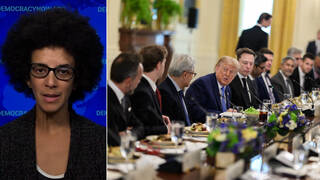
“In many ways, the deal is good, because the right for self-determination is approved,” says Julie Rademacher, chair of Uagut, the national organization for Greenlanders in Denmark. At the same time, “after threats [for] one-and-a-half years to annex Greenland, we don’t have the same faith or the same trust in Americans and the U.S. president.”
Related Story
 StoryJan 20, 2026“No Going Back”: Trump Escalates Threats to Take Greenland & Tariff European Allies
Transcript
AMY GOODMAN: Remember when President Trump said this shortly after he returned to the White House?
PRESIDENT DONALD TRUMP: We need Greenland for national security and even international security, and we’re working with everybody involved to try and get it. But we need it, really, for international world security. And I think we’re going to get it. One way or the other, we’re going to get it.
AMY GOODMAN: Well, after more than a year and a half of threatening to take over Greenland by force, President Trump last week signed a 10-page agreement with Greenland and Denmark that fell short of his earlier demands to turn Greenland into U.S. territory. The deal, that Trump described as “tremendous,” allows the United States to open new bases in Greenland, bolstering its military presence on the vast, mineral-rich and strategically located island.
Under the 1951 Defense of Greenland Treaty, the United States already has wide latitude to station forces and build military bases in Greenland. The U.S. currently has one active military base on Greenland, about 160 troops on the ground. During the height of the Cold War, the U.S. maintained 17 military installations in Greenland with over 10,000 troops. Under the new deal, the U.S. would be allowed to build two new bases.
The new agreement, signed shortly after President Trump’s speech to the U.N. General Assembly last week, recognizes Greenland as part of Denmark but would still apply if Greenland eventually chooses independence. Describing as, quote, “a deal that could last forever,” the Danish Prime Minister Mette Frederiksen praised the deal as strengthening NATO and staving off the growing presence of Russia and China in the Arctic.
PRIME MINISTER METTE FREDERIKSEN: This deal is good for the United States. It’s good for Greenland, for Denmark, for the NATO alliance, and therefore, also good for Europe. … Mr. President, you have been very clear. You don’t want adversaries to come too close. I fully agree. And with this deal, they are not. We are making sure that they will not be allowed to get any control or significant influence in Greenland,
AMY GOODMAN: Greenland’s Prime Minister Jens-Frederik Nielsen reiterated his support for the United States and the NATO alliance.
PRIME MINISTER JENS-FREDERIK NIELSEN: This agreement should put to rest any doubt today and in the future about where Greenland’s loyalty lies. Our commitment to this alliance and to the security we build together is not in question. We are, have been and will remain a steadfast friend of the United States and a part of the Western alliance. Your security is our security, and our security is your security.
AMY GOODMAN: To understand more about this deal and what it really means, we’re joined now by Julie Rademacher, chair of Uagut, which means Us, an organization for Greenlanders in Denmark. Julia is a former member of the parliament here in Denmark.
Welcome to Democracy Now! It’s great to have you, well, in your in your country here. Talk about the significance of this. You had President Trump saying he’s taking over Greenland, he’s annexing Greenland, he’s occupying Greenland, and now there’s this deal made between your country, Greenland, and Denmark and the United States, but involves expansion of the U.S. military presence.
JULIE RADEMACHER: Well, we already have military presence by the U.S. in Greenland, and we have had that for several decades. Actually, it’s been even more in the past. So two more military bases will not be new in Greenland. But it’s very important for the Greenlandic people that they are listened to, because the last time the Americans left the bases, they didn’t clean up. So, this is one of the very important questions asked by the public in Greenland.
But the deal has been absolutely amazing in so many years in Greenland, because we have felt listened to the last week. For the first time in world history, an American president has said out loud, “Yes, it’s the Greenlanders’ right for self-determination.” And we’ve been not only fighting for Greenland the past one-and-a-half year, but also been the front of the fight for democracy in the world, because we’ve been fighting for our own right to decide whether or not Greenland should be part of Denmark, U.S. or become independent. And with this deal, Greenland can do what Greenlanders in Greenland want it to do. So, I think, in many ways, it’s definitely a good deal for Greenland and for Greenlanders. So it’s been great news, especially concerning the last one-and-a-half year, where we have felt threatened by the American president.
AMY GOODMAN: So, what would you like to see happen with Greenland? I mean, you are a member of the Danish parliament here. You are a Greenlander. What does Uagut, your organization, the organization of Greenlanders in Denmark, want?
JULIE RADEMACHER: Yeah, as a former member of the Danish parliament and also as a Greenlander, I’ve been living for so many years in Greenland. I’m a mother also, so, for me, it’s very important that the future of Greenland will be decided by Greenlanders also in Greenland. I think, in so many ways, we have been threatened by military with force, to be taken over by annexation of — the U.S. Congress still have the proposal that they want to annex Greenland. So, I would like to see that happen in reality, not only on a paper, now signed by the American president, but also in reality, definitely.
But I also kind of have and worry that the trust between Americans, Greenlanders and Danes is not the same anymore, because we’ve always relied on the Americans, we’ve always trusted the Americans and the American president to be our protector, but now after threats in one-and-a-half year to annex Greenland, we don’t have the same faith or the same trust in Americans and the U.S. president. So, we definitely have some work, something to work on in the future.
AMY GOODMAN: Julie Rademacher, so far Trump has vowed to build two, as he says, “very major bases” in Greenland. There’s also interest in Greenland’s resources. If you can talk about this? Last month, it was reported that a U.S. oil company linked to President Trump, called Greenland Energy, was preparing to drill in Greenland without local approval. The firm recently landed drilling equipment on Greenland’s eastern coast. Greenland’s government issued a strong warning that no permission was granted. The island’s Mineral Resources Authority must provide all future logistical operations before they proceed, officials said. What are Trump’s personal interests here?
JULIE RADEMACHER: Well, that question, you have to ask the American president. But I can say that, as Greenlanders, our interest is to be listened to. We have our own democracy in Greenland. We have a self-rule government. We’re also part of the Kingdom of Denmark. So, when we make deals, we do it together with Greenland and Denmark, and then, of course, also negotiate with other countries, like the U.S. If Americans want to drill for oil in Greenland, it has to be approved by the population in Greenland. You know, Greenlanders don’t go to the U.S. and drill for oil. So, of course, Americans also have to ask Greenlanders if they want to, yeah, drill for oil, and the government and municipalities have to approve it. And this hasn’t been the case.
So, in so many ways, we still fight for the platform and also to be listened to as Greenlanders. Because of the MAGA movement and because of all these investments going on, we are still quite worried that money men from MAGA movement will try and buy Greenland in other hands, also despite the fact of this new deal on security. So, I think we are very much aware of that.
AMY GOODMAN: Trump said in a social media post announcing this agreement that it “gives the United States permanent control over security, and all other needs, in Greenland, completely addressing ALL of our many U.S. concerns,” he said. What does he mean, “permanent control” of “all other needs”?
JULIE RADEMACHER: Well, again, you have to ask that question to the American president. But I think, in many ways, the deal is good, because the right for self-determination is approved in the deal, and also the fact that if Greenlanders want to become independent within the NATO alliance, it can happen. So, for the first time in history, Greenlanders are actually acknowledged and also approved as a people for the right to Greenland.
But at the same time, we can see that if you want to build U.S. military bases in Greenland, it also has a chapter in the deal where it says it has to be with respect of the culture, of the fishery, of the hunting. Right now it’s hunting season in Greenland, so everyone is talking about reindeers and caribou hunting. And at the same time, we sit here in Copenhagen discussing this in a room. And many people ask me here in Denmark, “So, how — what do the Greenlanders talk about?” And I tell them, “Well, they talk about reindeers and caribous, because it’s that time of the year.” But at the same time, yes, definitely, we sleep better now at night with this deal, but we still have uncertainty and worries, and we don’t feel completely that we can completely rely on the Americans.
AMY GOODMAN: And who are the adversaries that the Danish prime minister referred to?
JULIE RADEMACHER: Adversaries?
AMY GOODMAN: He talks about the adversaries, the interest of different powers in the Arctic.
JULIE RADEMACHER: Yes, I think, in so many ways, it’s the Arctic is opening up. We already saw that in the American U.S. Navy strategies from 2018. I believe it’s very important that now Greenland, Denmark and the European Union works on new Arctic strategies, and also they work on working to — they work very close together with the Americans about security in the Arctic. Because who’s the real enemy here? You know, maybe it’s Russia and China, and not Denmark and the U.S. So, I think it’s very important that we can make deals on security and that we now have leaders in the same room signing deals, but also diplomats that can negotiate, because we haven’t seen that for one-and-a-half year. We have just felt terrified and being threatened. So, this is definitely a new situation, but we are still worried as Greenlanders, in both Denmark and also in Greenland.
AMY GOODMAN: And who is paying for this deal? Trump said there will be no cost to the United States.
JULIE RADEMACHER: Yeah, that’s kind of interesting, because at the same time Trump wants more military in Greenland. So, I don’t know who’s paying for the new military in Greenland. But we can hear on the Danish and Greenlandic leaders that it will not be the Danes and the Greenlanders that will pay. So, it’s going to be interesting to follow. And I can see in financial acts and suggestions and proposals for next year again that it isn’t in the budget. So, that’s a good question to ask back home in the U.S., too.
AMY GOODMAN: Also, aren’t there four unexploded nuclear bombs dropped by a U.S. B-52 bomber there from 1968 still under the ice?
JULIE RADEMACHER: Yes, and there was also this very crazy project where the Americans drilled, like, a tunnel inside of the ice cap. So, we have several military bases where the Americans haven’t cleaned up in Greenland, and that’s also why many people in Greenland are worried that these military bases will be built, but with no respect of the culture of the local people, of the hunters, but also of the environment and nature, because for Greenlanders, it’s — for us, the nature is like a holy place. It’s what we come from. It’s what we live by. So, for us, it’s very important that it’s respected.
AMY GOODMAN: Julie Rademacher, we want to thank you so much for being with you. It’s nice to be in the same studio with you here in Copenhagen. She is chair of Uagut. It means Us, the national organization for Greenlanders in Denmark. She is a former member of the Danish parliament.
Coming up, as the death toll in Gaza tops 74,000 over these past three years, we’ll speak to the Palestinian analyst Muhammad Shehada. He’s from Gaza but lives here in Denmark. Stay with us.
[break]
AMY GOODMAN: Song by Aaju Peter, a Greenlandic Inuit activist and attorney.





 Top
Top
Media Options