










 Watch Full Show

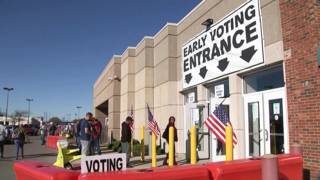
Ahead of the November midterm elections, Republican officials in the third most populous county of Texas have voted to slash the number of polling sites by nearly one-third. Tarrant County, which includes Fort Worth, will have just 224 polling sites for 1.3 million voters. The change was approved in a party-line vote Tuesday, with all three of the county’s Republican commissioners voting in favor and the two Democrats opposing it. Civil rights groups including the ACLU and NAACP warn the changes will disproportionately affect voters of color.
“The eyes of the nation are on Tarrant County,” says Roderick Miles Jr., a Democratic Tarrant County commissioner, who calls the voting restriction a “modern-day poll tax.”
Related Story
 StoryNov 08, 2022Election Protection Force Fights Voter Suppression: Racist Poll Workers, Vigilantes, Missing Ballots
Transcript
AMY GOODMAN: This is Democracy Now!, democracynow.org. I’m Amy Goodman, with Nermeen Shaikh.
NERMEEN SHAIKH: In a party-line vote, all three Republican commissioners in Tarrant County, Texas, have voted to slash the number of polling sites for November’s midterm elections by nearly a third, leaving 1.3 million voters with just 224 polling sites. Civil rights groups, including the ACLU and NAACP, warn the changes will disproportionately affect voters of color in Texas’s third-largest county, with majority-minority areas of Arlington and Fort Worth targeted.
During a marathon 10-hour hearing on Tuesday, commissioners heard from dozens of citizens who opposed the reduction. Here are some of their voices.
GABE GONZALEZ: My name is Gabe Gonzalez. … The population of the city has increased, and voting has increased. You saw that in May. You do not need to make poll workers’ lives harder by cutting the locations and bottlenecking our democracy.
CATHERINE WOODS: Catherine Woods. How is our budget unable to accommodate our voting needs in Tarrant County? … Did you not have enough money in the budget after the hand recount that you ordered in the 2024 election, the one that confirmed the original result? Or was that money spent performatively? Did you not have enough money in the budget for the redistricting? … This proposal is hypocritical. It is irresponsible. It is anti-democratic. It is anti-American.
LINDA NORTHERN: I’m Linda Northern. The right to vote is the bedrock of our democracy. Reducing the number of polling places does not uphold this right. … This will make it harder for Brown, Black and low-income voters, who have the same right to vote as you do. This is wrong.
NERMEEN SHAIKH: The two Democratic commissioners on the five-person board also spoke out forcefully against slashing the number of polling sites. This is Democratic Commissioner Roderick Miles Jr.
RODERICK MILES JR.: What I hold in my hand — and I want y’all to get this — is my wife’s great-grandmother’s poll tax receipt. Get a good look at it. Her name was Miss Maggie McCain. She was a married woman and a housewife who raised 10 children. And she understood how important her vote was, and the voice and the power that came along with it. And she was willing to suffer the indignity of having to pay a poll tax for a right that belonged to her.
What we are doing with reducing polling locations — and we can use semantics, and we can make — you can make us look like we don’t know what we want and we’re wishy-washy all you want to. But at the end of the day, we are instituting barriers to making access to voting for people. It’s modern-day poll taxes. And I’m not trying to be — I’m not trying to use hyperbole. This is a reality.
AMY GOODMAN: The vote comes ahead of a critical and closely watched Senate race in Texas, with the Democratic state Representative James Talarico leading in the polls for Senate against Republican state Attorney General Ken Paxton. Ahead of the Tarrant County vote, Talarico spoke out against cutting polling sites.
REP. JAMES TALARICO: Well, we are here outside what used to be a polling location here in Tarrant County. The most powerful people in this county, the most powerful people in this country don’t want us to be able to vote easily. And that’s why extremist officials in Tarrant County government are trying to close 92 polling locations. That’s nearly a third of the polling locations in Tarrant County. And that means on Election Day there will be longer commutes, longer lines and lower voter turnout, especially in our Black and Brown communities. That’s because the people in power don’t want us to know or use our power. And nothing terrifies them more than people who show up to vote and people who show up to hold elected officials accountable.
AMY GOODMAN: So, that’s James Talarico, the Democratic candidate for Senate in Texas up against Ken Paxton. And it looks like it’s a toss-up, or perhaps he’s ahead in the polls, way raising more money than Paxton. Supporters of the cuts argue too few voters were using the sites, to justify their expense.
For more, we go to Fort Worth, Texas, where we’re joined by Democrat Roderick Miles Jr. He represents Precinct 1 of the Tarrant County Commissioners Court. His recent piece for the Fort Worth Star-Telegram is headlined “We need answers on why a growing Tarrant would cut voting locations.”
Commissioner Roderick Miles Jr., welcome to Democracy Now! The reason I talked about Talarico there and we played his clip is we’re wondering if this is the motivation, the fact that in this red state, he is surprising so many in surging in the polls, and the Republicans are trying to cut Democrat participation any which way. Can you give your assessment of what’s happening and this incredible 10-hour meeting that led to a party-line vote — three Republicans, two Democrats, you were one of the Dems — who voted to cut the voting polls by, what, 92, they’re cutting out, from the little more than 300 across Tarrant County?
RODERICK MILES JR.: That’s correct. Good morning, Amy, and thank you for the opportunity to be with you today.
From my perspective, this is about access and ensuring that every resident, regardless of age, disability, working families, providing access to pollings, to polling locations. It’s about making sure that everybody has a right to use their God-given right and their right to vote, and they need to be able to have easy access to polling locations. This is not about fiscal responsibility. This is about making sure that every resident in Tarrant County has a right to vote. Voting belongs to the people. Elections belong to the people. They don’t belong to government officials. We are just stewards of the election process, but the process belongs to the people. And the people have the right to choose who represents them. And we don’t need to make it difficult or more difficult for them to vote. We need to make it easier.
NERMEEN SHAIKH: And could you explain who you believe will be most impacted? What communities?
RODERICK MILES JR.: I believe, for example, with these reductions, my precinct, Precinct 1, takes the brunt of those reductions. We have the most polling locations that are closed. And those communities are primarily represented by minorities, by African Americans and Latinos. By reducing that, we are making it more difficult and more challenging for those communities of color to be able to go to the polls and to vote.
Voting locations are not just buildings. There’s a story behind every voting location. There’s history behind those voting locations. There’s familiarity, and there’s relationships that have been formed at these voting locations. And it’s our responsibility as an elected official to make sure that they have access to places that are familiar to them, that they have historically gone to to vote. We should not be punishing communities of color by cutting away voting locations that are familiar and common to them. We should be making access easier for them, and not more difficult or challenging. When you think about working families, when you think about seniors, people with disabilities and things of that nature, when you close down and restrict polling locations, you make it harder and more of a burden on those communities to be able to vote.
AMY GOODMAN: And one of the polling locations that’s being closed is on the campus, which is more progressive than the state, the University of Texas-Arlington. I want to play this next clip, Tarrant County Democratic Commissioner Alisa Simmons and Republican County Judge Tim O’Hare. They had this exchange.
ALISA SIMMONS: Y’all redistricted, saying the population is growing. Correct? You mid- — you mid-decade —
JUDGE TIM O’HARE: I redistricted because I wanted a 4-1 court.
ALISA SIMMONS: You redistricted because we’re growing. Population’s growing. Or was it power? Which one was it?
JUDGE TIM O’HARE: I think it was very clear from all three: We did it to have a majority-Republican commissioners court.
AMY GOODMAN: Well, he was very clear about this, Republican County Judge Tim O’Hare, one of the three commissioners, Republican commissioners. And you and Alisa Simmons were the Democrats. You voted against; the Republicans voted for. We just have 30 seconds. What can you do at this point with almost a third of the polling places closed on Election Day? How are you organizing?
RODERICK MILES JR.: Amy, I’ll say the — I’ll say this. Tarrant County, the eyes of the nation are on Tarrant County. We have an opportunity to shift power and to change the course of this country. Democracy, and the country as a whole, is at an inflection point.
We are not deterred. We will vote. We won’t miss this moment. We are mobilizing now to make sure that everybody has access to the polling locations that we currently have to work with. And we’ll stand in lines. We’ll wait. We’ll do whatever we have to, to make sure that the people’s voice is heard, and they are electing the people that they want to represent them.
I want to share with you the poll tax receipt of my wife’s great-grandmother. We are going to fight against what is modern-day poll tax in this country. We are making sure —
AMY GOODMAN: And just to be clear, Roderick Miles, a poll tax, for young people —
RODERICK MILES JR.: Yes.
AMY GOODMAN: — who are watching this show who don’t even know what you’re talking about — a poll tax is?
RODERICK MILES JR.: A poll tax was something that the government put on Black people to make it difficult for them to vote. They had to pay to vote. My wife’s great-grandmother had to suffer the indignity and to pay to vote. And I’m not saying that this policy is a poll tax, but history teaches us that when government makes changes and does harm to people, we need to be vigilant, and we need to speak out against it. And that’s what my colleague and I are doing now.
AMY GOODMAN: Roderick Miles Jr., representing Precinct 1 on the Tarrant County Commissioners Court. His recent piece for the Fort Worth Star-Telegram, we will link to, “We need answers on why a growing Tarrant would cut voting locations.”
Coming up, we look at how artificial intelligence is transforming healthcare. Back in 20 seconds.
[break]
AMY GOODMAN: “Women of the World” by Amadou & Mariam in our Democracy Now! studio.




 Top
Top
Media Options