


Guests
- John CavanaghInstitute for Policy Studies.
- David AaronU.S. under secretary of Commerce.
- Vandana Shivarenowned critic of corporate globalization from India.
- Scott Millerspokesperson for Procter & Gamble.
- Ralph Naderconsumer advocate.
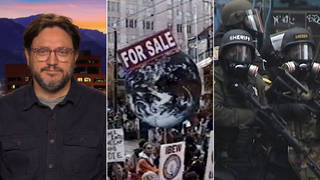
As Seattle police tear-gassed, beat and shot protesters with rubber bullets this past Tuesday evening, hundreds of people gathered at Seattle’s Town Hall to hear consumer advocate Ralph Nader and renowned global capitalism critic Vandana Shiva face off with representatives from the Clinton administration and Procter & Gamble. The following is an excerpt of the debate.
Transcript
AMY GOODMAN: You are listening to Pacifica Radio’s Democracy Now!, the Battle in Seattle. I’m Amy Goodman, here with Juan González, as we bring you an event that took place last year — last week, certainly eclipsed by what was happening in the streets, the tens of thousands of people who were facing off against the police as they tear-gassed them, as they pepper-sprayed the people, as they shot them with rubber bullets. But a debate did take place inside Seattle’s Town Hall, and it involved a number of people, including Ralph Nader, Vandana Shiva and John Cavanagh, and a representative, as well, of the Clinton administration. We wanted to play an excerpt of it for you today. It was a debate on the World Trade Organization, free trade versus fair trade.
PAUL MAGNUSSON: Leading off this evening is John Cavanagh. John is the director of the Institute for Policy Studies, a Washington think tank. He was formerly an economist at the United Nations Conference on Trade and Development and at the World Health Organization.
JOHN CAVANAGH: On a lighter note, I dare say that the rules of this debate are a lot fairer than the rules of the World Trade Organization.
What you’re hearing — what you’ll be hearing tonight from our side in this debate, and what you’ve been hearing from Seattle’s streets as tens of thousands of people have gathered here in recent days, is this, two things. One, the dominant model of economic globalization, enforced by the World Trade Organization, that attempts to increase trade and investment at almost any cost, is catastrophic for the environment, for working people, for small farmers and for cultural diversity. And two, that citizens’ organizations, backed up increasingly by public opinion, are forging alternative paths to development and alternative rules that steer trade, investment and other economic activities more squarely towards the advancement of healthy communities and dignified work and a clean environment.
Now, on the critique of the free trade model, which Public Citizen, in their excellent new book, rightly, I think, calls “corporate-managed trade,” there’s nothing free about a system based on thousands of pages of rules that gives breaks to one corporate sector or another. On the critique of corporate-managed trade, I think Ralph will talk a little bit about how it’s undermining democracy. I think Vandana will talk a bit about its devastating nature and on farmers. Let me say a word on its impact on working people and inequality.
No figure better sums up the negative impact of corporate-managed trade than this, from a recent IPS and United for a Fair Economy study, that is this: Since 1990, U.S. CEO salaries have risen 481%, while average U.S. worker pay has risen only 28%, or, cast on a global scale, the world’s 475 billionaires, led by Seattle’s very own Bill Gates, have a combined wealth greater than the collective incomes of the poorest half of humanity. In other words, corporate-led globalization is creating two Americas, two worlds, one gaining benefits from expanded trade and investment, the other losing. In this scheme of winners and losers, we have estimated that as much as two-thirds of humanity has been left out, hurt or marginalized by economic globalization.
Debaters on the free trade side, especially here in Washington state, often point out that exports have created millions of jobs and that they’re good jobs. What they fail to add is that in this globalization frenzy, imports of everything, from toys to clothing to machinery, have been growing much faster than exports. These imports, most of them, displace more jobs, and wages in these industries pay, on average, more than the export jobs. To add insult to injury, the Labor Department tells us that only 35% of those who find new jobs find ones that pay as well or better than the old ones. Likewise, in poorer countries like Mexico, investment and trade flows have expanded rapidly under NAFTA and the WTO, but real wages there now are lower than they were in the 1980s.
But the other message of Seattle is that there’s another way, there’s another path forward, and it is not the darker, separatist, racist alternative that the World Trade Organization’s Michael Moore warned of yesterday. Millions of people are rallying around principles of democracy, ecological sustainability, economic human rights, food security and safety, to propose new rules and institutions and alternatives, such as those released this week in a new alternatives report that the International Forum on Globalization has put out called “Beyond the WTO.”
Whereas the free trade side believes that the least accountable institutions of global governance — the WTO, the IMF and the World Bank — should be strengthened, we believe that these institutions should be scaled back, or, to use a corporate phrase, downsized, and instead — and instead, that accountable structures of government at the local, national and U.N. levels should be strengthened. Our colleague Walden Bello reminds us that many countries experienced their most vibrant development when global economic institutions were weak or nonexistent. This included East Asia in the 1960s and indeed in the United States in its first a hundred years. And I hardly need to remind you that Eli Whitney’s smuggling of the blueprints for the cotton gin and thousands of similar defiant acts that built this nation would have been declared illegal under the World Trade Organization. There are alternatives. They’re being heard this week. They can and will build a different world. Thank you.
PAUL MAGNUSSON: Our next speaker, on my right, is David Aaron. He’s the under secretary of commerce for international trade. Previously he was the ambassador to the Organization for Economic Cooperation and Development in Paris. In his current position, he’s responsible for formulating and implementing U.S. trade policy. Ambassador Aaron.
DAVID AARON: Thank you very much. I’d like to say three things, if I could, at the outset here. First of all, that the Clinton administration agrees with the concerns of many of those who have come to demonstrate peacefully here in Seattle this week. It’s —
PAUL MAGNUSSON: Could we remember — excuse me. Could we remember that this is a debate, and we need to hear both sides?
DAVID AARON: It’s right to insist that trade not be viewed in only narrow commercial terms, but must be conducted in a way that reflects our deepest values. It’s also right to insist that a world trading system not become a race to the bottom on environmental standards and workers’ rights. Moreover, it’s right to insist that multilateral trade agreements support an improvement in the environment and human rights. And it’s right to demand that the WTO tackle issues of how trade affects workers’ rights, social safety nets and child labor. And finally, it’s right to believe that the WTO conducts too much business in private, and to criticize the dispute settlement mechanism as being too closed and nontransparent. Not only — not only does the administration share these concerns, it has come to Seattle with a program to do something about them, to lead the way for change. That’s why we hope that your presence here in Seattle, including those who have come from all over the world, will send a powerful message to the trade community and to other government officials assembled here. It’s time that the WTO got with the program on environment, labor and openness. That’s what the Clinton administration is trying to achieve here in Seattle.
My second point is that I simply have to disagree with some of the charges, slogans and propaganda that’s being tossed around very casually in this week. It is not true that the WTO is some kind of secret government and that world trade rules undermine our sovereignty. Agreeing to these rules is entirely voluntary. They have been endorsed by our elected representatives in Congress. It is an exercise of our sovereignty, and a wise one at that. We retain full and complete control over our laws and our regulations. One hundred and thirty countries have joined the WTO, and 40 more are waiting to do so, as well. This is not some collective act of national suicide on their part. And it’s not just — and it’s not true the WTO rules and dispute resolution mechanisms weaken our ability to set the highest environmental health and safety standards. To the contrary, WTO bodies have explicitly reaffirmed that right, so long as it isn’t a lame excuse for protectionism, which in some cases it actually has been. It’s wrong to believe that world trade rules are just for the big players, for the global corporations. Ninety-seven percent of exporters in America are small and medium-sized businesses. Two-thirds of our exports — our exporters are firms with less than 20 employees. They need a rules-based trading system with effective dispute settlement. They do not have legions of lawyers and representatives that the big companies have to protect themselves. And so it’s wrong to propose that the answer to the problems of world trade is to tear down the WTO and tear up the rules. That would create a Darwinian anarchy in world trade, where only the global giants will survive.
Finally, my third point is that it would be tragically wrong to see trade as the enemy of American jobs, worker rights, the environment and consumer welfare, let alone democratic values. To the contrary, trade is vital to American jobs. In the last five years, trade has contributed roughly one-third of our total economic growth. Since 1993, 2 million jobs have been created by trade. Twelve million American jobs depend on exports in this country, and these jobs pay 15% more on average than other jobs. And I was impressed by the previous speaker a moment ago, who pointed out that during this period, there’s been a 28% increase in real wages. That’s a record to be proud of. This record economic expansion, now in its seventh year, has been fueled by world trade. It has kept inflation and interest rates low, and the American family has benefited enormously. Average family income is up $5,000. The Uruguay Round tariff cuts alone were worth $1,700 to the average American family. That’s the biggest tax cut in American history. And the whole world has benefited, as well. The world’s standard of living has doubled, while world trade has increased 16 times since we started writing trade rules 50 years ago. Whole regions of the world have been lifted out of abject poverty by international trade. Trade and the openness it demands have contributed not only to the spread of wealth, but also of environmental improvement, workers’ rights and democracy. Look at Korea. Look at Indonesia. Look at Thailand. Look at Latin America.
So, I urge you — so, I urge you not to listen to those who would have us dramatically change course and direct new trade barriers that would isolate America. That is a counsel of despair that would only condemn us to both economic and cultural stagnation. We are only 6% of the world’s population. Ninety-four percent of our potential economic partners are outside of our borders. Trade is vital to our future, and a rules-based system is key to making that trade, as one banner said in the streets this afternoon, clean, green and fair.
PAUL MAGNUSSON: Thank you. Our next debater will be Vandana Shiva. Dr. Shiva is a physicist and director of the Research Foundation for Science, Technology and Ecology in New Delhi, India. She’s an outspoken critic of biotechnology and U.S. trade policies.
VANDANA SHIVA: Thank you. Thank you, Paul. We do not see trade as our enemy. I want to go to the next-door market and be able to shop my vegetables from the 15 women who sell it today. I want to be able to go to my next-door flour mill and get my wheat ground. I want to be able to get cold-pressed oil from my ghanis, which is all being killed by the global trade rules within the WTO. The dumping of soya bean, including genetically engineered soya bean, over the last year has led to a 300% increase in the imports of soya bean and a destruction of millions of livelihoods. Those people have all been pushed into abject poverty. They haven’t been brought out of abject poverty. We want trade, but we do not want trade controlled by global corporations and trade rules written for them.
The idea that somehow if this set of rules within the WTO was changed, we would have Darwinian anarchy seems we are not getting the lesson from history, where we’ve had anarchy in Southeast Asia, precisely in the countries that have been cited as examples of having been lifted out of poverty. And if these coercive, unjust, imperialistic trade rules continue, we will have more and more anarchy in every part of the world, some induced by market collapses, others induced by dictatorial tendencies in society, which we are witnessing in free and democratic America today. The rules of WTO are wrong rules. Changing them will not mean absence of rule. It will mean having rules that ensure that the environment is protected, people’s livelihoods are protected. And it is precisely by dismantling at the national level the rules for environmental protection, livelihood protection, cultural diversity, that the criticism of the World Trade Organization is emerging.
The other big myth that this is removing poverty, creating growth, is not experienced when you live in societies, every society, including society here, every society in the Third World. There is no growth. There’s destruction. There’s destruction of the environment, and there’s destruction of livelihoods. The problem is, neither trade officials nor the WTO has yet found a way to keep count of that destruction. And that is why we are calling for a freeze on implementation, for a stopping of any further liberalization ’til those calculations are done. And if the trade negotiators do not have ability to do social and ecological audits, the movements can help teach them.
The idea that these are rules that create pluralism in the economy, that finish off protectionism and actually lead to competition, is not true. If that was the case, we wouldn’t have had 80% of the acreage of the biotech crops planted in this country controlled by one company, Monsanto. We wouldn’t have had Monsanto being able to buy up Holden, Agroceres, Cargill, Mahyco, Sementes in Brazil. It wouldn’t be able to have a monopoly of the kind it has.
We were told that two-thirds of the exports from this country to the rest of the world come from tiny businesses with less than 20 people. I would like to see a tiny business with less than 20 employees exporting grain to the world. It is one company: Cargill. And the rules of agriculture were written to protect Cargill. The rules of intellectual property rights were written to protect the Monsantos. These are not rules for the environment and people. These are rules for monopolies. And there is no way this perversion in these rules can be corrected by just adding on a little lip service to environment and labor within the existing treaty, because the only way that would work would be through unilateralism.
We want a return to national decision-making which we control. And just the fact that countries have got together doesn’t create democracy, because we have watched our countries being forced to accept the rules by arm twisting, by constant threats and the combination of the multilateralism of the WTO working with the unilateralism of special 301 and super 301 clauses of the U.S. Trade Act. What we are seeing right now in the area of patenting, which is preventing farmers from saving seed and has turned seed saving into a crime, just forcing countries like India to dismantle its intellectual property rights system, its patent systems that ensure that we have cheap medicine accessible to all, that we do not patent life forms, we do not patent basic agricultural commodities, we do not patent medicines and have product patents on them. All those structures are under dismantling, and every country, all of Africa, India and the Central American countries’ rightful demand for change has been stamped out by the so-called democracy at work within the WTO. WTO has no internal democracy, but it has no external democracy, because it only can work rules that are for a dictatorship. We want economic democracy at the local level, at the national level and the global level. And we will work on it.
AMY GOODMAN: Anti-globalization activist Vandana Shiva from India. When we come back from our break, a spokesperson for Procter & Gamble. You’re listening to Pacifica Radio’s Democracy Now!, Resistance Radio, the Battle in Seattle. We’ll be back in a minute.
[break]
AMY GOODMAN: This is Pacifica Radio’s Democracy Now!, the Battle in Seattle, a debate that took place last Tuesday night at Seattle’s Town Hall after tens of thousands of protesters in the streets were tear-gassed, sprayed with rubber bullets and pepper-sprayed.
PAUL MAGNUSSON: Our next speaker is going to be Scott Miller. He is the director of government relations in Washington for Procter & Gamble. He has also been chosen as —
AUDIENCE: [hissing]
PAUL MAGNUSSON: I’m sure you’ll make him feel welcome. He was chosen by his fellows in Washington to be the chairman of the U.S. Alliance for Trade Expansion, which is a large coalition of 250 corporate members, most of which are probably here in Seattle tonight. Mr. Miller?
SCOTT MILLER: Yeah, not all of them. There’s a lot that are not here. Thank you. Appreciate the opportunity to be here. My compliments to the International Forum on Globalization and the sponsors of this program for focusing on trade, because I think it is a very important issue.
I will start by confirming my belief, basically, where Ambassador Aaron left off, that trade is a powerful force for raising living standards. It’s the reason people have traded since the time of the Phoenicians. I think that there is a great story of economic growth that has yet to be told here in Seattle, but may well be during the week. Those of us who are part of open economies appreciate the growth that comes from an open economy. What we have in Seattle is many nations who have been observers to the WTO choosing to join it. They choose to join it voluntarily, because their governments have been convinced that it is the best way to raise the living standards of their nations.
It is — now, I will also note that the disciplines of the WTO are chosen by the governments. Governments can choose to leave the WTO, as China left the GATT in 1948. It is a voluntary association, and one which nations join based on their own interests. I believe that over time, most nations have learned that open, rules-based trade is, in fact, in their economic interest. Certainly, the nations that are moving fairly rapidly to join the WTO here in Seattle, many are former communist countries, formerly part of the Soviet bloc. And speaking with the citizens of those countries, you will note that they would much rather have an open — an economy open to the world than one which is not, having lived with both.
I think that trade creates great opportunities. It’s been true in the United States, and as we have seen in the last 10 years or so, as Ambassador Aaron reflected on, both faster growth of our economy, where it’s easier to solve problems, frankly, than in slow growth, and in larger markets for our businesses. I’ve had opportunities this week to meet with small business people who have had dramatic improvements in their business, both importers and exports, over the last 10 years. I’ve also had the chance to meet with invisible exporters, companies, often very small, who are involved as a supplier of a larger company, and the jobs of that company depend just as much on trade, even though they’re delivering parts down the street rather than delivering a finished product to another country.
There are a number of great stories that Ambassador Aaron could have mentioned, small businesses in the environmental technology field, which have sort of tapped out their market in the U.S now that we’re 20 to 25 years past the Clean Air Act and Clean Water Act, who really want to go abroad to sell their products and help clean up the environment. Frankly, these companies, as I talk to them, need the rules, as much or more than any other company.
Finally, I want to point out that one of the great benefits of a trading system that we often take for granted is the benefit of peace. That is a benefit that the nations that founded the GATT at the end of two World Wars and a Great Depression really sought to achieve, with the founders’ great insight to understand that peace only comes when prosperity is delivered. So, we are not perfect in achieving that, but I think the founders would be proud.
Second, I would like to say that I think it’s right and healthy to debate trade and investment policies. I think, however, that is an incomplete debate. In the past 10 years, in my view, almost everything has changed, with the end of the Cold War and the technological change that has raised the pace of life so dramatically. I think that we are at a time when economic conditions are changing far faster than our political systems or our social systems. Income disparity is increasing, but I think not because of trade, I think because of skills. But our social systems don’t support the gain of skills. We have a retirement system that is based on working for a certain number of years and then retiring, rather than going back and being retrained. I think that our debate needs to be sufficiently open to avoid misdiagnosis, and we need to deal with the fact that the world is becoming faster and more transparent.
Finally, I want to point out that while it’s important to improve and work to improve the rules-based trading system, we should not take peaceful dispute settlement for granted. Many of us who are here in Seattle will remember November of 1999. I would like to finish by reflecting on November of 1839. November of 1839 was when two British frigates steamed up the Pearl River into Chinese territorial waters and began sinking merchant vessels. That was the beginning of the Opium Wars, which lasted three years. The antecedent to the Opium Wars were Britain’s trade deficit with China, and the ruinous opium trade and the conquering of parts of Britain — or, excuse me, parts of China by Britain, were the consequences of a trade deficit. Peaceful dispute settlement is key. Let’s work together to improve the systems we have, and stay with a peaceful system. Thank you.
AMY GOODMAN: You’re listening to Pacifica Radio’s Democracy Now!, a debate from Seattle’s Town Hall on the WTO.
PAUL MAGNUSSON: Thank you. Our next debater will be Ralph Nader, who may be known to some of you. Ralph Nader’s name is synonymous with the modern consumer movement in America. He’s the founder of Public Citizen and the author of Unsafe at Any Speed, a groundbreaking book about auto safety. More recently, he’s become a critic of international trade policy in the United States.
RALPH NADER: Thank you. I think this session is part of the activity here in Seattle, represent the emergence of the reeducation of Bill Clinton and Under Secretary David Aaron. Five years ago, when Mr. Clinton and a majority of the members of Congress developed the architecture of GATT, and earlier, NAFTA, that ended up with the WTO in Geneva, we didn’t hear much talk about a situation that they imposed on this country, where child labor is illegal in this country — you can’t buy any products made by child labor in this country — but we couldn’t prohibit the importation of products made by brutalized child labor overseas, because it was a violation of the WTO. We didn’t hear that. Now we’re hearing it from it. Thank you, Americans, for mobilizing and arousing yourself.
When the WTO imposed an autocratic system of dispute settlement in the tribunals in Geneva on the American people and the people of the world, kangaroo courts that would be illegal in this country under our jurisprudence but are legal under the WTO, which is federal law, it’s quite a contradiction. Our courts are open to the press and the public. There’s a public transcript. The briefs are available publicly. There’s an independent appeal. None of that operates in the tribunals in Geneva, where our health and safety laws, consumer, environmental, our laws dealing with environmental toxics, our laws dealing with our democratic processes, are subjected to challenge by other countries, and we do the same to them, in these closed tribunals. Now they’re talking about opening them up, transparency, making them a little bit more accountable. Thank you, all those Americans who have mobilized around this issue.
It was said that this was a voluntary association. It sure was. Our elected representatives in Washington voluntarily gave up more local, state and national sovereignty to an autocratic system of international governance in Geneva, Switzerland, than in American history.
It’s been said that all these exports are creating jobs. The under secretary forgot to mention the imports. We’ve been running massive trade deficits in 22 out of the last 29 years, trillions of dollars of trade deficit. I guess he agrees with Mickey Kantor, the former U.S. trade representative, who once told the AFL-CIO, “You know what? Exports create jobs, and imports create jobs.” What a wonderful closed circle of certainty.
We need international trade agreements that are pull-up, not pull-down, trade agreements. These trade agreements that we are subjected to, and the rest of the world is subjected to, are trade agreements that subordinate the critical living standards that we call consumer protection, worker protection, environmental protection and the underlying democratic processes, to the dictates of international commerce. That completely reverses the way we have progressed in our country in the past century. When child labor was abolished, it subordinated commercial profit to freeing children so they could go to school and leave their dungeon factories. When the environmental and worker safety standards and motor vehicle standards were implemented, they subordinated the commercial profiteering and myopia of these corporations. And if we had disputes, they were in open court. And that was completely reversed by the WTO.
And suddenly, our officials in Washington are getting reeducated. They’re talking about the environment. They’re talking about labor rights. Where were they when they rammed this down the throat of a Congress under an autocratic fast-track procedure where the House of Representatives was permitted enough time to discuss this globalization, less than what they spent on their own pay grab debate at that period of time.
But it’s the homogenization of the world’s economic practices, the chilling of people in countries that want to improve their country, and then be told by their government, “Sorry, this proposed legislation at the local, state or federal level in the consumer and environmental area, sorry, folks, it’s GATT illegal.” The harmonization is another word for homogenization, is another word for telling us and other countries in the world that they can’t be first in auto safety or environmental controls or in protecting the natural resources and heritage and commonwealth of humankind.
I’d like to end on this note. This is not free trade. Here’s the GATT agreement, 500 pages, and it’s just the beginning. These are who makes the rules, and it isn’t the people. It’s concentrated corporate power utilizing the governments of the world against us. Number two, for more details, “Whose Trade Organization?” This gives you the record of the WTO.
And finally, let me just quote Under Secretary Aaron, October 28, 1999, in Washington. Here is what he says: “The protesters now mobilizing outside Seattle are fueled mainly by ignorance and fear, but they have got some of their facts right. One of the legitimate issues raised by the protests by the Puget is a concern that some countries gain a competitive trade advantage from a failure to respect internationally recognized worker rights and environmental standards. This concern has undercut support for free trade in our country,” end-quote. Thank you, Americans, for teaching Under Secretary Aaron and Bill Clinton and Al Gore and the rest of the members of Congress who voted for this autocratic system of governance what democracy is all about.
AMY GOODMAN: Consumer advocate Ralph Nader at the Seattle Town Hall debate with Procter & Gamble’s Scott Miller, Vandana Shiva, Under Secretary of Commerce David Aaron and Institute for Policy Studies’ John Cavanagh.
That does it for today’s program. If you’d like to order a cassette copy, you can call 1-800-735-0230. That’s 1-800-735-0230. Democracy Now! is produced by María Carrión and David Love. Our technical director, Errol Maitland. Special thanks to Mark Torres. Democracynow.org is our website. That’s www.democracynow.org, where you can link to many of the sites that deal with globalization. From the studios of WBAI in New York, I’m Amy Goodman, with Juan González, for another edition of Pacifica Radio’s Democracy Now!’s Battle in Seattle.


Media Options