











Guests
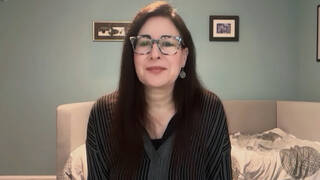
- Huda AsfourPalestinian oud player.
Palestinian musician Huda Asfour recently visited the Democracy Now! studio in New York to discuss her art and perform.
Born in Lebanon to a family of musicians, Asfour grew up in Tunis before moving to Gaza at 14, where she joined the National Conservatory of Music, and then lived in Ramallah in the occupied West Bank, where she studied under Khaled Jubran at the Edward Said Music Conservatory. She now divides her time between New York and Egypt. Asfour’s instrument of choice is the oud, a traditional Middle Eastern stringed instrument. Her latest project is “Naqus.”
Related Story
 Web ExclusiveJul 17, 2026“Helado Tropical”: Helado Negro & Reyna Tropical Discuss Collaboration & Perform at DN! Studio
Transcript
AMY GOODMAN: This is Democracy Now!, democracynow.org, The War and Peace Report. I’m Amy Goodman.
“I’ve always dreamed of the world without borders.” Those are the words of the musician, the artist and scientist Huda Asfour. Born in Lebanon to a family of musicians, Huda Asfour grew up in Tunis, moved to Gaza at 14, where she joined the National Conservatory of Music, then lived in Ramallah in the occupied West Bank, where she was mentored by Khaled Jubran at the Edward Said Music Conservatory. She now lives between New York and Egypt. Huda has serenaded audiences all over the world with her oud. In 2009, she released her first album, called Mars (Back and Forth).
In addition to her work as a musician, Huda holds a doctoral degree in biomedical engineering. She taught at George Washington University. In 2019, she left academia to dedicate herself to music. Her latest project is “Naqus.” Through oud, voice and looping, she explores repetition as both memory and resistance — as she puts it, what returns, what insists and what refuses to disappear.
Well, for more, we are joined by Huda Asfour herself. Welcome to Democracy Now! It’s so wonderful to have you with us.
HUDA ASFOUR: Thank you so much for having me. It’s such a pleasure.
AMY GOODMAN: So, you were born to a Palestinian family in Lebanon?
HUDA ASFOUR: I was. My parents met in Lebanon. Actually, my mother used to live in Iraq. She comes from a family of Palestinians that were displaced in 1949. She grew up in Baghdad and other cities in Iraq. And my father had been sort of — had left Gaza in ’67 and also studied in Baghdad, actually, and then moved to between Syria and Lebanon for a while. And then he met my mother, actually, through the Communist Party in Lebanon, the Palestinian Communist Party in Lebanon, that was working at the time.
AMY GOODMAN: So, you grew up in two worlds, in the music world, but you went into biomedical engineering —
HUDA ASFOUR: Right.
AMY GOODMAN: — which is so interesting, first, before you’ve devoted yourself full time to music.
HUDA ASFOUR: Right.
AMY GOODMAN: Talk about your journey, where where you — you were born in Lebanon, and then where did you move?
HUDA ASFOUR: A month after I was born in Beirut, in the middle of the 1982 Israeli invasion, we moved to Syria. The family stayed there for a couple of years. And then we moved to Tunis in '84, and I stayed in Tunis for 12 years until I was 14. That's when I removed to Gaza for two years. And then, after that, I lived in Ramallah. ’98 to 2000 were sort of like the golden years, I think, the golden years of Ramallah. And then —
AMY GOODMAN: And you were doing music there.
HUDA ASFOUR: I was doing music. I was studying at the Edward Said Conservatory at the time. It was called the National Conservatory of Music at the time. And then, I basically — I mean, I was a high school student. And then, 2000, I started college, and that’s when the Second Intifada started. They were turbulent two years, to say the least, after which I moved to Alexandria, Egypt, to finish my studies there.
And the whole engineering thing is a typical Arab story, or, I mean, I would say, even Eastern, Eastern parent story, where you try to not upset your parents. They have a vision, because you’re good in math and sciences, so you must become an engineer. For me, it was very clear from the get-go that I wanted to be a musician. But actually, I don’t — I really love this detour, because it gave me so many useful skills and a perception of the world and the universe that I truly appreciate.
AMY GOODMAN: You taught at George Washington University in D.C.?
HUDA ASFOUR: I did, for one year, yeah. That was —
AMY GOODMAN: So, there, you studied the heart. Now you appeal to the heart in your music.
HUDA ASFOUR: I think it’s a healthier —
AMY GOODMAN: Maybe healing it in another way.
HUDA ASFOUR: It’s a healthier tool to deal with heart problems.
AMY GOODMAN: Talk about borders and what they mean to you.
HUDA ASFOUR: You know, as a Palestinian, you grow up with a document that really reminds you all the time that you’re not treated equally in the world. So, the idea of moving, reuniting with family that was in diaspora, especially my mom’s family, which — who were really everywhere. I had an aunt in London. I had an uncle in the U.S. My family used to meet in Jordan regularly for reunions. My grandparents used to come from Syria, at least on my mom’s side. On my mother’s — on my father’s side, it was so much later that I started meeting my family. It wasn’t until we moved to Gaza, actually, that I really got to meet everyone.
So, the idea of being limited by these political borders has been very frustrating for me as a kid. And then, later on, you understand how limiting it is even further, when you live — when I went back to the home, that felt a little bit strange, I think, for a teenager moving into a new place, all the beauty of the home, but also all the challenges that come with a politically occupied state. So, the dream of living in a world without borders has been following me for a really long time.
And I really — sometimes it makes no sense to me that I need a visa to go to Lebanon, where I was born. I mean, all the time. Doesn’t make sense, this idea. Also because I was lucky to experience what it looks like not to be actually, like, sort of limited by these borders, so I realized very early on that the distance between Gaza and Egypt is only a five-hour drive, that the distance between Gaza and Ramallah is only an hour and a half by car, that I can go from Amman to Ramallah within two hours by car. So, even though that period of time where we had some liberty to move was so limited, and I was privileged to have this kind of — this privilege, which is not something to be taken for granted in Palestine at all, but realizing how these distances can be relative — like, for someone, this trip might take seven hours, but in reality, it’s only a two-hour trip.
So, I think, with the first album, it was this this desire to dream of a world without borders, and at the time, for me, perhaps maybe leaving Earth altogether towards, you know, Mars, or maybe thinking of Mars as an older Earth that was deserted, was sort of how I tried to sort of — to piece this idea together.
AMY GOODMAN: And talk about your instrument, the oud.
HUDA ASFOUR: The oud is an ancient instrument. It’s one of the earliest adaptations of this kind of idea. You see it in Baroque music. You see it all around South Asia, North Africa, Greece, Turkey. And similar instruments exist all the way to the Far East. My relationship with the instrument started at the age of 13. I saw my grandfather play the instrument for the first time —
AMY GOODMAN: Where?
HUDA ASFOUR: — in a family gathering in Amman. And it just — I mean, I’ve heard him play in cassettes. I had heard stories about his beautiful playing all my life. But really, the moment that changed everything was experiencing this communal theme that comes with actually having this instrument in the room and what it can do in terms of bringing community together.
AMY GOODMAN: Your love of music is conveyed in every song, in all your playing and your singing. But you stopped entirely in 2023?
HUDA ASFOUR: In 2023, it was really a moment to rethink what I’m doing. So, for a few years before that, I was not really comfortable singing. I needed a break from singing to try to figure out psychologically why, why this is not the way I wanted to experience my art. And then, in 2023, it became very obvious to me that we have to bring songs back, that the word became more important right now, that there’s a whole repertoire of language that is related to steadfastness, and what we call sumud, and the reality of things, you know. It’s like small things that didn’t make sense all my life started making sense. How my parents talked during my childhood, a lot of this language became relevant all of a sudden after the genocide. It’s like, “How are you doing?” Well, I mean, I don’t know how to answer that question. How am I doing? I’m going. That’s — I keep going. That’s the only answer I have, is that there’s no room to give up or be tired or — and these are things that kind of became important.
And also, I got to a point where I felt a little bit jaded by the world, I think. It’s like all the values that I thought still had importance kind of became completely irrelevant. We’re looking at a world system that doesn’t work at all but keeps pretending to be efficient and functional. So, it was time to sort of face this reality, for me to be able to survive the situation, but also because I wanted to give — I hope that I am able to give a voice to people who are not able to express these feelings right now.
AMY GOODMAN: So, you live between New York and Egypt, and you’re part of something called the Palestine Expo? Can you talk about this space and what it is?
HUDA ASFOUR: Yeah. So, the Palestine Music Expo is an organization that focuses on creating spaces for Palestinian musicians to be visible. I just — I joined as a volunteer last year to help work with musicians who had left Gaza to be in Egypt, that are now in Egypt and are working on their music. It’s a space that really is trying to bring musicians from all over the world that need this type of platform, and to sort of brainstorm also, as musicians, the infrastructure that we need to be efficient and to make a difference in these times.
AMY GOODMAN: And can you talk about your collaboration with Sonny Singh, who we’ve had —
HUDA ASFOUR: Yeah.
AMY GOODMAN: — in the studio, has performed here, to talk about what you did with Unboundable?
HUDA ASFOUR: Yeah. Unboundable started as an idea from Amplify Palestine. Shalva Wise came to me at, like, in 2021, I think, during — right after the Sheikh Jarrah events in Jerusalem. For me, what the Sheikh Jarrah events meant was that there’s still hope in uniting the Palestinian front. I think that was that glimpse of hope into really understanding that, despite all of it, Palestinians in 1948 and Palestinians all around historic Palestine still had the desire to unite. So, at the time, Shalva suggested that we — they had already launched two volumes for the BDS Mixtapes. It’s a, basically, call for people to boycott the state of Israel, the institutions that work with the state of Israel, and a movement to create cultural pressure on this Zionist entity, basically.
AMY GOODMAN: Talk about the different collaborations that you’ve been involved with.
HUDA ASFOUR: It’s been very important for me to remind people that all our struggles are connected. It’s really, solving the issue of Palestine will require us to work together and to really dismantle this colonial set mentality that we’ve been sort of forced to use. And I think, so, this last year — two years ago, I collaborated with Alsarah. We launched “NE3MA,” which is from the Sudanese archives of the '90s, a song by 3'eqd Aljalad, which is a Sudanese band, that was a bit of a leftist-leaning band; and also Sonny, Unboundable, Amplify Palestine; and more recently, also, we’re working on a production through PMX for 10 musicians from Gaza who are now in Egypt, 10 original songs that we’re really excited to put in this world.
AMY GOODMAN: And this is called?
HUDA ASFOUR: We don’t have a name for that one yet, but we’re still — we’re still working on the production side, so we haven’t really figured out those details.
AMY GOODMAN: So, as we now move into your three songs, tell us why you chose these particular three.
HUDA ASFOUR: The first piece is very special for me, because it was my first collaboration with a dancer, writing as a piece for performance. And it was — it was a result of a collaboration with a Syrian flamenco dancer. It’s very important for me to bring this pan-Arab sort of collaboration into the light, because I believe that we’re kind of fragmented, because we forget. With distance, it becomes hard to connect. It becomes hard to remember what we have in common.
The second piece is a reflection on the theatrics of politics currently. It’s a bit of a sarcastic take on all the talk, all the preaching, people who call for change but are not changing, people who are calling for a boycott but are basically, you know, creating wealth and have their priorities differently, even though what we hear is not that. So —
AMY GOODMAN: And what does naqus mean?
HUDA ASFOUR: Naqus is the — in Arabic, it’s the big bell, usually used either in churches, but also signifies war. So, they’re usually rung when there is war. So —
AMY GOODMAN: And does naqus encompass these songs?
HUDA ASFOUR: Naqus was the name that I chose because I felt that there is need for people to sort of start paying attention. So, naqus, like, really implies this urgency. So, it’s like ringing the bell in emergency.
AMY GOODMAN: And as we move into these songs, Huda Asfour, actually, tell us what Asfour means in Arabic.
HUDA ASFOUR: Asfour means bird.
AMY GOODMAN: And so we take flight with Huda Asfour’s songs. This is Democracy Now! Thank you so much for joining us. Huda Asfour.
HUDA ASFOUR: [performing “Abaq”]
HUDA ASFOUR: So, the second song is a bit of maybe satirical observation of our current state of affairs, the theatrics of politics, things that don’t make sense to me, things that I’ve been hearing that have been a bit illogical. It’s called “Haki.” It’s basically — just the gist of it is talk, talk, talk, keep talking, resolution after resolution, keep passing. And for those who have never bought in, may your curiosity be driving you. And then, it goes on to say, basically, what is change anyway, but changing yourself, you calling for change?
HUDA ASFOUR: [performing “Haki”]
HUDA ASFOUR: This last one is a trilogy that sort of I wrote, inspired by Hadra, which is a form of spiritual trance in Arabic, in the Arabic and Islamic repertoire. The first song — there are three songs. The first song is called “Khatar,” “Danger.” The second song is “Tama,” “Greed,” and the last song is “Darawish” or “Darwish” or “Darwishes.” So, I think the arc explains itself.
HUDA ASFOUR: [performing “Khatar,” “Tama” and “Darawish”]





 Top
Top
Media Options