









 Watch Full Show

Topics
Guests
- Clarissa Redwineco-founder of Kickstarter United and of the tech organizing conference Circuit Breakers.
- JS Tanformer software engineer at Microsoft who has organized in the tech industry for many years.
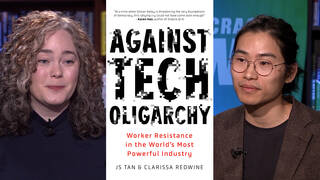
Longtime tech worker organizers Clarissa Redwine and JS Tan’s new book, Against Tech Oligarchy: Worker Resistance in the World’s Most Powerful Industry, draws on the authors’ experiences at major tech companies to chronicle the rise and fall of the tech worker movement, its early victories, and the repression and slide to corporate control that followed.
“Over the course of the 2010s, what we saw was that the tech industry wasn’t quite the industry that it had promised to its workers and to the public. Rather than making the world more open, more democratic, we saw it really be the culprit of misinformation,” says Tan, who was pushed out of Microsoft after raising objections to the company’s ties to fossil fuel companies.
Silicon Valley’s slide to the right was influenced by corporate backlash to labor’s demands, explains Redwine, who was fired from Kickstarter for union organizing. She says she hopes to inspire a new generation of tech workers to organize “within these tech oligarchs’ own empires, to stand up and push back.”
Related Story
 StoryAug 20, 2026“Love Machines”: James Muldoon on How AI Is Changing Relationships & the Global Workers Fueling AI
Transcript
AMY GOODMAN: This is Democracy Now!, democracynow.org, The War and Peace Report. I’m Amy Goodman.
If you work in the tech industry, your boss might not want you to tune in to our next segment. It’s about a remarkable new book called Against Tech Oligarchy: Worker Resistance in the World’s Most Powerful Industry. It’s written by longtime tech worker organizers Clarissa Redwine and JS Tan. Drawing on their own experience organizing at high-tech companies, they chronicle the rise of the tech worker movement, its early victories, and the challenges it faces today as tech titans consolidate their economic and political power, while tech workers face mass layoffs.
Clarissa Redwine helped unionize Kickstarter, where she was fired amidst a union-busting campaign before workers went on to win union recognition. JS Tan is a former Microsoft software engineer who publicly challenged Microsoft’s work with the Pentagon, with ICE and with fossil fuel companies, including its use of cloud and AI technologies to help Chevron expand oil extraction.
Their new book comes as tech companies embrace artificial intelligence, workplace surveillance and increased automation. At Meta, for example, a new initiative will collect workers’ mouse movements, keystrokes and some screenshots to help train AI models to replace them in the future. In response, Meta workers reached out to United Tech and Allied Workers, a branch of the Communication Workers Union, to discuss unionization efforts and how best to resist.
Clarissa Redwine and JS Tan join us now.
We welcome you both to Democracy Now! It’s great to have you with us. Clarissa, let’s start with you. First of all, explain what Kickstarter is and how you got the experience you did, and then how you tried to unionize your workplace, though it ultimately did get unionized.
CLARISSA REDWINE: Yes, it did. Yeah. So, I joined the tech industry in a moment where there was a lot of optimism for what tech could do for society. And Kickstarter was especially idealistic, where the reason the platform exists is to give communities a tool for bringing projects to life, cultural projects, but also technology. And, you know, in 2016, when I joined, there was a moment where tech management and workers felt aligned and united against the Trump administration. But as the years went by, we saw, over and over, tech companies capitulating, becoming complicit in the rise of the alt-right. And there came a moment at Kickstarter where we had the same experience.
So, there was a moment where Breitbart wrote an article saying that a Kickstarter project was inciting violence. This project was a comic book called Always Punch Nazis, which they did not like. And management decided, rather than stand up to Breitbart and this push from the alt-right, that they would cancel the project. And I and my co-workers demanded that we keep this project on the site. And that moment of collective action was transformative for myself, but also my co-workers, where we saw the promise of collective action. And after that, we decided we wanted structural power in the workplace. We wanted lasting change. And we fought for a union, and we won.
AMY GOODMAN: And talk about where you went in that struggle.
CLARISSA REDWINE: Yeah, so, I was part of the core organizing group at Kickstarter, and when management was attempting to bust the union, they decided to fire a third of our organizing committee in the same week. And unfortunately, I was first to go. But it was all completely worth it. And the reason that Kickstarter is such a bright spot in the tech worker movement is because it showed tech workers across the industry that it was possible to win a union. And ever since, I’ve been organizing and building worker power.
AMY GOODMAN: And, JS Tan, talk about your experience at Microsoft.
JS TAN: Yeah, you know, so, I started in the tech industry in the mid-2010s, and my first job out of college was at Microsoft. And, you know, I think it was around that time where this idea that the tech sector, you know, with the rise of the internet especially, was going to be this place that could really push for a more open society, a more connected society, and even a more democratic society. And so, coming out of college, you know, myself and a lot of us coming out of these CS departments had these ideas that joining the tech industry and building these internet platforms would allow us to do just that. And so, that’s what happened to me when I went to Microsoft.
But, you know, I think over the course of the 2010s, what we saw was that the tech industry wasn’t quite — you know, wasn’t quite the industry that it had sort of promised to its workers and to the public, right? You know, rather than making the world more open, more democratic, we saw it really be the culprit of misinformation. You know, when I started at Microsoft, they were starting to get involved with military contracts with the Pentagon. And, you know, in particular at Microsoft, at that time when I was working there, there was this really strong messaging push from the bosses that Microsoft was going to be this place of — that was really going to push the agenda of sustainability and green technology. But, you know, from the inside, it was clear to me and many of my co-workers that, actually, they were collaborating with the oil and gas companies and, in many cases, helping them intensify the drilling that these companies were doing.
AMY GOODMAN: And how did they respond to those inside raising objections?
JS TAN: Yeah, I mean, compared to some of the other companies, they were a little bit more tactful and not sort of just outright firing a lot of the organizers. But in my case, you know, I had gone to Kazakhstan and had had sort of seen up close how Chevron wanted to use Microsoft cloud and AI technologies to drill and to extract even more oil. And, you know, I came back to the U.S. and wrote about it all in an essay, and that ended up getting me in some trouble, where I ended up getting pushed out of the company.
AMY GOODMAN: And what do you do now?
JS TAN: Well, now I’m a — I’m a graduate student at MIT, and I continue, with Clarissa, to continue to organize in the tech worker movement.
AMY GOODMAN: So, this latest news that we just included in the lede about Meta, Clarissa, a new initiative collecting workers’ mouse movements, keystrokes and some screenshots to help train AI models to replace them in the future, especially for the Luddites among us, if you can explain what exactly that means?
CLARISSA REDWINE: Yes, absolutely. So, you know, if you think about how a company operates, management is always trying to cut costs, cut corners. And the management at Meta saw that they had this very valuable resource, which was their employees and the work that their employees do every day. So, they decided to ingest all of this activity from their workers, every time that you click on your keyboard, every time you move your mouse, and they used all of that data to train an AI model that could actually do software engineering, could do some of the core work that these employees do every day.
And unfortunately, this news slipped in the company, and workers were enraged, not just because this felt like they didn’t give consent for their data to be used this way, there was a threat of automation, but also because management was doing this in a very insecure way, not following procedures within the company.
And luckily, I was embedded with some workers at Meta when they were pushing back, and got to see up close how they, you know, had this amazing open letter that gained traction, thousands of signatures seemingly overnight. They were speaking back to management and even organizing in more structural, strategic ways behind the scenes.
AMY GOODMAN: I mean, the Meta AI surveillance came as the company announced 8,000 layoffs —
CLARISSA REDWINE: Right.
AMY GOODMAN: — in May?
CLARISSA REDWINE: Right. And that’s very convenient to announce layoffs right before you’re going to have this initiative that is very extractive of your workforce. You know, your workers want to keep their heads down and not make waves. But I’m very excited and really proud of the workers at Meta that did stand up in that moment.
AMY GOODMAN: Also from our headlines today, The Washington Post has revealed the names of private donors who’ve donated $330 million to help fund President Trump’s ballroom, the new White House ballroom. Tech giants Nvidia and Apple each gave $25 million. Other donors included Amazon and Microsoft. Your response? Well, actually, since you worked for Microsoft, JS Tan?
JS TAN: Yeah, you know, that’s a great question. And I think that really gets to the tip of this ice — the tip of the iceberg of what is a broader shift in the politics of Silicon Valley. You know, I’m sure your listeners know fully well that, you know, the tech elites have cozied up with Trump, and now they’re embracing the kind of politics that’s much more associated with MAGA. And tech workers know this well, as well. You know, in their own workplaces, they’re seeing a reduction in DEI initiatives, a crackdown on sort of the open culture that was once so celebrated in the tech industry.
And, you know, there are many ways to explain this shift. You know, we’ve seen in other reporting and other books that — you know, for instance, tracing key figures like Peter Thiel or Curtis Yarvin and how the spread of right-wing ideology permeated through Silicon Valley. You know, we’ve also sort of seen reporting that looks at why it was under the Biden administration that the tech elites essentially moved away from the Democratic Party, especially as they cracked down on monopoly-type patterns in the tech industry.
But, you know, to that list, our book adds one more, one more explanation, and that’s really about class struggle. You know, it’s really about how it was that the tech worker movement itself was central in the shifting politics of Silicon Valley. And I think, you know, to —
AMY GOODMAN: Explain that further.
JS TAN: Yeah, and, you know, I guess to really understand that, we have to go back to 2018, which was the beginning of the tech worker movement. And, you know, that was a period in which we saw, you know, tech workers from across the industry start participating in various kinds of activism, both labor activism and political activism, in the workplace. And, you know, for folks who remember the media cycle back then, that was a moment where we were seeing this type of activism happening in the news cycle on a weekly basis and, in fact, at both big and small companies alike.
And, you know, it was really quite a remarkable moment, I think, because that was a period in which the activism that was happening had fundamentally a progressive backing to it. Right? The folks who were — the folks who were, you know, participating in this activism were fighting over things like the collaboration with the Pentagon, right? So anti-militarism. They were fighting over things like I was involved with — right? — against the sort of collaborations with Big Oil, and also joining up with the #MeToo movement to fight rampant sexism in the workplace.
And so, you know, the way the bosses responded to that, initially, they tried to sort of double down on this progressive facade, you know, in some cases, putting more money into AI ethics, in some cases, ceding to worker demands. But eventually, you know, the bosses got fed up, right? They got fed up, and they didn’t want to continue listening to their employees.
AMY GOODMAN: JS Tan, you’re at school now. You’re at MIT. The technology of surveillance and repression is increasingly sophisticated. Are radicalized tech workers building liberatory code?
JS TAN: You know, I think right now, oftentimes they’re forced into a position where they cannot. Right? They’re forced into a position where their bosses are telling them that they have to do certain things or put their jobs on the line. And, you know, I think, in some cases also, tech workers themselves see the code that they’re building as not being — as not having a societal problem. But, you know, what’s really central in our book is that we realize that when tech workers participate in this collective action and participate in organizing against the boss, that transforms their politics, as well.
AMY GOODMAN: Clarissa, we have 15 seconds. The most important issue you feel you want conveyed in your new book, Against Tech Oligarchy?
CLARISSA REDWINE: Yeah. We hope this book inspires the workers within these tech oligarchs’ own empires to stand up and push back, like many of us did in the early days of the tech worker movement. And I think there’s a lot to learn from these struggles.
AMY GOODMAN: Clarissa Redwine and JS Tan, authors of the new book, Against Tech Oligarchy: Worker Resistance in the World’s Most Powerful Industry.
That does it for our show. Democracy Now! is currently accepting applications for an individual giving manager”:https://democracynow.hire.trakstar.com/jobs/fk0z819?source to support our fundraising team. Learn more and apply at democracynow.org.
I’ll be at Woodstock International Film Festival today at 2:30 — you can check our website — and California next week, USC on Monday. We’ll be screening Steal This Story, Please! I’ll be there with the film’s director. Also, next week, on Friday, I’ll be at Stanford University, and then in San Francisco and Marin, and then on to Colorado. Check our website. I’m Amy Goodman.




 Top
Top
Media Options