







 Watch Full Show

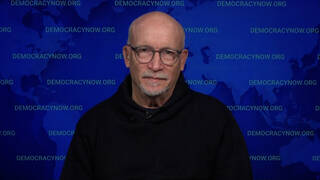
ICE is asserting federal immigration officers have the power to forcibly enter homes without a judicial warrant. “That’s just not true,” says legal scholar Stephen Vladeck, who says the claim directly violates the Fourth Amendment protections against unreasonable search and seizure. “What we’re really seeing here is an effort to twist a handful of old cases that have recognized circumstances in which the government doesn’t need a judicial warrant to enter a home.” Vladeck also encourages witnesses to share video evidence of federal agents’ abuses to support future prosecution efforts.
Related Story
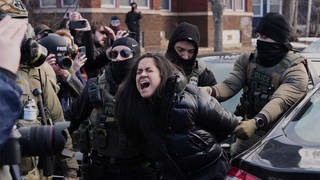
 StoryFeb 09, 2026Meet Aliya Rahman, Disabled U.S. Citizen Assaulted, Jailed & Traumatized by ICE in Minneapolis
Transcript
AMY GOODMAN: This is Democracy Now!, democracynow.org, The War and Peace Report. I’m Amy Goodman, with Juan González.
We are continuing our conversation with Georgetown University Law Center professor Stephen Vladeck, who’s written a piece, co-authored a piece, in The New York Times, “This May Be the Only Path to Accountability for the Minneapolis Shootings.”
I wanted to ask you about the Associated Press reporting that ICE is asserting federal immigration officers have the power to forcibly enter homes without a judicial warrant, in what legal experts say is a clear violation of the Fourth Amendment. ICE made the sweeping claim in a secretive memo dated May 12th. Two whistleblowers shared the memo with Democratic Senator Richard Blumenthal.
Last week, Homeland Security’s general counsel Jimmy Percival wrote a piece for The Wall Street Journal headlined “How the Deep State Thwarted ICE Administrative Warrants.” In it, Percival claimed, quote, “If the police come to a home to make an arrest, police generally must obtain a judicial warrant before entering without permission. Illegal aliens, however, don’t have the same rights as citizens. Under federal immigration law, officers may issue an administrative warrant, which means that the probable-cause finding is made by an executive branch officer rather than a judicial officer.” Again, that’s a quote of the — of general counsel for Homeland Security, Percival. Professor Vladeck, your response to these claims made by Percival? And talk about the whole TikTok story.
STEPHEN VLADECK: Yeah, so, Amy, I wrote a post for my newsletter, which is called One First, which is at SteveVladeck.com, yesterday that provides a much longer response to the general counsel’s claims.
Really, there are two basic assertions here that are both false. The first assertion that Percival made in his op-ed is that what he calls “illegal aliens” have less, fewer Fourth Amendment rights than other noncitizens and than U.S. citizens. Amy, that’s just not true. The Supreme Court has never said that. There are a smattering of lower court decisions that have suggested other contexts and other rights where maybe noncitizens, in general, and undocumented immigrants, in particular, have less protection, but none of those cases are Fourth Amendment cases. So, just from the get-go, this whole framing is incorrect.
But there’s also this really, I think, odious attempt to portray noncitizens who are subject to what’s called a final order of removal as, quote, “fugitives from justice,” unquote. That’s just not true. The way our immigration process works, there are countless tens of thousands of noncitizens who might receive a final order of removal, but who are allowed to remain at large until a date by which the government says you must report to us or leave the country voluntarily. Those folks aren’t fugitives. There are limits on how long the government can detain noncitizens pending with their removal, before they have to be released. Those folks are not fugitives.
And so, what we’re really seeing here is an effort to twist a handful of old cases that have recognized circumstances in which the government doesn’t need a judicial warrant to enter a home into this sort of systemic view that as long as they’re looking for, quote, “illegal aliens,” a term they don’t define with any specificity, they can go into anyone’s homes, Amy, including American citizens’ homes, without a judicially signed warrant. There’s no precedent for that. It reflects a remarkable attempt to shift what have been the historical precedents. And, you know, I think the alarming question about the Percival op-ed is this is the general counsel of the Department of Homeland Security, the agency that runs ICE, CBP, you name it. Either he knows all of these things and wrote that op-ed anyway, or he doesn’t. I’m not sure which of those is less comforting, but neither is especially reassuring.
JUAN GONZÁLEZ: And, Steve, you’ve suggested that Minnesota prosecutors should create an online portal for individuals to upload their videos and other evidence of alleged ICE misconduct, not just for killings, but any abuse of power. What would that allow prosecutors to do even without federal cooperation?
STEPHEN VLADECK: Yeah, I mean, Juan, I think we heard this from Attorney General Ellison during his conversation with you guys before the break. Prosecutions depend upon evidence, and they depend upon evidence that can be admitted in court, that can be provided to a jury, that can provide the basis for establishing a defendant’s guilt beyond a reasonable doubt. Evidence in this context can include video, and it can include, you know, video from multiple angles that would make it easier for prosecutors to establish that any particular act, not just the shooting of Alex Pretti, violated Minnesota state law, and critically, for our purposes, that these acts were not reasonable and necessary on the part of the federal officers in the carrying out of their duties.
The doctrine here, the nerdy legal point, is something called Supremacy Cause immunity, the idea that, in general, federal officers can’t be held liable under state law for simply carrying out their duties, even if those duties conflict with state law. The duties have to win. Juan, the question is going to be: How could prosecutors show that the officers’ actions were neither reasonable nor necessary? That’s where I think this kind of video evidence, contemporaneous video evidence, could potentially be so critical and even possibly dispositive.
AMY GOODMAN: Stephen Vladeck, we want to thank you for being with us, professor of law at Georgetown University Law Center, writes the One First Supreme Court newsletter, author of The Shadow Docket: How the Supreme Court Uses Stealth Rulings to Amass Power and Undermine the Republic. His recent New York Times opinion piece, co-authored with Barry Friedman, is headlined “This May Be the Only Path to Accountability for the Minneapolis Shootings.” We’ll link to it at democracynow.org. This is Democracy Now! We’ll be back in a minute.
[break]
AMY GOODMAN: “Seasons of Sorrow” by Brian Laurence Bennett.



 Top
Top
Media Options