










 Watch Full Show

Topics
Guests
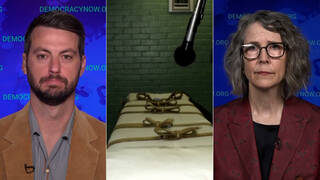
- Steven Halecriminal justice reporter at the Nashville Banner.
- Sandra Babcockdirector of the Cornell Center on the Death Penalty Worldwide.
Tennessee’s Governor Bill Lee has halted executions for the remainder of the year after a death row prisoner survived two lethal injections on Wednesday. According to her lawyers, Christa Pike was still breathing after she was strapped to a gurney and injected with two syringes of pentobarbital in a botched execution that spanned more than two hours. Prior to the scheduled execution, Pike and her lawyers argued a single-dose lethal injection could be tantamount to torture due to Pike’s small veins. Pike was sentenced to death for a 1995 murder she committed when she was 18. Now in the hospital in critical condition, she is the first person to ever survive lethal injection in the United States.
“I have seen five executions in Tennessee,” says Steven Hale, a criminal justice reporter for the Nashville Banner, who witnessed Christa Pike’s botched execution. “And I’ve never seen anything like what we saw Wednesday night.”
Christa Pike “has just experienced the most agonizing attempt at lethal injection in the country’s history,” says Sandra Babcock, director of the Cornell Center on the Death Penalty Worldwide. Babcock says Pike should have never been sentenced to death, because she was an “immature 18-year-old” with a history of severe childhood and sexual trauma who “was not receiving medication for post-traumatic stress disorder and bipolar disorder at the time of [the murder], which she committed with her abusive boyfriend at the time.”
Related Story
 StoryMay 26, 2026“He Was in Agony”: Tennessee Issues 1-Year Stay for Tony Carruthers After Botched Execution Attempt
Transcript
AMY GOODMAN: This is Democracy Now!, democracynow.org, The War and Peace Report. I’m Amy Goodman.
Tennessee’s Governor Bill Lee has halted all remaining executions this year after a death row prisoner survived two lethal injections Wednesday night. According to her lawyers, Christa Pike was still breathing after she was strapped to a gurney and injected with two syringes of pentobarbital in a botched execution that spanned more than two hours. Witnesses say Pike described a burning spot in her arm that felt like it was going to burst. She smiled and laughed, then gasped repeatedly and began snoring, but continued to breathe. She was later taken to the hospital.
Tennessee Governor Bill Lee has ordered an independent review of the botched execution, but Christa Pike’s attorneys say he should go further and commute her sentence. On Thursday, Christa Pike’s attorney, Randy Spivey, addressed reporters during a news conference.
RANDY SPIVEY: Christa is alive right now. We don’t have a sense of her prognosis or much update on her health at the moment, but we do know that she is alive right now and receiving lifesaving medical care.
The state of Tennessee has shown us again that they are not capable of carrying out an execution consistent with basic human dignity. Last night was not just inefficient; it was cruel, and it was torturous. It was also predictable. Christa’s legal team told the state of Tennessee and the court that her medical conditions would cause her to suffer an agonizing death. The state and the court dismiss Christa’s concerns.
The governor’s call for an independent review does not go far enough. After having endured solitary confinement for more than 20 years and a full attempt to kill her by lethal injection, Christa has endured punishment greater than any other person in the history of the American death penalty.
AMY GOODMAN: Christa Pike’s lawyers revealed the execution team went through at least seven needles trying to find a vein, including one that appeared to be bent when it was pulled from her arm. Medical experts say the blistering and burning around the IV insertion sites suggest the pentobarbital may have leaked into the surrounding tissue rather than entering Pike’s bloodstream, potentially causing chemical burns. Some experts have raised the possibility the pentobarbital may have degraded or expired, which could have made it less effective.
Christa Pike was sentenced to death for a 1995 murder she committed when she was 18 years old. She would have been the first woman executed in Tennessee in 200 years. Wednesday night’s attempted execution went forward only after the U.S. Supreme Court lifted a stay by an appeals court, which had paused her execution to consider whether her sentencing had fully weighed mitigating evidence, including severe childhood trauma and neglect, including rape and sexual abuse and mental illness.
Weeks before her botched execution, Pike and her lawyers argued a single-dose lethal injection could be tantamount to torture due to Pike’s small veins. This is an unedited audio recording shared by her lawyers with The New York Times.
CHRISTA PIKE: The concerns I have on our lethal injection method are simply that I do not have good veins. Tony Carruthers lived out my worst nightmare, detail for detail, and I don’t want to go through that. The drug is — supposedly burns very bad, and so that sounds scary to me, because they use the word “Drano” in speaking about this drug. And the thought of suffocating and drowning on my own bodily fluid and blood isn’t very appealing to me.
I’m very remorseful now. I wasn’t in the beginning when I first caught this charge. I didn’t care what I had done or who I had done it to. The horror of the pain that I caused her family, my family, my co-defendants’ families, I have affected this world in such a negative way. When all I ever wanted to do was care for people and leave love, I have done the opposite of that, and that pains me.
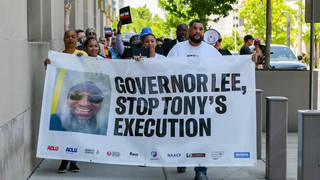
AMY GOODMAN: Those were the words of Christa Pike, speaking weeks ahead of her botched execution. She was referring to the case of Tennessee death row prisoner Tony Carruthers, who was issued a one-year stay of execution in May after prison officials were unable to find a backup injection vein in another botched execution attempt that left Carruthers suffering and in pain for over an hour.
Pike’s lawyers said, quote, “We take no pleasure in being right, but the concerns raised by Ms. Pike proved to be true: difficult vein access, blown veins, degraded pentobarbital, no emergency medical care available when things inevitably go wrong, all under a protocol that remains veiled in secrecy,” they say.
Well, for more, we’re joined by two guests. In Nashville, Tennessee, we’re joined by Steven Hale, criminal justice reporter at the Nashville Banner, author of Death Row Welcomes You: Visiting Hours in the Shadow of the Execution Chamber. He witnessed Christa Pike’s botched execution on Wednesday evening. In Orleans, Massachusetts, we’re joined by Sandra Babcock, clinical professor at Cornell Law School, director of the Cornell Center on the Death Penalty Worldwide. She recently co-wrote an article headlined “Tennessee failed Christa Pike long before her execution date.”
We welcome you both to Democracy Now! Let’s begin in Nashville. Steven Hale, you witnessed the attempted execution of Christa Pike. Can you explain what happened?
STEVEN HALE: Well, thanks for having me, Amy.
I guess the answer is yes and no. I can tell you what I saw. One of the continuing frustrations of this situation, from our perspective as reporters, is that we can’t explain as much as we’d like to be able to. But I can tell you that, yes, what you described there in your intro is correct.
Christa Pike, we understand, was given two rounds of lethal injection drug pentobarbital. I have seen five executions in Tennessee, including the aborted one that you mentioned of Tony Carruthers back in May, and I’ve never seen anything like what we saw Wednesday night. And a number of the witnesses who were there with me have also seen a number of other lethal injections in this state and others, and it was new to all of us.
It was pretty clear early on that things were going wrong, but even then, we didn’t know they would go quite as wrong as they did. And it’s all — it’s all been quite disturbing, as you can imagine.
AMY GOODMAN: Describe what you heard and saw.
STEVEN HALE: So, you mentioned that Christa Pike was talking and kind of smiling even at times. She was in conversation with her spiritual adviser, who was in the room with her. And they, in the early stages of this attempted execution, were repeating a kind of prayer mantra. They were saying, “May you be at peace. May you be at peace. May you be kind and gentle to yourself.” At one point, she looked over in our direction at the window that we were sitting behind, and she said to the people behind the glass, and she repeated that again, “May you be at peace.” But it wasn’t long after that that the drugs were administered, and even at a certain point, we saw what we understand to be a signal in the execution chamber that the drugs had been fully administered. And even after that point, she was still moving her body. She was still talking to her spiritual adviser. And that continued long after we expected it to.
What then happened was obviously a very long process, but the curtain was drawn twice. And for your viewers to understand, that’s normally only done right before the person is declared dead. In this case, it was the curtain was closed while we all knew she was still alive, and we could still hear her breathing, snoring, kind of struggling. And it was then her spiritual adviser was pulled out of the execution chamber. We waited there in the dark for a bit, and then the prison officials came and brought the spiritual adviser back into the execution chamber so that they could try again. And that’s when they gave her a second round of pentobarbital. We continued to hear her snoring at times, saw her, you know, kind of opening her mouth wide, almost as if gasping, but without making a sound. And then, at a certain point, the curtain was closed again. And I repeat, it was closed while we could still hear her and knew she was alive. And we sat there for around 50 minutes, listening to the sound of her snoring quite loudly, breathing, you know, in strained breaths, but with no information about what was or wasn’t going on behind the curtain.
AMY GOODMAN: As we watched the news conference, Sandra Babcock — you’re one of the attorneys for Christa Pike — the attorneys called for the governor to commute Christa’s sentence. The governor’s announced independent review is described as “insufficient without greater transparency and preservation of records.” Can you talk about the legal recourse you have right now? I mean, my understanding is Christa [Pike] is in the hospital in critical condition. They’re trying to keep her alive. And if they succeed and she’s sent back to the prison, they will try to kill her again?
SANDRA BABCOCK: [inaudible] The most important thing right now is that Christa pulls —
AMY GOODMAN: Sandra Babcock, can you hear me?
SANDRA BABCOCK: I can hear you. Can you hear me?
AMY GOODMAN: Yes, I can. Go ahead.
SANDRA BABCOCK: I can hear you. Can you hear me? OK.
The most important thing right now is that Christa pulls through this. We still don’t know what her prognosis is, and we are all waiting to see. And that is the primary concern. But in the meantime, the governor must immediately commute her death sentence. Christa Pike, as Mr. Spivey said a few minutes ago, has just experienced the most agonizing attempt at lethal injection in the country’s history.
And it’s important to remember that Christa should never have been in this position. She should never have been sentenced to death in the first place. She was an 18-year-old kid, an immature 18-year-old, who was just a year after a violent rape, which was the last of three different men who — three different men who had raped her in the course of her childhood and adolescence. She was not receiving medication for post-traumatic stress disorder and bipolar disorder at the time of this crime, which she committed with her abusive boyfriend at the time. There are so many reasons why she never should have been in that execution chamber in the first place.
And on top of that, the state of Tennessee had always accused her of fabricating these accounts of childhood sexual abuse and rape. They called her a liar, a pathological liar. They said that she was promiscuous. They said that — basically, that she had invited it or invented it. In fact, her sexual assaults were documented by police reports, court records, hospital records. She actually reported them, unlike most rape victims. And after decades of denying the truth of her suffering, the state just last month finally admitted that she had — that it did not dispute her history as a survivor of unimaginable sexual violence.
We tried to get the courts to stop her execution, and the 6th Circuit agreed, and they halted it. And the state immediately appealed, and the Supreme Court vacated that stay over the dissents of three justices, who said we we must recognize that we are not infallible and that there is a risk of irretrievable harm if this execution goes forward. Their concerns were ignored. The state of Tennessee plowed ahead. As you said at the top of the hour and as Mr. Spivey explained, the state was on notice about her medical condition. All of these facts were known to the courts. This case represents a colossal failure, not only of the lethal injection process, but of the legal architecture that is supposed to ensure that people do not suffer a torturous death at the hands of the state.
AMY GOODMAN: Sandra Babcock, Tennessee’s Governor Bill Lee has halted all remaining executions this year. You’re having a governor’s election this year, and one of the candidates, the Republican Senator Marsha Blackburn, who’s running for governor, has said many times on the campaign trail she wants executions to happen quicker, and she wants to use the electric chair. Can you respond?
SANDRA BABCOCK: Well, I’m not a Tennessean, and I will not be voting in the election. But what I think about that statement is that it is typical of politicians who are seeking to appeal to a common thirst for vengeance when people hear about violent crime. It is a black-and-white way of viewing the world that does not reflect the complexities of crime, that does not reflect the complexities of women’s histories of violence and the experiences that pave the pathway to incarceration. It’s what they perceive as something that will appeal to the electorate. It’s a cop-out, is what it is.
And people who have worked in the system — and that includes prison officials and guards who have worked alongside, supervising people on death row — recognize that these are full human beings and that you cannot execute someone under the conditions that Tennessee just attempted to do, without recognizing that what Tennessee did was an act of cold and calculated homicide that was far crueler in its way, because of its premeditated, deliberate nature, than the act that Christa Pike was committed of — was
convicted of committing at a time when she was in the grip of a mental illness that was unmedicated, coming off of the trauma of a violent rape.
AMY GOODMAN: Sandra Babcock, can you say whether Christa Pike is conscious in the hospital in critical condition?
SANDRA BABCOCK: We do not know. We have no information. None of the information that we have heard — most of it is rumors — is reliable. We are waiting to hear any official word from the medical team. She is now receiving medical assistance from doctors who respect the Hippocratic Oath, unlike the doctor who was present in the execution chamber with her, who we know is incompetent and who is also responsible for the botched execution of Tony Carruthers in May.
AMY GOODMAN: And finally, I want to go back to Steven Hale in Nashville. You not only witnessed the attempted execution of Christa Pike, you witnessed the attempted execution of Tony Carruthers in May. Your final comments on what happened there, leading to him being granted a stay of execution?
STEVEN HALE: Yeah, Amy, as you say, and I spoke to you in May, and we do need to find a much better way of getting in touch, but I — or a much better reason for doing so. That was also a horrifying attempt at execution in its own way. A difference was that this one went much further. That execution, as you remember, was called off, from our perspective as witnesses, before the curtain was open, and so before it had sort of fully begun, from our vantage point. Of course, on Tony Carruthers’ end, they had been trying and struggling to get IV access for a long time.
I think, overall, I would just emphasize to your viewers that we have been here before in Tennessee, not just in terms of there being a botched execution earlier this year, but in terms of the governor calling for a pause on execution so that the protocol can be reviewed. That happened in 2022 when an execution was called off at the last minute because of problems with the protocol. An outside legal review found that the department had not been following its protocol on numerous occasions, and a new protocol was created. That’s the one we’re using now. And this year, there have been, as we’ve been discussing, two botched executions under that protocol. We did not know until yesterday, after hearing from Christa Pike’s attorneys, the degree of struggle that there had been to get IV access for her. So that was new information to us because, as reporters and witnesses, we don’t see that part during an execution. But that, obviously, it appears, was a problem yet again in this process. And so, what will happen going forward is very unclear. But this is — the experience that we all had Wednesday night and that Christa Pike had is unique in some ways, but also not new here.
AMY GOODMAN: Steven Hale, I want to thank you for being with us, criminal justice reporter at the Nashville Banner, author of the book Death Row Welcomes You: Visiting Hours in the Shadow of the Execution Chamber, speaking to us from Nashville, and Sandra Babcock, clinical professor at Cornell Law School, director of the Cornell Center on the Death Penalty Worldwide. We’ll link to your piece that you co-wrote, “Tennessee failed Christa Pike long before her execution [date].”
Coming up, “Massacre at Minab: The School That Became a Grave.” We’ll speak to Jeremy Scahill of Drop Site News. Back in 15 seconds.
[break]
AMY GOODMAN: “The World’s on Fire” by Feral Foster.






 Top
Top
Media Options