












 Watch Full Show

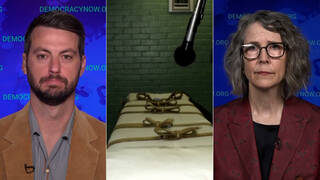
Tennessee death row prisoner Tony Carruthers was issued a one-year stay of execution last Thursday after prison officials were unable to find a backup injection vein in a botched execution attempt that left Carruthers suffering and in pain for over an hour. Nashville reporter Steven Hale attended the execution and describes his and fellow witnesses’ confusion as they heard the sounds of what Carruthers’s attorneys are calling “torture.” Per Tennessee’s lethal injection protocol, witnesses can only see inside the execution chamber once the injection process has begun. Carruthers, who has long struggled with mental health issues and represented himself in his trial, was convicted of triple homicide in 1996. He has always maintained his innocence, but courts have thus far blocked his requests for modern-day crime scene analysis that could lead to his exoneration. Tennessee resumed capital punishment last year, following a three-year moratorium put in place to review the state’s lethal injection protocols. Since its resumption, three people have been executed by the state, all by lethal injection. Carruthers would have been the fourth.
Related Story
 StoryOct 02, 2026“Cruel & Torturous”: Christa Pike in Critical Condition After Botched Tennessee Execution
Transcript
AMY GOODMAN: This is Democracy Now!, democracynow.org. I’m Amy Goodman, with Juan González.
We end today’s show in Tennessee, where the execution of Tony Carruthers was called off after prison officials struggled to find a vein to administer lethal injection drugs. Last week, the Republican Governor Bill Lee issued a one-year reprieve to Carruthers over the botched execution, which came despite Carruthers’s claims of innocence and demands for a new trial.
We’re joined now by Steven Hale, criminal justice reporter at the Nashville Banner, author of the book Death Row Welcomes You: Visiting Hours in the Shadow of the Execution Chamber.
Steven, thanks so much for being with us. You were a media witness for this botched execution. If you can tell us what happened, and tell us the story of Tony Carruthers?
STEVEN HALE: That’s right. Thanks for having me, Amy.
So, last week, I was one of several of the media witnesses for this planned execution. One of the frustrating things is it’s — I can’t tell you what we saw, because we didn’t end up seeing anything. In Tennessee, as of right now, the process where the person who’s being executed is prepared for the execution, in this case, where the IV lines are placed for a lethal injection, happens behind a curtain. And so, me and the other media witnesses were literally in the dark, in a dark viewing room with the curtain that looks into the execution chamber drawn. And that curtain would have opened if they had successfully placed these IV lines in Mr. Carruthers, but that never happened.
So, what we ended up doing was sitting in the dark for more than an hour and trying to listen to what was happening in the execution chamber, not all of which we understood at the time. A lot of it, we found out later. But that turned out to be the sound of them struggling to place the IV lines in Mr. Carruthers. We were told later by his attorney that they tried to, after getting a primary line in his — in one of his arms, they tried the other arm. They tried a hand, his feet, ultimately tried his jugular vein in his neck, and before trying to place a central line in his chest. And when that was unsuccessful, after more than an hour, they called off the execution.
So, yeah, it was quite an ordeal. And obviously, his attorney later would tell us that he was in agony. And we could hear him groaning in pain from the viewing room, but, like I said, we didn’t end up ever seeing him or what was going on.
AMY GOODMAN: Let’s go to Caruthers’s attorney, Maria DeLiberato of the ACLU.
MARIA DELIBERATO: IV line in his shoulder was filled with blood, like back-filled towards the — towards his chest area. And he said that his chest really hurt. … This was a tortured, botched execution. I mean, there’s no question about it. I mean, I guess it’s not an execution, because, thankfully, by the grace of God, he’s still alive. But they tortured him, trying to find a vein. … I am so grateful that we are going to have a chance to prove what we’ve been saying and what Tony has been saying for 30 years, that he didn’t commit this crime. … I know that he believes that this happened, that this botched attempt to take his life happened for a reason, and it will strengthen his resolve to fight even more.
JUAN GONZÁLEZ: And, Steve, could you talk about the case that was originally filed by the ACLU, seeking DNA testing about crucial physical evidence? Why hasn’t this DNA testing happened in over 30 years?
STEVEN HALE: Yeah, well, that’s a good question, but you’re right. The ACLU filed earlier this year asking for crime scene evidence to be tested, both for DNA analysis and fingerprint analysis. And Mr. Carruthers was convicted, along with a co-defendant, in 1996 for a triple murder in Shelby County, Memphis, here in Tennessee. And he’s always maintained his innocence.
But his case has — you know, I was saying to someone the other day, pretty much every issue that you see come up in death penalty cases is present in this case in one way or another. Mr. Carruthers has maintained his innocence. His attorneys have long said that he’s profoundly mentally ill. He was forced to represent himself at his trial. Six defense attorneys were appointed to be his attorney and then ended up leaving the case, and the judge eventually refused to appoint a seventh, and so he represented himself at this capital murder trial. And so, his representation — you know, often see in capital cases that people later will talk about how they had poor representation. He basically had none. He represented himself. He did not have an attorney. And so, he’s always maintained that he was innocent, and there was no physical evidence in this case brought by prosecutors. What there was was the testimony of a man who later turned out to be a paid informant and who later recanted his testimony. And so, there’s basically just questionable circumstantial evidence against Mr. Carruthers.
And so, all these years later, his attorneys at the ACLU have been pushing for that crime scene evidence to be tested. They said that this evidence, if it were tested, it could potentially exonerate him. We don’t know, because the court, so far, had blocked those efforts. And the governor, right before this failed execution, had announced that he was not going to intervene to hold off the execution so that testing could take place. So, I can’t answer really for you why, why it hasn’t been. But now that Mr. Carruthers has a one-year reprieve, I imagine his attorneys will be trying to get that done in whatever way they can.
JUAN GONZÁLEZ: And what does this case raise about mental illness issues in relation to death row prisoners, as well?
STEVEN HALE: Yeah, I mean, so, Mr. Carruthers, according to his attorneys in court filings for years now, they say that he has had delusions about his case, basically that he didn’t even believe he was going to be executed, that he thought he would be released any time, and because he was, as I said, convinced of his innocence and had started to believe that his attorneys and other people involved in his case were actually plotting against him.
And, you know, sadly, this is not unusual. Every — of all the death penalty cases I’ve covered, and all the ones that I have read about, some of the ones I’ve watched you all cover on Democracy Now!, mental illness is often a factor in one way or another, and whether that’s affecting a person’s ability to kind of help their attorneys represent them at trial, whether it’s a factor in the crime that they committed, if they were indeed guilty, or in their understanding of the case later.
And so, his attorneys did go to court and argue that he was not mentally competent to be executed, that he was too mentally ill to be constitutionally executed. The courts rejected that argument. But this is a situation, in one form or another, that we see in lots of death penalty cases around the country, and certainly in Tennessee.
AMY GOODMAN: Steven Hale, as we wrap up, you have been covering this case and other death penalty cases. You’re not only a criminal justice reporter at the Nashville Banner, you wrote Death Row Welcomes You. You decided not to be a witness to these executions after being a witness to them a number of times. Why did you decide to witness Carruthers’s execution, that didn’t actually happen?
STEVEN HALE: Yeah, that’s a good question. I mean, I did — as you said, I witnessed three executions a few years back, in 2018 and 2019. And, you know, it’s not a pleasant assignment, and my other colleagues and reporters who have done so, as well, I think, would agree, but — and so, I was pretty well burnt out on that and exhausted and not — not in a good place to do it again.
I decided to do it again now, you know, years later, because a colleague of mine at the Banner has done a couple of these. My editor, Steve Cavendish, has witnessed a couple that have happened recently. Other reporters that I work with here in Tennessee have been witnessing them. And I think it’s vitally important that if the state is going to execute its citizens, that someone who can, you know, I guess you’d say, represent the citizens, can be there in the room to watch them do it, and report what happens. And so, I did think it was important that I volunteer to do it again. You know, I certainly don’t want to go to every one, and I’m not eager to watch any of them, but I do think it’s really important that people be able to see clearly, or as clearly as we can tell them, what an execution looks like.
And, you know, that’s part of — part of a lawsuit that we at the Banner and some other media outlets here in Tennessee are part of, is to expand the transparency of this process, so that media witnesses could see the IV lines being placed, could see more of this process, because I think if people are going to live in a state that has the death penalty, they deserve to see as much of it as is possible, so that they can judge it for what it is.
AMY GOODMAN: Steven Hale, we thank you so much for being with us. We’ll link to your articles in the Nashville Banner, author of Death Row Welcomes You: Visiting Hours in the Shadow of the Execution Chamber, speaking to us from Nashville, Tennessee.
That does it for our show. On Wednesday night, I’ll be at the IFC Center, the theater here in New York City, with Chani Nicholas and Steal This Story, Please! director Tia Lessin. I’m Amy Goodman, with Juan González, for another edition of Democracy Now!






 Top
Top
Media Options