




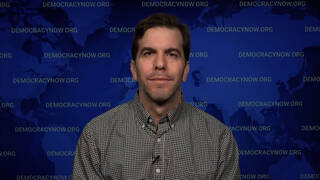





Part 2 of our conversation with Dave Zirin, author of the new book The People’s Historian: The Outsized Life of Howard Zinn.
Transcript
AMY GOODMAN: This is Democracy Now!, democracynow.org. I’m Amy Goodman.
FIFA president and Trump ally Gianni Infantino has dropped his proposal to sell stakes in the World Cup to a private equity group run by Joshua Kushner, the brother of Jared Kushner, President Trump’s son-in-law. The plan had sparked massive outcry across the world. On Thursday, European soccer associations agreed to boycott the World Cup, men’s and women’s, and other FIFA competitions if the deal went through. UEFA, the Union of European Football Associations, publicly declared it had lost confidence in Infantino. It remains to be seen if he will remain head of FIFA.
We’re continuing our conversation now with Dave Zirin, sports editor at The Nation, author of a new book called The People’s Historian: The Outsized Life of Howard Zinn.
In Part 1, we talked about Howard Zinn, but now we’re going to talk about world soccer, one of your specialties, and what exactly happened, because, I mean, this is a worldwide movement, the outcry. Explain to people who aren’t familiar with the sports world.
DAVE ZIRIN: Absolutely. It even broke through my bubble of thinking about Howard Zinn 24/7. This story was so wild and outrageous. Let me try to explain this for folks.
For years, there has been concern by the international soccer bodies about Gianni Infantino’s relationship with Donald Trump. We can go through chapter and verse on this, whether it was Gianni Infantino’s constant visits to the White House, whether it was him wearing MAGA hats in public all the time, whether it was his membership in that Board of Peace to remake Palestine in the Middle East and his pledging of hundreds of millions of dollars of new stadiums, basically on Palestinian graves, that he was going to build in stadiums throughout Gaza — that was his pledge for the Board of Peace — and then, of course, in an act of sycophancy that defines the word, him bestowing on Trump the FIFA Peace Prize, which he completely made up because Trump was so upset about not winning the Nobel Peace Prize. And he said, “We have the first FIFA Peace Prize,” and all of the various bodies and voters in the FIFA world were like, “Wait a minute.” Like, they were completely blindsided. “Like, what’s a FIFA Peace Prize?” So, for years, people have been concerned about the coziness of this relationship.
So, to then have this happen, the brother-in-law of of Ivanka Trump, Joshua Kushner, for him to step forward and say, “Well, now I have a sweetheart deal to actually buy a section of FIFA,” for too many people, this was like this is just Trumpism, you know, writ large. This is selling us off for parts. This is stripping the meat off the bones of FIFA. This is everything that’s wrong with private equity. I mean, fill in the blanks. But most of all, what people said was the fact that it’s a Kushner is just a sign of the cozy and utterly, I would argue, amoral relationship between Gianni Infantino and Donald Trump. And that’s why there was this level of outrage.
And I’ll just throw in there, as well, the anger throughout the world when Donald Trump intervened in the World Cup itself to get a red card removed from a star U.S. player.
AMY GOODMAN: And then, of course, when the Spanish team won, not his favorite —
DAVE ZIRIN: Yeah.
AMY GOODMAN: — the Spanish team, given the Prime Minister Pedro Sánchez’s criticism of the Iran war, of U.S.-Israel policy when it comes to Gaza and the West Bank, he stands in front of the team. Interestingly, even Infantino had to pull him away as the cameras were going off and Trump was standing in front of the team as they celebrated.
DAVE ZIRIN: Yes, which also led to the photoshopping out of Trump, so the Spanish team could have a proper picture and a proper celebration display. I mean, there are no words. I mean, Trump was very open about this. Benjamin Netanyahu was very open about this. They wanted Argentina to win the World Cup, specifically because of the question of Israel and the fact that Argentina is easily, outside the United States, the biggest supporter of Israeli genocide in Gaza and the continued incursion into the West Bank.
AMY GOODMAN: Weren’t some of the Spanish players also very vocal about Gaza?
DAVE ZIRIN: Extremely, a lot of the players, including their star 19-year-old, Yamal, would wave a Palestinian flag in various celebrations. So, I mean, this became so much more than a soccer game. It became almost like a proxy war about where you stood on the question of Israel-Palestine.
I mean, we all talk about we want politics out of sports so we can just enjoy sports by itself. But because the World Cup might be the last event we have that’s watched by the globe, that imbues it with a certain kind of politics, especially because it’s nation-states against one another. There is a political weight to who wins the World Cup.
And when you have a situation like this, with Spain cutting aid to Israel, and Argentina called by Benjamin Netanyahu — their leader, Milei — saying that he was the real star, not Lionel Messi, the real star of the Argentinian team was Milei, I mean, it got — Milei, I should say — like, it got very political very quickly.
AMY GOODMAN: And we have ESPN reporting that the British Prime Minister Andy Burnham has called on the FIFA president, Infantino, to resign over the plan to sell stakes in the World Cup to a private equity group.
DAVE ZIRIN: I have to say, this can’t be said loudly enough. The heads of FIFA have been so incredibly corrupt historically, including the previous head, Sepp Blatter. And you even have Sepp Blatter now taking to social media and look at Gianni Infantino, saying, “Wow, this is really corrupt.” And I’m just — I’m sorry, but if Sepp Blatter is calling out your corruption, it’s really time to reevaluate your life.
AMY GOODMAN: So, what is this going to mean for the World Cup now?
DAVE ZIRIN: Well, we have 2027. We have the Women’s World Cup in Brazil. It’s going to be a huge deal, because you’ve seen this incredible flowering of women’s soccer throughout the world. It’s not just going to be the U.S. dominating and running straight through, to any extent. So, everybody’s very excited about it. And what UEFA has done is they’ve said, “We might not even have this World Cup if Gianni Infantino is still in a perch of power.” That’s the threat with the no-confidence vote — with the declaration, I should say.
So, this is a very — Gianni Infantino has one foot out the door right now, and it would be a tremendous blow, not just to Infantino and his titanic ego, but also to the Trump administration and their desire to use soccer not just in terms of like a kind of global statement about Trump’s superiority standing atop the globe, which is what he was using the World Cup for, but also the question of Israel and Palestine.
AMY GOODMAN: Dave, before you go, I wanted to turn to another issue.
DAVE ZIRIN: Sure.
AMY GOODMAN: I wanted to ask you about Mumia Abu-Jamal —
DAVE ZIRIN: Yes.
AMY GOODMAN: — who’s been imprisoned in Pennsylvania for 44 years, a number of those years on death row. You visited him last week, just after the Abolitionist Law Center and other groups submitted a petition to a United Nations Working Group on Arbitrary Detention, seeking relief.
DAVE ZIRIN: Yes.
AMY GOODMAN: Tell us about your visit.
DAVE ZIRIN: An incredible visit to Mahanoy State Prison in Frackville, Pennsylvania, where I sat with Mumia and his attorney, the incredible Noelle Hanrahan. And what we did was we talked about the United Nations plea and what it could possibly produce for him in terms of, finally, earning his freedom after 44 years as a political prisoner.
But that’s not all we did. I mean, we also talked politics. He’s incredibly sharp on contemporary politics. He follows everything on a day-to-day basis. He’s working on his Ph.D. for Cal Santa Cruz on the life of Frantz Fanon. If that gets published — and there’s no reason to think it wouldn’t be, because publishers are already asking about it — that would be his 16th book that he has written behind bars.
And we told a lot of jokes, too, like just trying to keep spirits up. And, you know, he’s someone who keeps my spirits up, just to give you a sense of how straight his spine is on the question of both not just fighting for his freedom, but, frankly, fighting for all of our freedom.
AMY GOODMAN: Did Howard Zinn ever comment on Mumia Abu-Jamal?
DAVE ZIRIN: I love that question, because it’s like a slow-pitch softball, and I feel like Barry Bonds, because Howard Zinn visited Mumia in prison. Mumia told great stories about it. I’d also heard this story from the Zinn side of things. And this was something that Howard Zinn did. He taught classes in prison. I mentioned before his collaborator Anthony Arnove. He met Anthony because Howard Zinn called the office where Anthony was working, to try to find a job for someone behind bars who he is tutoring, at the time, in history.
So, Zinn’s commitment to people behind bars, I think, because he’d been arrested so many times in struggle and met all kinds of people who weren’t just in the big holding tank with other activists, but people who really were prisoners behind bars. He really lived by the famous line that you tell how civilized a country even is by how it treats its prisoners.
AMY GOODMAN: And in the case of Mumia Abu-Jamal, the latest on law in this country, as you have a world body calling for relief?
DAVE ZIRIN: Yeah, the options in this country are very narrow. It’s a state crime. There is a call going out to all the politicians in Pennsylvania to finally step in after 44 years, with a direct challenge that I think needs to be issued to Josh Shapiro, who — the governor of Pennsylvania, who obviously has been running for president since he was in first grade. What we need in this country, though, is the kind of movement that makes someone like Josh Shapiro say it’s smart politics to finally let this man go after over 40 years behind bars.
AMY GOODMAN: Well, as you talk about Howard Zinn visiting Mumia Abu-Jamal, and in the first segment, we talked more extensively about Howard Zinn’s history and the history he shared with the world through A People’s History of the United States, I wanted to go back to Howard Zinn here on Democracy Now! in 2005 talking about patriotism.
HOWARD ZINN: There’s somehow some wrongheaded notion of what treason is and what patriotism is, and there’s some notion that if you disobey the orders of your government or the laws of your government, you’re being treasonous. But I believe the government is being treasonous and the government is being unpatriotic when the government violates the fundamental rights of human beings, when the government invades another country, a country that has not attacked it, a country that has not threatened it. When our government invades another country and drops bombs and kills huge numbers of people, and then Americans have the guts to go to that country and bring people food and medicine or go to see what is going on, as many Americans did when they went to Vietnam, I think these are the most patriotic Americans.
And, you know, if you define patriotism as obedience to the government, then you are, I think, following a kind of totalitarian principle, because that’s the principle of a totalitarian state, that you do what the government tells you to do. And democracy means that the government is an instrument of the people. This is the Declaration of Independence. Governments are artificial entities set up in order to preserve the rights, equal right to life, liberty, pursuit of happiness of people. When the government violates those rights, it is the duty of people to defy that government. That is patriotism.
DAVE ZIRIN: Two big quotes just came to my mind that Howard Zinn said. The first he said in the late 1960s during the movement against Vietnam, where he said, “The problem in this country is not civil disobedience. The problem is civil obedience.” And the second quote that came to mind watching that, he said in 1986 after the U.S. bombing of Tripoli, when he said, “There is no flag large enough to cover the shame of killing innocent people.”
AMY GOODMAN: And before you go, I wanted to talk to you more about Howard Zinn during the Red Scare.
DAVE ZIRIN: Please.
AMY GOODMAN: I mean, you talked about the ups and downs, and we know about the ups, but how difficult things were. I mean, Howard Zinn, before he was the famous historian, followed by the FBI. Talk about the people’s lives who were — that were destroyed.
DAVE ZIRIN: Yes, absolutely. I mean, Howard Zinn, in his late twenties, was part of an organization called the American Veterans Committee, and he was the head of the Brooklyn chapter. He would speak at panels all over the place. And remember, he’s 26 years old when he’s doing this, and he’s a leader. He’s a movement leader. And there was a big push, because of HUAC, because of the Red Scare, because of J. Edgar Hoover, to actually kick anybody who was in any way, shape or form socialist- or communist-aligned out of the American Veterans Committee.
Now, the American Veterans Committee had thousands of chapters, multiracial chapters, including the Jim Crow South. But it was also broad enough that its members included not just Howard Zinn, but someone listeners may have heard of named Ronald Reagan. So, it was that much of a broad tent. And there was the push to kick people out. And Howard Zinn, who was not a member of the Communist Party — and this is, I think, one of the great lessons of his life, especially now as Trump is trying to whip up a new Red Scare, is that people should never be removed from a movement just because of their political beliefs. He said, if we start playing that game, what’s going to happen is we’re just cutting our own throats, because then it becomes the other person’s problem, then the other person’s problem, that we need unity and solidarity in the face of division. And that was a fight he lost, in part because of the pressure of the constant surveillance, not just on him, but on everybody else.
And I got to say, reading through Howard’s FBI files, the one story I have to share with you is they have one note sent directly to J. Edgar Hoover that they had proof that Howard Zinn was a dangerous subversive, because he used an alias. And then you read down the pages, and the alias they had for him was “Howie.” So, I almost called the book Code Name Howie: The Outsized Life of Howard Zinn.
AMY GOODMAN: Also, how it impacted, the Red Scare, his organizing, like with SNCC?
DAVE ZIRIN: Yeah, absolutely. Oh, a tremendous influence in that he was very conscious of the way that Red Scares could be used, and so he was always very, very clear that it had to be the students front and center. It had to be the incredible young fighters, like Bob Moses, like Diane Nash. He was there in an advisory role. And this was true at Spelman, too.
I mean, here he is with this incredible history of activism, even though he’s in his mid-thirties at this point, and yet he took a big step back and just helped the 18- and 19-year-olds lead. That’s he and Roz. Their apartment was movement central for them to organize and lead. They were putting on music and getting people food, you know, and when asked, they would give advice. But it was really about the students being in the lead. And I just think that that’s an incredible mentality. I do think it comes out of the Red Scare period, but I also just think it comes out of his political smarts of knowing that a 35-year-old white dude, Jewish guy from Brooklyn, wasn’t going to lead the civil rights movement.
AMY GOODMAN: Him, Ella Baker. I mean, you have his address book —
DAVE ZIRIN: Yes.
AMY GOODMAN: — the phone numbers of James Baldwin, Ella Baker.
DAVE ZIRIN: So cool. Anne Braden, the Berrigans. I found that in his files. I almost fell over. Though the cool thing about that, too, is that when you really thumb through the book, it’s tons of names scrawled who I don’t think anybody, unless they were a deep, deep historian in the civil rights movement, would even know these names. But that’s part of the guy who wrote A People’s History. Like, he wanted to be connected to the people who were actually doing the work, and that certainly meant Ella Baker and James Baldwin, and it also meant people whose names we just do not know.
AMY GOODMAN: I wanted to go back to the SOT, to the clip of President Trump in his first term actually naming Howard Zinn.
PRESIDENT DONALD TRUMP: The left-wing rioting and mayhem are the direct result of decades of left-wing indoctrination in our schools. It’s gone on far too long. Our children are instructed from propaganda tracts, like those of Howard Zinn, that try to make students ashamed of their own history.
AMY GOODMAN: Trying to make us ashamed of our own history. You can’t help but think that President Trump’s own father was arrested at a Klan rally —
DAVE ZIRIN: That’s right.
AMY GOODMAN: — a KKK rally.
DAVE ZIRIN: And he’s clearly not ashamed of that fact, if we’re not supposed to be ashamed of our own history. You think about that statement in 2020. Now it’s 2026, and we see what he was really laying out. You know, we have teachers and professors being fired. We have warning signs being put up at the Smithsonian museums now for people not to believe the history therein.
There is a war on history happening in this country right now, and Howard Zinn and other historians who dare say we need to understand this country, warts and all. We need to understand 1776 not just from the perspective of, quote-unquote, “Founding Fathers,” but from the perspectives of the enslaved, the Indigenous, women, you know, that history is different depending on which side of the line you are on. That was Howard Zinn’s grand contribution to how we understand history.
And that actually makes it really threatening to the powers that be, because Donald Trump is demanding — though you hear these words again — civil obedience, because that’s the only way his agenda can be pushed through. It’s a war on history. It’s a war on truth. It’s why they are so for alternative facts, because without truth, without history, it’s very difficult to really live through the ups and downs of struggle, because you start thinking, “Well, nothing is real anyway.” And it’s really nefarious.
And although I will say this: There is something very kind of amusing about Howard Zinn, who passed away in 2010, blaming him for the 2020 protests, which were the largest set of protests in the history of the United States. I was like — after the police murder of George Floyd. I was like, “Wow! That’s a — that’s a heck of an honorific on Howard Zinn 10 years after he passed.” So, it’s not because of police violence. It’s not because of the desperation people felt in that summer of 2020, given COVID and people’s desire just to get out of their homes and be a part of something in a period of great desperation. That’s not why we had the largest demonstrations in history. It’s because Howard Zinn wrote a book in 1980.
AMY GOODMAN: Dave, tell us about Howard Zinn’s experience at what became the Peekskill riot of 1949. He just went to see Paul Robeson? And especially for our younger audience, who even Paul Robeson was?
DAVE ZIRIN: Exactly. I’m so glad you asked it that way. Paul Robeson is just one of the great freedom fighters in the history of this country, somebody who aligned himself with the left, aligned himself with radical movements, was way ahead of his time in fighting Jim Crow, fighting racism, fighting capitalism. I mean, Paul Robeson was a frontline fighter. He worked closely with the Communist Party. He was never a member of the Communist Party, although during McCarthyism, Robeson actually offered to publicly join the Communist Party as a show of solidarity and resistance. Robeson was also, I have to say, like I think anybody would say one, of the great singers of the 20th century, trailblazing actor, somebody who went to Columbia Law School, was one of the great football players —
AMY GOODMAN: Rutgers.
DAVE ZIRIN: — of the first part of the 20th century, at Rutgers. Incredible, was an All-American at Rutgers, incredible player. And actually, for decades, the All-American team he was on only listed 10, not 11, players, because he had been taken off the All-American team because of his radical politics.
AMY GOODMAN: And he had his passport revoked.
DAVE ZIRIN: He had his passport revoked, which was a —
AMY GOODMAN: He was a global figure, so for him to have his passport revoked…
DAVE ZIRIN: It was such a blow to him and his family. Robeson was going to do a concert in ’49 in Peekskill. It was going to be a freedom concert. It was going to be the sort of concert to rally people together in the time of McCarthyism. And Howard Zinn went to it with his wife Roz and with their newborn baby daughter Myla. They were going up to see — they had no sense that it was going to become like what amounted to a white race riot.
And so, they go out there, and all — the American Legion folks, the police, any type of instrument of either state or nonstate violence and reaction hit the people who were going up there to Peekskill. And when Howard Zinn turned his car around and attempted to drive back to New York, he said that their car was hit with so many rocks, with Roz in the back seat holding baby Myla deep into her arms — he said that he never experienced a fusillade like that when flying in a bomber during World War II, the amount of rocks that were peppering his car.
But you know what’s kind of great about this is that you read Howard Zinn’s FBI file, and you see that he and Roz immediately were in an organization in New York called Justice for Peekskill, to get justice for all the people who’d been physically harmed during that, trying to get police prosecuted, trying to get people financially compensated, their medical bills compensated. So they go right into activism following the Peekskill riots, which just speaks to Howard Zinn and Roz Zinn and their approach to history and their approach to the people.
AMY GOODMAN: And Paul Robeson, known globally, he was — he played Othello —
DAVE ZIRIN: Yes.
AMY GOODMAN: — in London in 1930 — this was 19 years before the Peekskill riot — and on Broadway in 1953, breaking barriers as the first Black actor to star in the role in major U.S. and U.K. productions, and then not able to travel the world.
DAVE ZIRIN: Exactly, starred in films like Emperor Jones, most famously in Show Boat, where he sang “Ol’ Man River,” which has really, really transcended time as a song. But while people might know “Ol’ Man River,” what they don’t know is that Paul Robeson, like Howard Zinn, was a frontline activist throughout his entire life, and somebody they really have attempted to erase from history. So, when we talk about Paul Robeson, we’re actually pushing back against Trump’s whole agenda about history, that we erase our heroes so we can only genuflect in front of the white and the powerful and the wealthy.
AMY GOODMAN: And finally, you’re known as one of the great sportswriters of our time. You wrote A People’s History of Sports —
DAVE ZIRIN: Yes.
AMY GOODMAN: — at the behest of Howard Zinn.
DAVE ZIRIN: Yes.
AMY GOODMAN: What did he teach you in how you cover sports? Because —
DAVE ZIRIN: Everything.
AMY GOODMAN: — you talk about them as movements.
DAVE ZIRIN: Yes.
AMY GOODMAN: You talk about the sports, the athletes, where they come from, what they represent today, in addition to how they play.
DAVE ZIRIN: Everything I understand about covering sports comes from a nonsports book called A People’s History of the United States. For me, it was a book that was shaping my life politically. And then, in 1996, a basketball player named Mahmoud Abdul-Rauf made the decision to not come out for the national anthem, in opposition to U.S. foreign policy in the Middle East. And when I heard that and learned that, I was like, “Whoa! There’s this whole other story in sports.” And I will say I was a sports obsessive at the time I was also reading A People’s History of the United States. And I started to then see how Zinn’s politics applied to people in the sports world who were also rebels, and I wanted to tell the story of these rebels. And when you have somebody like Howard Zinn as a guide of how to tell the stories of the true freedom fighters in this country’s history, and then just applying that to sports, that I found an irresistible topic to write about, and a topic that had gone incredibly underdiscussed in the sports realm, if discussed at all. So, the ability to then apply Zinn to the sports world was so much fun.
And then, to have Zinn’s collaborator, Anthony Arnove, who I’ve known since I was a teenager, like, give Zinn my work, and then Howard wrote me a note saying, “You’re gonna — you’re getting my award for most valuable sportswriter,” and I almost fell out of my chair when I got that. And then we just got along really well, you know, a couple Jews from Brooklyn, I don’t know. But we ended up doing these events together, and it was just — it was so incredibly moving to see hundreds of people, young people, come out in states that we would describe as red or purple, you know, and people would come out just to hear what he had to say. And that’s something I feel like we desperately need, because I think why people who might — people today might write them off as Trumpists or what have you. They also wanted to hear what Howard Zinn had to say, because he told their history, too. And that’s what makes him so indispensable.
AMY GOODMAN: Dave Zirin, author of the new book The People’s Historian: The Outsized Life of Howard Zinn, sports editor at The Nation, author of many other books, including A People’s History of Sports in the United States. To see Part 1 of our discussion, go to democracynow.org. I’m Amy Goodman. Thanks so much for joining us.



 Top
Top
Media Options