






 Watch Full Show


Guests
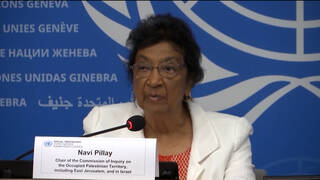
- Navi PillaySouth African human rights lawyer and international jurist who was awarded the 2026 Nobel Peace Prize.
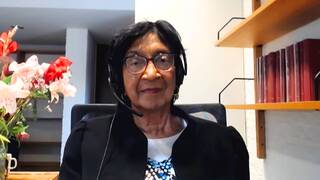
We speak with the acclaimed South African human rights lawyer and international jurist Navi Pillay, who was awarded this year’s Nobel Peace Prize. Pillay has been the United Nations high commissioner for human rights and a judge at both the International Criminal Court and at an international tribunal investigating the 1994 genocide in Rwanda. Most recently, she led the U.N. Independent International Commission of Inquiry that concluded Israel had committed genocide in Gaza. Hours after Pillay was announced as winner of the Nobel Prize, the United States imposed sweeping new sanctions against the International Criminal Court.
“It’s extremely shocking to me, totally unacceptable, that the United States administration can today impose sanctions against the International Criminal Court,” says Pillay, speaking to Democracy Now! from The Hague.
Navi Pillay is now 85 years old. She was born into an Indian Tamil family in apartheid South Africa in 1941. The first woman to start a law practice in Natal, South Africa, in 1967, Pillay began her legal career defending anti-apartheid activists including Nelson Mandela, exposing torture, and helping establish key rights for prisoners on Robben Island. Mandela, as president, later appointed Pillay to the High Court of South Africa, making her the first woman of color on that bench.
Related Story
 StoryOct 09, 2026Navi Pillay, South African Jurist, Wins Nobel Peace Prize in “Stinging Rebuke to Donald Trump”
Transcript
AMY GOODMAN: Later in the broadcast, we’re going to talk about a ballot initiative here in California, which would be, if passed, the first billionaires’ wealth tax. But first, we begin today’s show with this year’s Nobel Peace Prize winner, the South African human rights lawyer, international jurist Navi Pillay. Speaking in Oslo earlier this month, the chair of the Nobel Committee announced the award.
JØRGEN WATNE FRYDNES: This year’s laureate has been instrumental in ensuring that war crimes, crimes against humanity and genocide are prosecuted. The Norwegian Nobel Committee has decided to award the Nobel Peace Prize for 2026 to Navanethem “Navi” Pillay for her efforts to promote peace and international law.
AMY GOODMAN: The Nobel Prize Committee said it chose Navi Pillay as this year’s Nobel Peace Prize winner to, quote, “issue a reminder” at a time when “judges and institutions of international law are under political attack,” unquote.
Navi Pillay has served as the United Nations high commissioner for human rights and a judge at both the International Criminal Court and at an international tribunal investigating the 1994 genocide in Rwanda. Most recently, she led the U.N. Independent International Commission of Inquiry that concluded Israel committed genocide in Gaza.
Navi Pillay was in Nuremberg, Germany, at an annual conference of human rights lawyers and judges when she heard the news.
NAVI PILLAY: Thank you very much. Thank you very much. If you clap a little bit more, I may share this prize with Trump. … The last thing I did is the delivery of the report on Gaza naming what’s happening there as genocide.
AUDIENCE MEMBER: Yeah! Bravo!
AMY GOODMAN: Hours after Navi Pillay was announced as winner of the Nobel Peace Prize, the U.S. imposed sweeping new sanctions against the International Criminal Court that target the institution as a whole. Earlier U.S. sanctions targeted individual ICC judges and court personnel. This is U.S. Secretary of State Marco Rubio.
SECRETARY OF STATE MARCO RUBIO: President Trump will never allow the International Criminal Court to prosecute Americans. And that’s why today the United States is sanctioning the International Criminal Court. We will ban transactions with this rogue court, cutting off their resources and crippling their ability to operate against us, because our message is clear: The United States and the American people are not subject to the jurisdiction of this fake ICC.
AMY GOODMAN: Soon after winning the Nobel Prize, Navi Pillay visited her former colleagues at the ICC in The Hague in a show of solidarity.
Navi Pillay is now 85 years old. She was born into an Indian Tamil family in apartheid South Africa, the first woman to start a law practice in Natal, South Africa, in 1967. She began her legal career defending anti-apartheid activists including Nelson Mandela, another Nobel Peace Prize winner, exposing torture, and helping establish key rights for prisoners on Robben Island.
To talk more about her remarkable career, from apartheid South Africa to serving on the International Criminal Court, findings of genocide from Rwanda to Gaza, and President Trump’s attacks on international law, we are joined now by the 2026 Nobel Peace Prize winner Navi Pillay, joining us today from The Hague in the Netherlands.
Navi Pillay, welcome to Democracy Now! It’s great to have you with us. Congratulations on winning this global peace prize. If you could respond to its significance and also talk about the significance of you hearing the news when you were in Nuremberg, Germany, so seminal when it came to the establishment of international law so many decades ago after World War II? Congratulations again!
NAVI PILLAY: Thank you so much, Amy. I’m really pleased to be on your program. You know, the discovery now is — I mean, Democracy Now! is well known. I hope you would include my country sometimes. It’s a extremely valuable program. I’m really happy to be on the program.
And to your questions, yes, I’m now at the International Court of Justice. I serve as ad hoc judge in one of the cases. I came to do some work here. And this was a big surprise to me. I was attending, as you’ve just told the audience, that I was attending a conference in Nuremberg in Courtroom 600, when someone shouted — it was Stephen Rapp, an American, actually, the previous U.S. war crimes investigator, and he announced from his cellphone that that’s the news. And, of course, I had not heard from the committee, so I was astonished, and I disbelieved them, until I heard the announcement myself later online. And it turned out that they had been trying to get hold of me, but there was no connection in the inside the courtroom. A wonderful surprise.
Part of the reasons why I was skeptical is, firstly, because we don’t often hear of them giving the award to women. They have given — mine, apparently, is the 21st woman out of 100-some-odd — 90 were men — recipients. So, that was one factor. And the other is, yes, you know, judges and lawyers don’t often get awards, especially not judges. We work quietly in our courtrooms. We speak through the judgments. And we don’t act it out or make speeches thereafter.
For me, the significance of the fact that I was in Courtroom 600, where the Nazis were tried, is very important, because as an 18-year-old, when I was studying in apartheid South Africa, I was studying law, and nonwhite students attended the university separately, in separate facilities, which in our case happened to be a potato warehouse, and I found these copies of the Nuremberg judgments. Nobody else had seen them. They were high up. I climb a ladder, find some of them. And that started my interest in international justice, because in my country the laws were bad. They were immoral. Ronald Reagan and Margaret Thatcher had used the veto to stop U.N. sanctions against apartheid South Africa. Of course, later, they were pressured by civil society to change and not use the vote, so sanctions were applied, and all of which contributed to ending apartheid. So, I was very interested in us having some access to international justice or a system of laws that had values and principles behind them.
And the significance of Nuremberg is, of course, it was mainly a U.S. idea. The person who is always quoted when it comes to the Nuremberg trials is Justice Jackson, who was a United States person. And all of us have learned about Nuremberg through his writings. So, here’s a country so highly committed to international justice, opting to use the rule of law rather than force in dealing with the high-level Nazi criminals. It was such a wonderful idea. All of us lawyers and judges subscribe to that.
And therefore, it’s extremely shocking to me, totally unacceptable, that the United States administration can today impose sanctions against the International Criminal Court. Straight from Nuremberg, I came to The Hague and went to that court to show solidarity with the staff. These sanctions affect all the staff, who are doing such a courageous job in their investigations.
Now, I don’t want to jump too much, but if I may just add that if the objection is that the judges authorize the prosecution to investigate not only the Taliban’s activities but also the activities of U.S. soldiers who were based in Afghanistan at that time, so if the objection is to the ICC even thinking or considering of investigating those U.S. soldiers, the solution for U.S. is simple: You begin investigating, because the ICC statute doesn’t allow that court to intervene as long as the state is investigating, prosecuting these crimes.
JUAN GONZÁLEZ: And, Navi Pillay, you chaired the U.N. Independent International Commission of Inquiry on the Occupied Palestinian Territories from 2021 to 2025, and as soon as you got news of the Nobel Peace Prize award, you mentioned the decision of the commission there in terms of the genocide committed by Israel in Gaza. Why did you feel it was so necessary to immediately refer to that, especially?
NAVI PILLAY: You know, as I said, I work very well with the U.S. I chaired commissions of inquiry that the U.S. supported, such as two in respect of North Korea. So I know that Americans support the principle of ending impunity for these serious crimes and that they support justice and accountability.
I mentioned the Gaza report because it has been widely covered, and I’ve been accused of being biased and taking sides and speaking lies. That report was mandated by the United Nations Human Rights Council, so it’s a U.N. body. We followed all the U.N. rules, and we worked in cooperation with all the U.N. agencies. We had access to U.N. satellite footage. We did not include a single fact in our report that was not personally verified. So, based on the facts and the statements of the leaders, we named them, the former — the president, the current prime minister and the former defense minister. We said that those three individuals should be investigated and prosecuted for having committed genocide and for the continuing commission of genocide. The report was mentioned — my activities as chair of that commission was mentioned as one of the categories of my life work by the Nobel Committee.
JUAN GONZÁLEZ: And nearly 20 years ago, back in 2008, you were appointed the U.N. high commissioner for human rights by Secretary-General Ban Ki-moon, and the United States initially opposed your appointment then. Why was that?
NAVI PILLAY: I believe they opposed my appointment because the secretary of state felt I would influence my office, the High Commissioner’s Office, towards supporting reproductive rights for women.
AMY GOODMAN: Speaking of reproductive rights and speaking of overall women’s rights, one of the issues that you have focused on that has been so important, I believe coming out of the Rwanda Tribunal, was talking about rape as a weapon of war. And I’m wondering if you could elaborate on that and that whole body of law coming out of your emphasis.
NAVI PILLAY: So, I’ll deal with the background just now, but the important point is, as all judges know, you need the evidence before you. So, all judges look at the evidence first. So, in this case, we heard from many women and men from Rwanda who gave evidence of rape, sexual violence on women, girls, and even some men. So we had this massive body of evidence.
It’s true that when we first heard the evidence, we realized that it had not been charged, so we would have had to completely ignore all that evidence in the normal course. But this is an international court. We were there to render justice. And so we judges allowed the prosecutor to investigate and apply for an amendment of the charge sheet to add four counts of rape and sexual violence.
And that is the case, which is now very well known, of Jean-Paul Akayesu, the mayor of Taba province. Most of the rapes took place on those premises under his control, and there was also evidence that he encouraged them: you know, “Taste the Tutsi women today, because you’re not going to be able to do that in future.” They were raped and killed, largely.
I first, then, credit the courageous women and men who testified on these matters, which enabled the court to consider them and see whether they fulfilled the requirements of the Genocide Convention, which is proof of the specific intent by the perpetrators to destroy, in whole or in part, a group — in this case, the ethnic group of Tutsis. So, that’s the evidence we established. We looked at statements of incitement made by the leaders. The Rwanda Tribunal tried mainly the leaders, the political leaders, military leaders, religious leaders. One, in fact, was a religious leader of the Seventh-day Adventist Church, and we heard evidence from the head of that church from the United States, who came to plead on behalf of that particular priest, whom we convicted because of the evidence before us of his own involvement in these crimes.
Let me say then that we had no precedent. There was no universally accepted definition of what constitutes rape, what constitutes sexual violence under international law. And we looked at very many jurisdictions, and most of us from the common law system — United States, South Africa — we followed the requirement that there has to be proof of no consent, that there has to be proof of penetration by the male organ in the female — in the vagina. So, how do you use that definition when this is happening to hundreds of women? The prosecutor asked these witnesses, yes, “Was there penetration?” And the witness answered, “Well, that’s not the only thing they did to us. These are children. And they didn’t respect us as mothers, and they said vile things to us. They did terrible things to us.” So, we were influenced once again by the experience of sexual violence as viewed by the victims themselves, in order to create a definition that is gender-neutral. Rape and sexual violence constitute crimes of invasion of a person — that’s gender-neutral — under coercive circumstances of a sexual nature. So, we completely did away with the requirement where the victim or the prosecutor has to deal with the element of consent. These are coercive circumstances.
And we had help, of course, from very many academics, from the U.S. in particular. Professor Catharine MacKinnon was very helpful to us, because we had to, very importantly, say why does sexual violence committed under those circumstances constitute a destruction of the group, which is the key element, what we call the dolus specialis, the special intent, required under the Genocide Convention. Here, I must interrupt myself to point out to you very many judges, then and now, believe that they should only look at killings as destruction of the group, that sexual violence does not constitute destruction. Well, we used what we’ve been advised by Professor MacKinnon to describe rape and sexual violence as the destruction of life itself for the victims.
JUAN GONZÁLEZ: Navi Pillay, I’m wondering —
NAVI PILLAY: Yeah, so I’ll stop there. Yeah.
JUAN GONZÁLEZ: Yeah, I’m wondering if you could share with our audience, not familiar with the trajectory of your life’s work, your own family origin story. You’ve said your grandparents were shipped from India as indentured laborers to South Africa. They worked on sugar cane plantations. How did this inform your own experiences? And if you could talk about the conditions under which you were raised in Durban that led you to become a lawyer and get involved in social justice work?
NAVI PILLAY: Well, thank you for that question. I still remember my grandfather, who was brought as an indentured laborer, and he lost both his arms in an accident at the sugar mill. Both his arms were cut off, but he still survived ’til age 87 or so. My parents were born in South Africa. Now, Mahatma Gandhi described the indentured system as akin to slavery, so they apparently really suffered. They focused on education as a way out. My parents were not educated. My mother was told by her father that if he let her learn to read and write, she would be writing letters to boyfriends. So, she made sure that her children were — and so did my father — that we — we were seven children in all — that we were educated.
And, of course, then, we didn’t have money. I wanted to do law. I wanted to know what are our rights, because even as children, we experienced discrimination. We couldn’t go to the beach. Our parents said, “No, we can’t take you to that park. You’re not allowed on the swings.” And we would ask, “Why? Why not?” Yeah. And so, they made it out as if it’s written in stone, things will never change, you are a lesser being because you have a dark skin. That’s what children experience, which got to me, as well. I wanted to know my rights. I wanted to study law.
And the teacher in my high school asked the question of all the students, “What would you like to do when you grow up?” And I said I wanted to be a lawyer. And he said, “Well, your father must have a lot of money. You need a lot of money to go to university.” I was the lucky one, one of the lucky ones. The school approached the community. They went door to door, tapping on doors. This is a poor community of Clairwood, a suburb outside Durban. So, they contributed their pennies and sent me to university, because they were told, “We have a student with potential.” And that is how I was able to get a university degree.
AMY GOODMAN: So interesting. It may be you’re the first Nobel Peace Prize winner to represent another Nobel Peace Prize winner, and that was Nelson Mandela. I believe you were the first woman lawyer to set foot on Robben Island, where he was imprisoned for decades. If you can talk about that relationship? And I also believe you were the first nonwhite lawyer to be — nonwhite woman lawyer to be appointed by Nelson Mandela — the first nonwhite woman judge on the High Court. If you can talk about your relationship with Nelson Mandela and one first after another?
NAVI PILLAY: Thank you. Well, that’s true. He did appoint me as the first woman of color to be a judge on the High Court. Until then, they were all white, and they were all male. It was a pretty drastic step on his part. I was also an attorney. We have a split bar, and judges were usually drawn from the Bar Council. And they were almost — they were always white men. The Bar Council held a meeting. Agenda item one was the competence of Pillay. The public took that up because, remember, this is our new, newly emerging democracy. The public then questioned why these advocates in the Bar Council did not question the competence of the apartheid-era judges. Why me? So, I was very heartened by that level of interest from the public.
Let me — let me begin, though, in answer to your question, to make very clear: I was not his defense counsel. There were other lawyers, various lawyers, who represented him. I, you know, engaged about him with my clients who were on Robben Island Prison. I went to see them on an appeal that had been lodged on their behalf. That’s why I got access into Robben Island Prison, where Mandela was serving and eventually served close to 27 years. My clients told me that they didn’t know their rights. They didn’t have the prison regulations. They were being punished for apparent violations of the prison regulations. And one of them, who happened to be a lawyer, was sentenced to six months’ imprisonment in isolation and spare diet, because all he had done is drawn a petition of their requests, one of which was they needed to see the prison regulations. And the other was that they were — they started a small class where they were teaching English to their companions who needed to learn English, for which he was punished in this way. They discussed the matter. And as soon as I turned up there, we secretly, by code, engaged in their problems and challenges, which I was not allowed to discuss. I was there specifically to talk about the appeal.
So, it was a visit within sight, and supposedly out of hearing, but we were all aware that the whole discussions were — the lawyers’ visits were taped anyway. And I was informed that they had consulted Mandela inside the prison, who discouraged them and me from bringing any application, because there was little chance of succeeding in an apartheid-era court. I then went out and consulted other lawyers, and some of them were very senior white male lawyers who readily, very readily, gave me the time. That’s what lawyers do. You get interested in a challenge. They then encouraged me to bring this application, which we did.
And we won, with costs. The court ordered that the prisoners have a right to a lawyer. They have a right not to be further penalized apart from the court sentence. And if they are alleged to have broken any regulation, there must be magistrates brought out of Cape Town, the mainland, onto Robben Island, and trials must be held. So, since their rights were now spelt out, they were able to have visits from their lawyers, and they were able to study, which was a survival necessity for them. And this is how he came to know of me.
AMY GOODMAN: Navi Pillay, we have to end it there, but I want to thank you —
NAVI PILLAY: Yes.
AMY GOODMAN: — so much for taking this time, South African human rights lawyer, international jurist. She was just awarded the Nobel Peace Prize. She will actually receive that prize on December 10th. Navi Pillay has been speaking to us from The Hague.
Coming up, we look at Proposition 40, a California ballot initiative to impose the world’s first billionaire wealth tax. Stay with us.
[break]
AMY GOODMAN: “The Harvestman” by The Corner Laughers.



 Top
Media Options