









 Watch Full Show

Guests
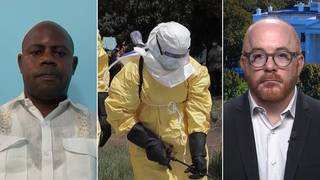
- Akilimali Chomachomaindependent Congolese journalist.
- Craig Spencerpublic health professor and emergency medicine physician at Brown University.
We go to the Democratic Republic of the Congo, the site of the fastest-growing Ebola outbreak in history. Health authorities believe the outbreak first began in January but was not detected until May, in part due to cuts in global health investments, like the dismantling of USAID. Since then, over 8,000 cases have been recorded, with more than 4,000 fatalities so far. From Bunia, Ituri province, the epicenter of the outbreak, we speak to Congolese journalist Akilimali Chomachoma. Chomachoma describes the strain on the underfunded Congolese healthcare system as the disease spreads. Many frontline workers have not been paid for months.
“We are seeing this outbreak emerge, and really unfurl, in a setting of decreased global health support,” says Craig Spencer, a doctor and public health expert based in the United States who contracted Ebola while on a medical mission to Guinea in 2014. “The U.S. has not shown up in the same way that it has in previous Ebola outbreaks.” Spencer also comments on the “unprecedented” measles outbreak in the United States, which he warns is likely to continue and lead to additional deaths.
Related Story
 StoryMay 22, 2026“Politically Driven Epidemic”: Ebola Response Hampered by Impoverishment & U.S. Global Health Cuts
Transcript
AMY GOODMAN: This is Democracy Now!, democracynow.org, The War and Peace Report. I’m Amy Goodman, with Juan González.
The Ebola epidemic in the Democratic Republic of the Congo, the DRC, has killed over 4,000 people since the World Health Organization declared a public health emergency in May. At least 50 health workers are among the dead. More than 8,300 cases have been recorded, and counting. It’s now the fastest-growing Ebola outbreak in history. The number of recorded cases appears to have peaked in August, but that drop may be due to undetected spread in insecure areas. The largest number of new cases are currently in the North Kivu province.
The outbreak was declared in May, but health authorities believe it began spreading in January. The delay in detection was due in part to international disinvestment in global health, particularly the rapid dismantling of the U.S. Agency for International Development, USAID, last year when Trump took office.
Earlier this week, tents at a displacement camp of 19,000 people were burned by soldiers looking for weapons. A transit center used for Ebola patients there was also destroyed. Many families fled the camp. Across Ituri, more than 373,000 people are living in displacement camps due to ongoing conflict.
Meanwhile, many workers on the frontlines of the Ebola response say they have not been paid in months, despite being critical to containment efforts and putting themselves at risk. Workers protested in Bunia, the capital of the Ituri province, this week. Ituri is the epicenter of the crisis, accounts for 90% of the confirmed cases.
This is health investigator Biongi Beiza of the Bunia Health Zone.
BIONGI BEIZA: [translated] The reason for our frustration is that the authorities still owe us. We went two months without pay. There are outstanding payments owed to our colleagues for the first 45 days. They haven’t been paid. The WHO had a sign for transport allowances covering a period of 75 days. Unfortunately, they still haven’t settled that.
AMY GOODMAN: Misinformation has complicated the response as information in local languages has not been readily available. This is Lydia Combe of the Ituri Journalist Syndicate, who says local journalists have had more trouble accessing sources.
LYDIA COMBE: [translated] Even within the communication pillar focused on risks and community engagement, there is no presence of local journalists, including those living in Bunia or the Ituri province. This means that when people see others coming to raise awareness, but the population trusts journalists much more, it creates a certain mistrust within the community. We ask the response teams to provide us a spokesperson whenever journalists need someone to speak, so that we know, for each situation, to discuss prevention, to know who we can approach to talk to, so the journalists address this person directly. If we need to talk about epidemic surveillance, we will be able to speak to the appropriate person without much back-and-forth. If we need to discuss aid and dignified, secure burials, issues that still cause problems in the community, we would already know who to turn to. If the response team can provide us with this kind of people as resources, they will have greatly helped us address the difficulties.
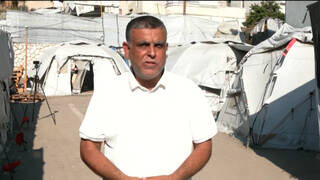
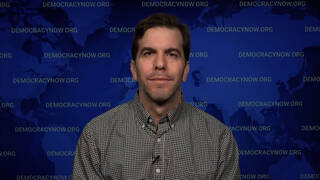
AMY GOODMAN: For more, we go to two guests. Independent journalist Akilimali Chomachoma is an independent Congolese journalist, normally based in Kinshasa, who’s been reporting from Ituri since the start of the outbreak, a contributor to the Friends of the Congo blog and Substack, joining us from Bunia, the capital of Ituri. And from Providence, Rhode Island, we’re joined by an Ebola survivor, Dr. Craig Spencer. He’s a public health professor, emergency medicine physician at Brown University. He contracted Ebola in Guinea in 2014 while on a medical mission there, he made a full recovery at Bellevue Hospital here in New York.
Let’s begin with Akilimali. You are in Ituri. Can you talk about what exactly is happening in the epicenter of the outbreak? Four thousand people now dead, and now we have word a person has died in Kenya, as it crosses the border. I mean, we’re talking about diseases like this know no borders. Tell us what we should know, Akilimali Chomachoma.
AKILIMALI CHOMACHOMA: Thank you so much.
What you should know exactly is that the situation is still worse, even if the government say that the situation is under control. But until now there is no any sign which can confirm us that the situation is under control.
You have so many organizations which are working here on the ground, but with no more results, including on the surveil of the situation. You have also — as you said, you have also so many local organizations who are working, like SOFEPADI, Basandja Coalition and the other organizations who are working on the ground, but which doesn’t have enough money, like international NGOs. But they didn’t get inside. They didn’t get more resources to do what they can do. And it’s them who are more easy and more near to populations. This is the first.
And the second is the Ebola, it’s spreading a lot, because at the beginning it was only one province, and in that province it’s only three health zones, but right now it’s now in Democratic Republic of the Congo 64 health zones and seven provinces which are touched. And right now we know that Kenya now has a case of dead. And we have Uganda, which had, in a few weeks ago, its last case. So, it means the situation, it’s not 100% under control, even if there are some activities like medical activity which are done by partners of government to respond to this Bundibugyo outbreak.
JUAN GONZÁLEZ: But, Akilimali, this whole issue of the frontline workers who are risking their lives to combat this outbreak, they’re not being paid. What is the government saying, and what are health officials saying, about the reason for that?
AKILIMALI CHOMACHOMA: So many of them are saying that those person didn’t pay because they have to analyze their data and they have to analyze their identity. But the problem right now, the government said also that they haven’t enough money to help them because the government only invest from the beginning of this outbreak around $15 million of U.S. dollars right now, and international partners put around $600 million, $600 million, right now, and those $600 million are under control of NGO. This is what government is saying, and it hasn’t enough resources to respond. And also, there are NGOs which are saying that it’s an issue for the government to respond to this issue, to this issue, and to pay local staff. And they are always promising them that they will have solution, and some of them have been paid, but others, until now, haven’t been paid yet.
AMY GOODMAN: And, Akilimali, can you talk about you, yourself, afraid that you were coming down with Ebola? Talk about your experience in one of these clinics and getting tested.
AKILIMALI CHOMACHOMA: Exactly. Shortly, I had some disease, and I went in Ebola treatment center, where I should be received. I have been received at an Ebola treatment center here near Bunia. And in that Ebola treatment center, I received a good medical help, a good medical help. And this is the opportunity to thank all doctor, all health worker, all hygienists and all person who are working in this risky environment, but without being paid or with not enough money.
But from my experience, I experienced how afraid, because, first of all, I was afraid because when you went there and you are seeing near you that there are people, other people, who are dying in a room after. You are listening that there are other people who were declared positive of Ebola, and they went with them to the positive case rooms. And it’s really scared. It’s really scared. And also, there are so many things which didn’t work really, really well, like things of food, like things of water, like things of sanitation. And for example, for food, they didn’t really give the answer — they didn’t really ask the person, “What will you eat, and what you can’t eat?” so they can prepare. They are only like in prison, I can say. They are only preparing, and they are putting there, and you have to eat. If you don’t eat, you will manage yourself, while other people from outside can’t join, can’t join and can’t give other things from outside to — as people who are in the red zone, in the zone where are some suspected cases.
JUAN GONZÁLEZ: I’d like to bring into the conversation Dr. Craig Spencer, public health professor and emergency medicine physician at Brown University. He’s an Ebola survivor himself. Dr. Spencer, what can you tell us about why this latest outbreak of Ebola has spread so quickly, and some of your own experiences?
DR. CRAIG SPENCER: Well, the biggest reason that it spread so quickly is that we didn’t detect it until much later than we ideally would have. This was first detected back in May, so just about five months ago. But by the time that Congo and the international community was aware of the outbreak, it had already been spreading for months.
And has been pointed out already is the fact that it went from a few health zones to dozens of health zones, which means that in every single one of those, you need to stand up a team and a response. You need to build an Ebola treatment center. You need to work with the community so that they can trust that the center there is taking care of patients and their loved ones. But you also need to staff it, and that often means local staff, but bringing in international partners, NGOs. That requires a lot of money, a lot of expertise. And you can see how this starts to build up into a really complicated response.
This is what we’re seeing over the last five months, is that at the outset of this outbreak, there were, you know, a couple hundred cases that were identified really on day one of this outbreak when it was reported, but that is much bigger than most Ebola outbreaks are when they end. So, just the way that this started was already problematic.
We knew that on the day one of this outbreak, there were already cases in Congo, but also cases reported in Uganda, next door. Since then, Uganda has led a really efficient response and has been declared Ebola-free. But with this case reported today in Kenya, it highlights the fact that if there is an outbreak or multiple fires that are burning, as they are, particularly around North Kivu in Congo right now, the risk of onward transmission, both locally, internationally and further abroad, remains high. And it’s something that we need to remain vigilant about; otherwise, this outbreak is going to continue, and the risk to the neighboring countries, as well as those communities in Congo and countries further abroad, remains high.
AMY GOODMAN: And, Dr. Craig Spencer, if you can talk about the role of the dismantling of USAID and what role USAID, the Agency for International Development, played, and what exactly the NSPS is, the National Special Pathogen Service?
DR. CRAIG SPENCER: These are all incredibly important, because we are seeing this outbreak emerge and really unfurl in a setting of decreased global health support, not just from the U.S., but from many countries around the world. But the U.S. played an incredibly large role up until the first week of the second Trump administration. If you recall back then, there was an Ebola outbreak in Uganda. Just days into the second Trump administration, USAID had already been kind of, you know, incapacitated, and since then, the U.S. has not shown up in the same way that it has in previous Ebola outbreaks. In the past, we would have sent people to be on the ground in the middle of these communities that are most affected. Right now the U.S. is not doing that. We’re not sending our CDC people into the same communities. They’re staying in the capital or far away, meaning that they’re relying on secondhand information.
As you pointed out, we don’t have USAID capacity here to work with local actors, to support them, to make sure airport screening is being done and people who are symptomatic are not getting on planes to travel further afield. And without the USAID capacity, that means that moving samples or testing samples is not going to be as efficient as it has been in the past, when the U.S. helped coordinate a lot of that. And the result is that you have not just in eastern Congo, where there’s an Ebola outbreak still ongoing and still getting much bigger, you have PEPFAR, other programs, that were helping provide HIV treatment to millions and millions of people around the world, that are less robust than they were just over a year, two years ago. And the result has been that many people, unfortunately, are dying because of the U.S. pulling back in its global health commitments.
At the same time — you mentioned NSPS — the U.S. over the past decade, in the aftermath of infections like my own and others, built this incredible hospital system all throughout the U.S. We have over a dozen extremely well-equipped, well-prepared hospitals that deal with things like Ebola at a moment’s notice. We have put hundreds of millions of dollars, if not more, into making sure that they’re always ready. But what we’ve seen over the last few months is that when Americans have been infected with Ebola, responding to the outbreak on the ground in eastern Congo, they have not been brought back to these well-prepared facilities, ready for them in the U.S. Instead, this administration has done everything that it can to bring these patients to places outside of the U.S. So, two Americans were not brought back home, as we know we’re capable of and have done in the past to provide them high-quality care. They were brought to Germany, where the teams there are wonderful, but if it were me and I was a U.S. citizen, I would want to go back home, particularly knowing that there’s a system built exactly for this. And my worry is, is that going forward, Americans won’t know that this system exists, politicians won’t be aware of how important it is, and we won’t continue to invest in it in the future.
AMY GOODMAN: Dr. Spencer, we just have 30 seconds, but here in New York, the governor has just declared a state of emergency because of measles, which was considered eliminated in 2000, a quarter of a century ago. A fifth person has died of measles in Pennsylvania right now. There are over a hundred cases in New York. Your response?
DR. CRAIG SPENCER: Most people don’t know that 45 states have reported measles cases this year. New York is one of the few to declare this an emergency, would expand — it expands who can test and who can vaccinate, but it doesn’t do anything to address the underlying trust issues that many of these communities have. New York is challenged because, next door, Pennsylvania has had over a thousand cases. We’ve had five deaths this year, eight over the last two years. And so, we’re dealing with a pretty unprecedented outbreak, something we haven’t seen in decades in the U.S. And the worry is, is that there are multiple fires all around the country, and any of these can get much bigger. And it’s likely that we’ll have many more, maybe thousands of cases of measles, and more, unfortunately, deaths in the near future because of this ongoing outbreak.
AMY GOODMAN: Dr. Craig Spencer, public health professor, emergency medicine physician at Brown University and Ebola survivor himself, and Akilimali Chomachoma, independent Congolese journalist, reporting from Ituri since the start of the outbreak, speaking to us from Bunia.
Coming up, a federal judge has issued an emergency injunction to block the Trump administration from building new border barriers and roads inside Big Bend National Park in Texas. Back in 20 seconds.
[break]
AMY GOODMAN: “Songbird” by Henry Ferland.




 Top
Top
Media Options