





 Watch Full Show

Israelis and Palestinians are marking three years since October 7, 2023, when Hamas launched a surprise attack on Israel. Nearly 1,200 Israelis were killed, and around 250 were taken hostage. It was the deadliest such attack in Israel’s history, after which Israel immediately began bombing the Gaza Strip, killing at least 5,000 people by October 23, 2023. At least 74,000 Palestinians have been killed.
Israeli peace activist Maoz Inon lost both of his parents, who lived on a kibbutz just north of the Gaza border, in the Hamas attack. In the aftermath, Inon called for peace and reconciliation rather than revenge. He has spent much of the past three years working closely with Palestinian peace activist Aziz Abu Sarah.
“The Israeli government exploited the trauma, the pain, the fear of the Israelis after the October 7th massacre to change the status quo from conflict management to ethnic cleansing,” says Inon. “Those who choose ethnic cleansing, those who choose bloodshed, those who choose destruction must be sanctioned,” he adds.
Related Story
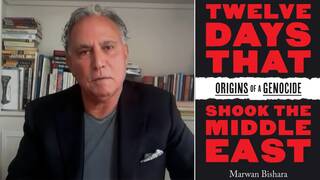
 StoryOct 07, 2026“Origins of a Genocide”: Al Jazeera’s Marwan Bishara on “Twelve Days That Shook the Middle East”
Transcript
AMY GOODMAN: Israelis and Palestinians are marking three years since October 7th, 2023, when Hamas and allied groups launched a surprise attack on Israel. Almost 1,200 people were killed in the attack. About 250 were taken hostage. It was the deadliest such attack in Israel’s history.
In Gaza, October 7th is viewed as the beginning of the genocide. Over the past three years, Israel has killed over 74,000 people in Gaza, according to its Health Ministry, but many believe that number is a vast undercount. The killing continues despite a so-called ceasefire. Most of Gaza remains in rubble.
We’ll go to Gaza later in the program, but we begin in Israel, where a moment of silence was held to remember the victims of the October 7th attack in southern Israel. Mourners gathered near Kibbutz Reim to commemorate hundreds of people who were killed and abducted at the Nova music festival. During a moment of silence, the booms of Israeli airstrikes on the nearby Gaza Strip could be heard ringing out.
We’re joined now by the Israeli peace activist Maoz Inon. He lost both of his parents, Bilha and Yakovi Inon, in the Hamas attack. His parents lived on a kibbutz, a farming collective, just north of the Gaza border. They were 78 and 76 years old. In the aftermath of the attack, Inon called for peace and reconciliation rather than revenge. Maoz Inon has spent much of the past year — of the past three years working closely with Palestinian peace activist Aziz Abu Sarah, whose brother died in 1990 from injuries from his time in an Israeli prison. Last month, they addressed the United Nations Security Council. This is Maoz Inon.
MAOZ INON: To build a different future, we must face — we must face reality. Hamas committed atrocious war crime on October 7, killing and abducting innocent Israeli. At the same time, the Israeli government exploited these atrocities to wage a devastating war of revenge. They have inflicted catastrophic destruction across Gaza, while accelerating ethnic cleansing, settlement expansion and forced displacement in the West Bank. … They weaponized our pain. But our grief must not be an excuse for war; it must be the catalyst to end the bloodshed.
AZIZ ABU SARAH: We believe this is not Israelis versus Palestinians; it is a choice between those who believe in peace, justice and equality, and those who don’t. … We call for targeted sanctions on all individuals and institutions that support violence. Apply sanctions without partiality.
AMY GOODMAN: That was Palestinian peace activist Aziz Abu Sarah and Israeli peace activist Maoz Inon addressing the United Nations just a few weeks ago. They co-authored the book The Future Is Peace: A Shared Journey Across the Holy Land.
Just this morning, on the anniversary of October 7th, the anniversary of his parents’ deaths, Maoz Inon gathered with family at the ruins of his parents’ home at their kibbutz. He sent us this clip.
MAOZ INON: This is what remains from my parents’ house: only the foundation. The entire house was burned to ashes. We put a memorial plaque for them. It’s on the safe room, the only — the only thing that remain.
AMY GOODMAN: Maoz Inon joins us now from Ashkelon.
Welcome back to Democracy Now! Thank you so much for joining us on this very difficult day for you and your family and so many, both of your parents killed on October 7, 2023. Your thoughts today, Maoz?
MAOZ INON: First, Amy, I would like to thank you personally and the entire team at Democracy Now! for supporting, for being there for me and for so many peacemakers, both in Israel and Palestine. And this maybe was what motivated me the most to join today in this difficult day, just to thank you from the bottom of my heart for being there with us in the devastating three years that we’ve been going through.
And this is exactly the thoughts that’s going through me, and with the tears and all the emotion that are coming, that we deserve a different reality. We must stop the sounds of bombs and start hearing the sounds of children’s playing. And we all deserve it. If it’s Palestinian kids or Israelis, Israeli kids, they all deserve to live within security, within his dignity, and to have a home, a safe place to go to bed at night and to wake up in the morning with a smile, and to be with their beloving and supporting family. And we must work as hard as we can to achieve it as soon as possible.
AMY GOODMAN: If you can talk about what happened in those days after you were in mourning with your family and you get this note from Aziz Abu Sarah, who also lost his brother in that — after brutality in an Israeli prison, and what that meant to you, and the journey you’ve been on since?
MAOZ INON: Yeah, so, two days after October 7th, me and my siblings were just sitting and crying and holding hand. And my young brother told us we must make a family decision based on moral clarity that we are rejecting revenge, that we don’t want to venge — to avenge the death of our parents, and explain that it’s not going to bring them back to life. It will only escalate the cycle of bloodshed we Israelis and Palestinians been trapped within for a century.
And the day after, as I was waking up crying in bed, I saw a message from Aziz, whom I met only briefly in 2014, maybe for 10 minutes, in Jerusalem. And on his message, Aziz shared his — offered his condolences, and he says that he’s standing with me and with my family in this tragic moment. And it was literally — it’s not a metaphor. It was literally like a hand reaching out, saving me from drowning, drowning into the ocean of sorrow and pain. I was literally drowning. And Aziz, it was my savior. He was my savior.
And in the last three years working together, co-authoring The Future Is Peace, starting our own NGO, InterAct International, I can now say — and I’m so proud to say it again and again — that, yes, I lost not only my parents, I lost many of the hundreds of numbers with — like, for you and for our viewers, there are a number for me. There are childhood friends. There are people I knew my entire life that lost their life on October 7th. So, I lost so much, but I won Aziz as a brother. And this brotherhood is what keep me going, keep us going to achieve a better future, not just for ourselves, but to our people.
AMY GOODMAN: In 2024, you and the Palestinian peace activist you’re talking about, Aziz Abu Sarah, met with Pope Francis, and then, in 2025, you met with Pope Leo. What did you say to him? And what are you calling for? What are you saying should happen right now?
MAOZ INON: Yeah. So, we shared with him how we channeled our pain and suffering and loss to create a dialogue to achieve a better future in the Holy Land. And Pope Francis asked us, “How can I help you? How can I be your ambassador?” And we asked him to amplify our messages, and that the question should not be “if,” but “when,” when the Israeli-Palestinian conflict will end. And we asked him to be our ambassador, our ambassador to the G7 leadership gathering that was few weeks after in southern Italy.
And he went there as our ambassador, and he was able to achieve, in the official communiqué of the G7 leader, the language of the Israeli-Palestinian civil society, language that the G7 countries must support the civil society in Israel and Palestine to achieve a lasting peace and to invest in reconciliation. Based on that, the EU created a peace fund with 18 million euro, that is now supporting the civil society. And few months ago, U.K., Canada and Australia initiated another peace fund.
And we are calling the G7, we are calling, of course, the U.S. and the EU to invest in peace, to invest in reconciliation and in the civil society in Israel and Palestine, and while, in one hand, investing and supporting peacemaker, in the other — in the other hand, those who choose ethnical cleansing, those who choose bloodshed, those who choose destruction must be sanctioned. They must be accountable for their wrongdoing. And this is basically what Aziz and I and so many others been advocating for the last three years.
AMY GOODMAN: I want to turn to Aziz Abu Sarah. This is a message he posted on Instagram yesterday.
AZIZ ABU SARAH: I woke up this morning to the horrible news that Israel demolished the house of my niece, Razan. She, her husband, her children and nine other families in East Jerusalem were rendered homeless. Imagine having to work all your life, as Razan has done with her husband, so hard, save every penny, so you can finally have an apartment you own, and then it’s all gone. Just a few days ago, Bezalel Smotrich, an Israeli minister, said that the way to get rid of Palestinians is to deprive them from hope. And this is exactly what the government did today, is to deprive my family from hope. Ben-Gvir himself came with the demolition party, with the Israeli police, so he can be there to witness it and to participate in demolishing the house. But you know what? This will not succeed.
AMY GOODMAN: So, that was Aziz Abu Sarah, your Palestinian peace partner as you travel the world. What more do you know about what’s happening, what’s happened to his family, and what’s happening in the West Bank? We just got this report: Armed settlers, Israeli settlers, beat a photographer in the presence of Israeli soldiers, hospitalizing him, as he covered worsening settler violence against the olive farmers in the West Bank. Jaafar Ashtiyeh, 58-year-old veteran photographer with AFP — that’s Agence France-Presse — was assaulted by a group of settlers. They beat him with their rifle butts, despite him being marked as press, assaulted in full view of about a dozen Israeli soldiers. Talk about the situation. Also, Netanyahu, the Israeli prime minister, addressing the nation today and what his message was? Can you hear me, Maoz?
MAOZ INON: No, I can’t. So, OK. First, I’m not listening to Benjamin Netanyahu. He is not my leader. He is not my prime minister. He is accused for being a war criminal. And I think he should clear his name at the ICC and ICJ. It’s not for me to talk about him.
And it’s exactly what’s happening nowadays, and including to Aziz’s niece — it’s exactly what we said at the U.N. Security Council: that the Israeli government exploited the trauma, the pain, the fear of the Israelis after the October 7th massacre to change the status quo from conflict management to ethnical cleansing. And it’s happening in the West Bank, it’s happening in East Jerusalem, and it’s happening in now more than 70% of the Gaza Strip.
And this is why we are calling for international intervention, because they are doing it. The bulldozers and the assault rifles, they are all — many of them are manufactured by American companies. So, we are calling: Where is the international law will be applied against Israeli terrorists? It doesn’t matter if they are Cabinet members, they are prime ministers or IDF soldiers. And this is exactly why the work we are doing is — must be amplified, and not to give hope, not to give hope about the Israelis and Palestinians, but to act. We have enough empty statements. We have enough prayers. We have enough world leaders that cross their fingers for us. But crossing fingers is not enough. We need action, and we need to see them on the ground.
AMY GOODMAN: Maoz Inon, I want to thank you for being with us, Israeli peace activist and co-author with Palestinian peace activist Aziz Abu Sarah, author of the book The Future Is Peace: A Shared Journey Across the Holy Land. Maoz Inon lost both his parents, Bilha and Yakovi Inon, in the attack on October 7, 2023. He spoke to us from Ashkelon.
Coming up, Marwan Bishara, author of the new book Twelve Days That Shook the Middle East: Origins of a Genocide. And then we go directly to Gaza. Stay with us.
[break]
AMY GOODMAN: “Bear Witness, O World,” performed by the New York City Palestinian Youth Choir.





 Top
Top
Media Options