




 Watch Full Show


Guests
- Angela Lewispsychiatric nurse in Mississippi and daughter of slain civil rights activist James Chaney.
- David Goodmanbrother of slain civil rights activist Andrew Goodman.
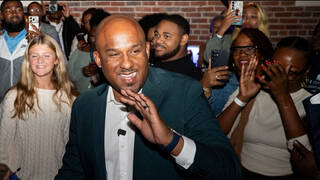
Democrat Scott Colom has defeated incumbent Cindy Hyde-Smith to become Mississippi’s first African American senator since the post-Civil War Reconstruction era. The electoral breakthrough is particularly meaningful given Mississippi’s history in the civil rights movement. In 1964, three civil rights activists — James Chaney, Michael Schwerner and Andrew Goodman — were murdered by the Ku Klux Klan after traveling to the state to register Black voters. We speak with two of their relatives about Colom’s stunning upset.
“I believe that people were voting for help. And they evidently saw something in Mr. Colom that made them feel like that they could hope again and that he was the help that was needed,” says Angela Lewis, the daughter of James Chaney.
“The people of Mississippi have spoken,” adds David Goodman, the brother of Andrew Goodman. “And we have to cease and desist this divide-and-conquer business, because it’s not in our collective interest as the United States of America.”
Transcript
AMY GOODMAN: We go now to Meridian, Mississippi, where we’re joined by Angela Lewis, the daughter of civil rights activist James Chaney. She was born just 10 days before he was killed by the Ku Klux Klan along with Mickey Schwerner and Andrew Goodman. The date, June 21st, 1964. They were killed by local white supremacists in Mississippi and buried in an earthen dam, not found until 44 days later. The three had traveled to Mississippi as part of the Freedom Summer campaign to register Black voters.
Angela Lewis, thanks so much for being with us. I’m wondering your thoughts today. And as you watched Scott Colom last night accept the vote as the next Democratic senator from Mississippi, the first time a Black senator will represent Mississippi since Reconstruction, your thoughts?
ANGELA LEWIS: Good morning, and thank you for having me today.
First, I would like to say congratulations to Mr. Scott Colom, his family, and to all of those newly elected officials. I’m very happy, and I just think that this is a day of celebration, not only for Mississippi and for those that won, but I believe that the ancestors are proud and that the work that has been done to get us to this point, it has paid off, and it’s paying off today.
NERMEEN SHAIKH: So, Angela Lewis, if you could talk about some of that work? Leon Russell, the chairman of the NAACP board, said, “This is purely the work of particularly the Black community. There was not a whole lot of money, but there was a whole lot of organizing.” Angela?
ANGELA LEWIS: Yes, the foot soldiers, the boots on the ground, and those that were making the phone calls and doing the work, those are the people, the unsung heroes, that deserve a lot of credit for the wins.
NERMEEN SHAIKH: And Mississippi, as we mentioned earlier, has voted for a Republican presidential candidate in every election since the 1980s, and just in 2024, two years ago, Trump won the state by 23 points. So, what do you think accounts for this shift?
ANGELA LEWIS: I think it’s the dedication of the people that stay hopeful and believe that change is possible. And I believe that that’s what we have seen in these recent elections and a lot of the flips and turnovers that we’re seeing. It’s just dedicated people, teachers and the people in the community that’s getting out and registering and getting information out.
AMY GOODMAN: I also wanted to get your response to the county that’s named after the first Ku Klux Klan grand wizard, Nathan Bedford Forrest, Forrest County. Colom won. He also won the county named after Jefferson Davis, the president of the Confederacy. Colom won with 70% of the vote. The significance of this?
ANGELA LEWIS: It’s very significant. But I just believe that people were not voting for a particular color, a particular party. I believe that people were voting for help. And they evidently saw something in Mr. Colom that made them feel like that they could hope again and that he was the help that was needed.
AMY GOODMAN: And I also wanted to ask you about the vote that you took. You’re a psychiatric nurse. You’re speaking to us from work. You voted in Meridian, Mississippi. What did you do when you got back in your car? What did you tell your kids?
ANGELA LEWIS: Well, actually, on voting day, I had gotten off from work, and I went to cast my vote. And I sat in my car for a minute and prayed, and I thanked my dad and all of those that worked to make it possible for me to even be able to cast my vote. And when I did cast my vote and I came back to my vehicle, I just had to take a moment again to realize the significance of what could happen in this state and to again just be grateful for those that worked that we would have the opportunity and the privilege to even be able to cast a vote.
AMY GOODMAN: And I also wanted to get your response — I mean, you were cited by Scott Colom, your father, James Chaney. The famous wanted FBI poster — or, it said not “wanted,” but “missing.” James Chaney, your dad, Andrew Goodman and Mickey Schwerner, Michael Schwerner, killed in 1964 when they’d gone to Mississippi as part of the Freedom Summer campaign to register Black voters. They were first arrested, held in a jail, looked like there was law enforcement involvement when they were followed and then killed and buried in an earthen dam. You had just been born. Your thoughts about your father fighting for African Americans to be able to vote, what he would be feeling this day, James Chaney?
ANGELA LEWIS: I think that he would be, just like the rest of us here in Mississippi, very proud. And I just believe that the day after the Tuesday, after we voted, I believe that next Wednesday, if not the same day, my dad would have gotten up and continued to work and to educate and to register people to vote.
AMY GOODMAN: Well, I want to bring in a person you know well, Angela Lewis, David Goodman. He is the brother of Andrew Goodman, who also, along with your dad and Michael Schwerner, were killed in June. It took 44 days for their bodies to be found, dug up in an earthen dam. The call to the White House — it was Lyndon Johnson, the president at the time — was taken by none other than the late, great journalist Bill Moyers, who was working for Johnson.
David Goodman, thanks so much for being with us. I spoke to you last night just as Scott Colom was about to speak. Your thoughts as you’re on this broadcast, as you’re on Democracy Now! with Angela Lewis today?
DAVID GOODMAN: Well, Amy, it’s — thank you for having us on the show. Hello, Angela. It’s always good to be with you in the spirit world that we live in.
My feelings are that we use words often that — like a “blue wave.” If the Republicans won, it would have been a “red wave.” We’re using the word “tsunami” now. This is not a tsunami. A tsunami is a destruction for all. This is a spiritual change of heart, and it wasn’t easy and a long time coming. And the people of Mississippi have spoken, but the people of the United States are benefiting, whether you’re a Republican or Democrat. And we have to cease and desist this divide-and-conquer business, because it’s not in our collective interest as the United States of America. And —
AMY GOODMAN: David —
DAVID GOODMAN: — [Senator]-elect Scott has taught us that.
AMY GOODMAN: David, you never stopped carrying on your brother’s work, Schwerner, Chaney and Goodman’s work, involved with supporting voter registration on colleges throughout the South. Is that right?
DAVID GOODMAN: Yes.
NERMEEN SHAIKH: And, David, you referred just now to a spiritual change of heart. How do you think this change of heart came about?
DAVID GOODMAN: You know, we’re a big country. We’re the third or fourth most populous country in the world, and one of the biggest. There’s 340 million of us, so making a generalization is tough. But there’s a lot of pain in our country. And I travel. I’ve been in every state. I’ve lived in many states. I’m in contact with people all over our exquisite and beautiful country. We’re complicated folks. We’re not a homogeneous race or identity group. We’re diverse. And we get fit into these little boxes: You’re Christian, you’re Jewish, you’re Muslim, this, that and the other. And it’s easy for power-hungry, authoritarian people to come in and drive wedges in between us. And this has caused massive problems. And we got hoodwinked by a con artist who’s in the White House using those wedges to make us fight with each other. And I think the American people are sick and tired of it. I am.
And the vote, look, these were just stunning messages. And the authoritarian force, which is heard all over the world, is doubling down. So, we’re not — we can’t stop. We can’t say, “Oh, we won an election. Let’s take a nap and go on vacation.” It’s going to go on indefinitely if we don’t continuously object to authoritarian small group of people running things. And that’s not what happened. I mean, I can’t make — you can’t make this story up. It’s just stunning. You have a person who’s the attorney general of one of our largest states, Texas, who was impeached by his own party and is running. The governor —
AMY GOODMAN: But, of course, he lost. James Talarico beat him, and there was —
DAVID GOODMAN: He did.
AMY GOODMAN: — to say the least, a blue wave in Texas. David and Angela, we do have to go, but I want to thank you both for being with us. David Goodman, the brother of Andrew Goodman. Angela Lewis, the daughter of James Chaney. Andrew Goodman, James Chaney and Mickey Schwerner were three civil rights activists who went to Mississippi to register Black people to vote. They were killed June 21st, 1964, cited by Scott Colom last night in his victory address at Tougaloo College, the historically Black college. Tomorrow, we’ll look at the legacy of Medgar Evers, also killed by the Klan, also cited by Scott Colom as the legacy on which he now will rebuild his state.
Coming up, David Sirota of The Lever. Stay with us.
[break]
AMY GOODMAN: “Nunca Más (Never Again)” by La Santa Cecilia in our Democracy Now! studio.



 Top
Media Options