












 Watch Full Show

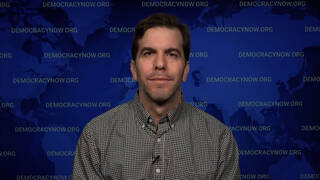
As Iranian missiles strike military, residential and economic targets in neighboring Gulf states, we speak to Al Jazeera’s senior political analyst Marwan Bishara in Doha, Qatar. Bishara says Iran’s targeting of U.S. allies in the region may be an Iranian calculation that there is “a cost to be paid for American interests” as Saudi Arabia, the UAE and other regional powers are forced to respond to an “Israeli war of choice.” Meanwhile, says Bishara, the U.S. has learned “nothing” from its own history. Not only has the Trump administration “repeated every single false pretext the Bush administration carried or diffused to justify the war against Iraq,” but “this threatens to be a far worse war in its implication for American long-term security and for the stability in the region … It’s like the American government [is] addicted to international violence, to wars, to assassinations, to launching those hegemonic wars that they [cannot] end.”
Related Story
 StoryJul 24, 2026“America First or Israel First?” Ex-Israeli Negotiator Daniel Levy on Saudi Nuclear Deal, Iran & More
Transcript
AMY GOODMAN: This is Democracy Now!, democracynow.org. I’m Amy Goodman.
Israel is also escalating its bombardment of Lebanon, where officials said today at least another 11 people were killed in an Israeli strike on a hotel in a Beirut suburb and a residential complex in eastern Lebanon. Israel also announced a wave of attacks across southern Lebanon. Lebanese authorities told Al Jazeera an estimated 65,000 people have been displaced in Lebanon due to Israel’s attacks.
This comes as Iran continues to launch retaliatory strikes at U.S. and Israeli targets across the region, including the U.S. Embassy and CIA station in Riyadh, Saudi Arabia, the U.S. Consulate grounds in Dubai and the Al-Udeid Air Base in Qatar, the largest U.S. military base in the Middle East. Turkey said today a ballistic missile fired from Iran had entered its airspace but was destroyed by NATO defense systems. It’s unclear whether the missile was targeting Turkey. In the UAE, debris from a drone intercepted by defense forces sparked a fire at an oil terminal. Meanwhile, Qatari authorities reportedly arrested 10 suspected members of Iran’s Revolutionary Guard Corps, including several accused of being assigned to spy on vital and military facilities in Qatar. That’s according to Al Jazeera.
For more, we go to Doha, where we’re joined by Marwan Bishara, Al Jazeera’s senior political analyst.
As we talk about this widening escalation, can you respond, Marwan Bishara, to what has taken place over this last five days?
MARWAN BISHARA: Well, clearly, since the assassination of Ayatollah Ali Khamenei, it seems that Iran plans for the war were put on an autopilot of sort. This is not a justification. This is simply a potential explanation as to why Tehran is lashing out the way it is, with many of its leaders and commentators that I’ve heard the past five days are incapable of explaining what exactly is Iran doing, because the claim is that they are attacking American bases and American installations, but, in fact, Iranian rockets and missiles and drones have hit various economic and residential installations in various parts of the Gulf. Of course, there’s also been attacks on Erbil in northern Iraq, on Jordan and other places.
So, the only plausible explanation for now is either there’s been a decision been made that if Iran is going to fall, everyone else is going to fall, or there’s a predetermined decision that says there has to be a cost to be paid for American interests, for the West and the various stakeholders in energy and economy and so on and so forth, so that the higher the price, the quicker there will be pressure on the United States to end the war.
AMY GOODMAN: Talk about this latest news in Turkey. Talk about how an attack on a NATO member could pull more countries into the fighting, and Turkey’s position on the U.S.-Israeli strike on Iran.
MARWAN BISHARA: You know, for the time being, what is quite astounding is the decision by, at least here, the Gulf countries not to respond, not to join the American-Israeli onslaught against Iran. They’ve been taking, of course, a lot of defensive measures. And I would expect Turkey to do the same. None of them want to join an Israeli war of choice, a hegemonic war on the part of the United States-Israel against Iran, not only because most of them don’t think it was right, and they stood against it, they condemned it, but also because this will even widen further the regionalization of the war, as we’ve seen in the past five days, but basically put on steroids.
So, the fact that this could actually go out of control, and the fact that there are those who are interested in this regionalization — notably, the Israeli government, Netanyahu and others, who actually foresaw this happening and wanted this to happen. They wanted the chaos within Iran. They wanted the chaos within the region, because they’re the only ones capable of affecting, influencing American decision-making for the time being. And they think the worse it gets out there for Turkey, for the Gulf region, for Iran, and so on and so forth, the better it is for Israel.
AMY GOODMAN: I want to go to the Connecticut Democratic Senator Richard Blumenthal. They were just briefed yesterday in the Senate.
SEN. RICHARD BLUMENTHAL: I just want to say I am more fearful than ever, after this briefing, that we may be putting boots on the ground.
AMY GOODMAN: Boots on the ground, Marwan Bishara. If you can comment on this and NBC reporting the U.S. torpedoing of an Iranian naval ship in the Indian Ocean off the coast of Sri Lanka? It’s the first time a submarine has sunk a ship since World War II.
MARWAN BISHARA: Yeah. You know, it’s interesting to read various assessments of this sort of a thing happening in the likes of The Economist — right? — the British Economist or The Wall Street Journal, where the stupidity, the fallacy, the failure of the American — of this administration in copying not one page, not two pages, not a chapter, but the entire playbook of the Bush administration. I mean, they’ve repeated every single false pretext that the Bush administration carried or diffused in order to justify the war against Iraq in 2003. We’ve known what a disaster that war was, not only for Iraq, not only for the hundreds of thousands who died in that war, but for the thousands of Americans who died and for the trillions of dollars that were spent in the first 10 years of the war.
So, we see the Trump administration, that called that the stupid war and called that the forever war, now repeating exactly the same, walking in the footsteps of the Bush administration, except this country, Iran, is four, five times the size of [Iraq]. The Iranian regime is far more coalesced and far more united than the Iraqi regime was. And clearly this threatens to be a far worse war in its implication for American long-term security and for the stability in the region than the Iraq War. And yet, here we have this, you know, American president, Israeli prime minister, who promise to become historical figures, tragic historical figures of sort, who have learned nothing from the lessons of history. And this is just fresh in the mind — right? — only 20-plus years ago, when the United States got stuck.
But it wasn’t just Iraq. I mean, after launching a 20-year war in Afghanistan for regime change, after launching a war for regime change in Libya, what happened in Iraq, Libya and Afghanistan the past 20 years? They all turned into costly fiascos. And yet here we have another administration. It’s like the American government, as if Washington is addicted to, you know, international violence, to wars, to assassinations, to launching those hegemonic wars that they could not end, that they always tend to end in fiascos.
And then, you know what, Amy? Not just the past 20 years. I mean, the Korean War, for God’s sake, hasn’t even ended, what, 70 years later. The Vietnam War, what happened with that? Right? So, America gets involved in all these wars, in the Gulf, in Southeast Asia and elsewhere. None of them are successful. They all end in failure, since Second World War. And yet, the capacity of American governments to be repeating the same mistakes again and again, launching hegemonic wars, forever wars, that fail, that are costly, that cost America its reputation, its credibility, its soldiers and its tax dollars. And here we are again.
AMY GOODMAN: Marwan, I wanted to ask you about the role of Saudi Arabia, The Washington Post reporting Trump launched Saturday’s attack on Iran, quote, “after a weeks-long lobbying effort by an unusual pair of U.S. allies in the Middle East: Israel and Saudi Arabia.” The Saudi Crown Prince Mohammed bin Salman has publicly supported a diplomatic solution, also said Saudi airspace and territory can’t be used for an attack on Iran, however, according to the Post, made multiple private phone calls to Trump over the past month advocating a U.S. attack on Iran. What does Saudi Arabia have to gain from this?
MARWAN BISHARA: Well, the thing is — right? — is that we’ve heard exactly the opposite scenario being expressed by Saudi commentators on Al Jazeera, amongst others, saying that the prince, the crown prince, sent his defense minister, his brother, to Iran, who met personally with the supreme leader, the late supreme leader, to tell them that Saudi Arabia has zero interest in a confrontation with Iran, and it agrees with Iran on the question of Israel. So, go figure.
But there’s one thing for sure, back to your question, is that Saudi Arabia has no interest in such a confrontation, such an Israeli-American war against Iran. There’s one thing we’ve learned in this region, is that when the type of, you know, Iran and the United States, or the Soviet Union and the United States, or whoever, it’s along that Swahili proverb, right? When the elephants fight, the grass gets crushed. When elephants play, the grass gets crushed. So, whether there is a rapprochement between Iran and the United States or whether there’s a war between Iran and the United States, the neighbors tend to pay the price. And clearly, there is no interest for any of the neighbors for this kind of war to be launched this way, on false pretext, on a total hegemony, not planned well, clearly with no end in sight and with no real objectives, right? The way this is happening and the way this is being rolled out, this promises to be an utter disaster for all involved, including Saudi Arabia, the Gulf states and many of the neighboring Arab states.
AMY GOODMAN: Marwan Bishara, I want to thank you for being with us, Al Jazeera’s senior political analyst, speaking to us from Doha, Qatar.
When we come back, the acclaimed Brazilian filmmaker Kleber Mendonça Filho on the Oscar-nominated film — the Oscar-nominated film, The Secret Agent. Stay with us.
[break]
AMY GOODMAN: “War Time” by Feral Foster.






 Top
Top
Media Options