










 Watch Full Show

The decades-old U.S. humanitarian aid agency USAID was largely dismantled in the early days of President Trump’s second term by Elon Musk’s Department of Government Efficiency. The authors of a new study in the journal Science conclude, “The abrupt withdrawal of USAID led to a significant and sustained increase in conflict across Africa’s most USAID-dependent regions.”
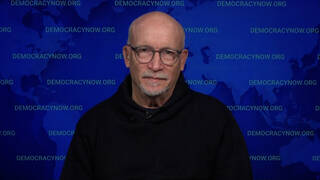
We are joined by Austin Wright, one of the study’s authors and a professor of public policy at the University of Chicago. “What we found is that that shutdown had these large effects,” says Wright. “These are often double-digit percentage increases in the incidence, severity and lethality of violence across Africa in the affected regions.”
Related Story
 StorySep 21, 2026“Extraordinary Rendition All Over Again”: U.S. Deportees Sent to Equatorial Guinea Beaten, Imprisoned
Transcript
AMY GOODMAN: This is Democracy Now!, democracynow.org. I’m Amy Goodman, with Nermeen Shaikh.
NERMEEN SHAIKH: Did the abrupt defunding and dismantling of USAID, the decades-old U.S. humanitarian aid agency, have an impact on violence? Well, researchers sought to answer that question and examined data from across Africa. They’ve just published their results in the journal Science, concluding, quote, “The abrupt withdrawal of USAID led to a significant and sustained increase in conflict across Africa’s most USAID-dependent regions.” Before it was shuttered by the Trump administration, the agency was the world’s largest provider of aid, active in over a hundred countries.
AMY GOODMAN: For more, we’re joined by one of the study’s authors. Austin Wright is associate professor of public policy at University of Chicago, co-author of the research article, just out in Science, headlined “Aiding peace or conflict: The impact of USAID cuts on violence.”
If you could start off by explaining what you found, Professor Wright, this issue of “the abrupt withdrawal of USAID led to a significant and sustained increase in conflict across Africa’s most USAID-dependent regions”? Can you elaborate?
AUSTIN WRIGHT: Sure. So, first off, thank you for having me and for amplifying the sobering findings of our research.
Yeah, what we were able to do is to document information on the incidence of conflict activity. And that ranges from riots and protests to armed conflict to violence against civilians across more than 870 subregions in Africa. We were then able to link that with the location of where USAID was present and operational years ago, and leveraged that information to understand the impact that the shutdown had. And indeed, as you mentioned already, what we find is a large increase in violence in the months immediately after the shutdown occurred. And unfortunately, although we’re able to extend the data out only for a period of time, we have yet to find a significant reduction in those effects over time, which means they continue to accumulate even now.
NERMEEN SHAIKH: Well, there have been a lot, Professor Wright, of inquiries and findings about the effects of the cuts in aid, in USAID, but in humanitarian terms, but never in the context of violence. So, what prompted this investigation?
AUSTIN WRIGHT: Yeah, so, that’s an excellent point. You know, prior research, including some work that was published in The Lancet, has focused on measures like excess death, the impact of the shutdown of humanitarian relief on healthcare systems. And those are certainly important dynamics.
But, you know, when USAID was initially conceived by John F. Kennedy, the aim there was an alternate version of putting America first, and that was creating the sort of economic and political opportunities for the rest of the world to flourish in the image of the U.S. And that includes the building of institutions and an explicit focus on stabilization.
And so, our project aimed at understanding another layer of those consequences of the cut, which was the conflict environment. And unfortunately, what we found is that that shutdown had these large effects. And to help your listeners and viewers understand what we mean by large effects, these are often double-digit percentage increases in the incidence, severity and lethality of violence across Africa in the affected regions. And I would say that the only silver lining element here is that in the places where USAID’s work was largely achieved, those areas were able to withstand the storm created by that shutdown. But, unfortunately, in a lot of other regions, the project was not yet finished.
NERMEEN SHAIKH: And did you make — in the study, do you make a causal argument, in other words, that because the aid was cut, violence increased, or it was more of a correlation, in other words, the two happened to coincide, but you don’t know precisely what the connection was, or is?
AUSTIN WRIGHT: Yes, this — mm-hmm, you know, I think this is a really important question, and I would encourage everyone, especially these days, to be very skeptical of the facts that are shared. And what I can assure you is that although the paper itself is only a few pages, the work that went into assessing all of the alternate mechanisms that could have been driving this effect amounts to roughly a book, that most of the readers aren’t going to actually see. And what we can effectively rule out are a number of potential sources of bias that could, as you point out, have led this to be a correlation rather than a causal relationship. And so, I think we’re rather bullish, ultimately, that what we’ve identified is a credible effect of the timing of the shutdown on violence.
AMY GOODMAN: Austin Wright, we want to thank you so much for being with us, associate professor of public policy at the University of Chicago, co-author of the research article, just out in Science magazine, headlined “Aiding peace or conflict: The impact of USAID cuts on violence.”
Coming up, as students graduate from colleges and universities across the United States, many schools are taking steps to silence pro-Palestinian voices at campus ceremonies, from canceling speakers to eliminating live speeches by students and alum altogether. Stay with us.
[break]
AMY GOODMAN: Bradley Roy Parsons and Howard John Pearse.




 Top
Top
Media Options