









 Watch Full Show

Topics
Guests
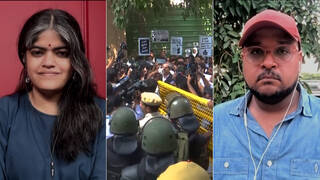
- Arfa Khanum SherwaniIndian journalist and senior editor at The Wire.
- Gilles Vernierspostdoctoral researcher at Sciences Po in Paris who focuses on Indian electoral politics and history.
Indian Prime Minister Narendra Modi and his right-wing Bharatiya Janata Party (BJP) won big in state-level elections this week, with the Hindu nationalist BJP now controlling over 70% of the country. Leading opposition politician and Chief Minister of West Bengal Mamata Banerjee has refused to recognize the results as legitimate, accusing the Modi government of mass disenfranchisement. Ahead of elections, 9 million names were deleted from the rolls under a process called “Special Intensive Revision” (SIR). The process, conducted by India’s Election Commission, “vitiates and creates an electoral advantage by pitting Hindu voters against Muslim voters,” says political scientist Gilles Verniers. Rather than the advertised purge of deceased and duplicate voters, SIR appears to have primarily affected Muslims and other minorities. Nearly 3 million voters in West Bengal, where more than a quarter of the population is Muslim, were unable to cast their vote.
From New Delhi, journalist Arfa Khanum Sherwani says blatant election interference has destroyed Indians’ faith in democratic elections. “The general public does not think the elections are free and fair in India,” she explains. “So this is a sad day for democracy, for people who believe that not only today, but tomorrow’s India should also be democratic.”
Related Story
 StoryOct 12, 2026Protesters Say India’s Democracy Is “Rotten” as Modi Gov’t Purges Voter Rolls, Arrests Thousands
Transcript
AMY GOODMAN: This is Democracy Now!, democracynow.org. I’m Amy Goodman in Austin, Texas, with Nermeen Shaikh in New York.
NERMEEN SHAIKH: We turn now to India, where recent state-level elections have created a political earthquake, further consolidating the power of the ruling Hindu nationalist BJP, led by Prime Minister Narendra Modi. With the recent victory, 78% of the country now live in BJP-run states.
Two major opposition parties to the right-wing BJP lost in West Bengal and Tamil Nadu, with the BJP winning the crucial border state of West Bengal for the very first time, defeating one of Modi’s most outspoken opponents, Mamata Banerjee. Banerjee’s term is supposed to end today, but at a press briefing Tuesday soon after the results were announced, she refused to resign as chief minister of West Bengal, claiming the elections had been rigged by the BJP.
MAMATA BANERJEE: [translated] If someone takes over by force and expects me to resign, that is not going to happen. [in English] Now also I want to say that we have not — we didn’t lose the election. It is their forceful attempt to defeat us. … We fought against all machinery, where prime minister and home minister is also involved, direct interference. … So, how they played the dirty, nasty and mischievous games, I have never seen this type of election in my life.
AMY GOODMAN: Mamata Banerjee has accused the Modi government of using the Election Commission of India to defeat her party by deleting 9 million names from the polls, in what she’s called an “exercise in mass disenfranchisement.” Nearly 3 million voters in West Bengal, most of them Muslim, were not allowed to cast their vote. Meanwhile, hundreds have been arrested and four people killed, including a close aide of the BJP’s leader in West Bengal, in the wake of clashes between supporters of Banerjee’s party and the BJP.
NERMEEN SHAIKH: For more on the Indian elections and their significance to the future of Indian democracy, we’re joined now by two guests. Gilles Vernier is a political scientist focusing on Indian electoral politics and history. He teaches at Sciences Po in Paris and joins us from San Francisco. And joining us from New Delhi, Arfa Khanum Sherwani, an award-winning Indian journalist and a senior editor at The Wire, a leading independent digital news website. She hosts a popular news and analysis show on YouTube.
Welcome to both of you to Democracy Now! Arfa, if we could begin with you? Could you just respond to the election results, what happened particularly in West Bengal, and the effects of what the Election Commission did prior to the election, what impact that may have had?
ARFA KHANUM SHERWANI: Thank you very much for having me.
First of all, I think, in the last 12 years of Narendra Modi’s rule, and me covering it as a journalist, I feel like these two particular states, Kerala and West Bengal, they stood as perhaps the biggest resistance to Narendra Modi’s majoritarian politics, which was intended to divide the Indian public based on their religion. And Mamata Banerjee in particular, like, if you ask me the effect and the impact it will have on Indian politics, I would say Mamata Banerjee, in particular, was — single-handedly was one of the fiercest chief ministers who stood against this divisive agenda of the BJP and its cultural wing, the RSS, starting from demonetization to the Citizenship Amendment Act, which was actually aimed to establish India as a Hindu nation. It was modeled on, you know, the state of Israel, a natural home for Hindus as Israel is for the Jews. Mamata Banerjee came out on the streets, you know, and taking along hundreds and thousands of people with her. So, I think BJP now getting hold of this bordering state called West Bengal is a bad news for everyone who believes in a plural, diverse idea of India.
And one more thing, I think, and the most important thing, that it’s also a blow to, I would say, the federal structure of India, because federalism allows India against this false uniformity that Mr. Modi’s politics and policies try to impose on India. And so, with Mamata Banerjee now not remaining the chief minister of West Bengal, I feel it is one of the biggest blows to the federal structures, and it is going to weaken the opposition.
And the saddest part, in the last 25 years of me covering India, Indian elections — I mean, I have covered at least five, you know, parliamentary elections and dozens of assembly elections — this is for the first time that I am observing on the ground, not just in the studio, that the general public does not think the elections are free and fair in India. The Election Commission of India, instead of being this, you know, an observer and responsible for conducting the largest elections in the world, seems to be playing the role of a party, as if it was in alliance with the BJP. And the SIR, which is the Special Intensive Revision of the voters’ roll, this was supposed to be the revision of the roll, but if you look at the seats and look at the election results, you would actually realize that how precisely this SIR has attacked, you know, the voters. They have deleted particularly the voters which were more likely to vote for the opposition party.
And allow me one more minute, and I’ll tell you that The Wire has just published a report, you know, by our West Bengal — by our West Bengal correspondent, Aparna, and this clearly says that in 150 seats, more than half of West Bengal’s 294 seats, total deletions were greater than victory margins, and the BJP won 99 seats out of those seats, 150 seats, where the exercise of SIR took place. So, the deletion — and in 2021, five years ago, when BJP had lost the elections in West Bengal, it had only managed to win 19 of these. So, this clearly shows that if this was not — even if SIR is not the single biggest or the single reason because of which the BJP has managed to win West Bengal, I would say this is one of the three top reasons why BJP has managed to win. So this is a sad day for democracy, for people who believe that not only today, but tomorrow’s India should also be democratic. And I think this is one of the biggest blows to everybody who believes in the idea of a democratic, a constitutional, a secular, a liberal and equal India for everyone.
NERMEEN SHAIKH: So, Gilles, if we could get you to respond to what Arfa said, in particular, about this SIR, Special Intensive Revision, and what enabled this to effectively disenfranchise 3 million people in West Bengal in particular, but also, more broadly, in the several states — five, I believe — where this was carried out? And what were the criteria that were used to disqualify voters?
GILLES VERNIER: Good morning.
Well, first of all, it’s useful to remember that, you know, cleaning or updating the electoral roll is an exercise that usually takes place on a rolling basis, and only very rarely has the Election Commission engaged into what it calls a Special Intensive Revision. There has been no explanation, really, why the Election Commission suddenly decided to do that so close to state elections, after having not done that, not done it for, you know, more than — more than 20 years. And so, we knew, we’ve always known, that the electoral rolls in India were far from perfect. But here, what is in question is the scale and the disorganization and the haphazard way in which it has done, which has led to undue deletions of millions of voters.
The point of the SIR is to remove from the list dead voters, voters who have migrated or who are present more than once on the rolls. And after this Special Intensive Revision, more than 9 million names were struck. But immediately, 3.4 million people immediately appealed to explain that they were unduly removed. And the tragedy is that no safeguards were put in place. The courts ordered an adjudication mechanism which could not be deployed. And at the end of the day, less than 0.05%, less than 2,000 people, were actually adjudicated. And among those adjudicated, about 98% were recognized to have been unduly removed.
Now the suspicion raises when we realize that the special revision was done with more zeal in areas which were more dominated by the Trinamool, by Mamata Banerjee’s party, and that the exercise in itself disfavored specific categories of voters, including Muslims, including urban voters, but including also migrant workers, people who were simply absent, you know, from their homes. And so, on the one hand, there is no incontrovertible evidence that the Election Commission wished to create an electoral advantage for the BJP. At the end of the day, it ended up creating an electoral advantage that is undeniable. And in that sense, it has completely vitiated the electoral process.
AMY GOODMAN: Arfa, last month, you traveled to West Bengal to meet people who’ve been disenfranchised. You wrote on social media, quote, “The Election Commission of India has failed the Constitution and the poorest of Bengal. … I have covered wars, communal violence, and mass movements. I have never seen anything like this before,” you said. Tell us about where you went, who you met and what you found, and put it in a global context, for people who aren’t familiar even with the geography of India, the significance of Bengal and West Bengal.
ARFA KHANUM SHERWANI: Yeah. Thank you, Amy. I mean, the whole idea, the basic principle of democracy, is that the people actually elect their leaders and their government. But I think for the first time, because of this, you know, special revision of the voters’ roll, we are witnessing that the government, or the friends of the government, which is the Election Commission of India, is actually allowing the government to select the people who will be allowed to vote. So this is a direct attack on the very idea of democracy.
And if you would ask me when I went to, you know, the districts of Murshidabad, which is one of the bordering districts with Bangladesh — so, there are three Muslim-majority districts, Murshidabad, Malda and, you know, Dinajpur. I was fortunate to go to one of these districts. And, you know, to my surprise — I was thinking that I was going to cover the elections, and I was generally thinking to, you know, also ask about SIR. So, when I reached this particular village in Murshidabad — you know, it’s called Samserganj — the majority of the people who were gathered to meet me, you know, as a reporter, was the Muslims. So, initially, there were, like, some 50 people. And then they — you know, there were a hundred people, and then there were few hundred people. And believe you me, then there were a couple of thousand people who wanted me to listen to their stories.
And, Amy, as I had said in my tweet, that I have covered communal violence and war, but I felt for the first time that my journalism was not enough. Me as a reporter, with one camera person and with one mic, we were not enough to cover the scale of the tragedy that was unfolding before my eyes. And there were hundreds of people who were screaming and shouting. And, you know, these hapless people, the poorest of Indians, they came with their families, with their small children. Some people actually brought their elderly parents and grandparents in their laps, you know, carrying them to me, saying that, “Look at my grandparent. He is an 80-year-old man, and he actually was born before the state of India was born in 1947.”
So, this is the scale of tragedy, that there were so many people who wanted to get heard. And they were the victims of not just, you know, the state police. They were not the victims of, let’s say, the state. There were no Hindu-Muslim riots. There was no external force that had invaded, you know, the district. Of all the people, of all the institutions, it was the Election Commission of India which refused to listen to these people. And now we have the data that 98% of the people who — you know, in Samserganj area where I had visited, these names were deleted. So, 98% of those people who were trying to talk to me so that they could be heard.
And, you know, it all unfolded in so many different ways, because there were people who were also scared of me. They thought of me, you know, this madam, you know, this woman who’s come from Delhi. Maybe she is a representative of the Election Commission. Is she here to arrest us? Will she send us to the detention centers?
So, what I’m trying to say here is that there was not enough knowledge, not enough information, not enough communication from the Election Commission, from the state, you know, agencies who were able to tell people that they were trying to do this for their betterment. And sadly, now I’m telling you that 98% of those people, their names have been deleted. They have not been allowed to vote. So, this is kind of, really, a great tragedy that unfolded before me. And I’m very — in a sense, I would say that elections in India are no more the same. There are many election — many opposition leaders who are now saying whether it’s actually kind of we should be fighting the Election Commission or the BJP or the state machinery. So it’s the whole state machinery versus the opposition in India.
NERMEEN SHAIKH: Could you comment on that? I mean, the fact that the BJP has won — irrespective of the irregularities that have occurred as a result of what the Election Commission did, the election results do tend to point to growing support for the BJP in states which have traditionally been opposed to this Hindu nationalist ethos. What do you think accounts for the increasing support of the BJP? And what do you think this means for the future of subsequent Indian elections?
ARFA KHANUM SHERWANI: I think it just —
GILLES VERNIER: So —
ARFA KHANUM SHERWANI: — means that now we have come to a point — are you asking me?
NERMEEN SHAIKH: I was actually asking Gilles. Gilles, if you could go ahead?
GILLES VERNIER: OK, yes, yes. So, I mean, the BJP is a party that disposed of considerable resources and organizational power to lead a mobilization campaign on a permanent basis. And so, if you look at Bengal, for example, they have been on the ground mobilizing alongside communal lines for the past 10 years. And so it’s not entirely surprising that these efforts would pay off in the long run. The fact also that the traditional opposition in West Bengal, the Congress, the Communists, have utterly collapsed created a space where the — that the BJP could occupy, becoming the number two party for more than for 10 years. And so, you know, long-term efforts sort of pay in the long run.
But also, and to, you know, provide another dimension on the special revision exercise, it had, of course, a direct effect of deleting millions of voters, but it also had an indirect, powerful effect of providing institutional validation of the BJP’s claim that most Muslim voters are actually doubtful citizens. There have been a number of policies implemented, notably in Assam and other parts of the country, that sort of sought to identify and approach, you know, illegal migrants, and creating a confusion between a category of illegal migrant and India’s minority. It is easy for the BJP to claim that most Muslims in West Bengal are illegals from Bangladesh.
And what is particularly distressing and concerning is to see the Election Commission providing backing to that notion by targeting Muslim voters more than others. In the state of Assam, which the BJP retained, the domination of the BJP is also based on extremely intense communal polarization. There, you did not have a Special Intensive Revision like you had in Bengal, but in 2023 there was a delimitation exercise that basically concentrated about 34% of the population that is Muslim in less than 20% of the seats. And there you saw, again, the Election Commission leading that exercise, when it actually didn’t have the mandate to do so. And again, the institution that is supposed to be the impartial arbiter intervenes, interferes in the electoral process, vitiates it and creates an electoral advantage by picking Hindu voters against Muslim voters.
AMY GOODMAN: Gilles Vernier, we want to thank you so much for being with us, political scientist focusing on Indian electoral politics and history, teaches at Sciences Po in Paris, speaking to us, though, from San Francisco, and Arfa Khanum Sherwani, award-winning Indian journalist, senior editor at The Wire, leading independent digital news website.
Coming up, voting rights under attack here at home. Republican lawmakers in Southern states are racing to redraw congressional maps after the Supreme Court guts the Voting Rights Act. Back in 20 seconds.
[break]
AMY GOODMAN: “Let Freedom Ring,” Tom Morello.




 Top
Top
Media Options