









 Watch Full Show

Israel is continuing to attack Gaza despite the so-called ceasefire. Israeli strikes killed Ahmed Wishah, a cameraman with Al Jazeera, and at least six people, including two children, on Saturday. Wishah’s brother Mohammed, who also worked for Al Jazeera, was killed in an Israeli strike this April. Israel has now killed over 260 journalists in Gaza, including at least 12 working for Al Jazeera, since October 2023.
“We don’t see the type of outrage that we would see if a Western journalist was killed by a country that is not a U.S. ally,” says Sharif Abdel Kouddous, Middle East and North Africa editor at Drop Site News. “It’s really a shameful state of affairs.” Kouddous also comments on the expansion of Israel’s “genocidal tactics” in Gaza that have now been “exported outside of Palestine in places like Lebanon.”
Related Story
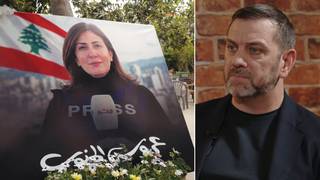
 StoryJun 17, 2026“Journacide: The War on Truth.” New Film Investigates Israel’s Killing of Reporters in Lebanon
Transcript
AMY GOODMAN: Israel is continuing to attack Gaza despite the so-called ceasefire. On Saturday, Israeli strikes killed at least six people, including two children and Ahmed Wishah, a cameraman with Al Jazeera. His brother Mohammed also worked for Al Jazeera and was killed in an Israeli strike in April. Since October 2023, Israel has killed over 260 journalists in Gaza, including at least 12 working for Al Jazeera.
On Sunday, mourners gathered in Deir al-Balah to remember Ahmed Wishah. This is Al Jazeera correspondent Talal al-Arouqi.
TALAL AL-AROUQI: [translated] The Israeli occupation deliberately assassinates journalists, largely and directly, during its war of extermination in a clear attempt to suppress images, prevent the dissemination of the message, and to conceal the massacres and atrocities committed against the Palestinian people here in the Gaza Strip.
AMY GOODMAN: For more, we’re joined here in studio in New York by Sharif Abdel Kouddous, the award-winning journalist and Middle East-North Africa editor at Drop Site News, also a frequent correspondent for the investigative documentary series Fault Lines on Al Jazeera English.
Sharif, welcome back to Democracy Now! The horror. Talk about the journalists killed, and particularly about Ahmed, the latest Al Jazeera cameraman to be killed.
SHARIF ABDEL KOUDDOUS: Right. Ahmed Wishah was killed in an Israeli airstrike on a home in the Bureij refugee camp in central Gaza. He was just 25 years old. He was the youngest of three brothers, and he was a cameraman for Al Jazeera Mubasher. And he worked most closely with his older brother Mohammed Wishah, who was a correspondent for Al Jazeera Mubasher. Ahmed would film the footage. He would set up the live shots for Mohammed. And the two were as close as brothers can be.
And Ahmed was killed on Saturday as he was still mourning the death of his brother, of Mohammed, who was assassinated by Israel in an airstrike on his car west of Gaza City in April. The Israeli military openly bragged about killing Mohammed at the time, claiming, as they always do, without evidence, that he was a Hamas militant. They did the same, actually, with Ahmed. The Israeli military confirmed to AFP that they killed him, and they said that he was, quote, “a Hamas terrorist.” After Mohammed’s death, it was Ahmed who was taking care of his late brother’s children. He was taking on additional responsibilities in their family. And now he’s been killed, as well.
And this latest loss among the journalistic community in Gaza is very difficult to bear. You know, I — as soon as he was killed, I contacted Abdel Qader Sabbah, who’s the main journalist I work with at Drop Site News in Gaza. I expressed my condolences, and I asked him, you know, “Do you have any footage of the aftermath of the airstrike? Do you have any interviews with the family, so we can report on it?” And he lives in Gaza City. He contacted colleagues in central Gaza to see if any of them could report. And for one of the first times ever, he came back to me and said, “I’m sorry, I don’t have anything for you,” because all of them knew him so well. They are so bereft, they are so overwhelmed with grief, that they couldn’t report at that moment.
And so, how do we fathom the depth of this kind of slaughter? And how is Israel allowed to continue to do this? It operates with such impunity because it pays absolutely no consequences from its Western backers in the U.S. and Europe, who continue to arm and fund it continuously, but also because of the coverage of most Western media institutions, which do cover these killings, but at an editorial institutional level, we don’t see the type of outrage that we would see if a Western journalist was killed by a country that is not a U.S. ally. And so it’s really a shameful state of affairs.
AMY GOODMAN: I want to say that we’re showing, for our video and TV audience, images that Ahmed took, credited, you know, in the news feed, by him, and what it means to show those images, the risks that he took. Do you know if either he or his brother, who he was mourning until he himself was killed in an Israeli airstrike, had gotten warnings from the Israeli military? We’ll talk about Lebanon in a minute, Mona Khalil, but — and the reporters there, like Amal Khalil, the journalist who was recently killed, who have gotten those warnings saying their heads will roll.
SHARIF ABDEL KOUDDOUS: I’m not aware of any direct warnings that either — that Ahmed received. Mohammed Wishah, who was more well known — he was a correspondent — did receive warnings. He was called on his phone. He was texted by Israeli officials, by the Israeli military officials. And once they assassinated him, they bragged about it in a very, very brazen way.
But this level of impunity and Israel’s genocidal tactics in Gaza have been exported outside of Palestine in places like Lebanon. And so, what we see in Lebanon, for example, with the invading Lebanese territory, the displacement of 1.2 million people, the systematic demolition of over 60 villages, made to look, as Israel’s defense minister said, like Beit Hanoun and Rafah, which have been completely erased, and also the attacking of medics and rescue workers, but also the assassination of journalists. And the echoes between Lebanon and Gaza, between the way the journalists are killed, are deafening. You know, when Israel killed the prominent Lebanese journalist Ali Shoeib in March, along with journalist Fatima Ftouni and her brother, photojournalist Mohamed Ftouni, it openly bragged about killing Ali Shoeib and said, without evidence, that he was a Hezbollah militant, the same way it does with so many journalists in Gaza, like the both Wishah brothers.
When we consider the case of Amal Khalil, who you mentioned, she was murdered by Israel on April 22nd in southern Lebanon. She was trapped for hours in a building where she was seeking shelter after — where she and another journalist, Zeinab Faraj, were sheltering, because they were both wounded in an airstrike. Emergency workers were able to rescue Zeinab, but they had to withdraw because they came under fire from Israeli forces. At this time, even the Lebanese president is calling on Israel to allow emergency workers to go in to rescue Amal. Again, the whole world watched while she bled to death, and by the time they got to her, she was dead.
This reminds us of the killing of Al Jazeera journalist Samer Abudaqa in December of 2023. He was wounded in an airstrike on a school in Khan Younis as he was with Al Jazeera’s then Gaza bureau chief, Wael al-Dahdouh. Wael was badly wounded. He managed to make it out. The whole world watched as everyone asked Israel, “Allow emergency workers to get in.” And Samer bled to death. So, the parallels are glaring and horrifying, and Israel is allowed to continue the slaughter.
JUAN GONZÁLEZ: And I wanted to ask you, Sharif. It’s not, obviously, just the journalists or the medical workers. Israel has continued to turn Gaza into a killing field. Could you talk about the berms, the massive berms that they’ve been constructing to divide Gaza, and how they continue to encroach on Palestinian territory in Gaza?
SHARIF ABDEL KOUDDOUS: Yes, as part of — you know, we’re supposed to be under a ceasefire. You know, Israel signed the ceasefire in October of 2025, and it is a ceasefire in name only. As part of that agreement, Israel was to — troops were supposed to withdraw to a point that they called the yellow line, which was supposed to encompass about 53% of Gaza. And that would then set the stage for a phased withdrawal, eventually back to the border.
But what they have been doing since then is that they have been steadily encroaching further and further west, taking over more Palestinian land. And let’s remember, the Gaza Strip was one of the most densely populated places on Earth before the genocide began. Now nearly 2 million Palestinians are corralled into less than 40% of the Gaza Strip. There’s literally nowhere to go. The streets are completely filled with tents. Any open space, stadiums, schools are filled with tents. And people are being driven further and further west. Right now estimates are that Israel controls about 60% of Gaza.
And what they have done in the eastern side that they control is they have built a series of bases, at least 38 military bases. And along the so-called yellow line that divides the part that Israel controls and the part that Palestinians live in, they’ve built 25 kilometers of earth berms. Think of a massive wall of earth that physically divides Gaza. And on top of these earth berms is where many of these bases have been built. These bases have been fortified and flattened on top. And Israeli soldiers then — you know, if you look at satellite photos and you look at photos from the ground, they appear as these elevated forts overlooking a colonial landscape. And Israeli soldiers fire from these elevated forts, from these positions, down onto Palestinians who are living close to the yellow line. We’re getting increasing testimony that they’re using remote-operated machine guns from cranes, which Israel has used before along the border with Gaza, but using them from these forts to fire down onto Palestinians there.
Just last week, residents of the Tuffah neighborhood in Gaza City, they awoke to the sound of gunfire and the rumble of tanks. And when they were finally able to go outside, they found that the Israeli military had moved yellow concrete blocks, which are used to demarcate the yellow line, along with some parts of it — they had moved them just next to their homes, about a hundred meters further west. And so, this sparked, obviously, panic. Dozens of families were forced to pack up their things and leave, because if the yellow line is right there, they’re going to be attacked. But many of them stayed, because they said there’s literally nowhere to go.
JUAN GONZÁLEZ: And, Sharif, Sharif, could you talk about the similar military tactics being used in Lebanon of seizing land, fortifying land, and then refusing to give it up?
SHARIF ABDEL KOUDDOUS: Right. This is what we’re seeing right now. Israel has destroyed about 60 villages, the estimates are, along the border. It’s also used the same term to demarcate its line of control, calling it a yellow line, in Lebanon. Right now there is a ceasefire that seems to be holding as part of the negotiations between the U.S. and Iran. Iran has insisted that Lebanon be a part of that ceasefire. We haven’t seen any Israeli attacks since Sunday, which is the longest time since March. We’ll see if that holds or not.
But what’s happening right now is that Lebanese residents are trying to move back south, but Israel is occupying vast swaths of the country and is refusing to leave. And many of these villages have been systematically demolished, so there’s nothing left. And many Lebanese residents, because they have been unable to go back home, they have been purchasing, pooling money together — for example, in one village, dozens of people will pull money together to buy satellite images, which are available, that you can purchase, so they can zoom in and see if their house is still standing. So, that’s the level of destruction that Israel has wrought in Lebanon and also in Gaza.
AMY GOODMAN: Sharif, we want to thank you for being with us. Sharif Abdel Kouddous, the award-winning journalist, Middle East-North Africa editor at Drop Site News, who was a correspondent on the Fault Lines documentary The Night Won’t End on Al Jazeera English. The film won the RTS Television Journalism Award and an Overseas Press Club Award. Sharif was also a producer here at Democracy Now!
And tonight will be one of the last nights that Steal This Story, Please!, the documentary about Democracy Now!, will be screening at the IFC theater here in New York, about the 30 years of Democracy Now! and independent media. It features Sharif Abdel Kouddous and Juan González. And Nermeen Shaikh will also be there, also in the film. I’ll be there doing the Q&A with the director Carl Deal and Tia Lessin, and the moderator will be Elliot Page. You can check our website at democracynow.org under events to click through for tickets.





 Top
Top
Media Options