







 Watch Full Show

President Trump said Thursday he may temporarily withdraw his nomination of Todd Blanche for attorney general after two Republican senators, John Cornyn of Texas and Thom Tillis of North Carolina, said they would not vote to advance Blanche’s nomination until they received written assurances that he would limit some of the terms in the controversial deal reached between the Department of Justice and President Trump to settle his personal lawsuit against the IRS.
Blanche, currently acting attorney general, is “refusing to make a clear commitment that American tax dollars aren’t going to go to the rioters of January 6th,” says Democratic Congressmember Ro Khanna. “He’s refusing to make a clear commitment that Trump’s family could still be held liable for violating financial laws.”
Khanna also speaks about his ongoing efforts to bring justice for survivors of Jeffrey Epstein’s sexual abuse, about which he says Blanche “has been the biggest obstacle to justice,” his recent trip to the occupied West Bank where he was detained by armed Israeli settlers and more.
Related Story
 StoryAug 21, 2026DOJ Whistleblower Confirms “Antisemitism” Probes Against Universities Were Sham Investigations
Transcript
AMY GOODMAN: President Trump said Thursday he may temporarily withdraw his nomination of Todd Blanche for attorney general after two Republican senators, John Cornyn of Texas and Thom Tillis of North Carolina, said they will not vote to advance Blanche’s confirmation until they receive written assurances that he would limit some of the terms in the controversial deal reached between the Department of Justice and President Trump to settle his personal lawsuit against the IRS.
Senators Cornyn and Tillis, who are both in their last months in the Senate, are seeking written assurances from Blanche that the Justice Department will not create the nearly $1.8 billion so-called anti-weaponization fund that could be used to provide payouts to Trump’s allies, including January 6th insurrectionists. The senators also want to scale back the agreement in the deal to exempt President Trump, his businesses and his family from future government audits. The deal could be worth $100 million in saved IRS penalties.
Acting Attorney General Blanche, who used to be Trump’s personal defense lawyer, has so far refused to make those commitments in writing. President Trump said on social media, quote, “I have no objection to temporarily withdrawing Todd’s name, if they do not do the right thing, and putting him back after Cornyn and Tillis are out of office,” unquote.
Trump also took credit for ending the senators’ political careers and said Blanche would remain acting attorney general regardless. Senator Cornyn responded online, saying, quote, ”POTUS is mistaken if he believes concerns about the provisions in his tax lawsuit settlement are limited to me and Senator Tillis,” unquote.
Senator Tillis had also made his vote conditional on Blanche meeting with survivors of Jeffrey Epstein’s abuse. Following that meeting, more than two dozen survivors signed an open letter to the senators urging them not to vote for Blanche, characterizing his attitude at the meeting as, quote, “an hour of deflection, interruption, and gaslighting,” unquote.
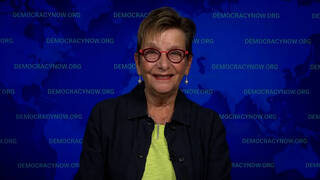
For more, we’re joined by California Congressmember Ro Khanna, joining us today from Pittsburgh, Pennsylvania.
Congressman Khanna, thank you so much for being with us. First, if you can explain to everyone what exactly is going on? You have Blanche in the Senate hearing, confirmation hearing, saying that the deal, the nearly $1.8 billion deal, is dead, but refusing to put it in writing, and then also that other part of the deal, which would grant immunity to Trump, his allies, his family, his businesses. Can you explain what he’s refusing to do right now?
REP. RO KHANNA: Well, he’s refusing to make a clear commitment that American tax dollars aren’t going to go to the rioters of January 6th. He’s refusing to make a clear commitment that Trump’s family could still be held liable for violating financial laws.
And basically, these senators are saying, “You can’t have two tiers of justice in America. Make a commitment that you would hold Trump’s family accountable.” We know the Supreme Court has held that Donald Trump is immune. That doesn’t mean that his family is immune. And they certainly aren’t immune from liability on breaking tax law or financial laws.
JUAN GONZÁLEZ: And, Congressman, the president has made it clear that Blanche would continue as acting attorney general. What are your concerns about his tenure with the DOJ so far?
REP. RO KHANNA: He has been the biggest obstacle to justice for Epstein survivors. He is in blatant violation of the law that Thomas Massie and I passed, the Epstein Files Transparency Act. He still has not released 3 million of those files, even though a federal judge has found that he is in violation of the act. And he has not undertaken a single investigation or prosecution of the men accused of sexual abuse, rape and sexual trafficking. All over the world, we have seen, based on Massie and my law, former princes prosecuted, former prime ministers prosecuted, former ambassadors prosecuted. The survivors have given him names, saying desperately, “Please, investigate these men.” And yet he has not opened a single investigation.
JUAN GONZÁLEZ: And you’ve introduced the Epstein File Transparency Act into Congress. What would that bill do if it was passed?
REP. RO KHANNA: That would give state attorney generals the ability to prosecute these wealthy and powerful men who committed sexual abuse. It would allow them access to the files to build their cases and prosecute. And it would give survivors the opportunity to sue in federal court to get the files. In some cases, survivors do not know the details of what happened to them, because their memory has faded, and they still have not been able to get the files that the law requires to be released.
AMY GOODMAN: One of the witnesses called by Democrats in the Senate Judiciary hearing earlier this month on the nomination of Todd Blanche to be attorney general was Dani Bensky, a survivor of Epstein’s abuse, who testified on the handling of the Epstein files under Todd Blanche.
DANI BENSKY: In that first release, I found my name in two places. In that next release in January, my name appeared again, but this time the redactions were so far worse. The files displayed not only my name, but my phone number, my former addresses, where I worked and other identifying information. When my name appeared in the third file release, it became difficult to believe that this was not intentional. Despite my lawyer repeatedly contacting the DOJ seeking protection, my information continued to be exposed. And it’s not just my name; it’s the identifying information. These documents contain disturbing, yet incomplete accounts of my abuse. They were available not only for the entire world to see, but my child, my students, my friends, my employers, my colleagues and my family. It was humiliating. Worse, my FBI 302 exposed a Jane Doe who had fought for decades to conceal her identity. It’s been absolutely devastating. Outing survivors causes real and irrevocable harm.
AMY GOODMAN: That’s Epstein sexual assault survivor Dani Bensky. Congressmember Ro Khanna, I wanted to move on to the bill that you’ve just introduced with Florida Republican Congressmember Luna. It’s related; it is not the same thing. Can you explain?
REP. RO KHANNA: There have been serious sexual assault, sexual harassment allegations against elected officials and some campaigning for the House and the Senate. Representative Luna and I teamed up to say that a elected official or a candidate cannot use their campaign funds to smear survivors, to smear victims, or to use it for their own legal defense against sexual assault and sexual harassment allegations. Any individual is entitled to their defense. They can use their own money. They should not be using donor money to do that.
JUAN GONZÁLEZ: And, Congressman, in terms of other assault allegations, should the House Ethics Committee investigate Republican Congressmember Max Miller of Ohio over allegations that he assaulted his wife Emily Moreno, daughter of the senator from Ohio, Bernie Moreno?
REP. RO KHANNA: Yes, but it also probably should be a broader investigation. I mean, domestic violence is a criminal matter. It’s not just a ethics matter. And I, frankly, don’t understand how he’s still in the House of Representatives. I mean, I had called for Swalwell and Gonzales to resign when serious allegations came up, and he shouldn’t be in the House of Representatives. And absolutely, there needs to be an ethics investigation, but there also needs to be a broader investigation. There should be zero tolerance for domestic violence or sexual assault in this country.
AMY GOODMAN: And in a moment, we’re going to talk with a Mother Jones reporter who just published an important exposé on Congressmember Max Miller. But as we begin to wrap up, I wanted to ask you, Congressmember Khanna — earlier this month, nearly half of all House Democrats voted to support a measure slashing military funding to Israel. A hundred three House Democrats voted to eliminate $3.3 billion in annual U.S. military assistance to Israel. Ninety-eight Democrats voted to preserve the funding. Ten abstained by voting present. The measure was ultimately defeated by House Republicans, along with the Democratic Minority Leader Hakeem Jeffries and the Caucus Chair Pete Aguilar, who vowed to continue funding Israel. If you can talk about the significance of this vote? More than half the voting Democrats voted to end the military aid to Israel. But start off by talking about your experience in the West Bank earlier this month, when you were detained by armed settlers, who were then joined by four Israeli soldiers.
REP. RO KHANNA: I had gone to the West Bank to see the West Bank from the eyes of Palestinians. I informed the American Embassy and the Israeli Embassy that I wanted a tour of the Palestinian West Bank from a perspective of Palestinian families, Palestinian guides.
And I was in East Hebron, the Palestinian area, where I saw violent settlers who threw rocks and rotten tomatoes and acid and urine at the Palestinian shopkeepers. I was in Umm al-Khair, where I saw a family who had been violently attacked, their home, by settlers.
And we were detained when we were at the Zanutah village, that was destroyed by Yinon Levi, who has also murdered a Palestinian in cold blood, Awdah, a one-year anniversary. We were detained by his hoodlums. They parked their car in front of our van, not letting us go. They wanted to take our phones because we were recording what happened in Zanutah. The IDF came, and they initially took the side of the extremist settlers. And we had to call the American Embassy, who got the Israeli police to let us out. But we were there almost 75 minutes.
But all of this just shows the brutal apartheid occupation of the West Bank. It shows that we need a Palestinian state. It shows that we should not be giving a dime to the Israeli government. It shows that we need to have accountability for the genocide in Gaza. And we should not be providing them with military weapons, that they’re being used to kill Palestinians and, in my case, to detain American citizens.
JUAN GONZÁLEZ: And, Congressman, could you talk about the impact of this growing divide within the Democratic Party over U.S. policy toward Israel, and what your hope is for what the party will do in the future?
REP. RO KHANNA: I don’t believe it’s a divide among the voters. There’s just some of the old-school politicians who haven’t caught up. I’ve been all over Pennsylvania talking about bringing back manufacturing and new economic jobs, and at every stop, even in rural communities, I get asked, “Why are we giving aid to Israel? What are we doing to change our foreign policy?”
The next American president should recognize a Palestinian state. We should put a consulate in East Jerusalem, an embassy in Ramallah. We should make it clear that we do not give aid to Israel. We should stop military sales that are being used to kill Palestinians.
This is the emerging consensus not just among Democrats; it also is the emerging consensus among independents and Republicans under 50. We need to have a moral foreign policy again. We need to be, as FDR said, good neighbors, voices for self-determination of people, voices for human rights, a friend to the world. And people understand that our foreign policy has betrayed our ideals.
AMY GOODMAN: Congressmember Ro Khanna, Democratic congressmember from California, member of the House Committee on Oversight and Government Reform, vice chair of the Congressional Progressive Caucus, joining us from Pittsburgh, Pennsylvania.
Coming up, “Assault, Misogyny, Verbal Threats: Records Detail New Allegations Against [Congressmember] Max Miller.” That’s the headline of a new Mother Jones piece. We’ll speak to the reporter.
[break]
AMY GOODMAN: “This Be Dear to Me” by American folk singer David Berkeley.



 Top
Top
Media Options