






 Watch Full Show

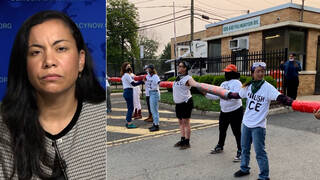
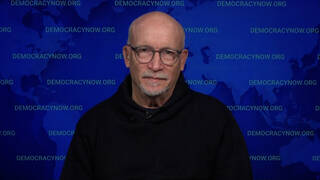
Today is Election Day in New York, with a number of primary challengers hoping to unseat Democratic establishment politicians. The Democratic Socialists of America (DSA) have a packed slate of 10 candidates across congressional, state Assembly and state Senate races. “People are really looking for something else other than these corporate Democrats,” says Liza Featherstone, author and columnist for Jacobin. Describing the DSA as a key part of the “grassroots base” of the left wing of the Democratic Party, Featherstone says DSA members want elected leaders who have come out of movements themselves, not just lifelong politicians who only turn to movements for endorsements every four years.
Palestine is a key issue in many of the races, with DSA challengers taking a strong stand against genocide, while some incumbents have received large donations from AIPAC-linked super PACs. “People are absolutely disgusted with the U.S. relationship with Israel, absolutely appalled by the killing that we’ve seen,” says Featherstone. Today’s primary results will show to what extent the DSA is seen as a genuine alternative to the establishment wing of the Democratic Party.
Related Story
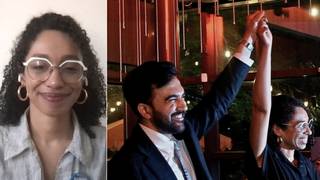
 StoryJun 24, 2026“Babies, Not Bombs”: DSA’s Darializa Avila Chevalier Beats 5-Term Rep. Espaillat. 1st Post-Win Intvw.
Transcript
AMY GOODMAN: This is Democracy Now!, democracynow.org. I’m Amy Goodman, with Juan González.
Today is Primary Day here in New York, as well as in Maryland and Utah, with a runoff in South Carolina. In several of the races, it’s a battle between different wings of the Democratic Party amidst the rise of one group in particular, DSA, the Democratic Socialists of America. In New York City, the DSA has a packed slate of 10 candidates across congressional, state Assembly and Senate races. In the 13th Congressional District, the DSA is backing organizer Darializa Avila Chevalier against incumbent Adriano Espaillat. And in the 7th District race for outgoing Congressmember Nydia Velázquez’s seat, the DSA is backing union organizer Claire Valdez against Brooklyn Borough President Antonio Reynoso, who is backed by Congressmember Velázquez, as well as the Working Families Party.
Earlier this month, Democracy Now! covered a rally hosted by the New York City DSA in Brooklyn, and spoke to some of the DSA-backed candidates in today’s primaries. Democracy Now! spoke to Eon Huntley and Conrad Blackburn, running for the state Assembly from Brooklyn and Harlem; Aber Kawas, running for the state Senate from Queens; and to New York State Assemblyperson Claire Valdez, running for Congress in New York’s 7th Congressional District.
CLAIRE VALDEZ: People are really mobilized. I think they’re outraged by the genocide. They’re outraged by what ICE is doing. They’re outraged by the Trump administration. And they want to see a Democratic majority that’s going to fight for universal healthcare, for truly deeply affordable housing, to stand up against, you know, the tech oligarchs and so many of the people who make our lives hard.
EON HUNTLEY: I know what it’s like to have to make a choice between paying for rent and paying for daycare. I know what it’s like to be concerned that when our lease is up, if we’ll be the next family that’s displaced from this community. I know what it’s also like to really, really be very scared about how am I going to pay for my kids’ college, because I’m still paying off my own student loans.
CONRAD BLACKBURN: The housing instability that people are facing in Harlem is due to the fact that the people in power are taking money from landlords, taking money from developers, and then turning around and telling people that they’re fighting for housing. It’s just not true. And so, in this moment, we really have to fight back.
ABER KAWAS: For me, as a Palestinian, to be at a rally for Democratic nominees and have “Free Palestine” signs, after years and years and years of having elected officials not even ever take Palestine seriously, go through a genocide, where people didn’t even speak out about Palestine, this is such a momentous moment, because it’s really a change in political will and political history in the United States.
AMY GOODMAN: That was Aber Kawas, DSA candidate for the New York state Senate, as well as Conrad Blackburn and Eon Huntley, DSA candidates for New York state Assembly, and Claire Valdez, the DSA candidate for Congress.
New York City Mayor Zohran Mamdani has also played a key role in the races, backing the DSA’s congressional candidates, as well as former City Comptroller Brad Lander, running as a progressive challenger to Congressmember Dan Goldman here in New York City.
For more on the rise of the DSA in New York and beyond, we’re joined by Liza Featherstone, columnist for Jacobin, freelance journalist, author of Selling Women Short: The Landmark Battle for Workers’ Rights at Wal-Mart. Her latest column is headlined ”NYC Socialists Are Trying to Expand Their Electoral Wins.”
So, talk about the divided Democratic Party and the power of the DSA, the Democratic Socialists of America, in New York and beyond.
LIZA FEATHERSTONE: Sure. Well, in the larger scheme of things, the Democratic Party is really divided between its corporate and pro-war wing, which is represented by the Democratic leadership, Chuck Schumer, Hakeem Jeffries, both of whom are New Yorkers, and its more — and its more left-wing, more grassroots base. And DSA in New York City is one of the very grassroots forces representing that base. And some of our — some of our contests, particularly the congressional contests, are really playing that out.
JUAN GONZÁLEZ: And, Liza, as you well know, there have been other periods in American history where socialists have gained local office, especially in mayoralties and city councils, hundreds during the early 1900s.
LIZA FEATHERSTONE: That’s right.
JUAN GONZÁLEZ: New York City had a famous socialist congressman, Vito Marcantonio, from East Harlem in the 1940s. What is different, in your estimation of this, because — of this wave? Because capitalism always figures out a way to come back and to take back those seats.
LIZA FEATHERSTONE: Yeah. I mean, in some ways, Juan, it’s similar, you know, in the sense that — you know, where socialists at that time, as now, were very strong at the neighborhood level and also made these bigger wins, you know, on the mayoral level and congressional. And yet, as you pointed out, we still live in a capitalist society, that’s true.
But I think that something — you know, something that’s a little bit different now is the real crisis on the national front in terms of the Trump administration, you know, a real — really signaling that the elite just doesn’t care about democracy at all. And, you know, we’re facing a climate crisis and an affordability crisis. And nationwide, as well as in New York, people are really looking for something else other than these corporate Democrats. So, the socialists become sort of less — you know, possibly less of a temporary local experiment and more of a genuine alternative that a lot of people are looking to.
JUAN GONZÁLEZ: And to what degree do you think some of these local elections in New York — I’m thinking specifically of the one in Brooklyn and Queens to replace Nydia Velázquez. You’re dealing with a relative newcomer to New York City in the candidate, Democratic Socialist, originally from Texas, running against a fairly liberal Democrat, not a — certainly not a socialist, but a fairly liberal Democrat. To what degree do you see greater divisions being sown in the progressive camp in a race like that?
LIZA FEATHERSTONE: Yeah, absolutely right. So, that’s a really interesting race, because, as you point out, Nydia Velázquez is, you know, the power, the power broker and congresswoman who represented that seat for so long, was certainly not a centrist or a corporate Democrat. In fact, she was an early backer of Julia Salazar, who was the first socialist in this current wave of socialist electeds, and she was an early supporter of a ceasefire in Gaza. Like, she’s certainly not — not one of the kind of Democrats that we usually go after. And she’s very supportive of Antonio Reynoso, the borough president who is running for that seat right now. On the other hand, Claire Valdez is supported by Zohran Mamdani, the socialist mayor, and by —
AMY GOODMAN: Of course, Nydia Velázquez supported Mamdani.
LIZA FEATHERSTONE: Yes, yes. So, you know, the plot thickens. And also by DSA and also by the UAW, which — the United Auto Workers, of which I am actually a member also.
And, I mean, if I could a little bit explain that race, the Working Families Party is a very worthy, but kind of disappointing formation. They have never had much of a ground game in terms of their organizing. They are — they’re very beholden to incumbents, incumbent Democrats, and a lot of the decisions are made by nonprofit, like, you know, nonprofits who don’t have a particularly democratic structure in their organizations. And so, it is a little bit of a — it does represent a little bit of a different form of left-wing power-broking, in which the DSA and the unions feel that they represent a more grassroots, more democratic.
And I will also say I think at stake in that election is, you know, obviously, it’s going to be a decent congressperson compared to the horrors that are mostly, you know, representing us in that body. You know, either Antonio Reynoso or Claire Valdez is going to be a decent congressman, congressperson. But Claire Valdez kind of represents a vision for what many of us think electoral engagement should be. She was a member organizer in our union. You know, she was active in DSA. Like, a lot of us on the left feel that our elected leaders should come out of our movements. They shouldn’t just be, you know, lifelong politicians who, you know, we have — who our relationship is that we sit down every four years and have an endorsement meeting with them.
AMY GOODMAN: You have both the focus on local issues with the DSA, but also the issue of Palestine.
LIZA FEATHERSTONE: Yes.
AMY GOODMAN: In this last 30 seconds, if you can talk about that being an engine of change in these elections in 2026?
LIZA FEATHERSTONE: Absolutely. So, in another race in Harlem, Darializa Avila Chevalier is challenging Adriano Espaillat, longtime Democrat in that seat, in that congressional seat. Darializa was a student organizer, Students for Palestine organizer. And she was also a field lead for Zohran Mamdani’s campaign. And that race, we just — nobody really expected that she was going to topple Adriano Espaillat or get as close as she has, but it’s really — it’s really going to be much closer than expected, and she might even win.
And the reason is Palestine. People are absolutely disgusted with the U.S. relationship with Israel, absolutely appalled by the killing that we’ve seen and the feeling that our tax dollars are going towards that, as Democracy Now! viewers have been seeing all day the violence in that region. And it’s just, you know, finally, we have some politicians, some leaders, who are willing to stand up and say that that’s — that that’s what it is, and that they’re not going to be taking money from AIPAC, you know, the Israel interest group.
And I think that that’s the same — you know, we have the same dynamic in the Claire Valdez race, even though Antonio Reynoso is probably not getting much money from AIPAC, or any money at all. He’s not really like an Israel asset. But Claire is a real fighter on the Palestine issue and has the most anti-imperialist platform of any congressional candidate ever.
AMY GOODMAN: Liza Featherstone, we want to thank you for being with us, columnist for Jacobin. We’ll link to your piece, ”NYC Socialists Are Trying to Expand Their Electoral Wins.” Special thanks to our Democracy Now! fellows, Amba Guerguerian and Diego Ramos.
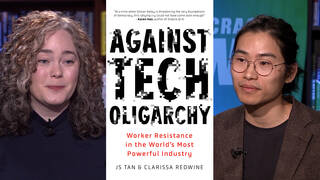
Coming up, ”MAGA Inc.: A Guide to Trump’s World of Crypto Czars, Tech Titans and Prison Profiteers.” Back in 20 seconds.
[break]
AMY GOODMAN: “U’Huh,” Sinkane, performing in our Democracy Now! studio.




 Top
Top
Media Options