








 Watch Full Show

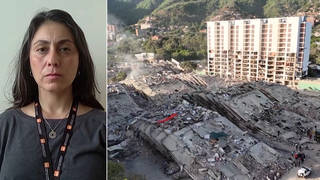
The death toll from twin earthquakes that hit Venezuela Wednesday night is expected to reach into the thousands as rescuers continue to search for bodies trapped in the rubble. Hospitals are rapidly reaching a breaking point, and thousands of survivors have been left homeless. Reporter Andreína Chávez’s building was one of the countless residences in Venezuela’s capital Caracas and its surrounding region that were damaged by the massive quakes. Chávez was on the street when the earthquakes struck, and says she “saw at least three buildings partially collapse right in front of [her].”
As Venezuelans band together to find survivors, the country is calling for international support and resources to step up critical rescue and recovery efforts. “We weren’t prepared for a disaster of this magnitude,” says Chávez. “Venezuela is a country that has been under U.S. sanctions … as well as a country that has an infrastructure that is very deteriorated. We have public services that are very deteriorated, and all of that has been something that has really added to this tragedy.”
Related Story
 StoryJun 30, 2026“Keep Supporting the Venezuelan People”: Thousands Missing as Earthquake Rescue Efforts Continue
Transcript
AMY GOODMAN: This is Democracy Now!, democracynow.org. I’m Amy Goodman, with Juan González.
We’re going to continue with the Supreme Court decisions that came out yesterday, but first, we’ve just made a connection with Venezuela, so we are going to go to it. The death toll from the twin earthquakes has risen to over 200, expected to rise dramatically as rescuers search for survivors trapped in the rubble. Thousands of people remain missing. At least 4,300 are injured in the two quakes that struck about a hundred miles west of Caracas Wednesday evening as many people were at home celebrating a national holiday. They were the strongest earthquakes to hit Venezuela in over a century. In Caracas, residents looked for friends and family trapped under the rubble of collapsed buildings.
SURVIVOR: [translated] We are here in solidarity with a colleague whose wife is under all this structure, his children. He has two children and his wife under there. And with the hope of finding them alive and well, we are here, as I say, in solidarity, hoping that his family is well. And, well, as I say, I’m not from the area. My building suffered some damage, but nothing compared to what this guy is going through in this place.
AMY GOODMAN: Survivors of the earthquake have shared horror stories about being trapped under collapsed homes and businesses.
ERIC PAUL MARTINEZ SANTOS: [translated] My name is Eric Paul Martinez Santos, and I’m a survivor of the earthquake that occurred yesterday afternoon. I was in my building for four hours until I was rescued by someone from civil defense, or I’m not sure. They didn’t have many tools. They couldn’t find the chisel, the drill, the grinder. They went at it with their nails. I also helped, because they passed me a tool. And it saved me, because I had a lot of furniture in my home that protected me from the wall.
AMY GOODMAN: We go now to Caracas. We’re joined by Andreína Chávez, reporter based in Caracas, her building damaged by the earthquakes.
I’m so glad we could reach you, Andreína. Can you describe what’s happening right now?
ANDREÍNA CHÁVEZ: We experienced this double earthquake. I was on the street when it happened, a few blocks away from my building. The absolute commotion was incredible. When I was running on my way home, I saw at least three buildings partially collapse in front of me. Thankfully, my own building didn’t collapse. It did have substantial damages, and, fortunately, we are — everybody in my building is safe.
However, there are other areas in Caracas, for example, a place called Los Palos Grandes, which is in the east of Caracas, it is severely affected. There is a huge building there that collapsed, and a lot of people are trapped under the rubble. We also saw several buildings that collapsed in San Bernardino, which is west of Caracas. And from what I understand, in a lot of these places, the rescue teams haven’t been able to arrive because all the efforts are concentrated in La Guaira state, which is the disaster zone. In La Guaira state, we have more than 250 buildings that collapsed. There are thousands of people still missing, thousands that are trapped under the rubble. We still don’t know exactly how many people died, because right now we don’t have a clarity about that.
The entire Venezuelan police, the entire Venezuelan military, Protección Civil, the Civil Protection, the fire fighters, volunteers of all kinds, they’re all working. They’re all concentrating their efforts in La Guaira, in part of Caracas, to save people, to rescue people. However, of course, we weren’t prepared for a disaster of this magnitude, so it’s not enough. That is why Venezuela has been calling people, calling other nations to please send equipment, to send rescue teams, to send humanitarian aid, anything possible to help Venezuela overcome this tragedy, because we obviously cannot do it alone.
And a lot of that has to do that, of course, Venezuela is a country that has been under U.S. sanctions, that has been economically asphyxiated for at least 10 years now. So Venezuela is a country that has an infrastructure that is very deteriorated. We have public services that are very deteriorated, and all of that has been something that has really added to this tragedy.
JUAN GONZÁLEZ: And, Andreína, you mentioned the U.S. sanctions and efforts to shut down Venezuela’s economy, but yet you’re still — there’s still quite a bit of civic activity by citizen groups, by communes. Could you talk about that, as well?
ANDREÍNA CHÁVEZ: Yes, absolutely. I mean, every single institution in Venezuela, like I said, the National Police, the military, firefighters, and all kinds of volunteers have been working tirelessly since Wednesday trying to rescue people. But we also have people from communes, from the Venezuelan communes, from popular organizations. These people are organizing, gathering food and anything, medicine, and anything that people in La Guaira might need. And themselves, they are carrying all of this humanitarian aid and taking it to La Guaira. Only yesterday, at the end of the afternoon, we saw a huge caravan of motorcycles, people who were collecting food and taking it themselves to La Guaira.
So, there is a huge network of solidarity going on right now. We also see that there’s the people outside of Caracas, in other states, like Zulia, Aragua, other places, in which people are collecting food, collecting medicine, collecting clothes, blankets, water, and bringing it to Caracas to help people here. So, there is a huge, a huge network of solidarity right now. We have university students in the Central University of Venezuela who are using the university spaces to collect all of this aid and to volunteer to rescue people. So, we have a lot of solidarity right now. So, despite the fact that Venezuela certainly needs a lot more help from other countries, we have a huge movement going on right now to try to do everything possible to save people.
AMY GOODMAN: Andreína, I want to thank you for being with us, and, of course, we’re going to continue to follow this story. While hundreds have been documented dead, it’s feared that thousands are, because of the number of missing and the thousands who are injured. We thank you so much for being with us, Andeína Chávez, a reporter based in Caracas.



 Top
Top
Media Options