






 Watch Full Show

Guests
- Baher Azmylegal director at the Center for Constitutional Rights.
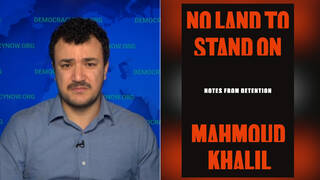
- Mahmoud KhalilPalestinian activist.
We speak with Palestinian activist Mahmoud Khalil about his lawsuit against top Trump administration officials, two pro-Israel groups and a conservative think tank for conspiring to suppress his constitutional right to free speech.
Khalil, who helped lead protests at Columbia University against the U.S.-backed Israeli genocide in Gaza, was one of several international students targeted for deportation by the Trump administration last year over pro-Palestine advocacy.
“I don’t want everything that happened to me to go in vain,” says Khalil.
The lawsuit names Secretary of State Marco Rubio and several other top administration figures; the Heritage Foundation, which launched Project Esther, a campaign to suppress pro-Palestine protests; the far-right pro-Israel group Betar; and Canary Mission, a long-running operation to identify and harass pro-Palestine activists. The lawsuit was brought under the Ku Klux Klan Act of 1871, a Reconstruction-era law to restrict government coordination with vigilante groups like the Klan.
Related Story
 StorySep 30, 2026“No Land to Stand On”: Mahmoud Khalil on His Memoir, Palestine, Fighting Deportation & Suing Columbia
Transcript
AMY GOODMAN: We begin today’s show with a new federal lawsuit filed by Palestinian activist Mahmoud Khalil against several top administration officials, two pro-Israel groups and a conservative think tank accused of conspiring to suppress Khalil’s criticism of Israel and his constitutional rights to free speech. The lawsuit says the Heritage Foundation created Project Esther, which became a blueprint for a public-private partnership to weaken the growing pro-Palestine movement by targeting prominent noncitizen activists and smearing them as antisemites. It says the Heritage Foundation turned to groups like Betar, a far-right pro-Israeli group, and Canary Mission, which has long surveilled pro-Palestine advocates, to identify their targets. The case was also filed against White House adviser Stephen Miller, Secretary of State Marco Rubio, Secretary of Homeland Security Markwayne Mullin, Acting Attorney General Todd Blanche, former Secretary of Homeland Security Kristi Noem and John Armstrong, a State Department official.
The suit was announced by the Center for Constitutional Rights at a news conference here in New York Tuesday, where Mahmoud Khalil addressed supporters.
MAHMOUD KHALIL: I will not stop fighting until everyone who willingly contributed to my missing the birth of my son and to taking 104 days of my life from me answers for what they’ve done. But this case is about far more than what was done to me. It’s about a coordinated, ongoing campaign to punish, silence and intimidate anyone who dares to speak out for Palestinian liberation.
AMY GOODMAN: The lawsuit was brought under the Ku Klux Klan Act of 1871, which is a Reconstruction-era law to restrict government coordination with vigilante groups like the Klan.
Democracy Now!'s María Inés Taracena was at Tuesday's press conference and spoke to Baher Azmy, legal director of the Center for Constitutional Rights, a member of Mahmoud Khalil’s legal team.
BAHER AZMY: The entire United States government has been persecuting Mahmoud through the immigration courts in a race to deport him for no reason other than his constitutionally protected speech.
What we’re — what Mahmoud is doing now is fighting back and filing an action against his persecutors, which are a set of private hate groups — Heritage Foundation, Betar and Canary Mission — who developed this elaborate plan along with federal officials — Miller, Rubio and Noem — to target noncitizen students for their protest of Palestine.
So, they had not the courage or the capacity to debate the question about their support for the Israeli genocide, so what they chose to do is identify perceived leaders of the Palestine movement and use the maximal terrorizing power of the state to send a chilling message everywhere: If you disagree with the United States government, if you support Palestine, we will throw you in an immigration detention a thousand miles from home and work tirelessly to deport you.
Mahmoud won’t stand for it, so he’s sticking up for himself and everyone else who would be subject to the state power, that’s not just limited to him. …
This is a lawsuit against the private entities and the federal government, because they worked together in a conspiracy. There’s also litigation attacking the federal government’s attempt to punish him, through habeas corpus proceedings, for his speech. But this is the first demand for accountability via damages, and a court ruling that this conspiracy is unconstitutional, and any attempt to remove him on that basis is illegal.
MARÍA INÉS TARACENA: What kind of evidence has there been found to show this coordinated targeting between the federal government and these private entities against Mahmoud Khalil?
BAHER AZMY: What’s remarkable here, and as we set out in the 130 pages of connect-the-dot detail, is how open and notorious this plan is, how arrogant it was. Heritage announced a blueprint, what they called it, for this conspiracy. They asked for a public-private partnership. And then they recruited these anti-Palestinian hate groups to identify students. They wanted to attack noncitizen students and do more than dox and surveil. Project Esther realized they had a friendly, willing administration coming into power, so they could use the power of the state.
Now, all of them announced or predicted that Mahmoud would be arrested, and all of them boasted after the fact about their role in working with Secretary Rubio to denominate them as enemies of the state and DHS to arrest them. And a federal court had a trial in Massachusetts, the AAUP trial, where so much testimony came out of basically a one-to-one relationship between who Betar and Canary selected for the Rubio determination, and then, a day later, denominating them enemies of the state and effectuating the rest, because this happened to Mahmoud, and in the same pattern, it happened to eight other students.
MARÍA INÉS TARACENA: What is the status of Mahmoud’s deportation case and immigration case?
BAHER AZMY: In his deportation case, the United States government is taking really unprecedented and irregular actions. You know, they are in control of the immigration courts; they’re not independent. They are racing at basically unprecedented speed to hurry up and effectuate what’s called a final order of removal. We still have an appeal to a federal appellate court from that sham-like decision, and he’ll continue to fight on all fronts.
AMY GOODMAN: For more on this story, we go to Mahmoud Khalil himself, a Columbia University graduate, green card holder, who became the first pro-Palestine college campus protester to be jailed by the Trump administration over his participation in Columbia’s Gaza solidarity actions in 2024. Arrested in March of 2025, he spent over 104 days in ICE detention in Louisiana, missing the birth of his son Deen. He was released last June, but the Trump administration is still trying to deport him.
Mahmoud Khilil, welcome back to Democracy Now! If you can go back to March 8th, 2025, to your — the place where you were living, the apartment building, and remind our viewers and listeners what happened?
MAHMOUD KHALIL: Good morning, Amy. Thank you for having me.
On that day, to be honest, we were all surprised by the rogueness of the Trump administration, of plainclothes ICE agents coming to my apartment building, stopping me in the lobby of my apartment and telling me that my visa was terminated and I am under arrest, without actually showing me any warrants, without telling me who they are. And everyone was then surprised, like, how this could happen. For a few days, no one knew what happened.
And what we thought was sort of like a rogue implementation of law turned out to be a conspiracy. And that’s what we are now basically alleging in court, that this was not just an officer deciding to implement the law. It was more of a conspiracy between different actors. And as a judge, a Reagan appointee, said in Massachusetts, that he was surprised that such officials would conspire with themselves to deprive someone of their freedom of speech just for the purpose of chilling speech across the country because they don’t want anyone to speak for Palestine.
AMY GOODMAN: And why are you doing it now?
MAHMOUD KHALIL: So, we’ve been working on this case, to be honest, since I was in detention, just looking into connecting the dots. And I’m doing it as a way to get accountability for what was done to me, what was done to this movement, because, for decades, these groups grew too comfortable in targeting Palestinians and harassing Palestinians and blacklisting Palestinians and their supporters, because when they cannot win on the argument, they would rather silencing us. And this is my message to them, that we will never be silenced, until Palestine is liberated. This is when we will shift our focus to building Palestine. But no matter of — or, no amount of oppression, of silencing, of intimidation will succeed in really silencing us.
AMY GOODMAN: Do you still have your green card, or did they — did they take it from you?
MAHMOUD KHALIL: So, they’ve been — they’ve been attempting at taking the green card from me for the past year since I got out, and we’re still fighting that in court. Of course, there’s a final order of removal against me that was issued by a Trump administration immigration court, fully controlled by the administration, and now we’re fighting that in federal court. And the good news now, this case, whether I’m here, whether I’m not here, I can still fight it in case — in court. A judge can still order my return to the country. So, this is also another fight into that.
And just let’s be clear now. Over one year after my detention, about 15, 16 months after my detention, the Trump administration has not brought any shred of evidence that I did anything illegal, that I did anything unlawful. And that’s what we’re trying to convince the court, that this is literally just like arbitrary detention, that they want to make an example out of me so others would stop talking.
AMY GOODMAN: Mahmoud, you experienced your son Deen’s birth in jail, in the prison in Louisiana?
MAHMOUD KHALIL: Sorry?
AMY GOODMAN: You experienced his birth — you experienced his birth in jail by listening on the telephone?
MAHMOUD KHALIL: Yeah, I did. And that’s another thing why I’m doing this, because I will never forgive the actors that contributed to my missing the birth of my son, of Deen, because this shouldn’t happen. This shouldn’t happen to anyone, because I could have been next to my wife Noor when she was giving birth. Yet because of their arrogance, because of their cruelty, they chose not to let me next to my — be next to my family.
So I’m really doing this lawsuit also as a form of accountability for that, to get justice. I don’t want a — I don’t want everything that happened to me to go in vain. And I’m really, you know, grateful for the organizations that helped me bring this legal actions against the government and these private actors.
AMY GOODMAN: I want to go to some of the people who stood with you outside in Foley Square supporting you, like Beth Miller, political director of Jewish Voice for Peace Action, also at the news conference.
BETH MILLER: These groups and the Trump administration thought that if they would start by attacking people that they thought were the most politically vulnerable, like student organizers, like Palestinians, like those who support Palestinian freedom, that everyone else would just stand back, that everyone else would be too afraid to fight back for their rights and for the rights of all of us. But today, by filing this case, Mahmoud Khalil is showing just how wrong they were. Mahmoud is fighting back, and we are all fighting back alongside him. And we will continue to organize to support him and to support the broader Palestinian freedom movement to end this genocide.
AMY GOODMAN: This is actor, producer and director Cynthia Nixon at the news conference in support of Mahmoud Khalil Tuesday.
CYNTHIA NIXON: For nearly three years, millions of people across the United States and across the world have raised their voices for Palestinian lives, for families living through unimaginable loss, for children who are just like all of our children and who deserve safety, dignity and a future, for the basic belief that every single human life should be valued. Whatever our politics, this should never be a controversial idea. Mahmoud has been one of those voices, and today his legal team is asking the courts to review how and why he was targeted. We know it’s not because he did anything wrong. It’s because he is a Palestinian standing up for Palestinian rights,
AMY GOODMAN: And this is another actor from The Gilded Age, producer Morgan Spector, speaking at the news conference.
MORGAN SPECTOR: Advocating for Palestinian rights isn’t an act of anything but humanity. It’s an expression of conscience, of the moral conviction that Palestinians deserve the same rights, dignity and freedom that we would want for anyone, anywhere in the world. Mahmoud has unstintingly embodied that moral conviction. But his courage has made him and far too many others a target, targeted by the government and targeted by extreme anti-Palestinian groups. Today, we’re fighting back together. …
The rights Mahmoud is fighting for belong to all of us. If they can put Mahmoud in prison for exercising those rights, then those rights become a privilege conferred by the state on those who accept the division between lives that count and lives that don’t. That’s why I’m standing with Mahmoud today and why it’s so important that he wins.
AMY GOODMAN: That’s Morgan Spector, Cynthia Nixon, Beth Miller of Jewish Voice for Peace Action. What does this kind of support mean to you, Mahmoud?
MAHMOUD KHALIL: That means that we’re building a wide movement, a diverse movement, to go — you know, to fight back against all these forces that are trying to deprive us from our basic rights. It means that what happens to me could happen to anyone, and that’s another thing about the case. It’s not about me as a person, as Mahmoud, because these same groups are working to deprive everyone of their rights, your rights, my rights, anyone in this country, if we don’t agree with them. And that’s why it’s important for these groups and individuals to be in solidarity with each other, to face these forces together. So I absolutely appreciate their support. I’m grateful for their voices, for lending their voices to me in order to just shed light on these atrocities that are being committed by this government and these Zionist hate groups in this country.
AMY GOODMAN: And finally, do you face a final deportation order now?
MAHMOUD KHALIL: I do, yeah. But we’re fighting that in court. It’s not — it’s not, I would say, in effect. There are protections from the federal court that prevents the government from doing — from coming and deport me or arrest me, as we are now seeking Supreme Court review to the case, as we’re also going through different courts in the country. It’s just like very, I would say, disheartening. It’s just like a lot of people in this country, a lot of immigrants, they don’t have the number of lawyers I do. It’s crazy that it’s taking more than 20 lawyers to free a person from unjust detention, while there are now tens of thousands of immigrants without any legal representation. So, I’m absolutely grateful and consider that a privilege that I’m able to fight this fight for over a year after my release.
AMY GOODMAN: I know I said final question, but as you said that about the immigrants who face what you’re facing without that kind of legal representation, I was wondering your final thoughts on the ICE killing of Lorenzo Salgado Araujo in Houston just in the past week, of the 26-year-old Colombian man with work authorization, Joan Sebastián Durán Guerrero in Biddeford, Maine, and, of course, before that, Alex Pretti and Renee Good. Your final thoughts?
MAHMOUD KHALIL: I mean, it’s absolutely heartbreaking that ICE is killing people. But, unfortunately, I wouldn’t say I’m surprised. And that’s why I’m fighting, because I could be one of — or, I could have been one of these individuals who were killed by ICE, by the rogueness of this agency, because this agency is acting extrajudicially. They want to instill fear and terror into the population. And it’s not surprising that, unfortunately, there are so many victims. But again, like, that’s why I am fighting this, because, by pure luck, I could have been one of these people when ICE agents showed up at my lobby. If for some reason they decided to kill me, they could have. And they lied when they came. They said that I tried to flee the scene, until we confronted them with the camera footage, that I was actually very calm and very, very cooperating.
It’s just like upon this Congress that allowed this to happen, that funded ICE with over $70 billion, that could have gone towards our communities, towards lowering the cost of living, towards like just supporting human rights. It’s just, you know, like, always, that’s what motivates me to go on and on, because we need — we need an end to this bloodshed. We need an end to this degrading of humanity. I don’t want us to be looking in 20 years at this, at these years and these days, and regret not doing something. I’m doing my part to stop that, and I ask everyone to do their part to stop this.
AMY GOODMAN: Mahmoud Khalil, I want to thank you for being with us, Palestinian activist jailed by the Trump administration —
MAHMOUD KHALIL: Thank you, Amy.
AMY GOODMAN: — now suing Trump administration officials and anti-Palestine groups for conspiring to deprive him of his constitutional rights. He got his Columbia diploma while he was in jail, and also experienced the birth of his son on the phone while he was in detention.
Coming up, two journalists who were part of a convoy attacked by Israeli settlers on the West Bank on Saturday, accompanying the father of slain Palestinian American Saif Musallet to the site where his son was beaten to death by Israeli settlers one year ago. Among them was CNN reporter Jeremy Diamond. Stay with us.
[break]
AMY GOODMAN: “Freedom Is Free” by Chicano Batman in our Democracy Now! studio.



 Top
Top
Media Options