











 Watch Full Show

Has the United States launched a forever war on Iran? As the Trump administration renews its attacks on Iran, killing at least 35 civilians over the course of five days, political analyst Ali Vaez warns that the U.S. is inciting potentially never-ending “cycles of violence” with its manipulations of the diplomatic process. The U.S.’s unilateral renunciation of the “memorandum of understanding” as a “pretext for another round of war” has further eroded trust between the countries, says Vaez. “There is really no military solution,” he concludes. “The best solution is for both sides to agree to return to the MOU and to respect its terms.”
Related Story
 StoryJun 18, 2026Trump’s War on Iran Ends with a “Triumphant” Tehran and a Diminished U.S.: Vali Nasr
Transcript
NERMEEN SHAIKH: This is Democracy Now!, democracynow.org, The War and Peace Report. I’m Amy Goodman, with Nermeen Shaikh.
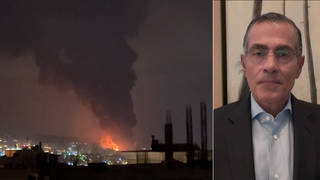
NERMEEN SHAIKH: The U.S. has struck Iran for a fifth consecutive day, targeting the capital Tehran and port cities, including Bandar Abbas, which is home to the headquarters of Iran’s Navy. Earlier today, the U.S. fired on an oil tanker attempting to reach Kharg Island in the Strait of Hormuz. In retaliation, Iran attacked Bahrain, Kuwait and Jordan. Iran’s military warned that if President Trump follows through on his threat to strike civilian infrastructure, it would strike all infrastructure across the Gulf. At least 35 civilians have been killed by U.S. strikes in recent days, according to Iranian authorities.
AMY GOODMAN: For more, we go to Ali Vaez, senior adviser to the president of the International Crisis Group, where he’s also Iran Project director. His piece for The New York Times this week is headlined “This Is a Forever War in the Making.”
Ali, explain.
ALI VAEZ: Good to see you, Amy.
So, what I meant by saying that this is a forever war in the making is that Iran and the U.S. had a ceasefire agreement on April 8th. It took them almost another two months to reach a memorandum of understanding, which was really a basic formula for ending the war and reopening the Strait of Hormuz. They decided in that page-and-a-half document, which only has 14 paragraphs, to address the essential, which was ending the war, and defer all the substantial issues about how to resolve the nuclear standoff or provide Iran with more substantive sanctions relief. So, this was really the minimal that they could do, and it took them more than two months to negotiate it. But then, in implementation, that MOU has almost fallen apart in less than three weeks. So, if even a minimal understanding is not going work between Iran and the U.S., it means that no floor would basically be able to bear the weight of this animosity. And that means that we are going to end up in cyclical cycles of violence. It might be limited tit-for-tats. It might be all-out confrontations. But if we cannot resolve this diplomatically, then there is only one formula that remains, which is the continuation of the conflict in one form or another.
NERMEEN SHAIKH: And, Ali, in The New York Times piece, you point in particular to the fifth paragraph of the memorandum of understanding. If you could explain what that was, what it said, and why it was ambiguous in terms of what implementation was required by both sides?
ALI VAEZ: Right. So, Article 5 of the MOU is really a masterclass in diplomatic malpractice, because you might at times decide to have some constructive ambiguity in the text in order to get the two sides to the finish line and sign on to the document, but then you have to resolve those differences in interpretation; otherwise, that constructive ambiguity becomes destructive. And this is precisely what has happened.
Paragraph five basically allowed — it says that it would be Iran’s responsibility to reopen the Strait of Hormuz and bring the traffic back to where it was prior to Israeli-U.S. aggression against Iran in late February. It doesn’t name any other country. It doesn’t talk about a northern corridor, which is in Iran’s territorial waters, or a southern corridor, which is in Oman’s territorial waters. It just says Iran will do its best efforts to reopen the strait.
Now, Iranians took that as U.S. recognition of their control over the Strait of Hormuz. The U.S. saw that as Iran opening the northern corridor and the middle corridor, which is the international waterway that Iran claims that it has mined, and then the U.S. would be able to open a southern corridor in Oman’s territorial waters as an alternative to Iranian-controlled transit routes. Now, obviously, Iran saw this as a U.S. attempt to try to erode Iranian leverage. It warned Qatar and Oman and other countries that were using that transit route. And it eventually started firing at vessels that were going through that route. And that is what has started the conflict, which, again, is quite a tragic irony, because the MOU was negotiated to finish the war, not that it becomes the pretext for another round of war.
NERMEEN SHAIKH: Well, it is extraordinary, as you say in the piece, that the war has now become entirely about the control of the strait, which is an outcome of the war and not a cause of it. So, if you could talk about that, to begin with, and then the fact that The Wall Street Journal reported yesterday that Trump hosted a meeting in the Situation Room where among the possibilities that were discussed with respect to Iran was the potential seizure of Kharg Island and the potential bombing of a tunnel complex at Pickaxe Mountain? If you could respond to that?
ALI VAEZ: Sure. So, you’re absolutely right. Before the war and in the 47-year history of U.S.-Iran animosity, the Strait of Hormuz was always open. Iran had never shut it down, until it faced an existential threat from U.S. and Israel. And now this conflict has become entirely about reopening of the strait.
But let’s also be honest about what has happened here, because I think even within the White House, there is not clear recognition of how elements of this same Trump administration have tried to undermine the president’s agenda. The U.S. representative to the U.N., Mike Waltz, negotiated this southern corridor with the International Maritime Organization, I think, precisely aimed at undermining the MOU that Vice President Vance had negotiated, in the same way that Secretary Rubio negotiated an agreement between the government of Lebanon and Israel, which undermined another article of the MOU, Article 1 of the MOU, because, in a way, it implicitly recognized Israel’s occupation of southern Lebanon as long as Hezbollah is not disarmed. So, this is not just — you know, some in Iran see it as a division of labor, but I do believe that it’s just divisions within the Trump administration that is responsible for this situation, that, you know, instead of the MOU becoming a confidence-building exercise, it has turned into the exact opposite. Now —
AMY GOODMAN: We just have a minute left, but I want to ask you about this new news out of CNN, that the U.S. military hasn’t conducted the standard review of intelligence tied to the strike on the girls’ school in Minab that killed over 175 people. They’re saying it sat for months with a military command while leaders have held off on ordering critical, standard intelligence review. President Trump was interviewed on Fox News, and he — remember, over 160 little girls going to school, around that number, died. And Trump is now saying the fact that a U.S. Tomahawk missile was used might be AI?
ALI VAEZ: Well, that is really one of the most tragic things that happened in this war, and the Pentagon hasn’t really taken responsibility. And I would say, Amy, that this is one of the main reasons that the U.S. lost the battle for hearts and minds in Iran, because the U.S. was supposed to go to the rescue of the Iranian protesters, not to target civilians and not take responsibility for it.
NERMEEN SHAIKH: And, Ali, finally, you end your piece by proposing a means for the U.S. and Iran to transcend this impasse. If you could just say what you propose? And also, just say a little bit about what the situation in Iran is like, where, reportedly, inflation is nearing 90%.
ALI VAEZ: Right. So, look, there is really no military solution to reopening the strait, other than the U.S. occupying the entire southern shoreline of Iran, which would come at a very high cost in terms of American blood and treasure. And it’s not even sustainable, because at the end of the day, the Iranians could continue firing drones and missiles into the strait from much more further inland. So there is really no military solution.
The best solution is for both sides to agree to return to the MOU and to respect its terms. Iran had already returned 50% of the traffic of the strait back to normal in the first week of the MOU’s implementation, if there was no insistence on opening a southern corridor. Now, there could be a joint coordination center between Iran and the GCC so that both sides of the Gulf have control over what’s coming in and going out. It wouldn’t be just Iranian control. And that is something that I do believe that the Iranians can live with.
AMY GOODMAN: We want to thank you so much, Ali Vaez, senior adviser to the president of the International Crisis Group. We’ll link to your new piece in The New York Times, “This Is a Forever War in the Making.” And on that Minab school in southern Iran where over 170 people were killed, they were little boys and girls.
Coming up, we look at the Trump administration’s move to gut the Endangered Species Act. Back in 15 seconds.
[break]
AMY GOODMAN: Joan Baez singing “Joe Hill.”





 Top
Top
Media Options