








 Watch Full Show

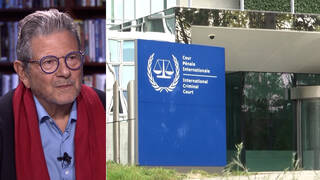
The 2026 FIFA Men’s World Cup has concluded, with Spain defeating Argentina to claim the coveted title. Spain’s national team players accepted the championship trophy at New Jersey’s MetLife Stadium alongside FIFA President Gianni Infantino and his close ally, United States President Donald Trump. Former professional soccer player Jules Boykoff, now a scholar who studies the political dimensions of the sport, joins us to discuss the various controversies that swirled around this year’s tournament, held in Canada, Mexico and the U.S. this past month.
“While many of us were engrossed in this World Cup, Immigration and Customs Enforcement ramped up its violent deportation machine,” says Boykoff. “And so, the World Cup helped Trump advance his agenda. It deflected attention from a lot of people away from his brutal immigration program, and it sets him up well to do the same in Los Angeles in 2028 when the United States hosts the Summer Olympics.”
Related Story
 StoryJun 09, 2026Why New Yorkers “Thunderously Booed” Trump at Knicks-Spurs Game: Sportswriter David Zirin
Transcript
AMY GOODMAN: This is Democracy Now!, democracynow.org. I’m Amy Goodman, with Juan González.
The Spanish football team has returned to Spain for a victory parade in the streets of Madrid, where they were greeted by an estimated 2 million people. These are the soccer players that won, carrying the World Cup trophy. They wore shirts with the words ”Somos campeones,” or “We are the champions.” The 2026 FIFA Men’s World Cup ended Sunday with Spain beating Argentina one-zero during extra time, with Spain winning a goal at the 106th minute of a long, intense final.
In Gaza, too, Spain’s win was widely celebrated. Spain’s support for Palestinian rights and Israel’s backing of the Argentine team turned the final into more than just a football showdown.
Meanwhile, FIFA has opened an investigation into the ugly brawl that followed Spain’s victory, with several players from Argentina facing bans. As Spanish soccer players ran onto the field to celebrate their victory, some of Argentina’s players appeared to attack members of the Spanish team, including the Spanish midfielder Rodrigo Hernández, or Rodri, who later won the FIFA Golden Ball as the tournament’s best player. On TikTok, Fox Sports posted a video that went viral after the game ended. Spain’s teenage star Lamine Yamal is seen praying on the field while, nearby, Argentine players started clashing with some players from Spain. Fox Sports captioned the video “two very different scenes.”
Lamine Yamal is a 19-year-old star who was born to a father from Morocco and a mother from Equatorial Guinea. The game also marked the first time he faced off against the Argentine soccer star Messi, who is widely considered one of the greatest soccer players ever. But it was not the first time they met. Images have gone viral of their first meeting in 2007, when a 20-year-old Messi was photographed holding a 6-month-old Lamine Yamal in a plastic baby tub. Last week, UNICEF reposted the photo on X, writing, “Yes, those photos you’ve seen are real. More than 18 years ago, a baby named Lamine Yamal and his mom Sheila met Lionel Messi at a UNICEF fundraising photoshoot,” unquote. UNICEF also posted a video describing the photoshoot.
LAIA RUICH: [translated] Fifty percent of calendar sales went to UNICEF to contribute to UNICEF projects which support children’s rights. And we have it here! In the photo showing the month of January 2008, Leo Messi appears helping to bathe Lamine Yamal next to his mother. The photographer, Joan Monfort, has said that Lamine Yamal stole Messi’s heart because he was always smiling and he was very nice.
AMY GOODMAN: In other World Cup news, President Trump was booed by fans as he walked onto the field alongside the FIFA President Gianni Infantino to take part in the post-game trophy ceremony. Later, Infantino tried to usher Trump away as he tried to stand in front of, and then beside, the Spanish team as Rodri lifted Spain’s trophy.
Well, as the most expensive and financially lucrative FIFA Men’s World Cup comes to an end, we’re joined now from Toronto by Jules Boykoff, author of Red Card: The 2026 World Cup, Sportswashing, and the FIFA Greed Machine, also the book Kicking, a memoir about his former life as a professional soccer player.
Jules, thanks so much for joining us again. Can you talk about the significance of what took place? Also, Spain now enjoys having both the World Cup trophy for the men and the women, the only country in history.
JULES BOYKOFF: Well, a lot of people out here were cheering for Spain for a lot of reasons. First of all, they play beautiful football. Second, their football is all about collectivity. Their star player, Lamine Yamal, he has to adjust to the structure of the team. On the flip side, with Argentina, their superstar, Lionel Messi, the team has to adjust their structure to him. It’s much more individual-based, unlike any team really I’ve seen in recent World Cup history.
This reflects wider currents in both of the countries. Pedro Sánchez and the socialists that he works with have advanced a more humane immigration agenda in Spain. They’re pushing forward green policies. They’re talking about bringing an investigation against Benjamin Netanyahu for war crimes for what Israel did to the flotillas that recently tried to reach Gaza. On the flip side, you’ve got Argentina led by Javier Milei, as you noted. Netanyahu supported Argentina, not so much because he’s a Leo Messi fan, but because he’s a big Javier Milei fan. Milei is an extreme libertarian who embraces the zombie neoliberal capitalism of the 1990s with great fervor. So, you couldn’t have much more of a sharp divergence in terms of the two teams that made the finals and what they mean for the bigger politics of the world right now.
JUAN GONZÁLEZ: And, Jules, what about the FIFA itself? Clearly, the World Cup was extremely popular, not only in the United States, but throughout all over the planet. But FIFA reports that it will bring in — has brought in $15 billion in revenue. The greed that is at the center of the FIFA organization, I’m wondering if you could talk about that.
JULES BOYKOFF: Absolutely, Juan. So, originally, FIFA said that they would take in $11 billion in revenue from this tournament alone. That itself would have been more revenues than any sporting event in the history of sporting events. Instead, their projections are more like $15 billion. Part of that is because they really catered to the luxury classes. I mean, let’s not forget that the World Cup is an opportunity for a privileged sliver of the global 1% to come together, to sit in the luxury boxes, to appear on screen on TV, to cut deals behind the scenes. And that’s exactly what this World Cup was about. They made a lot more money than they expected from the luxury packages that they set up.
Essentially, FIFA is keen to turn the people’s game into a game for the 1%, a game for the plutocrats. Going into this final, the average ticket price, according to SeatGeek, was $12,000. Twelve thousand dollars! Who can afford that? There were tickets along the sidelines that were selling for $1 million a piece. And so, what you saw here, in a way, is that the FIFA Men’s World Cup is, in a sense, too big to fail. And as we’ve seen with other situations where there’s a too-big-to-fail mentality, that is a dangerous recipe, whether we’re talking about the 2008 financial collapse, where banks survived and, in fact, thrived, where we saw an upward transfer of wealth, trickle-up economics, if you will. Similar dynamics are in play here with FIFA. Moving forward, they’re in a stronger position perhaps than ever.
JUAN GONZÁLEZ: And I wanted to ask you also — there were three countries that were hosting this World Cup: Canada, the United States and Mexico. But at least one of those leaders, Claudia Sheinbaum of Mexico, had a different approach to when — especially when the Mexican team played. She would not go into the luxury boxes, but instead stayed in events in communities in Mexico itself. I’m wondering the difference in her approach versus, let’s say, a Trump or the Canadian prime minister.
JULES BOYKOFF: Claudia Sheinbaum did the right thing. She gave away some of her free tickets to people who would otherwise never be able to attend a match. And you saw from the two leaders, in Sheinbaum and Trump, a sharp contrast, Sheinbaum using the opportunity to stay in tune with her own politics, and Trump using the opportunity to essentially weaponize the event for his political advantage.
More specifically, everybody knows about the rescinded red card heard round the world, where U.S. forward Folarin Balogun received a red card in the match against Bosnia, and President Trump called his BFF over at FIFA, the president, Gianni Infantino, and pressured him to overturn the penalty for that red card, thereby politically intervening. It should be noted that when other countries have politically intervened in the machinations of FIFA, they’ve been suspended, whether it’s Pakistan, whether it’s Kenya, whether it’s Zimbabwe. They paid a price. Donald Trump, he benefited from his political intervention.
But his weaponization of this tournament for political gain goes far before that particular incident. After all, he banned the award-winning referee from Somalia, Omar Abdulkadir Artan, from participating in the tournament, interrogating him for 11 hours, and then sending him on a plane to Turkey and eventually home to Somalia.
The Trump administration treated the Iran team like they were second-class citizens at the tournament, essentially forcing them to commute from Tijuana to their matches in Seattle and Los Angeles. And this definitely had an effect on their play. As if that weren’t enough, Department of Homeland Security head Markwayne Mullin said he may have danced a happy dance when Iran was ultimately eliminated from the tournament.
And so, you can see that the Trump administration was active weaponizing. As if to go further, the Department of Homeland Security’s X feed issued a number of racist and anti-immigration tweets using the U.S. men’s national soccer team players as their political backdrop. They issued a tweet that read, “One nation. One homeland. One team.” And if that sounds like Nazi propaganda, that’s because it essentially is. It mirrors Nazi propaganda from the 1940s. One of their slogans was “One people. One realm. One leader.”
One point that I absolutely think is crucial to note here is that while many of us were engrossed in this World Cup, Immigration and Customs Enforcement ramped up its violent deportation machine. During the actual World Cup, we saw a surge from ICE detentions. At one point, they were averaging 2,000 detentions a day, right in the thick of the World Cup. Now, this isn’t quite the 3,000-a-day fever dream of Trump’s assistant white nationalist Stephen Miller, but it’s still almost double what was happening before the month that the tournament started.
And so, the World Cup helped Trump advance his agenda. It deflected attention from a lot of people away from his brutal immigration program, and it sets him up well to do the same in Los Angeles in 2028 when the United States hosts the Summer Olympics.
AMY GOODMAN: And as we finally wrap up, Jules, you have all of that, and then you, though, have, running counter to throwing immigrants out of the country — I was just in Kansas City this weekend. The flags of so many nations were fluttering in the wind in Lawrence, Kansas, where they hosted the Algerian soccer team. I think they came late at night, and the whole town was out wearing the flag colors of Algeria, marching bands playing their national anthem. The significance of at this time, at this time of an immigrant crackdown, having this global celebration?
JULES BOYKOFF: This is extremely significant, because people across the country, whether in Lawrence, Kansas, whether in Portland, Oregon, where Jordan was based, they stepped up and showed the world that the United States population cannot be distilled down to the MAGA version of the United States that is often projected to the world. They welcomed people from around the world with open arms and said, “We want you here. We appreciate immigration.” And this couldn’t have come at a better time.
AMY GOODMAN: Jules Boykoff, we want to thank you for being with us, author of Red Card: The 2026 World Cup, Sportswashing, and the FIFA Greed Machine and Kicking, a memoir about his former life as a professional soccer player.
Coming up, a movement is growing targeting Flock, the automatic license plate reader company. Critics accuse Flock of building a nationwide mass surveillance system. Stay with us.
[break]
AMY GOODMAN: “Soledad” by Helado Negro and Reyna Tropical from their newest collaboration, Helado Tropical. See their performance and interview, go to democracyneigro.org.



 Top
Top
Media Options