









 Watch Full Show

Guests
- Negina Yaripeace activist and longtime women’s rights defender from Afghanistan, executive director of Window for Hope.
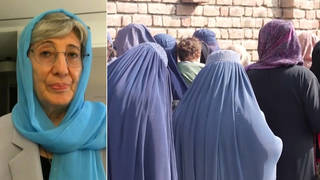
Restrictions on women’s rights have expanded in Afghanistan since U.S. forces withdrew from the country five years ago, ceding control to the Taliban in the process. Afghan women are banned from attending schools and gyms, books written by women are removed from libraries, doctors and nurses are unable to practice, and child marriage rates have increased. Wives have been rendered legally subordinate to their husbands, and women are required to stay silent in public. “Women and girls of Afghanistan are suffering the most darkest situation in the world,” says Negina Yari, an Afghan women’s rights activist living in exile in Germany, who discusses the impacts of what some advocacy groups are characterizing as “gender apartheid,” as well as the effects of regional diplomatic normalization on the Taliban’s political influence.
Related Story
 StoryAug 29, 2024“Gender Apartheid”: Taliban Approves Law in Afghanistan Requiring Women Remain Silent in Public
Transcript
NERMEEN SHAIKH: In Afghanistan, this month marks five years since the Taliban returned to power and the U.S. withdrew forces. Since retaking control in August 2021, the Taliban have stripped away the rights of women and girls, with UNESCO reporting some 2.5 million girls are now barred from secondary and higher education. The United Nations warns more than half of women’s organizations still working in Afghanistan could cease operations within the next year due to funding problems.
Human rights organizations describe the Taliban’s sweeping restrictions as a systematic erasure of women and girls from public life, with some characterizing the system as gender apartheid. The restrictions extend even beyond schools and workplaces. Under the Taliban, Afghan women are banned from outdoor parks, among other spaces, and books written by women have been removed from libraries. Women venturing beyond the home must be accompanied by a male guardian, and so-called morality laws curtail their rights to speak, sing or recite out loud in public.
AMY GOODMAN: Women have also been stripped of their protections against domestic violence, rendered legally subordinate to their husbands, and forced to remain in unwanted marriages. The rollback of women’s rights, coupled with deepening poverty, has also led to a surge of child marriages in Afghanistan.
This is the permanent representative of Denmark to the United Nations, Christina Markus Lassen.
CHRISTINA MARKUS LASSEN: The Taliban’s systematic repression of women and girls has become a defining feature of the current system. Afghanistan remains the only country in the world where girls are banned from secondary and higher education. The grave abuse of the right to education is also having far-reaching consequences for Afghanistan’s economic development and provision of essential public services.
NERMEEN SHAIKH: That was the Danish representative at the United Nations.
Malala Yousafzai, winner of the 2014 Nobel Peace Prize, is also speaking out on the fifth anniversary of the Taliban takeover of Afghanistan. In 2012, she was shot in the head by a Taliban gunman who boarded her school bus in Mingora in the southwest of Pakistan. Yousafzai survived serious wounds and now continues to campaign around the world for girls’ education. This is Yousafzai.
MALALA YOUSAFZAI: Five years ago, women were doctors, engineers, athletes and artists. Now they are banned from university, from work, even from going to public parks. Girls who once raced to school in the morning are now confined to their homes, banned from education. The Taliban have enforced a system of segregation and domination, a gender apartheid, on millions of women and girls.
And today, the Taliban are celebrating. But while they are marching in military parades and firing weapons, Afghan women are organizing. They are building a movement and working with governments, from Mexico to Spain to South Africa, to ensure justice for women and girls in Afghanistan. Today, I want the Taliban to know that they have nothing to celebrate, because we will hold them accountable for their crimes, and we will make sure gender apartheid will not be tolerated anywhere in the world.
AMY GOODMAN: That was Malala Yousafzai, winner of the 2014 Nobel Peace Prize.
Well, for more, we’re joined by Negina Yari. She is a peace activist, longtime women’s rights defender from Afghanistan. She’s the executive director of Window for Hope organization, forced to leave Afghanistan in 2022, just months after the Taliban takeover five years ago, has been organizing aid campaigns from exile in Germany. She also serves on the board of the Nobel Women’s Initiative, which Nermeen is also on the board of.
Negini Yari, welcome to Democracy Now! Thanks so much for being with us. It’s been five years since the Taliban retook power in Afghanistan. Talk about what’s happened, particularly to the women, half the population of Afghanistan, women and girls.
NEGINA YARI: As-salamu alaykum. Hi, everyone. Good morning. Thank you so much for inviting me and giving this opportunity to share the messages and also the reality of today’s women in Afghanistan.
It’s really hard to say that it’s almost five years. It is not only five years, to say it in a number. It is the five years that the women of Afghanistan are banned to attend a school, to attend a secondary education, to attend a university, to become nurses, to become doctors, to become a lawyer. In the last five years, almost more than hundred orders are directly came from the emir of the Taliban, from Kandahar, and more than 25 of those orders are targeted women and girls in Afghanistan. And it started from the orders to ban rights to education, rights to work, rights to sport, rights to attend a gym, rights to social movements, and even in some of the provinces women are banned to attend the male doctors. While the education is banned, no one is allowed to attend the university. And then they are putting ban on women to visit the male doctors, and especially the male dentists, and including the civil society and media space, which is very shrinking.
In Kandahar recently, the voice of women are banned, and they are not allowed to speak in the radio and not allowed to show their faces in the television, as well. Not limited to that, but also in the bigger city, a female who are working at the media and the television, they have to put face masks, and they are not allowed to appear their full faces.
And it also comes to the social movements of the women, as well. You know that in couple of weeks ago, the Taliban and the morality law forces, they have went to the street in Herat and also in Kabul, and they detained more than hundred of women from the streets. They bring the excuse that it’s because of the hijab, which is not the reality, which is not the truth. But it’s all coming again to bargaining the rights of women in a country.
And they see that how the international community attention are shifted from Afghanistan. That’s why they are pressurizing more on women. And unfortunately, today, Afghanistan and women and girls of Afghanistan are suffering the most darkest situation in the world.
NERMEEN SHAIKH: So, Negina, as you said, you know, women are prevented from — women and girls are prevented from seeing male doctors, and now women and girls are prevented from getting an education. So, at a certain point, if this continues, women and girls will simply have no access to medicine. So, if you could talk about that, and also, overall, what the condition is, given funding cuts and spiraling poverty in Afghanistan, what is happening to the health conditions of women and girls?
NEGINA YARI: So, thank you, Nermeen, for the question.
Honestly, the situation of the health crisis in Afghanistan is getting increased, and especially it was started from the climate change, you know, which is happening in the country, with the recent earthquake in Herat and then in Paktia and Kunar and Nuristan provinces. Most of the women who were needed to visit the clinics, but, unfortunately, in those four districts, the female nurses were not allowed to travel without mahram. And in most of the project, especially the health project, which was funded by international organization, due to cut of funding, they were not allowed even to support everyone’s male cost. That’s why even the female nurses were not able to visit those in most of those provinces that the women were affected by the earthquake and also by the floods.
And recently, one of the organizations, which is named DROPS, they also conducted a survey with more than thousands of women in Afghanistan. They mentioned that not only limited to the nurses, the lack of access, but it is also a big percentage of lack of access to the female doctors, as well, because it has different causes and different results. And recently, we noticed that a big number of female nurses have been graduated and even big number of female doctors have graduated from university, but the Taliban are not allowing them to attend their final examination and to get their certificate.
So, it is — it’s a very shrinking situations, and it’s not limited to the health situations. It comes from the medical services, but it’s also the mental health crisis, as well. So, women and girls right now in Afghanistan are facing a crisis of the mental health, as well, because the psychosocial support in Afghanistan, the pressure which exists, and including every ban that the Taliban are implementing at different city level, it all causes the mental health situation of women in Afghanistan, as well.
NERMEEN SHAIKH: So, Negina, you mentioned the term mahram, so just to clarify what that means, it’s effectively that women must have a mahram accompanying them in public. That’s someone whom they’re permanently barred from marriage through blood ties, legal marriage or breastfeeding.
So, I wanted to now ask you about the broader historical context in which the Taliban came to power, starting with the Soviet occupation of Afghanistan from 1979 and then the U.S. backing of the Afghan resistance, the mujahideen. How did the Taliban come out of that history?
NEGINA YARI: So, overall, it’s a — it’s a very geopolitical history [inaudible] to Afghanistan and very relevant to the counternarcotics and also to the security of the geopolitical situation of Afghanistan. But, overall, what we can say, that the Taliban is a political and armed group, and they hold the extremist and jihadist belief.
During last two decades of democratic regime in Afghanistan, the Taliban was — fought with the NATO and U.S. Army in Afghanistan, and they were also killed more than 56,000 of Afghan civilian, as well, and including the special forces of republic government, as well. So, but it was continued — like, this fight and war was continued ’til 2019 to ’18, and then the Doha process and the Doha talks was started. It was continued ’til 2000 — almost 2021, but the agreement was signed in 2020. In February 2020, the Doha agreement was signed, and the Taliban take over in August 2021.
But still, the process was not very clear to the people of Afghanistan, because no one know and no one had access to the information that, really, in which purpose or in which kind of government the Taliban are coming and taking over Afghanistan. Even as I was a civil society activist, I was in Afghanistan. We did a lot of campaign for women participation in Doha process or in peace talks, and even we didn’t have this information that, really, how Taliban will get the power in Afghanistan. It goes to be a share power; it goes to be hundred power to the Taliban.
But now what Taliban is claiming, that we have been fighting more than two decades in Afghanistan, and now we take over, and we have all the power. And that’s why, with the support of regional countries, they are becoming more powerful, and especially why recently — it’s almost not recently, but more than years — that the China and Russia has recognized them and give them the political accreditations. That’s why they are feeling more powerful at the regional level, and they are starting building diplomatic relationship with some of regional countries and, beyond that, to the European countries, as well. They send the diplomats to the Norway, to the Germany.
So, this is how this time the Taliban are coming and thinking for a long-term strategy. They are thinking more to build a diplomatic and more sustained political relationship beyond the regional countries, as well, because the first regime was — depended only on the regional countries, and it was a different political relationship, because it came — it started after the mujahideen and civil war in Afghanistan. But this time, everything is very well structured and very well systemized in Afghanistan, because it is after the republic time. Like, it’s a system that handed over to a group, and they are running it. And they are — well know that because the international community attention is also — like, the foreign policy is not anymore Afghanistan —
AMY GOODMAN: Negina — Negina, in 2024, the Taliban approved a wide-ranging law that forced women to totally cover in public and remain silent in public. This is a woman living in Afghanistan who concealed her identity as she recorded herself singing, quote, “You have silenced my voice until further notice. You’ve imprisoned me in my home for the crime of being a woman.”
AFGHAN WOMAN: [translated] [singing] You placed the stamp of silence on my mouth until further notice. You will not provide me with water and bread until further notice. You’ve imprisoned me inside the house for the crime of being a woman.
NERMEEN SHAIKH: So, Negina, finally, as we wrap up, if you could say — you know, the U.S. were in Afghanistan, the U.S. forces, for 20 years. The Taliban survived those 20 years. Explain how the Taliban were supported at that time. And by whom? What countries?
NEGINA YARI: So, during last two decades, the Taliban were supported from different regional groups and also from different political armed groups. We know that when the Taliban take over, the first country that came and welcomed them was Pakistan. And most of the Taliban leaders have already invested, and they had big businesses in Pakistan. And they were trained on the madrasa system, which was exist across the border of Afghanistan, the military madrasa. And some of them already get this support from parliamentary member of the Pakistan government, as well.
So, this is how the regional countries was well involved and were supported them during last two decades, and including the Russia, as well. They were also involved. They were also built this diplomatic relationship, even during the Doha talks. The Taliban diplomats was invited from Doha and also from Pakistan several times to visit the Russian diplomats in Russia.
So, it shows that how they already built this relationship. They were allowed to travel to these countries to sit in the table, to talk about the future of Afghanistan, to talk about the Taliban takeover and to already get this commitment from the regional countries, and including Iran, as well, because the Taliban had a very close diplomatic relationship even during the republic time of Afghanistan with Iran, as well. And they would travel several times to Iran, as well. Like, during last two decades of the republic government in Afghanistan, the Taliban was already built this relationship across the regional countries and beyond that. And they thought that for sustainable political process in Afghanistan for their self —
AMY GOODMAN: Negina, we have to go, but I want to thank you so much for being with us. Negina Yari, peace activist, longtime women’s rights defender from Afghanistan, executive director of the Window for Hope organization, fled Afghanistan in 2022 soon after they took over five years ago, organizing aid campaigns from exile in Germany.
Coming up, we hear from the first person jailed in the U.S. for protesting AI, then Connor Leahy of the group ControlAI. And we will speak with another guest, James Muldoon, author of two books: Love Machines, investigating how people form relationships with AI, and Feeding the Machine: The Hidden Human Labor Powering A.I. Back in 20 seconds.
[break]
AMY GOODMAN: “Mazel” by Emel Mathlouthi in our Democracy Now! studio.



 Top
Top
Media Options