



 Watch Full Show


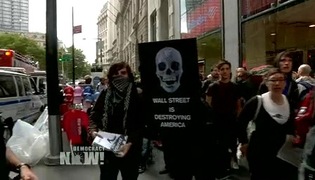
Fifteen years ago this week, thousands of activists marched on the Financial District in New York City. They formed the Occupy Wall Street encampment in Zuccotti Park, launching a movement focused on economic inequality that spread across the nation and globe under the slogan, “We are the 99%.” Protesters would go on to sleep in Zuccotti Park for nearly two months before police raided the encampment.
“Occupy Wall Street changed the public’s common sense about class and class struggle and inequality in this country,” says Yotam Marom, who helped organize the Occupy protests in New York City. “It’s hard to see how you get a Bernie Sanders 2016 run without the public shifting its relationship to that story.”
Marom says Occupy participants were inspired by mass protests happening around the world at that time, including the Arab Spring and the anti-austerity movement in Spain known as the Indignados.
Still, “We got it wrong on a lot of things. We had a ton of internal conflict that really jeopardized the project,” he says.
Marom’s new book is For Louder Days: Reaching Beyond a Politics of Powerlessness.
Related Story
 StorySep 19, 2011“Occupy Wall Street”: Thousands March in NYC Financial District, Set Up Protest Encampment
Transcript
AMY GOODMAN: This is Democracy Now!, democracynow.org. I’m Amy Goodman, with Juan González.
We end today’s show looking back at Occupy Wall Street. Fifteen years ago this week, September 17, 2011, thousands of activists marched on the Financial District here in New York, then formed an encampment in Zuccotti Park, launching a movement that shifted the conversation on economic inequality. Protesters would go on to sleep in Zuccotti Park for nearly two months before the New York police raided the encampment. The Occupy movement spread across the nation and the globe under the slogan, “We are the 99%.” The impact of the Occupy movement is still being felt today.
Democracy Now! was one of the only national outlets to report on the first day of the action. This is our producer Sam Alcoff filing his report.
SAM ALCOFF: On Saturday, thousands of protesters took to the streets of downtown Manhattan for what was described as an action to “Occupy Wall Street.” Inspired by the popular uprisings of the Arab Spring and the European anti-austerity movements, Adbusters, a Vancouver-based culture-jamming magazine, put out a call for Saturday’s protest on Wall Street in July. The goals were various, from limiting corporate contributions to political campaigns, to auditing the Federal Reserve, to challenging all of global capitalism. Protesters included 71-year-old Mary Ellen Marino of Princeton, New Jersey.
MARY ELLEN MARINO: I came because I’m upset with the fact that the bailout of Wall Street didn’t help any of the people holding mortgages. All of the money went to Wall Street, and none of it went to Main Street. Now, we’ve just learned that Geithner was actually asked to split up the Citibank, and he didn’t do it. And Obama didn’t do anything about it.
SAM ALCOFF: The plan wasn’t simply for a one-day protest, but an ongoing and creative occupation of the Financial District itself. Organizer Lorenzo Serna.
LORENZO SERNA: The idea is to have an encampment. Like, this isn’t a one-day event. Like, we’re hoping that people come prepared to stay as long as they can and that we’re there to support each other.
SAM ALCOFF: But on Saturday, after hundreds arrived, the NYPD shut Wall Street down itself, barricading activists off of Wall Street and forcing a move to the nearby Zuccotti Park. Despite sometimes tense standoffs with the police, hundreds slept in the park and have maintained that they will stay until their demands are met.
AMY GOODMAN: That report by Democracy Now!’s Sam Alcoff. You can see the whole thing online at democracynow.orgmarchin.
But this is 15 years later, and we’re joined in studio by Yotam Marom, New York-based political organizer, educator and writer, the author of the new book For Louder Days: Reaching Beyond a Politics of Powerlessness. Yotam helped organize the Occupy Wall Street protests here in New York.
Pick it up where Sam left off. You were there that day. Talk about the significance of this moment 15 years ago.
YOTAM MAROM: You know, it’s hard to track how — the impact that movements have when they’re happening. And Occupy is a complicated one. I remember actually in the immediate aftermath wondering, “What did we accomplish? Did we win anything?” and feeling a lot of loss and despair. But it’s really clear to see now, 15 years back, I mean, how much of an impact it’s made. I think obvious things like, you know, thousands of people get politicized in these big movement moments, and that definitely happened with Occupy Wall Street, and then training of lots of leaders and building of lots of organizational infrastructure that movements really didn’t have at that time.
But I think the biggest impact, I think the biggest contribution, is the 99% and the 1%, this sort of intervention in the language of this, of the public. I think this is what movements often do really well when they’re successful, is they change the public’s common sense about something. And Occupy Wall Street changed the public’s common sense about class and class struggle and inequality in this country. And, I mean, I think when you — I think it’s hard to see how you get a Bernie Sanders 2016 run without the public shifting its relationship to that story. Bernie has been saying the same thing for decades — and bless him — but suddenly, it was popular. And that’s because movements came around and made it a thing. And effective organizations and good politicians can support that and turn it into something durable. And that’s how you get Bernie and AOC and the Squad and Zohran. And, yeah, I think that’s a huge impact.
JUAN GONZÁLEZ: Yotam, can you talk about the international inspirations to Occupy? Because, clearly, about a year earlier, the Arab Spring had broken out in May of 2011, the indignados in Spain. To what degree the activists in New York and across the United States were aware and inspired by those movements?
YOTAM MAROM: Yeah, I think we were hugely — I think a lot of the people in the sort of heart of Occupy Wall Street were hugely inspired by those movements, by Arab Spring, yeah, I mean, the indignados in Spain and movements kind of all across, and, yeah, really saw ourselves as part of a lineage of mass movements in the streets, taking life into their own hands. I think we were — and I think even the form, this sort of, like, decentralized taking over public squares, we were deeply inspired by those movements.
AMY GOODMAN: Yotam, on September 19, 2011, two days after the start of Occupy, Democracy Now! interviewed the late activist and anthropologist David Graeber, who has been credited with helping to coin Occupy’s defining rallying call, “We are the 99%.” He talked about who showed up on the first day of the protest.
DAVID GRAEBER: It was mostly young people, and most of them were people who had gone through the educational system, who were deeply in debt, and who found it completely impossible to get jobs. I mean, these people have felt — really feel very strongly that they did the right thing. They did exactly what they were supposed to. The system has completely failed them. And they’re not going to be saved by the people in charge. You’re just going to have — if there’s going to be any kind of society like we — worth living in, we’re going to have to create it ourselves.
AMY GOODMAN: That’s the late David Graeber. Of course, he was talking about — that was two days after, September 19, 2011. And then Occupy, that mass protest in October in Times Square, talk about the scene and looking up and seeing the ticker.
YOTAM MAROM: Yeah. So, this is a story in my book, too, that I helped — you know, played a bunch of roles at Occupy Wall Street, and one of them was helping to pull off this October 15th action, which was our biggest day of action. And, you know, we were sort of tearing through the streets of New York and shutting down banks and blocking traffic. And it was also the day that, I think, 100, 150 occupations started in other cities around the country, not just big cities, but also, like, you know, a parking lot in Idaho and the state lawn in wherever, and really became a significant political force.
And that day ended in Times Square with like 80,000 people. And I remember this moment standing on a trash can in Times Square. And, you know, Times Square has these massive buildings. And the ABC building has a ticker, a rolling ticker, that pumps out the news. And we’re standing there, and the ticker goes “Occupy Wall Street goes worldwide” — while we’re there. And it’s this, like, time-stops kind of moment.
And I look back at that, actually, as a pretty transformative moment for me. And I think, in a way, Occupy was very transformative for a whole generation of us. For me, what that moment was, was a first feeling that we could build movements that were powerful, that were popular. I think I had grown up in movements that had lost and were used to losing. And I think we, over time, sort of accepted the idea that we were going to be on the margins. We were going to be the righteous few, but we weren’t going to win. And Occupy Wall Street was this first glimmer of, “Oh, we could be — we could be powerful. We could be something that the public is paying attention to. We could potentially win.” And, of course, that’s not exactly how Occupy played out, but when you look at — you know, that is an important prerequisite to movements, is the sense that we could be powerful. I think movements that don’t believe that they can win tend to take on, you know, hard dynamics internally.
JUAN GONZÁLEZ: And, Yotam, you mentioned your book, For Louder Days: Reaching Beyond a Politics of Powerlessness. But, clearly, as you also mentioned, a lot of what the protesters were hoping for did not occur. And you also deal with the conflicts and divisions that developed within the movement. I’m wondering if you could talk about that a little bit.
YOTAM MAROM: Yeah, yeah, it’s a good question. I mean, I think, look, Occupy Wall Street brought us a lot, and I think there’s a lot to be grateful for. But I also think, in some ways, it was an embodiment of this thing that I call “the politics of powerlessness,” which is when movements and organizations internalize the sense that they belong on the margins and that they’re always going to be on the margins, whether because — you know, out of bad habit or having lost for a very long time or feeling despair in the face of the climate crisis or this towering opponent.
When movements don’t believe that they can win, they tend to turn away from our opponent. We turn away from the public we’re supposed to be organizing, and we turn towards each other — and often against each other, because that’s what we can control. We don’t like to feel powerless in the face of this big wide world, so we sort of enact power on each other. And that often looks like tearing down leaders. It looks like forming these sort of tight clubs that are really hard for everyday people to join. It looks like battles over identity and things like that, and a kind of conflict avoidance that makes all that possible.
So, the book is really about — you know, Occupy was, in a way, a case in that, where I learned a lot of that. And then the book is stories from my work as a movement facilitator and strategist for social movement organizations, supporting them to work through that thing and watching them break through those patterns over the course of the last 10, 15 years. Yeah, that’s what I mean by the politics of powerlessness. And I’ll stop there.
JUAN GONZÁLEZ: And to what degree do you think the decentralized, autonomous, anti-hierarchical approach of the Occupy protesters made it more difficult for them to actually, once the protest ended, build national organizations that could actually exercise power?
YOTAM MAROM: Yeah.
JUAN GONZÁLEZ: Have you thought about that?
YOTAM MAROM: Totally, yeah. It’s another good question. I think, you know, all the things that made Occupy magical were also its sort of self-destruct mechanism. You know, the sort of leaderlessness was a thing that invited people to join and take agency and be creative, and movements often are decentralized, and that’s how they go to scale. But it also made it impossible to figure out — to craft a strategy, to build long-term organization, to really absorb all these thousands of people who were being politicized. In some ways, that is just part of what happens in movement moments, and it’s the responsibility of — it’s our responsibility as movements to be building organizations and parties and things that can capture that kind of momentum. But I do think that, yeah, we got it wrong on a lot of things. We had a ton of internal conflict that really, I think, jeopardized the project.
AMY GOODMAN: Well, you write all about it in For Louder Days: Reaching Beyond a Politics of Powerlessness, as we talk about Yotam Marom’s book, out on the 15th anniversary of Occupy Wall Street.
That does it for our show. On the 22nd, on Tuesday, we’ll be at IFC here in New York for the screening of Steal This Story, Please!, then to London beginning Friday, September 25th, and over the weekend, as well. We’ll be at the Picturehouse, Hackney. And then we’ll be in Copenhagen on the 29th at the Grand Theater, and then to Berlin, Germany, on the 1st of October. We’ll be at Spore. I’m Amy Goodman, with Juan González, for another edition of Democracy Now!



 Top
Media Options