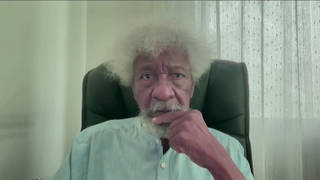

Guests
- Michael Frantithe lead singer of the group Spearhead and a spoken word poet.
He’s a cultural icon, an outspoken voice on many issues like the death Penalty, and has captured the hearts of many young women around the country. No, Juan, I’m not talking about George W. Bush, or even his nephew George P. I’m talking about hip-hop artist and spoken word poet Michael Franti. Pushing music, lyrical and social boundaries is what Michael Franti has been doing for many years now, and he is one of the foremost artists of conscience in the country. Whether it is issues relating to HIV/AIDS, encouraging his community to go and get checked, singing out against sexual violence toward women or rapping about what he calls the hypocrisy of the United States government, Michael Franti is known around the world for his intellectual and socially conscious music. From the streets of Seattle to the rally for Mumia Abu-Jamal held yesterday here in Philadelphia, Franti is seen, especially by young activists of color, as one of them.
Transcript
AMY GOODMAN: You’re listening to Pacifica Radio’s Democracy Now!, The Exception to the Rulers. I’m Amy Goodman, here with Juan González, and we’re at the Independent Media Center. That’s IndyMedia.org. You can also go to our website at democracynow.org and see this program videoed, live-stream video, as well as audio live stream. We are on public radio stations around the country, as well as public access cable stations, and we’ll be here for the Republican convention, today in the third day, as well as for the Democratic convention in Los Angeles.
Well, he’s a cultural icon and an outspoken voice on many issues, like the death penalty. No, Juan, I’m not talking about George W. Bush, or even his nephew George P. I’m talking about hip-hop artist and spoken word poet Michael Franti. Pushing music lyrical and social boundaries is what Michael Franti has been doing for many years now, and he’s one of the foremost artists of conscience in this country. His outreach to African Americans through music is, he says, how Black people communicate, whether it’s issues relating to HIV/AIDS, encouraging his community to go and get checked, singing out against sexual violence towards women, or rapping about what he calls the hypocrisy of the U.S. government. Michael Franti is known around the world for his intellectual and socially conscious music.
MICHAEL FRANTI and SPEARHEAD: [performing “Rock the Nation”]
We livin’ in a mean time and an aggressive time
A painful time, a time when cynicism rots the vine
In a time where violence blocks the summer shine
Lifetimes, go by in a flash
In a search for love, in a search for cash
Everybody wanna be some fat tycoon
Everybody wanna be on a tropic honeymoon
Nobody wanna sing a little bit out of tune
Or be the backbone of a rebel platoon
It’s too soon to step out of line
You might get laughed at you might get fined
But do you feel me when I say I feel pain everyday
When I see the way my friends gotta slave
And never get ahead of the bills they gotta pay
No way no way
Some make a living doing killing Columbia penicillin
Some are willing to play the villain they just chillin’
To pass the time, pass the information
Or pass the wine
Pass the buck or pass the baton
But can’t pass the police or the Pentagon
The IRS or the upper echelon
I think it’s time to make a move on the contradiction
Bom-Bom, rock the nation
Take over television and radio station
Bom-Bom, the truth shall come
Give the corporations some complication
Bom-Bom, rock the nation
Take over television and radio station
Bom-Bom, the truth shall come
Give the corporations some complication
AMY GOODMAN: Well, Michael Franti, welcome to Democracy Now!
MICHAEL FRANTI: Thank you very much. It’s a blessing to be here. And I’m a fan of your show, so I’m glad to be on it.
AMY GOODMAN: Well, what’s a hip-hop artist like you doing at a convention like this?
MICHAEL FRANTI: Well, I’m here, firstly, as an observer. And that’s how I get inspiration for my songs. But as an activist and a protester, I’m here on behalf of Mumia Abu-Jamal, Leonard Peltier and against police brutality in our communities and the build-up of prisons over education.
JUAN GONZÁLEZ: Your reaction to the events yesterday, both of the protesters and of the police?
MICHAEL FRANTI: Well, I was up in Seattle during the WTO protests, and I was actually surprised yesterday that the violence, the police violence, wasn’t as widespread as it was in Seattle, because it was a lot more, you know, of all-out military-style weaponry, of rubber bullets and tear gas everywhere and, you know, very swift operations to break up protests. But, you know, then again, I come onto the Independent Media website, and I see all kinds of video of people being brutalized and, you know, arrested and unjustly broken into their places where they’re organizing. And, you know, it’s — I wish it was a shock. I wish it was a surprise to see that type of thing taking place, but, unfortunately, it’s not.
AMY GOODMAN: You know, I actually first just heard you, I have to admit, earlier this year, the end of last year, at the Key Arena in Seattle. And when the music came on, I thought, “OK, I’m going to go out and book some guests for the next day,” and I’m walking out of the arena, you come on, and I said, “What is this? Who is this guy?” And I came back in. For a long time I was calling you “Spearmint,” and then someone corrected me and said “Spearhead.” How did you get the name?
MICHAEL FRANTI: Well, we took the name from Chief Shaka of the Zulus, and he invented the assagai, which is a spear that was recrafted from a long spear that you throw into a shorter spear with a larger spearhead. And he redefined warfare for the Zulus in their battle against colonialism. And so, in my development of music, I was trying to see how it is that I can redefine the tools that I use to still stay in that battle against, you know, colonial forces.
JUAN GONZÁLEZ: Tell us a little bit about your own development and your own development of your own consciousness. So, where were you raised, and how did you begin to attempt to use your music as a political weapon?
MICHAEL FRANTI: Well, I was adopted as a baby. And my mother was white, my father was Black. I was raised by a family of white parents who also adopted other children of color. And so, my whole life was spent one of questioning of, you know, who am I, and where am I going, who are my relatives. And as I got to be older, I went on a search to find my birth parents. And I found both of them and found that the reason that my mother and father had given me up for adoption is because they never got married, and my mother was white, and she felt that I wouldn’t have had a chance in her family because of their racism. And so, you know, I’ve always had an affinity for people who were trying to express themselves and have pride in themselves and want an inward journey. And I try to reflect that in my music. And so, over the course of my career, my first music was just very angry and militant. And as time went on, I began to write songs that were more about all the other wide range of emotions that I was feeling in my heart as I was going through, you know, the struggle, in a political sense and also in a personal sense.
JUAN GONZÁLEZ: And how did that personal journey evolve into your political views?
MICHAEL FRANTI: Well, I was a ball player in high school, and I went to the University of San Francisco, thinking I would just go there and play basketball, and really wasn’t that interested in school. And when I got there, I got involved in the anti-apartheid movement that was taking place on campus, and I started to find that I wanted to speak my mind and my heart, not just through this physical sport of basketball, but through poetry and through song.
AMY GOODMAN: Let’s go to another piece on your new CD. What is your CD called?
MICHAEL FRANTI: It’s called Stay Human.
AMY GOODMAN: Stay Human.
MICHAEL FRANTI: Yeah.
AMY GOODMAN: And even that, while we get to it, is a interesting story about how you’re getting this music out and your CDs out, as you take on the record industry. Let’s go to this segment.
MICHAEL FRANTI: You’re a Christian man. You know, what do you think about the Bible, which says, “Thou shalt not kill”?
GOVERNOR: [voiced by Woody Harrelson] Well, that’s a good question. I think that — I think that at the time that the Bible was written, people could not necessarily consider the world that we would be living in now. It’s desperate times, and it calls for desperate measures. And if you think about it, too, there’s an overpopulation situation in the world, and we’re going to eliminate the people who do not function within the society, and we’re going to encourage those who do.
MICHAEL FRANTI: How are you going to eliminate them?
GOVERNOR: Well, there’s various means. There’s electrically. There’s cyanide gas. There’s a lot of different options for these people. It’s relatively painless. It’s not cruel. And it makes more room in our prison systems today. And frankly, they’re overcrowded, so it’s actually a much more humane thing to do for the rest of the prison population.
AMY GOODMAN: Tell us about this, Michael Franti.
MICHAEL FRANTI: Well, the new album is called Stay Human, and it’s about a pirate radio station that is covering this election, and they’re kind of the only station that is covering it from an independent media perspective. And so, there’s this governor who’s trying to kill this woman prisoner who was an activist in the community, and all the evidence against her was very sketchy. And this governor, who’s — that was Woody Harrelson’s voice, who plays the governor — feels that if he executes the woman the night before the election, then he’ll win the election. And so he does. He executes her. And the next day, the actual murderer, who was — who this woman was convicted of killing these people, the actual murderer comes forward and confesses to the crime and tells where the bodies were, gives up the murder weapon, everything. And so, then, kind of hell breaks loose. And so, that story is all being told through this pirate radio station interludes that go in between the songs on the album.
JUAN GONZÁLEZ: Sounds familiar to another political campaign of a few years ago.
MICHAEL FRANTI: Yeah, yeah.
AMY GOODMAN: That one a Democrat. Are you going to be at the Democratic convention?
MICHAEL FRANTI: I’m planning on being there, yeah. Yeah.
JUAN GONZÁLEZ: And what do you — what do you make of this Republican claim, some of our guests who just were here before, delegates, claiming that the Republican Party has this new, inclusive approach to debate and discussion?
MICHAEL FRANTI: Well, I think that the Grand Old Party calls itself that for a reason, which is that they have some grand old values that they intend on holding onto. And until I see them inviting speakers who we from the Black and Latino community have chosen ourselves to come and speak, then I think that it’s all just lip service and tokenism.
AMY GOODMAN: Michael Franti, tell us about your meeting with Fidel Castro.
MICHAEL FRANTI: Well, last year, I had the opportunity to go to Cuba with this group called Music Bridges, and we put on a concert. And we were asked by the U.S. State Department not to speak out about anything political, and I was asked to emcee the concert. And between the songs, I did say something political, and I — because it was the weekend that we had first started bombing Kosovo, so I said, “I hope that the conflict between our nations doesn’t end up like the situation in Kosovo.” And then I called for an end to the blockade.
So, afterward, I went to — there was a party afterward, and we were told that we were going to meet Fidel. And I was there with my godmother, and she had been a woman who, before the revolution, was basically like a slave, cleaning people’s floors. And after the revolution, she became educated and went on to university. She walked up and met Fidel first, and I could see how moved she was by meeting her revolutionary hero. And so, I went up to Fidel and shook his hand, and I told him that I was happy to see that he had stood firm in creating a nation where all people had access to healthcare and to education, and that we, as Black Americans, remember that in 1959, when he came to New York, that he stayed uptown in Harlem rather than downtown. And so, the interpreters told him what I had said at the concert about the blockade, and he said, “I want to embrace you.” And he reached out, and he hugged me.
AMY GOODMAN: Well, on that note, I want to thank you very much for being with us, Spearhead, Michael Franti, as we go out with your music and we go out of the program right now. Thank you.
You are listening to Pacifica Radio’s Democracy Now! A lot of people to thank. Democracy Now! broadcast live from the Independent Media Center in Philadelphia. It is produced by Jeremy Scahill. We had help from Deepa Fernandes. Our technical director is Graceon Challenger, with assistance from Sanaz Mozafarian, Karen Pomer, David Thompson, Lisa Shaul, Nell Geiser, video production by DeeDee Halleck, Skip Blumberg, Linda Iannacone, John Hamilton. Thank you very much to Peter St. Marie, Jessica Glass and Jay, as well. That does it for the program. Pratap Chatterjee, our new media reporter. Democracynow.org is our website. Write to us at democracy@pacifica.org. From the studios of the Independent Media Center, I’m Amy Goodman, with Juan González. Thanks for listening.


Media Options