









Guests
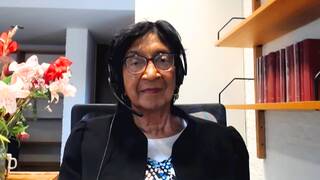
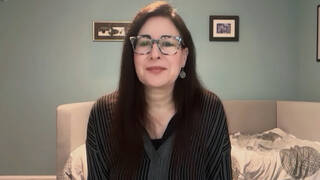
- Cherien DabisPalestinian American director and actress.
Part 2 of our conversation with Palestinian American director and actress Cherien Dabis about her new film, All That’s Left of You. It’s a new feature film that looks at 70 years of Palestinian history through the lens of one family’s experience over three generations. The film features the acclaimed Palestinian actor Mohammad Bakri, who died in December.
Transcript
AMY GOODMAN: This is Democracy Now!, democracynow.org, The War and Peace Report. I’m Amy Goodman, as we continue with Part 2, our look at the film All That’s Left of You. It’s by the acclaimed Palestinian American director and actor Cherien Dabis. It’s a feature film that looks at seven decades of Palestinian history through the lens of one family’s experience over three generations, beginning in 1948. The film has been shortlisted for an Oscar.
Cherien Dabis continues to join us in studio.
Thanks so much for staying. So, you laid out this film, this multigenerational film, starring you, yourself, and the Bakris. Mohammad died in December. It is so moving. Talk about how long this took you. This has been your lifelong dream.
CHERIEN DABIS: It has, in many ways. You know, as a Palestinian American who was born and raised in the West, my father was exiled from Palestine in 1967, and a lot like the characters in the film, he had to get foreign citizenship just to return to visit his family and the only home he’d ever known. And so, I grew up with his heartache over his exile, and I also grew up going back home with him on these visits and seeing him harassed and humiliated at checkpoints. And I also grew up surrounded by Western headlines that dehumanized us, that that made us sort of nameless, faceless numbers. And I always wondered why that was the case and why people didn’t know who we were and what happened to Palestinians in 1948 and how we became refugees.
And so, I always wanted to tell a Nakba story. And after I made my first two feature films, I really began thinking about this one. And this was back in 2014. And I decided to really sit with it and just take my time to develop it. So I actually sat with the story for five years and developed the characters and really came up with what was going to happen, what the structure was, how I was going to tell this multigenerational epic over all of these decades. And I read books, I immersed myself in different periods of Palestinian history, and just really chose very carefully how to tell the story. I started writing the script in 2020. And, you know, so it’s been more than a decade in the making. And it’s just sort of — you know, especially considering what happened while we were attempting to shoot in Palestine, sort of feels like a miracle to get it.
AMY GOODMAN: October 7, 2023.
CHERIEN DABIS: To this point, that’s right.
AMY GOODMAN: And in Part 1, you started to talk about this, but talk about the grief of everyone at that point. You were in the West Bank, just about to start filming.
CHERIEN DABIS: That’s right. We were two weeks away from shooting, and we had done all of the work, all of the pre-production. You know, everything just came to a screeching halt, and we were just thrust into total uncertainty. You know, we didn’t know if we’d be able to continue making the film, how, where. You know, my foreign crew was afraid and wanted to evacuate, understandably. You know, their families were worried. And so, you know, we had to leave — not only leave all of our work behind, but leave behind our Palestinian crew, which was absolutely devastating. You know, we had spent so many months working so closely with an amazing, incredibly talented group of people, and we were all so excited to be showing these different moments in Palestinian history that had never before been seen in cinema.
So, at that point, we had to literally start from scratch. We had to figure out where to go. We were in a state of financial crisis, logistical crisis. And that was the state in which we made the film, was just constantly uncertain about whether we’d be able to continue, always raising more money, because what we spent in Palestine was gone. You know, a production that should have taken us a few months ended up taking us 11 months, from the time —
AMY GOODMAN: You went to Cyprus?
CHERIEN DABIS: — we started shooting until the time we wrapped. We went to Cyprus first, and then we shot most of the film in Jordan, which is why it’s Jordan’s submission. We shot —
AMY GOODMAN: Submission for the Oscars.
CHERIEN DABIS: For the Oscars. We shot most of the film in the Palestinian refugee camps in the north of Jordan, which was amazing, because we got to work with the Palestinian refugee community, in, essentially, what is the telling of their story, of our story, of all of our stories.
AMY GOODMAN: And explain, because this actually isn’t a documentary. I mean, you play the star.
CHERIEN DABIS: That’s right. It’s a fiction film that is the story of three generations of one family, and in many ways, you know, really takes a look at the collective trauma of the Nakba and the legacy of that trauma, the fact that the Nakba really never ended. And so it looks at the ongoing impact of that event on one Palestinian family over time and the continuing impact of the occupation.
You know, “occupation” is such a benign term for something that is so brutally violent. And the movie shows, you know, very few moments of violence, and they’re carefully chosen moments of violence, but it’s really not about those moments. It’s about the consequences of violence and the impact of violence on one family, and how they’re shaped through these political events that we see.
AMY GOODMAN: Tell us about your character, the woman that you play, through the generations.
CHERIEN DABIS: Well, the film really follows three generations of men. It is the story of three generations of men — a grandfather, a father and a grandson — and, in many ways, traces the passage of trauma from one generation to another. My character is kind of the voice of the woman in the film and the storyteller. You know, she is — I play the wife of Saleh Bakri, and so I am the mother of the grandson, or the teenage boy who we see at the beginning of the film in the protest, which, you know, is also — kind of opens the trailer. And I am — you know, I’m telling the story. I’m attempting to heal the family through storytelling. And, you know, my husband and I in the film are faced with quite a moral conundrum, and that really is the heart of the movie.
AMY GOODMAN: So, I want to actually dissect this more. It is not a spoiler to say that your son in the film dies, because he dies right away in the film. He is killed by Israeli forces.
CHERIEN DABIS: That’s right.
AMY GOODMAN: Talk about what he — what you faced as the mom in this dramatic narrative, you and your husband, played by Saleh Bakri, in trying to get him medical aid, though he’s shot in the head.
CHERIEN DABIS: That’s right. So, you know, my character discovers that my son has been shot, and I race to where I can find him, where he’s being tended to. He was shot during a protest in the section of the film that is the First Intifada. The film takes place during four different time periods. So, in the First Intifada, he’s shot at a protest. I race to find him. We take him to a hospital in the West Bank, where he’s treated. But when they reach the capacity of the treatment that they can do there at that hospital, they have to transfer him to a hospital in Israel proper, in Haifa. And so, my husband and I are then kind of made to get permits so that we can travel into Israel proper with our son. And then we discover in this process that we also need his ID and that he also needs a permit. And this process takes, you know, a couple of days and, of course, just delays the really vital treatment that our son needs. So, through this event, we sort of see the bureaucratic violence that is imposed on Palestinians all the time, sadly.
AMY GOODMAN: I wanted to go back to a clip we played in Part 1 of this conversation — not the trailer, but the scene where, at this point, Mohammad Bakri is the grandfather, his son played by his actual son, Saleh, and his grandson. It really focuses on the grandpa and the grandchild, which goes to this issue of generational trauma.
VOICE ON TV: [translated] This military invasion of Lebanon, known as Operation Litani, and the following massacres…
OLDER SHARIF: [played by Mohammad Bakri] [translated] What’s the rush? Can’t even greet your grandpa, your sweetheart, your best friend? Who else do you have?
What a crazy family!
I smell the scent of a human.
GRANDSON: [played by Sanad Alkabareti] [translated] Grandpa.
OLDER SHARIF: [translated] I smell —
GRANDSON: [translated] Grandpa, I’m too old for that game.
OLDER SHARIF: [translated] Too old? You? With Grandpa, you can never grow up, especially not with this game. Take it back. Take it back. Take it back.
GRANDSON: [translated] No!
OLDER SHARIF: [translated] Take it back!
GRANDSON: [translated] OK, OK, I take it back.
OLDER SHARIF: [translated] How was school?
GRANDSON: [translated] Boring.
OLDER SHARIF: [translated] I had the feeling you’d say that. That’s why I have a surprise for you.
OLDER SHARIF and GRANDSON: [translated] [singing] My homeland, my homeland / Glory and beauty / Sublimity and splendor / Are in your hills, are in your hills.
AMY GOODMAN: A scene from All That’s Left of You. The grandfather there is played by the noted, world-renowned Palestinian actor and director, Mohammad Bakri. Describe this scene for us and what you’re conveying in it, for people who haven’t seen it.
CHERIEN DABIS: Well, this scene takes place during the 1970s portion of the film, where we see all the three generations on screen together — grandfather, father and grandson. And you really get to see how there are — how their identities are shaped in relationship or in opposition to each other and in relationship to what’s happening outside, you know, in Palestine.
And in this particular scene, you see the really special relationship between the grandfather and the grandson. You know, the grandfather, Mohammad Bakri — you know, it’s hard to watch this scene, because he’s so missed. And it was just — it was so amazing to work with him in this. You know, the character of Mohammad Bakri in this scene, and really throughout this portion of the film, is really teaching his son — or, his grandson about Palestine, about what they had, about what Palestine was, about Yaffa, like really instilling in him their history and where they come from. And so, you really see — you see how the father, Saleh Bakri’s character, kind of rejects this living in the past and just really wants to kind of forget the past and live in peace right now and sort of make the best of what they have. But you see that Mohammad Bakri’s character is just really holding on, and it’s causing him a lot of suffering. And he’s passing that past and that history on to his grandson. And so you see this conflict between the three generations.
AMY GOODMAN: And the song at the end of that scene?
CHERIEN DABIS: That is actually the national anthem. That is the Palestinian national anthem. It’s actually an anthem that’s used throughout the Arab world, but Palestinians used it as their national anthem, you know, for many decades, and definitely in the '70s. And so, they're sort of bonding over this, this moment of just love for their country.
AMY GOODMAN: I wanted to weave in who Mohammad Bakri is within this film and outside, best known for his 2002 documentary, Jenin, Jenin, featuring the voices of Palestinians in the Jenin refugee camp following this devastating Israeli military operation that killed 52 Palestinians. In 2007, we spoke to Mohammad Bakri on Democracy Now! about interviewing survivors of the Jenin massacre.
MOHAMMAD BAKRI: They wanted to tell their stories, because they were still in shock. When I came in Jenin, I was shocked with what I saw. I couldn’t think. I couldn’t feel. I was really just humiliated as a human being, not as a Palestinian, not as a director, not as an actor, just as a human. How come people can do such things like that in the camp?
AMY GOODMAN: That is Mohammad Bakri, who died in December. How did that, his experience, and his sons, Adam and Saleh, who also star in this film, inform this film, that is also really about your life and your family, your generations, coming right through to living here today in the United States?
CHERIEN DABIS: Well, they brought so much of their own personal experience as Palestinians living in Palestine. I learned, talking to Saleh very early on, that his mother is actually from Yaffa. And he was born in Yaffa. And at the age of 5 years old, they moved to his father’s village, and so — and he was sad to leave Yaffa. So, in many ways, he really related to the character of Salim that he plays in the film.
And, you know, to be able to cast a real family, it was really such a dream, I mean, to bring — you know, to make this an intergenerational portrait both on screen and off screen. They brought so much of their own relationship dynamics, especially Mohammad and Saleh, who have many, many scenes together in the 1970s portion of the film. They’re on screen quite often playing father and son. And they just brought so much emotional depth and nuance from their own relationship, that I just never would have been able to, I think, capture if I had cast, you know, non-family members. It was really beautiful to see them together and to see them working together. And, you know, not only do they resemble each other physically, but they also have similar — they sound alike, and they have similar mannerisms. And so, you suspend disbelief, and you really kind of go along with the fact that you’re watching a family.
And actually, I also want to mention Mohammad Bakri’s nephew plays teenage Noor, the teenager who’s shot at the beginning of the film. So it’s actually four generations of one family. And teenage Noor is Muhammad Abed Elrahman, who’s an incredibly talented young actor. And as you can see, he looks so much like Saleh and the family. And it was just, for me, really like just my dream cast.
AMY GOODMAN: Can you tell us how — when he died, how his life was honored in Palestine and in Israel?
CHERIEN DABIS: Well, I mean, you know, I wish I could have been there, but I wasn’t. My understanding was that there was just a huge service, and it looked like just massive amounts of people showed up, Palestinian and Israeli, though I’m sure, you know, Saleh could probably speak better to that. But there was just such a huge outpouring of love for him that I saw all over social media. I mean, that was the part that I really, you know, was so moved by, that it was so clear that Mohammad touched so many people and left behind such a legacy.
And, you know, Saleh recently introduced All That’s Left of You at our premiere in Palestine. We finally got to return home. We got to return the film home for our premiere in Ramallah. And he told this beautiful story that basically ended with him saying, you know, that Mohammad doesn’t die, that his dad doesn’t die, that he’s someone who lives on in our hearts, in the legacy that he left behind, in his incredibly talented children, who continue to just, you know, carry his torch and his love and his passion, not only for cinema, but for a free Palestine. And for him, those two things were the same. They were one and the same.
AMY GOODMAN: Tell us how this was received in Ramallah. You were right outside Ramallah, where you were supposed to film, and, of course, in the end, you couldn’t.
CHERIEN DABIS: That’s right. We were actually — our production was based in Ramallah during the events of October the 7th. Then we had to evacuate from there and leave our crew behind, which was so devastating. And it was so beautiful to see that we had a sold-out screening, that the theater was totally packed, and that it was very emotional. I got so many messages afterward. It just felt that there was — it felt like there was so much love for the film, but also for Mohammad, who was honored at that screening.
AMY GOODMAN: So, if you can talk about, without me saying, spoiling one of the story lines in your film — at the heart of the film is this unique moral quandary that addresses the inevitably intertwined fates of Palestinian and Israeli society, both the concessions of Palestinians, who seek to live their lives in dignity, and an Israeli society that enabled genocide and apartheid. Talk about that, without, I guess, giving away what actually happens in the film, which is based on a true story.
CHERIEN DABIS: That’s right. Our couple at the heart of the film — the character that I play and Saleh Bakri, who plays my husband — we are faced with a moral dilemma. And, you know, this is a moral dilemma that in any other context might not be a moral dilemma. It’s just a choice. And in any other context, it wouldn’t be such a loaded, such a politically charged choice. But within this context, it is. And you really see our characters go about making this decision in a very careful, very well-thought-out way. They go and they consult with an imam, and they try to understand, you know, sort of the religious — what the religious advice might be in this, in this moral quandary.
And I think, ultimately, what I wanted to do by introducing this in the film and putting this at the heart of the film was to really broaden the scope of the film and to talk about why Palestinians are suffering, you know, the fact that Palestinians are paying such a high price for European persecution of the Jewish people. And I wanted to really talk about how our fates are intertwined, that at this point the Palestinians can’t be safe without the safety of the Jewish people, and the Jewish people can’t be safe without the safety of the Palestinian people. And so, that was really kind of where the movie goes. That’s really where I wanted the movie to go in the end, and where the movie does go in the end, to really then also kind of leave the audience with whether or not they would make that choice, and whether or not, you know, they would choose humanity, the way that our — the way that our couple does.
You know, Palestinians resist in all kinds of ways. And one of the ways that I’ve seen Palestinians resist again and again is by choosing humanity. You know, the forces of oppression want us full of hate. They want our hearts full of hate and anger. That’s how they dehumanize us, you know. But when we hold on to who we are, when we hold on to our love, when we hold on to our humanity in these unbelievably difficult circumstances, then I think that’s when we win. And I know it’s incredibly difficult to do, and, you know, easy for me to say from my position of privilege, but I must say that because I’m not living in — you know, under the threat of violence, I feel even more responsibility to kind of really make sure that I’m holding my humanity.
AMY GOODMAN: As I look at you now, I mean, you’re the director of this film, but you also star in it, the mom of the boy who’s killed by the Israeli forces. And we watch you age throughout. Talk about — I mean, like Mohammad Bakri, he was an actor, he was also a director.
CHERIEN DABIS: That’s right.
AMY GOODMAN: But talk about what this meant for you to star in the film and also direct it. How do you do that?
CHERIEN DABIS: Well, it was tremendously challenging, I have to say, I mean, absolutely, just a radical shift in perspective to go from acting to directing. You know, you’re directing — when you’re directing, you’re sort of looking at the world through the widest possible lens, and you know everything that’s going to happen, and everything is crystal clear. And then you jump into, you know, the role, and you’re on camera, and you have to forget everything and zoom into the longest possible lens and just focus on this one perspective. And so, it’s this constant mind game, you know, this kind of schizophrenic, radical shift in perspective that is tremendously challenging.
But I learned so much by diving into this part and playing this character. I must say, she taught me so much, so much grace and humility. And in many ways, I really wanted to do it because I felt such a kinship with her, in that she is, you know, in so many ways, trying to heal the family through telling this story. You know, at the beginning of the film, we see that she’s speaking directly to us, the audience. But at the end of the film, we discover she’s actually talking to someone and telling someone her family’s story, in order to try to bring some closure or some healing or some sense of relief to what they’ve been through. And I think that I, as the filmmaker, was also looking to tell the story to explore my own intergenerational trauma and see if I could bring some kind of healing, or at least transform that trauma into something useful through this film.
AMY GOODMAN: So, we’re speaking as the film is opening around the country. It just opened at the Laemmle in Los Angeles. It’s at the Roxie in San Francisco.
CHERIEN DABIS: That’s right.
AMY GOODMAN: Here in New York, it’s at New Plaza on the Upper West Side. It’s at Angelika. It’s at Kips Bay. But it’s going beyond New York. It’s opening in Chicago as we speak.
CHERIEN DABIS: Chicago, Miami, many other cities, that’s right. Today.
AMY GOODMAN: And most people don’t think about the process of how films open and where they open. It is quite something that the films shortlisted for the Oscar, whether in the dramatic narrative category, like yours and The Voice of Hind Rajab, there are a number of Palestinian films and Israeli-Palestinian films. But it is extremely difficult for these films to get distribution. Talk about what it means to have these films come out, what it means for audiences to come out to see these films.
CHERIEN DABIS: Yeah, these films have historically not gotten major distribution or major streaming. You know, Watermelon Pictures was formed in recent years in order to really, you know, take these movies on and do them justice. They felt it was really important to get these movies out into the world and get them seen. And so, I’ve partnered with them to get this movie out.
And really, I mean, it’s so imperative that people support these films. You know, if they’re not seen in cinemas, then there’s just no other way for them to be seen, and there’s no other way to prove that there is an audience for these films. And therefore, filmmakers like myself will not get to continue telling these stories. And, you know, with a story like this, a story that’s been omitted from history books, that has been denied, that is actively still being denied and censored and suppressed, it is really an act of resistance, not just to make the film, but to support the film. It’s an act of solidarity to buy a movie ticket. It is an act of resistance to show up at the movie theater and support and watch this film.
And I also think that the film — you know, I think that people will be surprised by the film. I think that, you know, the film isn’t just about devastation and kind of these decades of political events. This is a film about a family. It’s a film about the love that it takes to survive all of this. It has tenderness and compassion and humor. And I think, you know, there’s many different colors within it, so I think that people will also really find that they’re quite entertained. I think people often think that watching Palestinian films is like eating broccoli or something, you know, but a lot of these films that we’re seeing now are really — they’re also made to entertain and to really bring an audience in and to be seen on the big screen with a group of people, you know. And I really think that there is kind of collective healing in coming together and watching these films, especially with —
AMY GOODMAN: Talk about that. I mean, that’s so important, because we may be seeing the end of theaters as we know it. We’re around the corner from a movie theater that was just taken down, and it’s going to be a condo or something.
CHERIEN DABIS: Yeah, it’s so sad. I mean, I think it’s really amazing to walk into a room, to go into a dark room with a bunch of strangers, to put your phone aside — you know, these days, we are so distracted by our phones; we’re constantly just on them — but to be able to just sit and focus and immerse yourself in an emotional story. And, you know, cinema is all-immersive. You know, you have the big picture. You’ve got the surround sound. You’ve got the reactions of the people around you. And it really creates a different environment. It’s a different experience. It’s a different kind of immersion.
And I think with films like this, it’s also a bit of a collective grieving and a collective catharsis. And I really think with everything we’ve seen in the last couple of years, we need that, that I think that there’s something healing in that for those of us who are far away and who’ve been just witnessing all of the devastation. You know, I’ve heard amazing stories about strangers meeting each other after screenings, just having deep conversations about what they just saw, hugging each other during the credits, because, you know, they see that the person next to them is sobbing, and then they — you know, they want to be there for them — just really beautiful stories about how the movie has brought people together. And I really think that these kinds of films have the potential to do that.
AMY GOODMAN: No Other Land won an Oscar last year. That was in the documentary category.
CHERIEN DABIS: That’s right.
AMY GOODMAN: About what’s happening in Masafer Yatta.
CHERIEN DABIS: That’s right. That’s right.
AMY GOODMAN: In the West Bank.
CHERIEN DABIS: That’s right. And it was widely seen, as well. It really — people really showed up at the theater for that film. And it was amazing, because we hadn’t seen really anything like that, not only for a Palestinian film, but a Palestinian documentary. You know, documentaries, historically, sadly, don’t do as well at the box office. And so, for that film to perform as well as it did at the box office really sent a message, I think, to distributors. And I think we need to keep sending that message, so that major distributors and streamers will change their tune and will really understand that there is an audience for these films, that people are hungry for this information that has been kept from them, and the world really deserves to see and hear and understand the Palestinian perspective.
AMY GOODMAN: Cherien Dabis, I want to thank you so much for taking this time with us.
CHERIEN DABIS: Thank you.
AMY GOODMAN: Palestinian American director, producer, screenwriter, now distributor, but actress in this film. Her feature film, All That’s Left of You, has been shortlisted for an Oscar. It’s out in theaters around the country, here in New York, in Chicago and Los Angeles, opening now in Chicago, in Dallas and beyond. To see Part 1 of this conversation, go to democracynow.org, and to see our interviews with Saleh Bakri, to see our interview with Mohammad Bakri, years ago, when he did Jenin, Jenin. Saleh and Mohammad are among those who star in this film. This is Democracy Now! I’m Amy Goodman. Thanks so much for joining us.



 Top
Top
Media Options