






 Watch Full Show


Guests
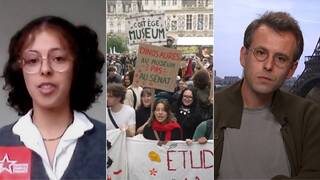
- Rayyan Seriketmember of Fédération Syndicale Étudiante, the French student union federation.
- Harrison Stetlerindependent journalist and teacher based in Paris.
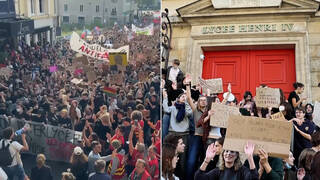
Hundreds of thousands of protesters marched in over 140 cities across France on Saturday, demanding relief from the high cost of living, more funding for public services and improvements to deteriorating schools, among other grievances. The demonstrations were the latest — and largest — in a series of protests that began in September with high schooler-led demonstrations against overcrowded classrooms and crumbling school infrastructure. Some cities saw property destruction, arson and theft on Saturday, with city halls and other symbols of the state coming under attack. Officials said nearly 1,000 police officers were injured and some 2,400 people were arrested.
“What is frustrating to see is how little the police violence is addressed and talked about, which is really the main violence and the real violence today that is taking place in France,” says Rayyan Seriket, a member of the French student union.
“We’re talking about shattered jaws, high schoolers and adolescents who have been blinded,” adds Harrison Stetler, an independent journalist and teacher based in Paris.
This all comes as Marine Le Pen of the far-right National Rally party is leading in the polls six months ahead of France’s elections. “This situation is essentially what Marine Le Pen hopes for,” says Stetler.
Related Story
 StoryOct 06, 2026French High School Students Lead Mass Protests over School Funding, Inequality; Thousands Arrested
Transcript
AMY GOODMAN: We begin in France, where hundreds of thousands of protesters marched in over 140 cities across France Saturday, demanding relief from the high cost of living, more funding for public services and improvements to deteriorating public schools. The demonstrations were the latest — and largest — in a series of protests that began in September with student-led demonstrations against overcrowded classrooms and crumbling, mainly high school, infrastructure, which grew into a broader nationwide movement.
Some cities saw property destruction, arson and theft, with 1,500 stores damaged and attacks targeting symbols of the state, including city halls in Lille, Marseille and Limoges, and a tourist office in Lyon. Officials said nearly 2,400 people were arrested, and close to a thousand police and security personnel were injured. France’s Interior Minister Laurent Nuñez said police had “lost control,” and [offered] to resign, an offer Macron rejected.
In a televised address Sunday, Macron condemned the violence but also acknowledged the legitimate grievances of the demonstrators.
PRESIDENT EMMANUEL MACRON: [translated] Dissenters from far-left groups, joined by numerous criminals, unleashed unrestrained violence in our cities. Shops were looted. Public buildings, stores and town halls were attacked, and some were destroyed. Several hundred police officers and gendarmes were injured. Watching these images, we all ask ourselves: What are they thinking? How can French people do this to France?
Yesterday, several hundred thousand of our fellow citizens demonstrated with a desire to voice legitimate demands. We must never confuse them with those who destroyed, vandalized and looted. These demonstrators expressed concern about the cost of living and fuel prices, which stem from the conflict that began in the Persian Gulf, a conflict in which France has taken no part but whose consequences we are suffering. I fully understand their concerns.
AMY GOODMAN: Hours after his address, President Macron arrived in Kuwait to begin a tour of Arab Gulf states today, including the United Arab Emirates, Bahrain and Qatar, aimed at strengthening economic and military partnerships that have been upended by the U.S.-Iran war. Before flying to Kuwait, Macron said the visit would help secure energy supplies and respond to protesters’ concerns over rising fuel prices.
Meanwhile, France’s far-right party criticized the government and the violence over the weekend. Far-right presidential candidate Marine Le Pen offered a, quote, “path of rebirth” if she wins the next election.
MARINE LE PEN: [translated] In six months, the French people will be able to choose a different path, that of authority and renewed security, that of sovereignty and a respected democracy. This is what I propose to you. Make no mistake: For France, it will be a path of hope, a path of rebirth. Long live the republic, and long live France.
AMY GOODMAN: Many of the hundreds of thousands who marched peacefully Saturday say there was too much focus on property damage by the media and not on the issues of austerity and police violence against children. The protests were begun by high school students. This is a young protester in Paris who works in the publicity industry.
PROTESTER: [translated] They want a better life for a little cheaper, and that’s what we want, too. That’s why we are drawing together, and everyone is here with the students, with the farmers and everyone who wants a decent life in France in the future.
AMY GOODMAN: For more, we’re joined by two guests. Rayyan Seriket is a student in France and a member of the FSE, the French student union federation. She’s joining us from Lyon. And from Paris, we’re joined by Harrison Stetler, independent journalist and teacher. His latest piece for The Nation is headlined “Has France’s Government Overplayed Its Hand?”
Let’s begin with Rayyan. Rayyan, thanks so much for being with us. Explain what these protests are about, beginning with the high schoolers who took to the streets.
RAYYAN SERIKET: Thank you for having me.
The reason behind those protests, indeed, it started with the high schoolers demanding better studying conditions, and it quickly extended to pretty much the whole French people. The reason behind this is that the demands are pretty much the same. People are demanding better life conditions, better living conditions, better studying, working conditions, a lower cost of living. And it’s really — what we can tell and get from those protests, it’s the reject of the current government and how little people still have faith in that government, a government that had made a bunch of promises over the years but mostly has broken them and, you know, applied a lot of harsh policies on the French people regarding, again, cost of — cost of living, sorry, and just the working and studying conditions. And so, this is the common point. The reason why those protests are so wide and extended wider than just high schoolers is because it’s the whole question not only of our living conditions, but also of who we are governed by and what interests they have, and the reject of a government that has shown time and time again that they will always choose their economic interests over the French people’s.
AMY GOODMAN: And talk about the joining of unions, college students. Who is supporting these protests? And then, can you respond to the violence and how President Macron has responded, before heading off to the Gulf, condemning the violence, the French government shoring up its military sales to various Gulf nations?
RAYYAN SERIKET: Yeah, well, most people are supporting the protests that are taking place — like you said, high schoolers, obviously, but also students, the working class very widely, as well, either in public services or, you know, private companies. A lot of people have joined and supported the protests and the demands that were made, because it’s about things that include pretty much the whole society. And we have seen also protests in suburbs, which are more working-class neighborhoods in France, and so a lot of protests also took place there, again, regarding living conditions and also police violence.
And so, to kind of respond to what President Macron was saying, he, again, said the police were being professional, and, again, blamed the violence that took place. But what is frustrating to see is how little the police violence is addressed and talked about, which is really the main violence and the real violence today that is taking place in France. It’s people, children often, that have lost their hands, their eyes, their teeth over the last few weeks. It’s people struggling to get food in their house by the half of the month. This is the true violence. It’s how violently and hardly the government has chosen to respond to the demands and how it keeps affecting people, and sometimes really young people.
AMY GOODMAN: I want to bring Harrison Stetler into this conversation. You have written a piece in The Nation, “Has France’s Government Overplayed Its Hand?” Can you explain what you mean? And also, as the elections are coming up in France, there is great concern that the property damage and street violence will benefit the more far-right parties. Can you talk about the significance of what this might mean for the National Rally — that’s Marine Le Pen’s far-right party — Harrison?
HARRISON STETLER: Sure. Well, first off, thanks, Amy, for having me on the show.
In response to your first question about, I mean, what from the beginning has been the French government’s response to this crisis, I mean, I think it’s been — there’s been many facets. First of all, we’ve seen from the beginning, essentially, a zero-tolerance policy to protests in many respects. Yes, there was indeed national, wide-scale, this past Saturday, protests and marches that were, as you mentioned in your introduction, widely peaceful. But from the beginning, a major component of the response coming from state authorities, from political authorities and government has been to essentially treat the uprising or the social movement this autumn as a case of urban violence.
I think many of the police responses recall what we’ve seen in recent cases of rioting over things like police violence in 2023, when there were three days or four, several days of, essentially, wide-scale national rioting over the police killing of a young man in the Paris suburbs. And essentially, from the beginning of these last few weeks of revolts, what have we seen from the government? Basically to revamp and fall back on what is, by this point, an extremely established playbook, essentially, on how do you police public disorder, how do you police questions or situations when popular frustration, essentially, hits the streets out of a reflection of the lack of, essentially, political outlets for these frustrations.
As far as what we’ve seen over the last weekend, I think I’m — personally, I’m actually quite surprised by the government’s response. And I think one of the big elements of the last 48 hours specifically has been unpacking the degree to which the government was, frankly, unprepared, as well. And what we were seeing from state intelligence services last week were estimations of anywhere between 100,000 and 200,000 people expected to come out on Saturday. And by the government’s own recognition, we’re at over half a million, or as many as 800,000, according to organizers. So, it seems like they vastly underestimated.
And what you see in these sorts of situations, I think, and it’s a lot of the criticism coming from the left, is in these situations, when the government essentially has its back up against a wall, what is an initial response? That is police charges, tear gas, rubber bullets, which has now resulted in a growing list of injuries among protesters. We’re talking about shattered jaws, high schoolers and adolescents who have been blinded. So, no, this is, unfortunately —
AMY GOODMAN: I mean, we’re talking about war-like injuries.
HARRISON STETLER: — the latest in a long pattern of — absolutely. I mean, what I — from this past Saturday, there’s at least one new case of a student being blinded, another adolescent who, again, lost a hand by a grenade that was launched into a crowd. So, no, these are — this is really a reflection of what has developed over many years, what has accelerated under Macron’s administration, which is, essentially, a model of zero-tolerance escalatory policing.
Obviously, there are conversations to have, and there are investigations to be conducted into cases of rioting over the past weekend that saw not only luxury stores or big box stores looted, or a town hall burnt to the ground, but also saw mom-and-pop businesses, what we would say in the United States, looted, as well. So, there are absolutely investigations that will take place. But first of all, I think it must really be underlined that this is the latest instance when, I mean, what the French call the model of public order in France, le maintien de l’ordre public, has again shown, essentially, a first escalation model coming from police forces.
I mean, to return to your second question, I guess, on the Rassemblement National, I mean, I, to be fully frank, am increasingly worried that we’re — we have long since entered an extremely dangerous situation as far as French electoral politics go. Since 2024, the situation in Parliament is extremely unstable, divided between three minority blocs, of which the governing centrist coalition has essentially been unable to do anything of substance to respond to the economic crises that are bringing people out onto the streets. Marine Le Pen, what is her response? It is — it was written on the wall from the beginning, and it is law and order, law and order, law and order.
And unfortunately, I mean, the situation like we have in France, what does it require? It requires that civil society look in an extremely lucid and clear way at what is a social crisis that is very revelatory of Macron’s governing style over the last 10 years. And I fear that French political culture, French media, French civil society is increasingly unable to make, essentially, the kind of lucid analysis and have the type of outlook we need to truly pick apart what is happening in this country.
And this situation is essentially what Marine Le Pen hopes for. I mean, I think they think — their strategic reading right now is: “This is absolutely what fits into our appeal, what fits into what is going to make voters choose us next spring.” I mean, I don’t want to, obviously, be the bearer of bad news this early, but, I mean, it must be noted that, essentially, what do all opinion polls show at this point? That Marine Le Pen is essentially the only candidate who’s guaranteed to make it through the first round runoff. And essentially, against contenders, she has the advantage at this point. Obviously, a lot can change, but for Marine Le Pen, within the Rassemblement National party, I think the mood is probably quite positive right now.
AMY GOODMAN: Harrison Stetler, thanks so much for being with us, independent journalist and teacher based in Paris. We’ll link to your piece in The Nation, “Has France’s Government Overplayed Its Hand?” And Rayyan Seriket, a student and member of the French student union federation, speaking to us from Lyon.
Coming up, we go to the occupied West Bank, where masked Israeli settlers brutally attacked Washington Post photojournalist Heidi Levine. You’ll hear her in her own words from her hospital bed. Stay with us.
[break]
AMY GOODMAN: “You Are the One Who Decides.”



 Top
Media Options