



 Watch Full Show


Guests
- Feroze Sidhwasurgeon in California who has worked on humanitarian deployments in Gaza, the occupied West Bank, Haiti, Zimbabwe, Burkina Faso and Ukraine.
Links
Israel’s latest bombing of Nasser Hospital in Gaza on Thursday killed six Palestinians, including surgeon Dr. Rizk Abu Shaira. He was featured in the recent documentary American Doctor, which follows international medical volunteers in Gaza’s battered hospitals as they work alongside Palestinian colleagues.
Israel claimed, without providing evidence, that it targeted a senior Hamas militant in the hospital strike. Israel has repeatedly bombed medical facilities in Gaza since the start of the genocide in October 2023, even though such attacks are prohibited under international law.
“It’s just barbarism. I don’t know why we’re supporting this,” says Dr. Feroze Sidhwa, one of the titular American doctors in the documentary, who demands accountability for Israel’s actions and a change in U.S. policy toward the country. “That’s an American-made bomb dropped by an American-made airplane burning American-supplied jet fuel.”
Sidhwa also comments on the catastrophic flooding in Gaza that has swamped the temporary shelters of tens of thousands of displaced Palestinians as Israel continues to block the entry of shelter materials into the territory. As a result, “babies are going to die of hypothermia in Gaza for the fourth year in a row,” Sidhwa says.
Related Story
 Web ExclusiveAug 14, 2026Dr. Thaer Ahmad & Dr. Feroze Sidhwa on Volunteering in Gaza & New Film “American Doctor”
Transcript
AMY GOODMAN: This is Democracy Now!, democracynow.org. I’m Amy Goodman.
In Gaza, funerals have been held for a surgeon, a teenage boy and four other Palestinians killed when an Israeli airstrike targeted the Nasser Hospital complex in southern Gaza. The surgeon was killed in the strike, Dr. Rizk Abu Shaira, featured in the recent documentary American Doctor. Footage filmed inside the hospital revealed severe destruction, rooms littered with debris and overturned furniture, cables hanging from broken ceilings, injured patients moved on stretchers through hallways covered in rubble.
NBC reports debris photographed at the scene shows fragments of a GBU-39 small diameter bomb produced by the U.S. aerospace and weapons manufacturer Boeing.
This is Dr. Ayman Abu Obeid, who was working an overnight shift and resting in a staff room when the explosion hit, leaving his right foot badly injured.
DR. AYMAN ABU OBEID: [translated] As usual, we were on shift at the hospital. We have rooms where we stay. We were surprised by a strike directly on the room we sleep in. Total destruction. No light left, no help left, no… I don’t know what happened. All of a sudden, the world turned upside down. It went dark all at once. Honestly, it was very terrifying.
AMY GOODMAN: The director of the Nasser Medical Complex, Ahmed Al-Farra, condemned the Israeli attack. Al-Farra spoke during funeral services in Khan Younis Thursday.
DR. AHMED AL-FARRA: [translated] This targeting and these crimes are happening under an alleged truce that the Israeli occupation talks about. We are talking about a series of attacks on hospitals. We are talking about the seventh targeting of Nasser Medical Complex. Unfortunately, the occupation pays no attention, not to a health system or to international laws or to international constitutions. …
Dr. Rizk Abu Shaira never hesitated to provide service to his patients. He was on top of his work. He was in his room between following up cases, treatments and preparing cases for surgery. But it was God’s will, and he was martyred in this treacherous strike. There are also doctors who were wounded in this attack.
AMY GOODMAN: We’re joined now by Dr. Feroze Sidhwa, general trauma critical care surgeon in California, who’s volunteered at Nasser Medical Complex alongside Dr. Rizk, who was just killed. Footage of the two of them working together appears in the new documentary American Doctor, which tells the story of Dr. Feroze and two other doctors from the United States who volunteered in Gaza.
Feroze, thanks so much for being with us. Our condolences. If you can talk about the doctor, the surgeon who was killed in this latest Israeli military strike on Nasser Hospital?
DR. FEROZE SIDHWA: Yeah, you know, I met Dr. Rizk probably on March 7th of last year, when I got to Nasser. And during that time, there was a ceasefire going on, so there was less bombing and shooting, and we could actually go around on rounds and, you know, see all the patients. And, you know, there are some — most surgeons like surgery, right? But Rizk was one of those surgeons that just loves surgery. Like, he could be in, like, the middle of his daughter’s wedding, and you’d be like, “Do you want to go do surgery?” and he’d be like, “Yes, let’s go. Let’s go right now.” He just absolutely loved surgery. He was a sweet man. He was the first one running ahead to get the patient’s dressings off on rounds.
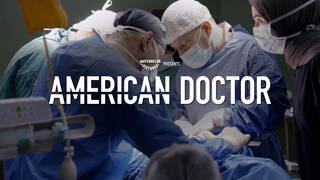
And so, I met him in the ICU on — or, actually, I met him at morning report, and then we went to ICU rounds. And there was probably a man in his early thirties with just devastating intestinal injuries, total disaster of a case. It was very obvious this man was going to die in Gaza. Here, he would have lived, but there’s no way he was going to live in Gaza. And so, the whole team is kind of saying, “Well, you know, maybe we should just let nature take its course.” And Rizk said, “Yeah, but we can operate on him. We can operate on him.” And everyone rolled their eyes. And I said, “Well, Dr. Rizk, I’ll operate on him with you. Let’s go operate.” So, that’s what’s on that movie poster that you saw. And so, you know, when we go around to film festivals, it’s his picture that’s sitting there with me.
AMY GOODMAN: I mean, you just —
DR. FEROZE SIDHWA: And we’re doing that case, yeah.
AMY GOODMAN: The film was just at IFC, and you were speaking afterwards. That image of you two doing surgery, so utterly painful. And you, yourself, survived a strike on Nasser Hospital. What is your response to what has just taken place?
DR. FEROZE SIDHWA: Well, it’s just — it’s just barbarism. I mean, I don’t know why we’re supporting this. You know, you showed the pictures of the — there were two munitions fired at Nasser this time. One exploded, which — and the remnants of that is a GBU-39 small diameter, like you said. The other one, that didn’t even explode, is sitting right there. Yeah, that’s the image of it right there. Somebody just picked it up and put it in — just think about — that’s an American —
AMY GOODMAN: And put it on a gurney.
DR. FEROZE SIDHWA: Put it on a gurney, because where else are you going to put it in a hospital? That’s an American-made bomb dropped by an American-made airplane burning American-supplied jet fuel, probably with targets selected by AI software, like your earlier guests were talking about, developed in the Bay Area and in Seattle, that ends up in a hospital bed. That shouldn’t happen. That’s just insane.
You know, this — and I hate to make it political, because Rizk was my friend, but this is why somebody like Schumer shouldn’t be the next, you know, majority leader. It really should be somebody like Chris Van Hollen, who’s been on the right side of these matters.
AMY GOODMAN: He went to Gaza.
DR. FEROZE SIDHWA: He tried to go to Gaza.
AMY GOODMAN: Tried.
DR. FEROZE SIDHWA: He went to Rafah. He reported very honestly on what he saw, saying, “Look, there are maternity kits sitting in these warehouses because they have scissors that are this big, and you’re saying that’s a threat to the state of Israel. This is ludicrous, you know?” And he’s just — you know, he’s an honest liberal. He’s — it’s a rare, rare breed.
AMY GOODMAN: So, talk about the other doctors and the patients who were hit.
DR. FEROZE SIDHWA: Yeah, so, Dr. Ayman, whom you showed, Dr. Ayman Abu Obeid —
AMY GOODMAN: Laying in the bed.
DR. FEROZE SIDHWA: He was laying in the bed, saying, you know, it was a terrifying attack, and things like that. He’s the head of the surgical department at Nasser. He’s a great guy, very experienced, like Dr. Rizk. I think both of them must have 20, 25 years of experience. I don’t remember where Dr. Ayman trained, but Dr. Rizk trained in Ukraine. And he really — he actually spoke Russian fluently because of that. And he really — he missed it. He loved it. He loved his time there.
AMY GOODMAN: So, he’s the head of surgery.
DR. FEROZE SIDHWA: He’s — yes, Dr. Ayman.
AMY GOODMAN: And another man lost both his legs?
DR. FEROZE SIDHWA: As far as I understand, Dr. Mohammed has been very badly injured. Dr. Ayman is injured and in the hospital, admitted, but Dr. Mohammed, from what I understand, is very likely to die, as well.
AMY GOODMAN: What impact will the suspension of four departments in Nasser Hospital — radiology, laboratories, surgical operations, inpatient surgical wards — have on providing services to Palestinians, also in the midst of the massive rain, where all of these thousands of tents are being held up —
DR. FEROZE SIDHWA: Yeah.
AMY GOODMAN: — and a baby dies of hypothermia?
DR. FEROZE SIDHWA: Yeah, it’s an utter disaster. I mean, so, the people of Gaza, the probably less than 2 million of them that are left, are certainly among the sickest people in the world. It’s a population of half children, 70% refugees. Ninety percent of the buildings in their society have been destroyed, or at least what we would call in the U.S. destroyed. They’re uninhabitable. Seventeen hundred of their healthcare workers have been killed, huge numbers of aid workers, poets, doctors, professors. Everybody who makes a society run has been targeted. All of the physical infrastructure, even the sewage system, has been destroyed.
And now the makeshift infrastructure that they live in, literally sticks stuck into the beach mud, you know, the sand and the mud on the beach, so that you can wrap some tarping around it and hopefully protect yourself from the winds and the rain that come onto this coastal plain in the winter every year, are just flooding and destroying all of this makeshift shelter that people have.
And like you said, you know, actually — you mentioned babies dying of hypothermia. Sarah Parkinson, she’s a professor at SAIS in D.C. She and I wrote a paper for Foreign Policy, which people in the government read, in — I think it was November of 2024. We said, last winter, babies died of hypothermia in Gaza simply because the shelters that are a few miles away were not allowed to come in. This year, meaning 2024, 2024-to-2025 winter, babies are going to die again of hypothermia, because the shelters that are a few miles away are still not being allowed to come in. And now we’re at another one. Yeah? Right? Like, we had another winter, 2025 to 2026, and now we’re going 2026 into 2027. And again, babies are going to die of hypothermia in Gaza for the fourth year in a row. It’s just shocking behavior. And taking away the medical system is — I guess it’s Israel’s cherry on top. I’m not sure how to describe it.
AMY GOODMAN: Can you go to Gaza? Can you go back?
DR. FEROZE SIDHWA: So, I tried to enter in November, and I was blocked from entering then. Strangely enough, I went to Israel to give talks then, so obviously the security wasn’t an issue. And I’m currently part of a petition to the Israeli High Court of Justice. We’ll see if that goes anywhere. And they should rule on it in December. If they do, I’ll try and go back. And if they don’t rule in our favor, I’ll try and go back anyway.
AMY GOODMAN: And your response to President Trump saying on Election Day, in response to Dr. Abu El-Sayed in Michigan calling for an end to Israeli military — U.S. aid to Israel, “We’ll cut off $4 billion. They don’t need it, and they don’t even want it,” he said, responding, saying, “Yes, the money should stay at home.” President Trump.
DR. FEROZE SIDHWA: It shows how extreme the change in public opinion has been over the past three years. You know —
AMY GOODMAN: And he thought he could affect things on election morning.
DR. FEROZE SIDHWA: And, yeah, yeah, I think he thought this was his way of winning, but it obviously was not. But, you know, I think people have seen so much, so much death and destruction, and I think they remember that it wasn’t just under Trump. You know, most of the killing and destruction happened under Biden. A lot of it’s happened now, too, under Trump. But I think it’s very hard for people to forget what they saw, you know, especially young people, especially politically engaged people, and these folks you have out here today. They will not forget what they saw. And I don’t think they’re willing to go back to business as usual. And if Donald Trump says some random nonsense like he tends to, I think people are pretty dismissive of that now.
AMY GOODMAN: Dr. Feroze Sidhwa, thanks for joining us today, general trauma critical care surgeon from California, featured in the documentary American Doctor about his time volunteering in Gaza. The surgeon that was just killed at Nasser Hospital was a surgeon that he befriended and also worked with, performed surgeries.
Coming up, we’ll look at the Trump administration’s escalating threats against Democratic lawmakers over their plans to investigate the president. The White House claims such probes, quote, “may cross the line into blatant criminality.” Stay with us.
[break]
AMY GOODMAN: Amadou & Mariam, performing in our Democracy Now! studio.




 Top
Media Options