








 Watch Full Show


Topics
Guests
- Marisa Francoco-founder and director of Mijente, a national organizing hub for Latinx and Chicanx communities.
Links
In 2024, Donald Trump won the presidency with the support of 44% of Hispanic voters, suggesting that a major realignment in party preferences might be underway. But just two years later, it appears much of that support has eroded. Sixty-one percent of Hispanic voters say they will now support Democrats in the midterms, including 11% who previously had voted for President Trump.
We get a bird’s-eye view of what to expect from the Latino vote from Marisa Franco, the co-founder and director of the advocacy organization Mijente. While ICE brutality will be at the front of voters’ minds, she says, Democrats cannot continue to take Latino voters for granted. “The vast majority of Latinos are working-class. Quite simply, they voted for Trump because they were looking at issues of economy, cost, inflation,” explains Franco. “And at the end of the day, these same issues have worsened under Trump’s administration, under Republican control. So people, I think, are looking for someone who’s going to explain what’s happening and propose solutions and be dogged about finding them.”
Related Story
 StoryNov 03, 2026Democratic Socialists on the Rise: Darializa Avila Chevalier & Claire Valdez Set to Win House Seats
Transcript
AMY GOODMAN: This is Democracy Now!, democracynow.org.
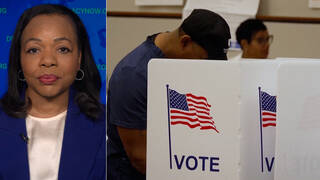
We end today’s show looking at how Latino voters could impact today’s midterms. In 2024, President Trump won the presidency with the support of 44% of Latino voters across the country — a significant shift following decades of Democratic advantage among Latinos. Two years later, it appears much of those Republican gains have eroded, and Democratic voters are significantly more motivated to go to the polls. Polling suggests cost of living is the top concern for all voters, including Latinos, who now trust Democrats more than President Trump to manage the economy. But the Trump administration’s violent crackdown on immigrants has also hurt his support among Latinos.
This is a former Trump supporter in Miami, Wayne DeMario, whose wife Yamile, who is Cuban, was recently deported to Mexico.
WAYNE DEMARIO: I am praying that everybody votes these pieces of garbage out. That’s it. Team up, everybody. I don’t care. Don’t be afraid that you voted for this jerk. Don’t be afraid that you voted for this guy. Team up and vote against him. Don’t worry about losing your guns. You’re not going to lose your guns if you vote Democrat. You’re not going to lose anything. Matter of fact, if I would have voted Democrat, I wouldn’t have lost my wife.
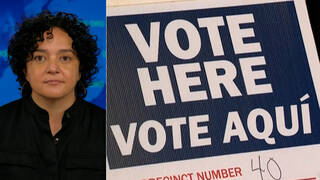
AMY GOODMAN: To talk about this and more, we’re joined by Marisa Franco, co-founder and director of Mijente, a national digital organizing hub for Latinx and Chicanx communities, joining us from Houston, Texas.
Thanks so much, Marisa, for being there. The New York Times has said Latinos are the most important swing vote in today’s election, making up 20% of registered voters in two dozen highly competitive House races, from Arizona, California, Colorado, Florida, Pennsylvania, Texas and other states. Can you talk about the shift that we’re seeing from 2024?
MARISA FRANCO: It’s good to be with you, Amy.
Yeah, it’s going to be a big night. The forecasts show a 15-point swing towards Democrats from Latinos and in heavy Latino districts. Just a quick roll call. You look at Florida, a place that oftentimes people have counted out as gone to the right. I’m really looking at the Boricua vote in Florida. I’m looking at Venezolanos, who were heavily hit by ICE. You just heard the gentleman talking about the impact of ICE and deportations on himself personally, feeling that, that Trump remorse, that MAGA remorse.
Georgia and North Carolina, and just overall in the Southeast, I’m looking at Latinos continuing to advance. I think you’re going to be looking — I’m really paying attention of, like, where are we making advancements and where are we helping break through. Georgia and North Carolina, I think you’ve seen the growth of Latino populations and actually be a flank and, what I would affectionately say, being helpers and not hurters, not only in Georgia and North Carolina, but also in Mississippi in a key race there.
Then we go to the Sun Belt — New Mexico, Colorado, Nevada and my home state of Arizona — where I am hoping that voters in southern Arizona take out “el trumpitas” Juan Ciscomani out of the House.
And then, last but not least, Texas, which I think could be the story of the night for the Latino vote. We have Democratic candidates who are knocking on the door. No Democratic candidate has won statewide in Texas for over 30 years. The early vote nationally is up 44% in comparison to the ’22 midterms. A big chunk of that is young voters, infrequent voters. That is the case here in Texas.
So, the question tonight is going to be: Will these numbers get at presidential levels, or will we surpass the early vote from '22? Which candidates will voters go for? And what is the message they're sending to the Trump administration?
AMY GOODMAN: So, talk about, from the deadly immigration raids to the spiraling economy due to Trump’s war on Iran, how those who supported Trump in 2024 shifted their views. And what does it take for Democrats to keep that support, Marisa?
MARISA FRANCO: So, I think it’s important to understand that Latinos, overall, are very, very working-class. The vast majority of Latinos are working-class. Quite simply, they voted for Trump because they were looking at issues of economy, cost, inflation. The people talk about the price of eggs. And, you know, we can talk about Trump’s overreach, but, in essence, what voters are looking at is impact. And at the end of the day, these same issues have worsened under Trump’s administration, under Republican control.
So people, I think, are looking for someone who’s going to explain what’s happening and propose solutions and be dogged about finding them. I think that it is an assumption to believe that whatever happens in this election, that Latinos are back in the Democratic tent for good. I believe that over the last election cycles, Latinos have been showing — declaring, in essence, their independence from partisan politics. And so, I think that the issues that they’re really caring about in this election is the cost of living, the war, opposition to the war, and ICE and what they’ve been doing in communities across this country.
AMY GOODMAN: Now, what are you doing about the possibility of voter suppression? ICE is supposedly not going to be deployed to the polls. We don’t know what’s actually going to happen. But other federal agents, about a thousand, are being sent to the polls across the country. What is Mijente and other Latinx groups doing?
MARISA FRANCO: You know, in some ways, I look at the Trump administration, I follow the moniker in Spanish, ”Más vale pedir perdón que pedir permiso. And that is, it’s easier to ask for forgiveness than permission. I think sometimes they don’t even ask for forgiveness. So, they’re saying they’re not going to be there. Who knows? I think there is a robust operation across the country of election protection. This has been an issue over several cycles. People will be on alert.
In our community, the damage has been done. It’s not only election, but they have been terrorizing our communities. There was incidents in the Central Valley, where you have a race, David Valadao, Republican, versus Randy Villegas, where ICE was in the community, was door knocking, supposedly looking at election fraud. Those are reports we got from the ground weeks ago. People are on alert.
And all we can do is urge people to come out and to have — you know, to utilize the infrastructure and the operations that have been set forth. But we cannot allow them to intimidate us from exercising our democratic right to vote, and ideally to vote them out.
AMY GOODMAN: Marisa Franco, co-founder and director of Mijente, a national digital organizing hub for Latinx and Chicano communities.
Tune in tonight for Democracy Now!'s four-hour live election night special, starting at 8 p.m. Eastern. We'll be streaming live at democracynow.org, also on our YouTube channel. Check your local Democracy Now! station for listings.
Oh, and Steal This Story, Please!, the documentary about Democracy Now!, is available now in the United States and Canada on many streaming platforms, from Amazon Prime to YouTube to Apple TV. Go to StealThisStory.org, and you can see where you can watch it. And check our website for where it is in theaters still.
Democracy Now! produced with Mike Burke, Deena Guzder, Anjali Kamat, Messiah Rhodes, Nicole Salazar, Nermeen Shaikh, María Taracena, John Hamilton, Sara Nasser, Charina Nadura, Sam Alcoff, Tey-Marie Astudillo, Robby Karran, Hany Massoud, Laura Bustillos and Diego Ramos. Our executive director is Julie Crosby. I’m Amy Goodman.




 Top
Media Options