













 Watch Full Show

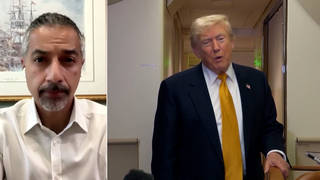
We discuss the ongoing crisis in the Strait of Hormuz with the Quincy Institute for Responsible Statecraft’s Trita Parsi. U.S. officials are denying Iranian reports that a U.S. vessel was struck by Iranian missiles amid the two countries’ dual blockade of the strait. The warring nations still say they are observing a fragile temporary ceasefire as negotiations continue for a possible longer-term deal. However, says Parsi, “both sides are making maximalist demands,” so a diplomatic solution is unlikely. “As long as Trump continues to listen to those forces, the very same forces that also sold him this blockade that has backfired, we’re not going to see a diplomatic breakthrough. It requires a far more disciplined and flexible approach to the negotiations, and right now we’re not seeing that from either side.”
Related Story
 StoryJul 09, 2026“A Disastrous Development”: Trita Parsi on Breakdown of U.S.-Iran Ceasefire
Transcript
AMY GOODMAN: This is Democracy Now!, democracynow.org, The War and Peace Report. I’m Amy Goodman.
Two missiles hit a U.S. Navy vessel in the Strait of Hormuz earlier today after it ignored warnings from Iran’s Revolutionary Guard to halt. That’s according to the Iranian state media. But the U.S. says no vessel was struck.
This comes as President Trump announced the U.S. will begin guiding ships through the Strait of Hormuz starting today, deploying guided-missile destroyers, more than a hundred aircraft and 15,000 U.S. service members. Tehran immediately rejected the move. A senior Iranian official warned any U.S. interference in the strait would be considered a ceasefire violation.
President Trump said he had reviewed Iran’s 14-point peace proposal, but warned the U.S. could resume strikes. Iran’s foreign minister said a deal is “just inches away,” but accused U.S. negotiators of making “maximalist demands.” No further talks have been scheduled.
At least two other vessels apparently were also struck in the Strait of Hormuz over the weekend, though all crew members were reported safe.
Meanwhile, U.S. gas prices have now reached $4.45 a gallon, up nearly 50% since the war began.
According to Iran’s Ministry of Health, U.S.-Israeli strikes have killed close to 3,400 people, including 376 children. The U.S. military has confirmed 13 combat deaths and 381 service members wounded.
This is President Trump speaking in Florida Friday.
PRESIDENT DONALD TRUMP: We get the radical left to say, “We’re not winning. We’re not winning.” They don’t have any military left. It’s unbelievable. It’s actually — it’s actually — I believe it’s treasonous, OK? You want to know the truth? It’s treasonous.
AMY GOODMAN: President Trump saying it’s treasonous to say that the U.S. is not winning the war on Iran.
For more, we go to Washington, D.C., where we’re joined by Trita Parsi, executive vice president of the Quincy Institute for Responsible Statecraft, his latest article headlined “Trump’s Iran blockade snatches defeat from the jaws of victory.” Trita is the author of several books, including Losing an Enemy: Obama, Iran, and the Triumph of Diplomacy.
Trita Parsi, thanks for joining us again.
TRITA PARSI: Thank you.
AMY GOODMAN: Talk about this latest news, right up to when we’re broadcasting, where Iran says they struck a U.S. naval vessel, and the U.S. is denying it, and then President Trump saying that it’s treasonous to criticize what the U.S. is doing.
TRITA PARSI: Thank you for having me, Amy.
Let me first start off by saying, because I think it’s important context, that according to the plan of those who sold this blockade idea to the Trump administration, Iran should have crumbled about 10 days ago, and it clearly has not happened. And I think that’s part of the reason why you see the president increasingly using desperate language and even considering desperate moves, such as moving U.S. warships through the Persian Gulf in order to protect other ships.
It’s important to understand the U.S. Navy has kept itself roughly 3,000 kilometers from Iran’s shorelines throughout the entire war in order to avoid getting hit by any of Iran’s missiles, that potentially could sink a major American warship. So, if the U.S. during the war was unwilling to get that close to the Iranian waters, I find it very unlikely that the U.S. will do so under the current circumstances, knowing very well that that could lead to a major confrontation, a restarting of the war, but perhaps more importantly, it could lead to American servicemen getting killed in a manner and on a scale that we did not see during the war that Trump started. And he was very careful to avoid those type of casualties, knowing very well what that would do to the degree of support that this war has within his own base. So, the idea that he now would go down that path, I find very unlikely. Rather, it is more of a sign of his desperation because this blockade has backfired on him, and he’s trying to do just something in order to be able to turn the tables on the Iranians.
AMY GOODMAN: So, talk about exactly what President Trump is saying will start happening today, this guiding of ships, that he said countries are calling for, that the U.S. military will do, through the Strait of Hormuz.
TRITA PARSI: Well, we don’t know, because all we have is that tweet. It’s very unclear, grammatically incorrect in places, etc. But bottom line is, it’s not clear whether the ships, the American warships, actually would escort these other ships out of the strait or whether it would be simply providing them with instructions on how to navigate different areas in which mines have been planted. So, it’s still unclear. And to me, it looks more like what we have seen in the past, in which Trump makes these big declarations, pretends as if there’s going to be a dramatic shift, but then he backs down, knowing very well that if he actually follows through on it, it will lead to an escalation that he cannot control and that likely will backfire.
AMY GOODMAN: And talk about Iran’s demands, and then Iran saying that the U.S. is making maximalist demands. And who exactly is doing this negotiating?
TRITA PARSI: Well, if we take a look at what has been publicly circulated — and may not be accurate information — clearly, both sides are making maximalist demands. The Iranians are demanding reparations for the war. Now, under other circumstances, perhaps, one would say that that is not unreasonable, mindful of the fact that they were attacked, but nevertheless, vis-à-vis the superpower of the United States, that is a very unlikely demand to be heeded. So, there’s plenty of demands the Iranians are making that likely will never be accepted by the United States. But then there are other things that I think could be part of a workable deal between the two sides.
The question, though, is, as long as Trump insists on demands such as zero enrichment, demands that were sold to him by the Israelis with the design of making sure that any deal would be impossible to reach and that it would force Trump into a military confrontation, as long as Trump continues to listen to those forces, the very same forces that also sold him this blockade that has backfired, we’re not going to see a diplomatic breakthrough. It requires a far more disciplined and flexible approach to the negotiations, and right now we’re not seeing that from either side.
AMY GOODMAN: This is the deputy speaker of the Iranian parliament speaking Sunday about the fate of the Strait of Hormuz.
ALI NIKZAD: [translated] The Zionist regime will under no circumstances be allowed to pass through the Strait of Hormuz. Hostile countries headed by the United States will also not have the right of passage. Other vessels wishing to transit will do so under the law we enact and with authorization obtained from the commander-in-chief and placed at the disposal of our armed forces.
AMY GOODMAN: So, the deputy speaker of the Iranian parliament is talking about a new law they want to pass banning Israeli and U.S. ships through the Strait of Hormuz, Trita Parsi.
TRITA PARSI: Yes. So, again, I think this is part of the maximalist approach that the Iranians are also pursuing. I don’t think that that is going to be what the end result of all of this will be. I do think the Iranians are going to retain control, and there’s going to be some sort of a mechanism in which they will receive payment. It may not be framed as a toll. It may be framed as something else, potentially together with other GCC states, particularly Oman, but I don’t think it’s going to look in such a manner that the Iranians are going to prevent U.S. ships indefinitely from being able to pass through the strait. And I think, again, in some ways, the Iranian maximalist goals or their strategy is just mirror-imaging what Trump is doing. This is Trump’s style. He always throws out maximalist demands publicly, tries to embarrass and humiliate the other side. And the Iranians are essentially mirror-imaging his strategy. Ultimately, however, that is not how you get to a deal.
AMY GOODMAN: OK, the U.S. has also threatened more strikes. Trita Parsi, in this last 30 seconds, where do you see this going this week, as this — in the U.S. population, the U.S. attacks on Iran are fiercely unpopular?
TRITA PARSI: Yes, and Trump knows this, and he knows that his members of Congress from the Republican side are privately making more and more phone calls complaining about this war, complaining about how it is destroying their chances in the November elections. Many of them are going to lose their seats as a result of this. Trump is under a lot of pressure. But he’s still looking for a silver bullet that will make him a winner, instead of engaging in serious diplomacy.
AMY GOODMAN: Trita Parsi, thanks so much for being with us, executive vice president of the Quincy Institute for Responsible Statecraft. Thanks for joining us.
TRITA PARSI: Thank you, Amy.
AMY GOODMAN: That does it for today’s show. A very happy birthday to Denis Moynihan! I’m traveling to Toronto today to speak at the Radiodays North America conference, then will appear at screenings of the new documentary about Democracy Now!, Steal This Story, Please! I will be Thursday night and Friday morning at the Main Cinema in Minneapolis, then in Chicago Friday night and for two screenings on Saturday at the Music Box Theatre, and at the historic Oriental Theatre in Milwaukee on Sunday. For information on all these screening and as well as our travel through the country, go to democracynow.org and StealThisStory.org. I’m Amy Goodman, in New York today. Thanks so much for joining us.






 Top
Top
Media Options