











 Watch Full Show

Guests
- Amanda Klasingnational director of government relations and advocacy at Amnesty International USA.
More than 200 people have now been killed in U.S. military strikes on boats in the Caribbean and eastern Pacific. Since September, the Pentagon has struck more than 60 vessels, claiming, without evidence, that the boats were engaged in “narco-trafficking” operations. Human rights groups have roundly condemned the attacks as extrajudicial killings.
“The U.S. is not in active conflict with any of these groups,” says Amanda Klasing, the national director of government relations and advocacy at Amnesty International USA. “These are law enforcement operations, … so the individuals on these boats have a right to life and a right to due process.”
Related Story
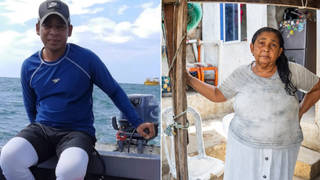
 StoryDec 05, 2025“Alejandro Was Murdered”: Colombian Fisherman’s Family Files Claim Against U.S. over Boat Strike
Transcript
AMY GOODMAN: This is Democracy Now!, democracynow.org, The War and Peace Report. I’m Amy Goodman, with Juan González.
U.S. Southern Command says it’s killed more than 200 people in over 60 strikes on boats in the Caribbean and eastern Pacific. The Pentagon has claimed, without evidence, the boats are “engaged in narco-trafficking operations,” unquote. Human rights groups including Amnesty International have called the attacks extrajudicial killings and a form of murder.
Earlier this year, in March, the ACLU, the Center for Constitutional Rights and other legal experts testified at a hearing on the legality of U.S. boat strikes at the Inter-American Commission on Human Rights. This is Angelo Guisado, senior staff attorney at CCR.
ANGELO GUISADO: The United States’s unprecedented military campaign, Operation Southern Spear, came without any plausible legal justifications. The world has failed to challenge these assassinations in any meaningful way. … The invocation of narcoterrorism has empowered President Trump and Secretary of Defense Pete Hegseth to publicize the boat strike videos on social media. They are seen boasting and celebrating the wanton infliction of suffering and death, and lampooning the lives of those caught in their crosshairs. We ask that the commission look through this thinly veiled cover and recognize the inhumanity that these actions reflect and the pain they have caused.
AMY GOODMAN: In April, Democratic Senator Tim Kaine of Virginia grilled Joint Chiefs of Staff Chair General Dan Caine over the legality of the boat strikes during a Senate Armed Services Committee hearing.
SEN. TIM KAINE: What legal justification could there possibly be that would allow the U.S. military to strike boats in international waters and kill the occupants of those boats without a showing of evidence that there’s narcotics on those boats?
GEN. DAN CAINE: I don’t have a copy of the order issued to SOUTHCOM with me today. It’s classified in its own right, which clearly articulates, based on a variety of criteria, what constitutes a valid military and legally valid target in that theater. And I know — I just want to say I know and trust that our commanders at echelon are rigorously following that legal opinion and those legal boundaries upon which we’ve been issued those orders.
SEN. TIM KAINE: And, General Caine, I would encourage again my colleagues — I am at a disadvantage. I’ve seen the legal opinion, but I can’t talk about it, because it’s classified. I’ve seen the targeting criteria, but I can’t talk about them, because they’re classified. I’ve seen the secret list of DTOs against whom we have declared war, that even they haven’t been informed of, but I can’t talk about it, because it’s classified. But I would urge all of my colleagues to go to the SCIF and read the targeting criteria and get briefed about it, and then also look at all of the files of all the strikes that have taken place. I’ve done that with the first 46 strikes or so, and I think there’s a profound mismatch between what is occurring and the underlying assumptions in the legal opinion.
AMY GOODMAN: That was Democratic Senator Tim Kaine of Virginia questioning Joint Chiefs of Staff Chair General Dan Caine in April.
We’re joined now by Amanda Klasing, national director of government relations and advocacy at Amnesty International USA.
Amanda, you say these actions committed against people who pose no imminent threat to life are extrajudicial killings, a form of murder, and amount to crimes under international law. Explain what’s happening, as the number passes 200, of deaths caused by U.S. bombing of boats in the Caribbean and the Pacific.
AMANDA KLASING: Yeah. Thank you so much, Amy, for having me on.
So, let me start by kind of clearing away the different types of justifications that are coming from the administration, and look at the facts. So, the first thing that we need to understand is that the U.S. is not in active conflict with any of these groups. The eastern Pacific and the Caribbean, they aren’t war zones. And drug smuggling is a crime; it is not a military attack. And so the laws of war do not apply in this situation.
So, if the laws of war don’t apply, what does? So, these are law enforcement operations. So, under human rights law, we apply standards like policing. So, the individuals on these boats have a right to life and a right to due process, and a government cannot use lethal force unless there’s an imminent threat or — and there’s no less extreme measure to stop that imminent threat. What we know is that these boats can be interdicted. We know that, because boats have in the past been interdicted. They continue to be, by the Coast Guard, in some situations. And Secretary Rubio himself, in fact, said that the boats could be interdicted, but instead they’ve decided to bomb them.
So, under all of these circumstances, there’s no lawful reason for these killings. And therefore, we have a state, a government, intentionally killing people outside of any lawful circumstance, and that is an extrajudicial killing, which, as you say, is a form of murder. And so, these extrajudicial killings are both strategy and murder as policy. And if that is the case, people of good conscience and U.S. taxpayers should be outraged, absolutely outraged, that their money is going to murder as a policy.
JUAN GONZÁLEZ: And, Amanda, only a few of the people who’ve been killed by the U.S. military in these attacks have even been identified. They’ve been, essentially, accused, sentenced and executed in one fell swoop. From a human rights perspective, how big of an obstacle is the virtual anonymity of the victims in terms of their families eventually seeking justice?
AMANDA KLASING: This is a massive problem. We don’t know who these people are. The U.S. government has not told us who they have killed, why they have killed them, and on what evidence they’ve made that targeting decision. And so, for family members, many of them are experiencing something similar to a disappearance. Their family member has gone out on a boat, and then they’ve not returned.
The reasons why we have some identification is there have been some survivors that have been returned — and I want to also flag that they have not been prosecuted by the United States; they’ve been returned to their countries — or there have been bodies that have actually — have actually washed up on shore. And some of those bodies can’t be identified. We still don’t know who they are.
And so, for families seeking justice, it is extraordinarily difficult to just not know what happened. And for people seeking justice and accountability, the fact that the U.S. has just failed to give any information, not only to the U.S. public, but they’ve stonewalled Congress, as well, we don’t know who they’re killing. And that is the policy that they are pursuing.
JUAN GONZÁLEZ: And can you talk about the difference, let’s say, between these series of attacks and previous incidents of extrajudicial killings by the U.S. government, for example, in Yemen and Pakistan and Somalia under President Obama?
AMANDA KLASING: Yeah, absolutely. So, we, of course, had significant concerns about the illegality of the drone strikes, the Obama-era drone strikes that were extrajudicial killings, under a rubric of war of terror. What we see here is using the same war of terror language, but expanding the government overreach to utilizing lethal means. And a significant difference is that while many human rights organizations and legal scholars were concerned about the drone killings, there were some discussions about whether or not this was under an international humanitarian law perspective. In this instance, there is near-universal agreement that these are killings that are occurring in law enforcement operations, that drug smuggling, under no rubric, can be understood as a military attack. So this is an escalation, building on the abuses and the expansion of executive power under the war of terror model, to the use of lethal means against people described as criminals with no evidence.
AMY GOODMAN: And if you can comment? You know, over and over, we see these — they look like video games, the bombing of these boats, and we don’t even see people. There was one where we saw people. The Pentagon and President Trump releasing the video game bombings, but the unedited video of a double-tap strike on the September 2nd attack on the boat, where apparently survivors were waving their hands or surrendering, we have never seen them, even though it was demanded by Congress.
AMANDA KLASING: Yeah, I mean, that instance is particularly troubling. So, I should note that was — September 2nd is when these strikes started. So, we’ve gotten nine months in. And when it came to light that there was, in fact, a double tap in that instance, it wasn’t just that there were survivors. The survivors were there for what we understand to be 45 minutes. And so, the double tap was over a very long period of time. And absolutely, we should all be demanding that the full video be released. We all need to understand exactly what happened, and whoever is accountable needs to be held to the highest standard of the law.
Now, the gamification of these killings is also extraordinarily worrying. It really takes away the humanity of the people that are being targeted and killed. It makes it look like this is just a game, when in fact it is a terrifying expansion of executive power.
AMY GOODMAN: Finally, Amanda, a bill is being marked up this week in Congress that directly applies. What is Amnesty International calling for?
AMANDA KLASING: So, Amnesty has drafted a letter that we’re submitting today to the House Armed Services Committee that outlines the many international law violations that have occurred over the last year and a half, everything from U.N. Charter violations to these extrajudicial killings to the gutting of civilian harm protection mechanisms within the Department of Defense. And we are asking that members of Congress do not fund extrajudicial killings or other international law violations. And American taxpayers should be demanding the same thing. Their hard-working dollars should not be going to a policy of murder.
AMY GOODMAN: I want to thank you, Amanda Klasing, national director of government relations and advocacy at Amnesty International USA.
Coming up, Steven Thrasher on his new book, The Overseer Class: A Manifesto. Back in 20 seconds.
[break]
AMY GOODMAN: That’s Roger Waters performing “We Shall Overcome,” accompanied by a young Alexander Rohatyn on cello in the Democracy Now! studio years ago.




 Top
Top
Media Options