









 Watch Full Show

Guests
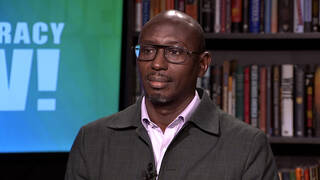
- Omer BartovIsraeli American scholar and the dean’s professor of Holocaust and genocide studies at Brown University.
Israeli American Holocaust scholar Omer Bartov says Israel’s assault on Gaza predicts “the future of genocide,” with the perpetrator not only enjoying impunity for crimes against humanity but also profiting from the death and destruction. He says Israeli leaders will almost certainly escape accountability because international allies, including the United States and many European states, have failed to uphold international law.
“The denial of what Israel has done is ubiquitous because there is no [accountability] mechanism that kicks into place,” he says. “If you don’t bring people to account, you’re sliding back into what the international community tried to prevent after 1945.”
Related Story
 StorySep 14, 2026“NAZA” Film on Gaza Genocide Wins Venice Special Jury Prize; Israel Threatens Directors’ Citizenship
Transcript
AMY GOODMAN: This is Democracy Now!, democracynow.org. I’m Amy Goodman, with Nermeen Shaikh.
NERMEEN SHAIKH: New York City Mayor Zohran Mamdani has announced that he does not have legal authority to arrest Israeli Prime Minister Benjamin Netanyahu when he arrives in New York to attend the U.N. General Assembly in September. But Mamdani is urging federal authorities to enforce the ICC arrest warrant for the Israeli leader. On Tuesday, Mamdani released a short video that has since gone viral with over 80 million views on X.
MAYOR ZOHRAN MAMDANI: Benjamin Netanyahu is a war criminal, the architect of a horrific genocide against the Palestinian people. He is responsible for the killing of more than 73,000 people; for the maiming of tens of thousands of children, as those who survive undergo amputation without anesthesia; for the targeting of neonatal hospitals and maternity care centers, denying newborns even the chance to live; for the countless people he starved as he blocked food and humanitarian aid from reaching them; for the gunning down of hundreds of aid workers and journalists. And just last month, the U.N. confirmed that Palestinian children continue to be deliberatley targeted and killed by Israeli armed forces — more than eight months after the so-called ceasefire. The list goes on and on, all as we, as Americans, pay for the bombs that do the killing.
There is a reason the International Criminal Court issued a warrant for his arrest. As human beings, we have seen generations building a shared understanding that there are crimes so grave, they offend all of humanity. Anyone, with their eyes, with their heart, with their conscience, should recognize the devastation he has wrought, and understand that he belongs before a court of law. As I’ve said, I agree with the ICC that Benjamin Netanyahu should be arrested and tried for his crimes, as I do for anyone else charged by the ICC.
My administration has reviewed every avenue available under applicable law to determine whether New York City could execute the International Criminal Court’s arrest warrant if Benjamin Netanyahu came here. It is clear that we do not have the independent legal authority to enforce this warrant. The federal government, however, does, and I call on them to join the ICC and execute this warrant.
And I want to be equally clear: Benjamin Netanyahu is not welcome in New York City, nor is any other war criminal at large. While we cannot end the genocide on our own, we can decide whether our silence will become another weapon. And we can examine every tool we have to defend the humanity and dignity of all people. That is my commitment to you.
AMY GOODMAN: That was New York City Mayor Zohran Mamdani in a video he released on Tuesday night. It has since been viewed more than 80 million times on X alone.
We’re joined right now by Omer Bartov, dean’s professor of Holocaust and genocide studies at Brown University, born in Israel, has been described by the U.S. Holocaust Memorial Museum as one of the world’s leading specialists on the subject of genocide. Professor Bartov has written a new essay for The New York Times headlined “I’m a Scholar of Genocide. We’re Entering a Terrifying New Era.” Last year, he wrote a New York Times op-ed headlined “I’m a Genocide Scholar. I Know It When I See It.”
Professor Bartov, welcome back to Democracy Now!, today from Lisbon, Portugal. Can you start off by responding to Mayor Mamdani investigating whether he could arrest Prime Minister Netanyahu based on the warrant for his arrest of the International Criminal Court, and then explain your piece that you just wrote in The New York Times, headlined “I’m a Scholar of Genocide. We’re Entering a Terrifying New Era”?
OMER BARTOV: Hi, Amy, and thank you for having me again.
Look, what Mayor Mamdani said is precisely the right thing. First of all, Benjamin Netanyahu has been charged with war crimes and crimes against humanity. There is a warrant for his arrest, and he’s been flying freely back and forth to the United States and visiting the White House. Now, we know, of course, that the United States has actually — United States government has actually been trying to undermine the International Criminal Court, the ICC, so we can’t really expect that the current American administration will arrest Netanyahu. But it is very important for major figures, such as Mayor Mamdani, to say what he said, and I greatly applaud him for it.
As for what I wrote, what troubles me deeply — and that, of course, does not include your program, but in general — is that we have sort of taken our eyes off what is happening in Gaza and what the future of Gaza is. What troubles me is that Gaza is providing now an example not only of how you carry out genocide, but what is the future of genocide.
And what I describe in this piece is that whether the plans that President Trump outlined, his 20 points, the creation of an ideal of a utopian city in Gaza, actually implemented or not, what we see now is a future of genocide where not only are people not being brought to account, people, obviously, like Benjamin Netanyahu and many of the people surrounding him, including Yoav Gallant, who is the other former Israeli minister of defense who also has a warrant for his arrest from the ICC, but that those countries, first of all, Israel, that carried out the genocide in Gaza and continues killing people there on a daily basis, and the countries that facilitated that, Israel’s allies, both European allies and the United States, that not only provided Israel with impunity, but also supported it economically and militarily and politically, that those countries not only will never be accountable for that, but also that they will profit from this, that we will see, potentially, that something will be created in Gaza which would be good for Israel, potentially good for Arab states that would support this new ideal city, good for European countries that will maintain their position in the Middle East, good for the United States, good for real estate moguls who will invest and profit from this venture, and the only people who were the victims of that genocide will continue being victimized by it, potentially being those who will build that ideal city and then serve the rich and famous who will inhabit it.
NERMEEN SHAIKH: And indeed, Professor Bartov, you you write in the piece that genocide may then “come to be seen by some nations as the legitimate and lucrative extension of politics by other means.” But I’d like you to elaborate on the historical examples you give of genocides, those in which the victims have come out, have, so to speak, won, and those in which the perpetrators have won, in the case of the Herero people in South West Africa and the Germans’ attempt — Germany’s attempt to exterminate them, and then what happened following the Second World War with the genocide of the Jews of Europe.
OMER BARTOV: Right. So, what I write in the piece is that, historically, at least in the case of modern genocide starting in the 20th century, genocide usually ends in one of two ways: either that the génocidaires, the perpetrators, accomplish their goal, and the other is that they’re stopped. And usually they’re stopped because of military intervention, not just because they want to.
Now, until 1945, some of the major genocides that occurred in the first part of the 20th century — the German genocide of the Herero in German South West Africa, now Namibia, in 1904; the genocide of the Armenians that began in 1915 by the Ottoman Empire during World War I — there was no mechanism for accountability. And so, the countries that carried out these genocides, first of all, killed and then inherited — that is, actually profited from the killing — and were never brought to account. There were some feeble attempts to do that with the Ottoman Empire after World War I, but they failed.
And what the international community decided after 1945 in light of the Holocaust and other horrendous crimes carried out by Nazi Germany was to set up a system that would prevent that kind of lack of accountability. Part of that system was the Genocide Convention of 1948. Now, that is not to say that there were not many genocides thereafter. Obviously there were. But in most of the genocides that occurred, some kind of system kicked into place, especially after the fall of the Soviet Union, in the case of the genocide in the former Yugoslavia, in the case of the genocide in Rwanda, where at least some people were brought to account. And it was no longer possible to deny, as Germany had denied the genocide in South West Africa and as Turkey continues to deny to this day the genocide in Armenia. It was no longer possible to deny that.
And what we see now is that the denial of what Israel has done is ubiquitous, because there is no mechanism that kicks into place. The mechanism exists, but it hasn’t been activated to actually bring people to account. If you don’t bring people to account, you’re sliding back precisely into what the international community tried to prevent after 1945.
NERMEEN SHAIKH: Professor Bartov, before we conclude, if you could just explain why you think increasing opposition to Israel in the U.S. across many demographics is not going to make a difference in terms of Israel being held to account?
OMER BARTOV: Well, look, I don’t know that it won’t make a difference. It may make a difference, but we may have to wait until the next presidential election. I actually think that public opinion in the United States has been shifting both on the left and on the right for different reasons, and it’s not impossible to think that a new American administration, whether Republican or Democratic, will have a different politics vis-à-vis Israel after the next election. However, that’s a long way away.
And what we are looking at now is an attempt to finalize this, to make people forget what happened in Gaza and to make them think that there is a bright future ahead and we don’t need to think about the horrors that occurred there and continue occurring. I’ll just say that, you know, on July 20th —
AMY GOODMAN: We have 10 seconds.
OMER BARTOV: Yeah. On July 20th, there was an editorial in Haaretz which indicated that 1,114 people were killed since the ceasefire in Gaza, including 275 children. So, the killing continues there, and it is time to put an end to it.
AMY GOODMAN: And we have to leave it there. Brown University professor Omer Bartov, leading scholar in Holocaust and genocide studies. That does it for our show. I’m Amy Goodman, with Nermeen Shaikh.





 Top
Top
Media Options