






 Watch Full Show

Topics
Guests
- Nicola Benedettiaward-winning Scottish violinist, founder of the Benedetti Foundation and the festival director of the Edinburgh International Festival.
Democracy Now! is broadcasting from Scotland at the Edinburgh International Festival, which features music, opera, theater and dance and is one of Europe’s biggest arts festivals. We are joined by the acclaimed Scottish violinist Nicola Benedetti, one of the most celebrated classical violinists in the world. She became the first woman and first Scottish artist to become director of the Edinburgh International Festival in 2022.
“I think what is quite unusual about the Edinburgh International Festival is the humanitarian mission that is woven into all of its origin rhetoric,” says Benedetti. She explains that this year’s festival focuses on the 250th anniversary of the American Revolution. “We’re not celebrating only dark or dazzling. We’re trying to present these things alongside each other.”
Related Story
 Web ExclusiveAug 10, 2026Brazilian Actor & Filmmaker Wagner Moura on His Acclaimed Work, from “The Secret Agent” to “Marighella”
Transcript
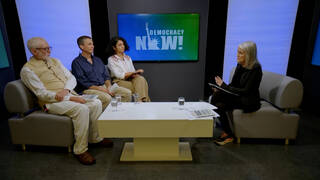
AMY GOODMAN: This is Democracy Now!, democracynow.org. We are broadcasting from Panmure House, the former home of Adam Smith here in Edinburgh, Scotland, where the Edinburgh International Festival is taking place, one of Europe’s biggest arts festivals.
We’re joined now by the Grammy-winning Scottish violinist Nicola Benedetti, one of the most celebrated classical violinists in the world. In 2022, she became the first woman and first Scottish artist to become festival director at the Edinburgh International Festival. She’s also one of the youngest directors of the festival, which began soon after World War II in 1947.
It’s great to have you with us. It’s odd for me to welcome you to your city, Nicola. But if you can tell the world what this festival is all about, how it came into being, and what you’re trying to do? You are transforming this festival in the last four years you have headed it, one of the youngest directors ever.
NICOLA BENEDETTI: If I may first just say what an absolute honor it is for me to be here. I’ve been watching your show for more years than I care to remember, and I’m just such an admirer of you, Amy, and of everything that this incredible show does. So, thank you for being here with us in Edinburgh and for having me on.
Our festival has a very unusual mix of its origins. Of course, it was undoubtedly a festival of the arts from all over the world, with an international stamp on its founding, but also cross-arts. So, we, in equal measures, present theater, dance, opera.
AMY GOODMAN: And the reason this came out of World War II?
NICOLA BENEDETTI: And, you know, I think what is quite unusual about the Edinburgh International Festival is the humanitarian mission that is woven into all of its origin rhetoric. So, yes, it was a festival of the arts, but also one that allowed for Jewish individuals and ex-Nazi individuals to be on stage, to be making art and music together. That took place in this city. And if you look at all of the original speaking about its purpose and its gift not only to Scotland, but as a beacon of what is possible and what the language of the arts can bring to people, so much of that was about reconciliation, about seeing each other more truthfully, about human relation, about international relation, about the the flowering of the human spirit and the opening of our hearts.
And I think we know, and I know we’re aligned on this, is that the language of the arts but of somehow slightly more abstract presentation can hit the emotion and the feeling first. And once that is open, then an argument or a perspective or a point of view can be altered and changed, hopefully for the better.
AMY GOODMAN: And can you talk about the themes this year, I mean, the political climate we face? You go back and forth between the United States and here in Scotland. And as you see this road to authoritarianism in the United States, if you can talk about, well, the history — many Americans may not know the ties — since you are focusing on the 250th anniversary of the U.S. leaving Great Britain?
NICOLA BENEDETTI: So, that is very much the theme of this year’s festival. We have named it “All Rise,” but it was a convergence of circumstance, both artistic and more, I guess, our overall rallying cry that we’re trying to — with the themed festivals year on year, we are trying to encourage our artists and participants and audiences alike: Stand with us in our acknowledgment that the arts is an integral pillar in that conversation. It’s an integral pillar in being able to heighten people’s relation with one another. We have the largest number ever in our festival’s history, a 79-year history, of American artists on our stage this year. But it is not —
AMY GOODMAN: I mean, Saturday night at Usher Hall was astounding. Describe what happened. You introduced it. I mean, there were, what, more than 300 musicians on stage, the Scottish Symphony Chorus and Jazz at Lincoln Center.
NICOLA BENEDETTI: Jazz at Lincoln Center and Jason Max Ferdinand Singers, whom I’ve actually just left one of our other venues. They were doing an uplifting, moving recital for us this morning that was just absolutely outstanding. “All Rise,” a piece written by Wynton Marsalis, I think, really has set the stage for how the rest of the festival unfolds. It’s not only a tale of the human cycles of life, so that being birth, death, tragedy, adversity and the sort of rising in the face of adversity, but it’s also a piece that draws upon the entire collection of the music of the Americas and what the American identity really is and represents.
And that’s something that we have tried so hard as a programming team and team of curators to unfold throughout the festival. We are not presenting either a celebration or a scrutinizing. We’re not celebrating only dark or dazzling. We’re trying to present these things alongside each other — who suffered as a consequence of some of the most innovative, outstanding achievements of the United States in the last 250 years.
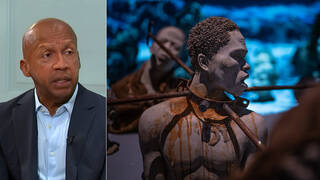
AMY GOODMAN: Tomorrow, Bryan Stevenson will join us here. He has the Legacy Museum. He founded it in Montgomery, Alabama, where Democracy Now! has been. You have, for the first time, he’s internationalized it with “The Legacy of Slavery” exhibition here. And as you sat here listening to Keith LaMar, you wept. Can you talk about why you have brought this exhibit here?
NICOLA BENEDETTI: I am so honored that Bryan agreed to do that. I think that the United States story is not only incomplete, but the integral nature of that aspect of the history is one that we couldn’t — I could not, in my right mind, try to present and defend the broad story of Americanness without that being thoroughly and seriously told. And there are no better, you know, words and depictions than that of Bryan Stevenson, someone who has fought his entire life on this subject.
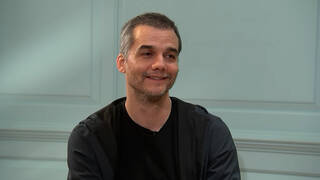
AMY GOODMAN: And if you could talk, finally — we’re going to have Wagner Moura on in one minute, and he has brought his play to the Edinburgh International Festival, a man who lives in Los Angeles, but, of course, is Brazilian, Oscar-nominated for Secret Agent. As he will talk about authoritarianism in Brazil, as we look at what’s happening in the United States, your thought about what the Edinburgh International Festival can accomplish in celebrating democracy?
NICOLA BENEDETTI: If you look at the convergence of simply the things you’ve talked about, so we are here now in Adam Smith’s home, who not only wrote The Wealth of Nations but The Theory of Moral Sentiment, which was about these concentric circles bringing together humanity around the world. The content of Wagner Moura’s phenomenal performance the other night and through this festival with A Trial — after An Enemy of the People, written by Christiane Jatahy, is a story of injustice, of that indignation against wrongs, against wrongdoings. And, you know, I think our event, too, is really trying to bring to the fore the notion that when you mix dialogue with the profundity of art presentations and pull these things together, we have the — we have the potential to not only change that mind, but continually to reflect more on the origin story of this festival. It was intended to make the world a better place, and all we can do is bring that into being over and over and over again.
AMY GOODMAN: And, Nicola Benedetti, we thank you so much for being with us, award-winning Scottish violinist, founder of the Benedetti Foundation and the festival director of the Edinburgh International Festival.
Coming up, we will be joined by the prize-winning Brazilian actor and filmmaker Wagner Moura, nominated for an Oscar for his performance in The Secret Agent. Here in Edinburgh, he’s starring in the play A Trial — after An Enemy of the People. But first, let’s hear more music from Nicola Benedetti.
[break]
AMY GOODMAN: Nicola Benedetti performing Wynton Marsalis’s Violin Concerto in Meyerson Symphony Center in Dallas, Texas, in 2018.



 Top
Top
Media Options