










 Watch Full Show

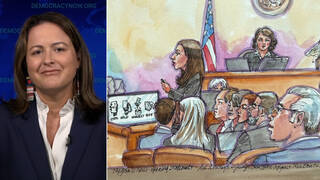
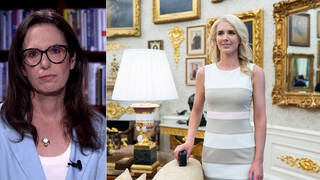
Pulitzer Prize-winning reporter Maggie Haberman is the co-author of the new book Regime Change: Inside the Imperial Presidency of Donald Trump. In the book, Haberman and her fellow New York Times journalist Jonathan Swan provide an inside look at how the administration has handled many of the biggest crises of Trump’s second term.
Haberman, who has been reporting on Trump since the 1990s, details his frequent attacks on the press over critical reporting, particularly against female reporters. She also discusses the renewed controversy over his close aide Natalie Harp, whom Haberman describes as “something like a human binky” for Trump.
Transcript
AMY GOODMAN: This is Democracy Now!, democracynow.org, The War and Peace Report. I’m Amy Goodman.
We begin today’s show looking at secrecy in the Trump White House. We’re joined by the Pulitzer Prize-winning New York Times reporter Maggie Haberman, who has been reporting on Donald Trump since the 1990s, often called “the Trump whisperer.” She is co-author of the new book Regime Change: Inside the Imperial Presidency of Donald Trump.
She and her co-author, New York Times reporter Jonathan Swan, give an inside look at how the Trump administration has handled many of the biggest crises of his second term, from the Epstein files to Trump’s decision to wage war on Iran. Haberman and Swan report many key decisions are made by Trump along with a tight-knit group of five to six people in the room with him.
Haberman has also been reporting on many recent controversies involving Trump, including the decision to fly the president out of a recent NATO summit on a secret plane due to an alleged Iranian threat. Trump had arrived in Turkey on the newly refurbished Boeing 747-8 jet gifted to him by Qatar, but on his departure, he was seen boarding the older Air Force One. But then the Secret Service used a catering truck to secretly transfer Trump to a military jet.
Well, to talk about all of this and more, we’re joined by Maggie Haberman.
It’s great to have you with us.
MAGGIE HABERMAN: Thanks for having me. I really appreciate it.
AMY GOODMAN: Before we start with Regime Change, let’s start with this story.
MAGGIE HABERMAN: Sure.
AMY GOODMAN: But I actually want to start before he got into that older U.S. Air Force One, to the subpoena to The New York Times reporters, your colleagues, for the earlier story that the U.S. Air Force One that was gifted to Trump — and I say Trump, not exactly the United States — by Qatar wasn’t militarily prepared to protect him, and then the Trump administration was so angry, that they subpoenaed the reporters and family members. A judge knocked that down. They withdrew their subpoenas. But I was wondering if you think that what they were really concerned about, the Trump administration, is the second part of the story, is when he went on to that second jet, in fact, he didn’t fly out on it, and that it would be discovered that, you know, he was secreted onto a catering truck and went onto a third plane?
MAGGIE HABERMAN: Entirely possible, Amy, and there’s so much we still don’t know about this entire episode. What we do know is, as you said, those subpoenas that were issued to my colleagues for doing their job, the the procedure and process by which they came about, the judge that was handling the matter condemned how the Justice Department dealt with it. You know, subpoenas are not new to reporters, as you know, but this is not how it is supposed to be handled. It’s not supposed to be within the first 24 hours of a story. It’s supposed to be the last stop. President Obama did a lot of subpoenas, but not in this way.
And, you know, the efforts to try to chill reporting, while not, you know, specific only to the Trump administration, this was a new level of intimidation. And what exactly they were looking at and trying to stop from getting out, I think that we have yet to learn.
But I do want to point out to your viewers that the whole reason that the public was aware that the president was not flying out on that Qatari plane was because he said it. He put it on Truth Social, his social media site, that he was going to fly the older Air Force One for, quote-unquote, “old time’s sake.” And anybody who has followed him found that rather hard to believe. But he puts this out, and then they’re surprised that reporters asked about it. Anyway, there’s so much about this whole episode that we don’t know yet.
AMY GOODMAN: And then explain what happened, coming off that plane onto the third plane. Who was with him, and who wasn’t?
MAGGIE HABERMAN: Trump, as you saw, made a display of going into the older Air Force One. He waves. There had been a pool camera — I think ABC News was the pool camera that day — set up just to capture what appeared to be a routine departure from the NATO summit at the Ankara airport. The president and a couple of aides were then taken, it appears to be, directly across to the other exit on this 747 to a catering container that was on a hydraulic lift, and that secrets them to the military jet, where Pete Hegseth, the secretary of defense, boarded himself, very visibly — it appears to have been part of the ruse.
The people who the president took with him — and there may have been others, but these are the ones we know about; the White House has refused to answer any questions about any of this — were Natalie Harp, who is his ever-present aide, who is known as the “human printer,” as Jonathan and I describe at length in Regime Change, that, you know, she’s — she alarmed the Secret Service during the campaign, because she left him these adoring letters in his personal spaces, in his private quarters, one of which said, “You are all that matters to me.” She prints out pieces of good news for him and searches on the internet for information he wants to see. She is an alternate channel for reaching the president.
AMY GOODMAN: And how do you know about that note, “You’re all that matters to me,” that she left for Trump?
MAGGIE HABERMAN: We obtained it, without getting into more detail.
AMY GOODMAN: So, Trump got very upset about being asked about this. On Sunday, the Democratic Senator Jon Ossoff of Georgia taunted Trump for his taking his aide Natalie Harp on the secret flight out of Turkey.
SEN. JON OSSOFF: He golfs and trades stocks. So he doesn’t want to do the job. He wants to build his ballroom and travel with Natalie on their apparently defenseless flying palace gifted by the emir of Qatar.
AMY GOODMAN: So, the president was then asked about Ossoff’s comments on Monday.
REPORTER: Jon Ossoff said you’d rather travel with your aide, Natalie Harp, and build the ballroom than do your job as president. What is your response?
PRESIDENT DONALD TRUMP: Who said that?
REPORTER: Jon Ossoff.
PRESIDENT DONALD TRUMP: You mean Pee-wee Herman? Pee-wee Herman look-alike? No, I would much rather do other things. It’s a — we’re building a great facility here. We’re fixing a White House that hasn’t been taken care of.
AMY GOODMAN: So, that was the president responding. And as you say, Maggie, you write extensively about Natalie Harp in Regime Change. Tell us more about her and why you think Ossoff’s raising this and her name is being raised at this point, and what it meant for her to be one of the few people on this third secret plane with him.
MAGGIE HABERMAN: I’ll work backwards. Natalie Harp is essentially a body person, for lack of a better way of putting it, but she is — I described her as something like a human binky a couple of days ago, and that really is what she is. You know, he describes her, as we report in the book, to staff as, you know, somebody who loves him as much as his wife and children. And he would say to aides, “You’ll all go off and make money. You know, she’s never going to leave me.” That’s one.
Walt Nauta, who is his actual body guy, also now the head of the Oval Office whatever, he has some official title —
AMY GOODMAN: Who was indicted in the —
MAGGIE HABERMAN: Who was Trump’s co-conspirator, indicted in the Mar-a-Lago documents case. Dan Scavino, who has been with Trump forever, started out as a caddie at his Westchester golf course. Those are three very personal aides. They also do deal with his social media piece. And then Pete Hegseth. So, what it tells us is that these are people who Trump would find most comfortable to be around him, who could give him certain pieces of information. Again, we don’t know exactly why.
But I’m not surprised that Ossoff focused on this, because, A, Natalie Harp is everywhere. She literally is in almost every Oval Office meeting. She was there when Jonathan and I went in to interview the president as a fact-checking interview for this book. And she was the one who handed us this document with — that he said was by a historian, that, in fact, was a former golf caddie for Gary Player who had described Trump as the most powerful person ever to walk the planet and compared him to history’s, you know, best-known despots and monsters and conquerors, separately.
Ossoff, I believe, was trying to get a reaction, and he did. And the White House bit. And he was obviously making an insinuation. It goes — it goes further than our reporting. Trump was traveling with other people. But she’s a taxpayer-funded staffer. It is not inappropriate to get asked a question about her by a reporter. And the president, all he did was draw further attention to this in how he handled that.
AMY GOODMAN: And, of course, attacking Kristen Holmes —
MAGGIE HABERMAN: Correct.
AMY GOODMAN: — of CNN, who — and, I mean, he so often attacks women reporters.
MAGGIE HABERMAN: Yes, he does.
AMY GOODMAN: Your response? They are all your colleagues, our colleagues.
MAGGIE HABERMAN: Look, a couple of things. I mean, he has attacked many of us for a very long time. He has expanded his roster of who he is attacking in this particular term. He is — you know, almost everybody who writes something he doesn’t like or even asks something he doesn’t like gets a “You’re dumb,” “You’re ugly,” “You’re” — I can go on and on and on. He does attack men, too. With women, it is always about their looks.
The Kristen Holmes attack, I want to — first of all, Kaitlan Collins does an incredible job, and she is basically alone in there every day, because this White House has taken control of the media pool that covers him. It used to be decided by the White House Correspondents’ Association. Now they pick the outlets. And so, Kaitlan, or Kristen, will be asking a serious question, and the person who asks after them is, you know, an influencer, who says something to the effect of, “Mr. President, why are you so fantastic?” It used to be that reporters would back each other up. It’s so much harder now.
And so, the Kristen Holmes attack, in particular, reporters don’t want to be the story. One of the things that was really very jarring about what this White House did yesterday — and this wasn’t the president directly, but it doesn’t matter — it was some social media account from the White House raising her children and attacking her, using her children, and saying that “Your children will be ashamed of you.” It’s really something for a White House that was making a point of the fact that its press secretary, who is a young mother, is leaving in part because she wants to take time with her children, is going after a female reporter, using her children. Children should be off-limits no matter what. They’re going to attack us, whatever we do. This was a different level.
AMY GOODMAN: Why doesn’t he attack you? I mean, yes, he’s called you “Maggot” and other names.
MAGGIE HABERMAN: For a long time, but yeah.
AMY GOODMAN: But actually, you have been covering him for decades. And you get a personal sit-down interview with him.
MAGGIE HABERMAN: Yeah, but I think there’s a — so, I was thinking about this when you used the “Trump whisperer” phrasing, which is a comment or, whatever, a description of me that I wish I had, you know, pushed back on years ago, when he first —
AMY GOODMAN: Why?
MAGGIE HABERMAN: Because it suggests a level of personal engagement that just doesn’t exist. It confers an intimacy that just doesn’t exist. And it also confers a sort of I’m — as opposed to just sort of interpreting and covering someone, that there’s some kind of a level of, like, you know, Rasputining, which is preposterous. I’m a reporter; he is my subject who I cover. I’ve covered any number of politicians over the last 20-some-odd years, going back to the 1990s, many of whom did not like my coverage. They just did not handle it like this.
In terms of the me of it specifically, it is largely about being at The New York Times. He really is obsessed with the Times uniquely. But I did cover him, you know, before he was a candidate. I did cover him for a long time. I covered his, you know, quasi-run in 2011. I worked at the New York Post. There is a New York of it that is real. But that is what it is.
Jonathan and I have both had very little contact with him directly this term. We actually did have to go to him directly to ask for this interview, but not because we wanted open mic night with Donald Trump. We wanted to do a fact-checking interview. And it was quite revealing.




 Top
Top
Media Options