






 Watch Full Show

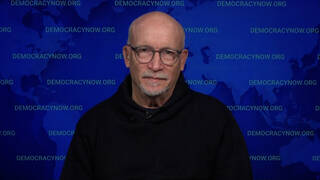
Bob Hennelly, general manager of WBAI Pacifica Radio in New York, broadcast live during the September 11 attacks in 2001 and has been covering developments ever since. He says officials rushed to reopen the city after the disaster, despite the health risks from toxic air and debris around ground zero. “There was no Zoom back then,” Hennelly says. “People were ordered back to their desks in Lower Manhattan, which turned out to be a death sentence.”
More from this Interview
- Part 1: “Toxic Nightmare”: 25 Years After 9/11, Juan González on His Predictions of Worker Illness & Death
- Part 2: Firefighter, EMT, Stuyvesant High School Student Describe 9/11 Exposure & Long Fight for Healthcare
- Part 3: “People I Flew with All the Time”: Flight Attendant Union Head Sara Nelson Remembers 9/11 Victims
- Part 4: 25 Years After 9/11: Cover-Up of Air Quality Risk Proved to Be “Death Sentence” for Thousands
Transcript
JUAN GONZÁLEZ: Yeah, I’d like to bring Bob Hennelly into the conversation. Bob, you were there. You have been reporting on this issue now for 25 years. I’m wondering if you could talk about your own experience, and also if you could deal with this issue of Mayor Giuliani developing a national reputation in the aftermath of 9/11 as “America’s mayor,” when some of the major decisions that caused so many lives to be lost were made by him, including the radios that the firefighters were using that didn’t work and the command center that Giuliani put in the World Trade Center and, therefore, was destroyed and was not available to keep firefighters and police in communication with each other.
BOB HENNELLY: Well, Juan, first of all, I want to thank you for all you did, and just thank you for keeping on and getting it right, right from the very beginning, so we can build this legacy forward.
I will tell you that anyone who really knows the New York City Civil Service, and I spent many years at The Chief-Leader, which has been around since 1897, knows that Mayor Giuliani’s presidential bid was ended, to a large degree, by a caravan of buses that were filled with widows of FDNY firefighters and people closest to the people that gave 343 lives on that day. And subsequently, 600 have perished, both retiree and active. There’s kind of a split-screen reality: The corporate news media portrays him as “America’s mayor,” but the reality is that he had a corrupt administration then, and what he’s doing now is corrupt.
One of the things that’s most tragic, as we look back — I know time is short — the 9/11 World Trade Center Health Program is a wonderful program that is keeping many people alive, and that’s wonderful. But the truth is —
AMY GOODMAN: Explain what that is, for a global audience.
BOB HENNELLY: So, in the aftermath of 9/11, the city of New York fought, under Mayor Bloomberg’s tenure, any recognition there was an occupational hazard. I was working at WNYC, and Mayor Bloomberg spoke into my microphone when James Zadroga passed. He was an NYPD detective who had worked at the Fresh Kills Landfill. He had been disabled towards the end of his life. He had gone to, basically, just die into his father’s home at the Jersey Shore. When he passed, Mayor Bloomberg said, “People are looking for a hero, and sometimes they don’t exist. James Zadroga was a drug addict.” And I just about couldn’t believe it. But, fortunately, for posterity, and for the survivors and people that were responding that day, Joseph Zadroga, his — Zadroga’s father, was able to make sure that he was taken to a medical examiner in New Jersey, who wasn’t connected into New York City politics, and it was discovered that he indeed — his body was riddled with this contamination. And Mayor Bloomberg issued an apology. But the damage had been done for years. I mean, two or three, four years, the city resisted this.
Now, the way the 9/11 World Trade Center Health Program was created, the Zadroga Act, with Carolyn Maloney, as congresswoman, pushed for, Jerry Nadler championed — there was a bipartisan, eventually, support for it — it is flawed. It is flawed fundamentally, because it makes, as my former mentor Dr. Joseph Fennelly, the chief medical ethicist for the New Jersey Medical Society — when I shared with him the parameters, he said, “Once you, as a medical professional, recognize a risk to public health, you can’t create a hierarchy of people in a uniform who work a pile, they are going to get annual screening, whereas, 'Oh, you went to high school there, or you worked there, and you're not on the pile, let me know if you have a cough.’”
AMY GOODMAN: And, of course, the pile is?
BOB HENNELLY: Actually the 16-acre site of the World Trade Center. And so, what’s happened is, we created this hierarchy, where survivors — and that includes, by the way, several thousand civil servants. There was no Zoom back then, as you know, Amy. We were both working. People were ordered back to their desks in Lower Manhattan, which turned out to be a death sentence. And then the city of New York subsequently tried to undermine the quality of the healthcare these retirees had by selling it out for Medicare Advantage.
So, “never forget” — they have been forgetting every day since. I mean, right now as we speak, talk about deals regarding EMS, there are on some days a hundred ambulances that don’t roll, 25% of the rolling stock, because the city of New York, including this administration, won’t pay EMTs a living wage. They’re paying $18 an hour. You get paid more to shovel snow in New York City at $30 an hour. So. when you say “never forget,” they’ve had amnesia since then.
JUAN GONZÁLEZ: And, Bob, in terms of the ability of the labor unions of New York City to protect the municipal workers, what’s happened with that?
BOB HENNELLY: Well, what happened was, under Mayor Bloomberg, they had so many contracts that weren’t settled. And so, he really had it out for public unions. And that created a situation where they just lost so much ground. You know all this. It was a generation of lost ground. And then, when Mayor de Blasio came in, he had to settle a hundred contracts in like a short period of time.
And that’s where the idea came: “Oh, listen, we have these retirees who are getting a free ride with Medicare. You know, we could sell that out to something like Medicare — to Aetna, and we could realize $600 million,” they said, “a year.” So they sold out the retirees who had kept the city of New York running, and including several thousand of them who were civil servants ordered back to their desks, who were not first responders but were dealing, in some cases, with terminal cancer diagnoses. That’s the city of New York, the wounded city that this young mayor is dealing with right now.
AMY GOODMAN: And, Juan, I have to end with you, because your reporting was so critical, the fact that you were writing columns about the toxic zone when all of the officials were saying that it was clean, to go back to work. The New York Daily News, who you wrote for at the time, ultimately would win the Pulitzer Prize for its reporting. But you, Juan, you should be the one who won that Pulitzer Prize, warning people nonstop, at the risk of your own job, about the toxic zone at ground zero. Juan, in this last minute, your final comments on this week of the anniversary of — the 25th anniversary of the 9/11 attacks?
JUAN GONZÁLEZ: Well, Amy, prizes and recognition don’t really mean anything. To me, the failure was to get the information — for all of the media to have gotten the vital information to the public at the time that more illnesses could have been prevented. So, I see it, ultimately, as a failure on my part, a failure of the profession of journalism and the — especially of the commercial media, to rise to the occasion when it was needed. Anyone can look back and say, “Oh, this should have been done that way or another way.” But the issue is: When the crisis is at hand, how do you deal with it? How do you get information to the public that they can use to protect themselves? And, unfortunately, in this, we all failed.
AMY GOODMAN: Juan, in this —
JUAN GONZÁLEZ: And the result is all the people who have died since then.
AMY GOODMAN: Juan, in this, people can judge for themselves. Read Juan González’s book, Fallout: The Environmental Consequences of the World Trade Center Collapse. I also want to thank our guests, Bob Hennelly, Sara Nelson, as well as Lila Nordstrom from Stuyvesant High School and Marianne Pizzitola. I’m Amy Goodman, with Juan González.



 Top
Top
Media Options