







Guests
- Pavel TalankinRussian primary school teacher and videographer.
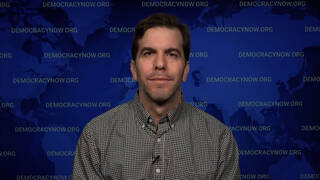
- David Borensteinco-director of Mr Nobody Against Putin.
Mr Nobody Against Putin is an Oscar-nominated documentary that tells the story of Pavel “Pasha” Talankin, a primary school teacher and videographer who becomes an international whistleblower. After being reluctantly drawn into Putin’s propaganda machine, he starts documenting how ordinary Russians are indoctrinated with pro-war messages and recruited for the war. We speak to Talankin and the film’s co-director, David Borenstein.
Related Story
 StoryMar 16, 2026“Mr Nobody Against Putin” Wins Oscar; Meet the Russian Teacher in Film Who Confronts State Propaganda
Transcript
AMY GOODMAN: This is Democracy Now!, democracynow.org, The War and Peace Report. I’m Amy Goodman.
This week marks four years since the Russian invasion of Ukraine, Europe’s biggest conflict since World War II. As the fighting enters its fifth year, entire cities in Ukraine’s south and east have been reduced to rubble. The Center for Strategic and International Studies says Russia has suffered 1.2 million casualties, including up to 325,000 troop deaths between February 2022 and last December, while Ukraine suffered up to 600,000 military casualties, including up to 140,000 deaths. Meanwhile, Russia has stepped up its crackdown on dissent, including those opposed to the ongoing war.
We turn now to a new film. It’s called Mr Nobody Against Putin, an Oscar-nominated documentary that tells the story of Pavel Talankin, “Pasha,” a primary school teacher and school videographer who becomes an international whistleblower. After being reluctantly drawn into Putin’s propaganda machine, he starts documenting how ordinary Russians are indoctrinated with pro-war messages and recruited for the war. Here’s the trailer for the Oscar-nominated documentary Mr Nobody Against Putin.
PAVEL TALANKIN: [translated] Hello. This is me. I am the event coordinator at Karabash Primary School No. 1. I’m also the school videographer.
TEACHER 1: [translated] Wave to the camera!
PAVEL TALANKIN: [translated] This office here is a pillar of democracy.
I’m giving them the space to be kids. In this moment, I have no idea the amount of trouble I’m about to cause for myself.
PRESIDENT VLADIMIR PUTIN: [translated] I decided to conduct a special military operation.
TEACHER 1: [translated] We need to get the kids to recite some patriotic songs and speeches.
TEACHER 2: [translated] Present the flag.
PAVEL TALANKIN: [translated] Are we completely [bleep] up? I was instructed to shoot all the events. I’m these kids’ propagandist. I love my job, but I don’t want to be a pawn of the regime.
TEACHER 1: [translated] Do you want to go to prison?
PAVEL TALANKIN: [translated] What she will tell you, she is forced to say.
TEACHER 2: [translated] If you live in our country and don’t love it, then you’re a parasite. Leave.
PAVEL TALANKIN: [translated] I’ll use my camera to film the abyss this school is sinking into. It’s the perfect cover.
SOLDIER: [translated] Never clasp your helmet! It will break your neck if you get shot in the head.
ON-SCREEN TEXT: Rebel.
TEACHER 3: [translated] No, Pasha. Don’t do this.
PAVEL TALANKIN: [translated] Go ahead, film the flag.
ON-SCREEN TEXT: Hero.
UNIDENTIFIED: [translated] I think what you’ve done is going to make a big impact.
ON-SCREEN TEXT: Teacher.
PRESIDENT VLADIMIR PUTIN: [translated] Commanders don’t win wars. Teachers win wars.
TEACHER 1: [translated] Marching steps. And march.
AMY GOODMAN: Mr Nobody Against Putin. It won the 2026 BAFTA Award for Best Documentary and the Special Jury Award at the Sundance Film Festival. It’s also been nominated for an Oscar for Best Documentary Feature.
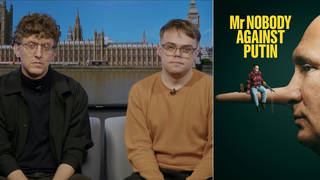
For more, we’re joined now by Mr. Nobody himself, Pavel Talankin. His nickname is “Pasha,” the narrator, the subject and one of the directors of the film, previously a teacher at a primary school in Karabash, Russia. Also with us is the film’s co-director, David Borenstein.
We welcome you both to Democracy Now! David, let’s begin with you. How did you learn about Pasha, what he was doing in his school? How did you come to collaborate on this film?
DAVID BORENSTEIN: So, Pasha actually responded to a casting call on the Russian internet. I had put out some feelers, looking for a story in Russia. And simultaneously, this Russian company puts up a casting call saying, “How has your job changed because of the special military operation in Ukraine?” Or so they call it in Russia. And they were actually looking for positive stories from the Russian perspective. So they were looking for stories of people writing letters to soldiers and things like this.
But Pasha sees this casting call, and he got angry. He wrote a letter saying, “Let me tell you how my job has changed. I’ve been turned into a propagandist, and I’m filled with guilt every single day coming into my work.” So he sent that in, and he sent it in to a random Russian web content company on the other side of the country. It was actually quite risky, the first of many risky things he would do to make this film happen.
But as it turns out, it landed at that company, and it landed on sympathetic eyes, who started forwarding that message around, and it reached me. And so, Pasha and I, we started talking very early on, and we came up with the idea to make a film together. In the beginning, we didn’t know how we would make it. We experimented with me sending a DP to Karabash to film him. But after some time, it became apparent that Pasha himself would be an amazing co-director on this film, and we just started working together as two directors.
AMY GOODMAN: So, before we go to Pasha in the London studio, I want to go to a clip that really introduces him, from Mr. Nobody Against Putin, which reveals one act of resistance on the part of our guest, Pasha, Pavel Talankin.
PAVEL TALANKIN: [translated] I might be a self-destructive person. But I can’t look at one more pro-war Z symbol on these windows. So I take them down and put up X’s instead. A symbol online in support of Ukrainian refugees.
AMY GOODMAN: The clip ends with Pasha posting pictures of the X on windows on social media with the hashtag #NoToWar.
Pasha joins us now, Pavel Talankin, in the London studio. You’ve been nominated for an Oscar along with David Borenstein as the directors of this film about you, Mr Nobody Against Putin. Talk about what motivated you as the school’s videographer and school’s teacher to begin to resist after the war, Russia invaded Ukraine, and how people responded along the way.
PAVEL TALANKIN: [translated] My goal, most of all, with this film is for people to see it inside of Russia. I want more and more people to see it. I need for as many people as possible to see what is happening inside of Russian schools.
It all began when the first directives from the government came into the school with requirements of what lessons to teach. And that’s when I got really angry and knew that people needed to know what was going on. And that’s what led to the film.
So, really, my motivation was that people know that what these children are being forced to hear, that Putin is forcing propaganda into their schools, and they’re absorbing all of this. And we’ll see what kind of generation winds up in five or 10 years after they’ve been learning this every day.
AMY GOODMAN: Why do you see Lady Gaga singing the U.S. national anthem as a form of resistance?
PAVEL TALANKIN: [translated] That happened the day after the U.S. announced that it was an unfriendly relationship with the government of Russia. I saw an interesting map recently. It was a map of places in the world where it’s safe to drink tap water, where drinking water is safe directly from the faucet. And then I saw another map of which countries in the world are considered unfriendly to Russia. And it’s interesting, those two maps completely coincide. They overlap perfectly.
AMY GOODMAN: Can you tell us about your city in Russia? Can you talk about this place that is one of the most toxic places on Earth? That’s not the main point of the film. It is the casualty toll, the effect on the kids who will go off to war — a number of them do during your film — to fight against Ukraine.
PAVEL TALANKIN: [translated] Karabash is a city, like a small city, like other small cities, where everybody knows each other, people talk to one another. But it also has a copper smelting plant, which, unfortunately, has really harmed the environment a lot.
AMY GOODMAN: Also, talk about the casualties, this horror of the kids as they get older — this war is now — it’s the fourth anniversary of the Russian invasion — becoming old enough to go to Ukraine, to attack Ukraine.
PAVEL TALANKIN: [translated] Mostly, the kids are just kids. They graduate from high school, and those that haven’t gotten into university or have been dropped out or kicked out of university, they really are called up immediately. Some might sign a contract, but others are drafted. And they all go off to war. They’re really young. And it’s a horrible tragedy. And many of them don’t come back, as you see in the film.
AMY GOODMAN: So, explain, when you talk about the directive, how it changed also the teachers — and you were one of them — how they had to read directives to the children, and they started marching around the school, and more than that.
PAVEL TALANKIN: [translated] The 14th of March, so really just after the war started in 2022, on the 14th of March, the directives started coming into the school. And they were sheaves and sheaves of paper with photos and lesson plans and videos and very complete instructions and curriculums of what the teachers were supposed to do and say about the war, how they were supposed to talk about Ukraine. And part of my job as the school’s videographer was to film all of this and then upload it to prove to the government that we were fulfilling all of their requirements.
And, of course, a lot of the teachers understood that these things have nothing to do with their actual academic subjects that they have to teach, but they were forced to do this. And if they had resisted, there were all kinds of disciplinary consequences. There could be fines or things a lot more serious, too. So, despite understanding this has nothing to do with their jobs as pedagogues, they had no choice.
There was even, you know, this situation that because so much of the lesson time was taken up by these propaganda lessons, the kids didn’t have enough time to actually learn the curriculum, and so their grades kept falling, and their understanding of their subjects kept falling. And the teachers were protesting, saying, “Look, we just don’t have time to teach everything. Let’s just stop or reduce the time of all of this other material.” And they said, “We can’t. We can’t, because we’ll all be fired if we do.”
AMY GOODMAN: Let me bring David Borenstein back into this discussion. Talk about what you saw as you were following the video. Was Pasha uploading the video to you? And then your increasing concern for Pasha himself being arrested.
DAVID BORENSTEIN: Yeah. So, in the beginning, we set up a system where footage would be sent to me via an encrypted FTP server. There was a lot of security protocols in this production. It was really, really daunting. But it got more daunting over time, because when we first started, we thought, “Ah, maybe Pasha can contribute to this project, and then he can stay in Russia.” Those first months of the war was a period where people thought they could still go out and protest, and things would be OK.
Well, soon they learned that that wasn’t the case. Within the first year of working on this project together, there was a foreign agent law that completely criminalized the way we work together. And then, even more concerningly, there was this treason law that basically completely criminalized everything he’s saying inside the film. So, if Pasha were to get caught filming and sending the footage to me, he could end up in prison for a very, very long time, potentially for the rest of his life. So it was really, really tense. We were constantly on the edge of our seats for two, two-and-a-half years. I don’t think we realized how nervous we were until he finally fled and got out, and suddenly our bodies became much looser. But it was a very, very intense process, both from security and also the process of creating this story, which had so many complex storylines and ethical kind of minefields to go around.
AMY GOODMAN: And, David, if you can — if you can — explain how you encouraged and you set up this ending of Pasha leaving, how he got out of the country? And I’ll ask him to tell us that story, as well.
DAVID BORENSTEIN: Yeah. Well, when we first started the film, all I knew was that Pasha wanted to show the world what was happening in these school classrooms. He wanted to give us the video that he was shooting for the Russian government. Then we had to find else what the film was going to be. I mean, he could have just given those videos to a journalist. Instead, he contacted filmmakers. So we had to decide: What is the story of this?
We looked for that story for a little while, and then, when the treason law really kicked in, we had this realization. Pasha, if you want to get this stuff out to the world, you’re going to have to leave Russia. You’re going to have to leave Russia, and we can potentially help you do that. But is this something that you want to do?
And the kind of conversations and discussions that we had around that really big decision ended up helping us find out — helping us find out what the story of the film is, because we had so many discussions. Is this the right thing to do? Would showing the world this footage make big enough of a difference? Can one person, one Mr. Nobody, really go up against someone like Putin or a regime as big and oppressive as Russia? Would it all be worth it if it meant leaving your students, because you’re the only teacher they can really rely on? So we had all of these discussions, and we realized that these questions about the value of one person’s resistance, about how much one person can do, about how much we can overcome complicity while the systems around us are succumbing to authoritarianism, these discussions and this decision — Do I leave? Do I sacrifice my life in Russia to make this? Do I take a giant leap into the unknown for the small chance of this film making some difference? — these discussions ended up being the plot of the film.
And so, we helped him figure out a way to leave Russia. And then, kind of over the next year and a half, we followed this process of him going through this transformation from teacher, trapped in this Kafkaesque, brutal, absurd propaganda system that’s creating death and destruction in Ukraine and within Russia, and following him ’til he leaves and he makes this fateful decision. And so, that was the process of finding the story of the film.
And after two-and-a-half years of filming undercover, he fled. He bought a round-trip ticket to Istanbul, pretending like he was going on a seven-day vacation. He got there. He smuggled some footage out of the border, in addition to what he had been uploading. And he never went back to Russia.
AMY GOODMAN: Talk about that, Pasha, how you got out of Russia, because, of course, David was way beyond that border. But what it meant for you organizing a commencement ceremony and then leaving, how you left with your film.
PAVEL TALANKIN: [translated] I had a suit — I was going as if I was going to Istanbul for seven days for vacation, but I had a suitcase that was filled with hard drives and memory cards and a laptop, and it was all filled with equipment. And I knew that I was going to have to go through security and go through customs, and my bag was going to be opened, and I was really scared. I mean, how could I hide any of this? And so, I grit my teeth, and I put my suitcase on the belt, and I was lucky. And, I mean, because how could I have explained it? I’m supposedly going on a vacation, and all I have is this equipment. I don’t even have a bathing suit with me? And then, when I got to the other side in Istanbul, people said to me just how lucky I was, because it really could have been bad.
AMY GOODMAN: Can you describe how your students transformed? And what level of resistance was there, even just cultural resistance, to the military dictates, Pavel?
PAVEL TALANKIN: [translated] My students really weren’t able to protest in any way. It’s in a small city in Russia. That’s just impossible, because the consequences are too great. There are too many people who will report on you. I mean, if they had done something, it’s possible that someone in the city or even one of the teachers would have submitted a complaint against them. And just the stakes were too high, so they couldn’t protest.
DAVID BORENSTEIN: I’ll say one thing that I learned about how propaganda can work, by watching hundreds of hours of Russian state propaganda as part of the editing process of this film. You know, in Karabash, you very rarely see anyone parrot the propaganda back. Very few people seem to believe in the propaganda. And the propaganda that’s taught doesn’t seem to even be designed to convince people of its truth. Rather, it seems to be designed to beat you down. It seems to be designed to make you repeat ridiculous things so many times that you just become cynical.
I learned that propaganda can be about making you cynical, more than it can be about making you believe one thing or the other. So, what you see in Karabash isn’t so much “I believe in the war” or “Putin is great.” No, what you see is kind of very, very cynical takes, like “there will always be war,” or “boys are always going to go off and die,” or “there will always be suffering in the world,” or even ironic detachment, like postmodern ironic detachment. That appears to be the end result of Russian propaganda, and that seems to be quite effective.
AMY GOODMAN: And finally, Pasha, the effect on the kids and on the teachers and the other staff, losing their boyfriends, their brothers, some of the students themselves, going off to war, the mother losing her son in this plaintive cry in the cemetery that you amazingly recorded?
PAVEL TALANKIN: [translated] The thing about propaganda is that it makes us feel like we’re alone, that everybody around supports the war and that we don’t have any ability to resist or protest. But I have to say that when news of this film has come out, when people have seen it, I’ve been getting so much commentary and response from Russia, but also from Karabash, where people are saying that, you know, we’ve kind of pulled aside the curtain, and people see that there are a lot of us, and we’re actually not alone.
And the mom of my friend Artyom, whose funeral we hear the audio of in the film, she wrote me on WhatsApp, and she said, “Thank you, Pasha. You understood everything.”
AMY GOODMAN: I want to end by asking David about the BAFTA controversy that’s brewing even as we speak today. You won a major award there, a BAFTA, which is the equivalent of the Oscar, the British ceremony on Sunday night. Then the BBC ran the ceremony a few hours later. And though they took out one of the filmmaker — award-winning filmmaker’s comments when he said “Free Palestine,” when a man with Tourette’s, on whom a film was based, shouted the N-word as Michael B. Jordan and Delroy Lindo were up on the stage, they didn’t beep that out the way they took out “Free Palestine.” As an award winner yourself, your thoughts on what took place?
DAVID BORENSTEIN: Well, I have to say, I also, in my speech, compared the importance of resistance in Russia to the importance of resistance in Minneapolis, and that was also taken out of the broadcast. So it seems that a lot of the political speeches were taken out of the broadcast.
And yeah, for me, that is indicative of a media ecosystem where people are afraid. People are afraid of political documentaries right now. Very few political documentaries are being picked up by the big corporate players. And right now in order to get out your political statement, whether it’s a statement in a speech or a statement in a story, you have to work really, really hard. You have to get a grassroots movement behind you. You have to be hitting the road for years, like we have with this film. And it’s a tough road.
And I think the only thing that will really get us out of it is a resurgence of public funding. And that’s something I think that’s really worth fighting for. I will say at the end of the day, this film wouldn’t exist without support from public institutions.
AMY GOODMAN: David Borenstein and Pasha Talankin, I thank you for being with us. They are the directors of the Oscar-nominated documentary Mr Nobody Against Putin. Thank you so much for being with us.
DAVID BORENSTEIN: Thank you.
AMY GOODMAN: I’m Amy Goodman. Thanks for joining us.



 Top
Top
Media Options