





 Watch Full Show

Guests
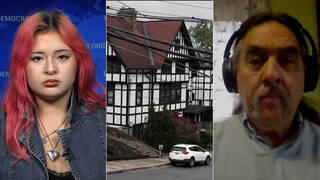
- Pavel TalankinRussian primary school teacher and videographer.
- David Borensteinco-director of Mr Nobody Against Putin.
Mr Nobody Against Putin won the Academy Award for Best Documentary Feature on Sunday. Democracy Now! recently spoke with co-director David Borenstein and the subject of the film, the Russian teacher Pavel “Pasha” Talankin, who personally documented Russia’s use of wartime propaganda. “I need for as many people as possible to see what is happening inside of Russian schools,” says Talankin. “Putin is forcing propaganda into their schools, and [the children are] absorbing all of this.”
Borenstein says the film is also a reflection on “the value of one person’s resistance, about how much one person can do, about how much we can overcome complicity while the systems around us are succumbing to authoritarianism.”
Related Story
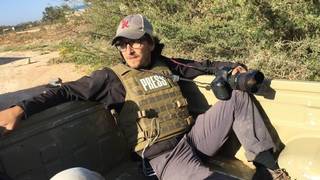
 StoryOct 21, 2025“Armed Only with a Camera”: HBO Film on Life & Death of Brent Renaud, Journalist Killed in Ukraine
Transcript
NERMEEN SHAIKH: This is Democracy Now!, democracynow.org. I’m Nermeen Shaikh in New York, with Amy Goodman in Los Angeles.
AMY GOODMAN: Yes, I’m in Los Angeles because I attended the Oscars last night. And so, today we’re going to start by looking at Mr Nobody Against Putin, the film that won the Academy Award for Best Documentary at the Oscars here at the Dolby Theatre.
The film tells the story of Pavel “Pasha” Talankin, a Russian primary school teacher and videographer who becomes an international whistleblower after being reluctantly drawn into President Putin’s propaganda machine. Talankin starts secretly documenting how ordinary Russians were being indoctrinated with pro-war messages following Russia’s invasion of Ukraine in 2022, which began four years ago last month. Talankin’s footage forms the basis of the film, which was directed by David Borenstein. Pasha Talankin is credited as co-director, cinematographer and narrator of the film.
This is Talankin and Borenstein last night at the Academy Awards.
DAVID BORENSTEIN: Mr Nobody Against Putin is about how you lose your country. And what we saw when working with this footage is that you lose it through countless small, little acts of complicity, when we act complicit when a government murders people on the streets of our major cities, when we don’t say anything when oligarchs take over the media and control how we can produce it and consume it. We all face a moral choice, but, luckily, even a nobody is more powerful than you think. And here’s Pasha Talankin, the main character of our film.
PAVEL TALANKIN: Thank you. [translated] For four years, we look at the sky for shooting stars to make a very important wish. But there are countries where instead of shooting stars, they have shooting bombs and shooting drones. In the name of our future, in the name of all of our children, stop all of these wars now.
NERMEEN SHAIKH: David Borenstein, speaking at the Oscars last night after their film, Mr Nobody Against Putin, won the Academy Award for Best Documentary. In a moment, we’ll air a recent interview with them, but first, let’s go to the film’s trailer.
PAVEL TALANKIN: [translated] Hello. This is me. I am the event coordinator at Karabash Primary School No. 1. I’m also the school videographer.
TEACHER 1: [translated] Wave to the camera!
PAVEL TALANKIN: [translated] This office here is a pillar of democracy.
I’m giving them the space to be kids. In this moment, I have no idea the amount of trouble I’m about to cause for myself.
PRESIDENT VLADIMIR PUTIN: [translated] I decided to conduct a special military operation.
TEACHER 1: [translated] We need to get the kids to recite some patriotic songs and speeches.
TEACHER 2: [translated] Present the flag.
PAVEL TALANKIN: [translated] Are we completely [bleep] up? I was instructed to shoot all the events. I’m these kids’ propagandist. I love my job, but I don’t want to be a pawn of the regime.
TEACHER 1: [translated] Do you want to go to prison?
PAVEL TALANKIN: [translated] What she will tell you, she is forced to say.
TEACHER 2: [translated] If you live in our country and don’t love it, then you’re a parasite. Leave.
PAVEL TALANKIN: [translated] I’ll use my camera to film the abyss this school is sinking into. It’s the perfect cover.
SOLDIER: [translated] Never clasp your helmet! It will break your neck if you get shot in the head.
ON-SCREEN TEXT: Rebel.
TEACHER 3: [translated] No, Pasha. Don’t do this.
PAVEL TALANKIN: [translated] Go ahead, film the flag.
ON-SCREEN TEXT: Hero.
UNIDENTIFIED: [translated] I think what you’ve done is going to make a big impact.
ON-SCREEN TEXT: Teacher.
PRESIDENT VLADIMIR PUTIN: [translated] Commanders don’t win wars. Teachers win wars.
TEACHER 1: [translated] Marching steps. And march.
AMY GOODMAN: That’s the trailer to the film Mr Nobody Against Putin. I recently spoke to the film’s director, David Borenstein, and the subject of the film, Russian school teacher Pavel “Pasha” Talankin. I asked Pasha to talk about what motivated him to go from being a school teacher, a videographer at the school, to being a whistleblower. (The film’s executive producer Robin Hessman served as an interpreter for the interview.)
PAVEL TALANKIN: [translated] I need for as many people as possible to see what is happening inside of Russian schools. It all began when the first directives from the government came into the school with requirements of what lessons to teach. And that’s when I got really angry and knew that people needed to know what was going on. And that’s what led to the film.
So, really, my motivation was that people know that what these children are being forced to hear, that Putin is forcing propaganda into their schools, and they’re absorbing all of this. And we’ll see what kind of generation winds up in five or 10 years after they’ve been learning this every day.
AMY GOODMAN: Also, talk about the casualties, this horror of the kids as they get older — this war is now — it’s the fourth anniversary of the Russian invasion — becoming old enough to go to Ukraine, to attack Ukraine.
PAVEL TALANKIN: [translated] Mostly, the kids are just kids. They graduate from high school, and those that haven’t gotten into university or have been dropped out or kicked out of university, they really are called up immediately. Some might sign a contract, but others are drafted. And they all go off to war. They’re really young. And it’s a horrible tragedy. And many of them don’t come back, as you see in the film.
AMY GOODMAN: So, explain, when you talk about the directive, how it changed also the teachers — and you were one of them — how they had to read directives to the children, and they started marching around the school, and more than that.
PAVEL TALANKIN: [translated] So, really just after the war started in 2022, on the 14th of March, the directives started coming into the school. And they were sheaves and sheaves of paper with photos and lesson plans and videos and very complete instructions and curriculums of what the teachers were supposed to do and say about the war, how they were supposed to talk about Ukraine. And part of my job as the school’s videographer was to film all of this and then upload it to prove to the government that we were fulfilling all of their requirements.
And, of course, a lot of the teachers understood that these things have nothing to do with their actual academic subjects that they have to teach, but they were forced to do this. And if they had resisted, there were all kinds of disciplinary consequences. There could be fines or things a lot more serious, too. So, despite understanding this has nothing to do with their jobs as pedagogues, they had no choice.
There was even, you know, this situation that because so much of the lesson time was taken up by these propaganda lessons, the kids didn’t have enough time to actually learn the curriculum, and so their grades kept falling, and their understanding of their subjects kept falling. And the teachers were protesting, saying, “Look, we just don’t have time to teach everything. Let’s just stop or reduce the time of all of this other material.” And they said, “We can’t. We can’t, because we’ll all be fired if we do.”
AMY GOODMAN: Let me bring David Borenstein back into this discussion. Talk about what you saw as you were following the video. Was Pasha uploading the video to you? And then your increasing concern for Pasha himself being arrested.
DAVID BORENSTEIN: Yeah. So, in the beginning, we set up a system where footage would be sent to me via an encrypted FTP server. There was a lot of security protocols in this production. It was really, really daunting. But it got more daunting over time, because when we first started, we thought, “Ah, maybe Pasha can contribute to this project, and then he can stay in Russia.” Those first months of the war was a period where people thought they could still go out and protest, and things would be OK.
Well, soon they learned that that wasn’t the case. Within the first year of working on this project together, there was a foreign agent law that completely criminalized the way we work together. And then, even more concerningly, there was this treason law that basically completely criminalized everything he’s saying inside the film. So, if Pasha were to get caught filming and sending the footage to me, he could end up in prison for a very, very long time, potentially for the rest of his life.
AMY GOODMAN: And, David, if you can — if you can — explain how you encouraged and you set up this ending of Pasha leaving, how he got out of the country? And I’ll ask him to tell us that story, as well.
DAVID BORENSTEIN: When the treason law really kicked in, we had this realization. Pasha, if you want to get this stuff out to the world, you’re going to have to leave Russia. You’re going to have to leave Russia, and we can potentially help you do that. But is this something that you want to do?
And the kind of conversations and discussions that we had around that really big decision ended up helping us find out — helping us find out what the story of the film is, because we had so many discussions. Is this the right thing to do? Would showing the world this footage make big enough of a difference? Can one person, one Mr. Nobody, really go up against someone like Putin or a regime as big and oppressive as Russia? Would it all be worth it if it meant leaving your students, because you’re the only teacher they can really rely on? So we had all of these discussions, and we realized that these questions about the value of one person’s resistance, about how much one person can do, about how much we can overcome complicity while the systems around us are succumbing to authoritarianism, these discussions and this decision — Do I leave? Do I sacrifice my life in Russia to make this? Do I take a giant leap into the unknown for the small chance of this film making some difference? — these discussions ended up being the plot of the film.
And so, we helped him figure out a way to leave Russia. And then, kind of over the next year and a half, we followed this process of him going through this transformation from teacher, trapped in this Kafkaesque, brutal, absurd propaganda system that’s creating death and destruction in Ukraine and within Russia, and following him ’til he leaves and he makes this fateful decision.
AMY GOODMAN: Talk about that, Pasha, how you got out of Russia, because, of course, David was way beyond that border. But what it meant for you organizing a commencement ceremony and then leaving, how you left with your film.
PAVEL TALANKIN: [translated] I had a suit — I was going as if I was going to Istanbul for seven days for vacation, but I had a suitcase that was filled with hard drives and memory cards and a laptop, and it was all filled with equipment. And I knew that I was going to have to go through security and go through customs, and my bag was going to be opened, and I was really scared. I mean, how could I hide any of this? And so, I grit my teeth, and I put my suitcase on the belt, and I was lucky. And, I mean, because how could I have explained it? I’m supposedly going on a vacation, and all I have is this equipment. I don’t even have a bathing suit with me? And then, when I got to the other side in Istanbul, people said to me just how lucky I was, because it really could have been bad.
AMY GOODMAN: That’s the Russian school teacher turned whistleblower Pavel “Pasha” Talankin and David Borenstein. They won an Oscar last night for their documentary, Mr Nobody Against Putin. To see the whole interview, go to democracynow.org.
In another notable moment from Sunday’s Oscars, Autumn Durald Arkapaw became the first woman to win the Oscar for Best Cinematography. She won it for Sinners, which is directed by Ryan Coogler.
AUTUMN DURALD ARKAPAW: Whenever I say thank you to Ryan, he replies and says, “No, thank you. Thank you for believing in me, and thank you for trusting me.” And that’s the kind of guy that I get to make films with. It’s a very, very honorable person. And he means it, and he really, truly means it. And I feel like I had to meet him, like this little girl, that their mother, who’s over there, told them that they could do anything, had to meet Ryan. That girl also had to look up Ellen Cross’s name, who’s also in this room today. And that girl also had to meet Rachel Morrison. I’m so honored to be here, and I really want all the women in the room to stand up, because I feel like I don’t get here without you guys.
AMY GOODMAN: And there was the Oscar presenter and actor Javier Bardem, who called for no war from the stage and also talked about a free Palestine.
JAVIER BARDEM: No to war, and free Palestine.
NERMEEN SHAIKH: And that does it for today’s show. Democracy Now! is produced with Mike Burke, Deena Guzder, Messiah Rhodes, María Taracena, Nicole Salazar, Sara Nasser, Charina Nadura, Sam Alcoff, Tey-Marie Astudillo, John Hamilton, Robby Karran, Hany Massoud and Safwat Nazzal. Our executive director is Julie Crosby. Special thanks to Becca Staley, Jon Randolph, Paul Powell, Mike Di Filippo, Miguel Nogueira, Hugh Gran, Carl Marxer, Denis Moynihan, David Prude, Dennis McCormick, Matt Ealy, Anna Özbek, Emily Andersen, Dante Torrieri and Buffy Saint Marie Hernandez. I’m Nermeen Shaikh, with Amy Goodman. Amy?
AMY GOODMAN: And I just want to say, for people to watch our Oscar interviews over these last months, you can go to democracynow.org. They’re a fantastic array, especially around the documentary category, both the short and long category, as well as our interview with Ryan Coogler, the Oscar-winning director of Sinners.



 Top
Top
Media Options