







 Watch Full Show

Guests
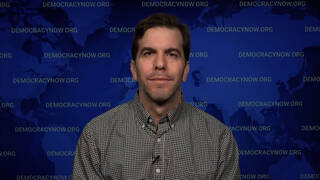
- Kristen Clarkegeneral counsel of the NAACP, former assistant attorney general for civil rights during the Biden administration.
Links
We speak with Kristen Clarke, general counsel of the NAACP, about growing threats to democracy in the United States following the Supreme Court’s gutting of the landmark Voting Rights Act of 1965. Republican lawmakers across the South are responding to the ruling by racing to redraw their congressional maps, which is expected to lead to a historic drop in the number of Black representatives in Congress.
“The Supreme Court’s devastating decision in the Louisiana v. Callais case has really turned our country upside down,” says Clarke, who previously served as assistant attorney general for civil rights at the Justice Department in the Biden administration. She says that given the history of racial discrimination in the United States, particularly in the Deep South, “it is unsurprising” to see lawmakers “race at lightning speed to eradicate the gains that have been made over the decades.”
Clarke also discusses President Trump’s efforts to take federal control of elections in at least eight states, which Clarke says is part of his administration’s goal to “lock out certain voters” and commit “mass disenfranchisement.”
Related Story
 StoryApr 30, 2026Supreme Court Guts Voting Rights Act in “Devastating Blow” to Democracy & Civil Rights: Maya Wiley
Transcript
AMY GOODMAN: We begin today’s show looking at the growing attack on voting rights across the United States following the Supreme Court’s recent gutting of a key provision of the Voting Rights Act of 1965. Republican lawmakers across the South are racing to redraw congressional maps in a move that’s expected to lead to a historic drop in the number of Black representatives in Congress.
In Tennessee, Republican Governor Bill Lee signed into law last week a new Republican-drawn map that aims to eliminate the state’s only majority-Black district. And in Alabama, the U.S. Supreme Court just cleared the way for Republican lawmakers to eliminate a district held by a Black Democrat.
NAACP President Derrick Johnson responded to the unsigned ruling by saying, quote, “We are witnessing a return to Jim Crow.”
Meanwhile, in Virginia, Democrats have suffered a major setback after the state Supreme Court struck down a new congressional map just weeks after voters approved it. The new map could have allowed Democrats to win four additional House seats in November’s midterm elections. On Monday, Democratic leaders in Virginia asked the U.S. Supreme Court to overturn the state court’s decision.
To talk about all of this and more, we’re joined by Kristen Clarke. She’s general counsel of the NAACP. During the Biden administration, Clarke served as assistant attorney general for civil rights at the Department of Justice. She’s also the former head of the Lawyers’ Committee for Civil Rights Under Law.
Kristen Clarke, it’s great to have you back. We used to often interview you when you were head of the Lawyers’ Committee for Civil Rights. Then you were in the Justice Department, now the new general counsel of the NAACP. Before we get into specifics, can you talk about what’s happening to civil rights law in this country, what’s happening at the Department of Justice and, for a global audience to understand, the Supreme Court’s decision gutting the Voting Rights Act?
KRISTEN CLARKE: Well, first, thank you for having me at this turbulent moment in American democracy.
A lot has happened in 14, 15 months into the Trump administration, but what we knew from day one is that this is an administration that would be hostile when it comes to enforcement of our civil rights laws. We’ve seen a Justice Department that is nothing but a shadow of its former self. The Civil Rights Division was once the crown jewel of the Justice Department. It’s no longer engaged in the business of standing up to protect our nation’s most vulnerable communities. They have driven out career professionals and have weaponized our civil rights laws to target communities, to target Black people and other vulnerable communities.
The Supreme Court’s devastating decision in the Louisiana v. Callais case has really turned our country upside down. I am a lifelong civil rights lawyer. I have spent the vast majority of those years working on cases in the South, in the Deep South. The Southern part of our country is a unique place that really wrestles with the legacy of discrimination. It is a place where you see tremendous suffering. It is a place where you see tremendous poverty. And a lot of those problems rear their ugly head in our politics, in our electoral politics. It is a part of the country where Black folks have had tremendous difficulty getting a seat at the table, have had tremendous uphill battles when it comes to having success getting elected to office. And the Voting Rights Act has proven to be the one tool that has helped to open the doors of democracy by giving Black voters a fair opportunity to elect candidates of their choice. There is no doubt that the Supreme Court’s decision in Louisiana v. Callais will mark a turning point in our country. And it is unsurprising that we are seeing the Deep South race at lightning speed to eradicate the gains that have been made over the decades.
Tennessee is a place where the NAACP is working very closely to push back against this effort. Over the course of 48 hours, they moved at lightning speed to dismantle the one majority-Black district in that state, that is home to Memphis, which is the largest — the city with the largest Black population in the country. It’s also a special place. It is the place where Dr. Martin Luther King tragically was assassinated. It is a place that is home to the KKK. The KKK was literally born in the state of Tennessee, and you feel and see that legacy today. And so, we owe a great debt to the people of Tennessee, particularly those in former Congressional District 9. And we are determined to use every tool available in the courts, through our advocacy, through protests in the street, to push back.
JUAN GONZÁLEZ: And, Kristen Clarke, a lot of attention has been focused in the last several months on the redistricting of congressional races, but, really, there’s a lot more at stake than just the representatives in the House of Representatives. There are city councils, school boards, county boards, legislative districts that could also face enormous redrawing in the next year or two. Could you talk about the impact at the local level, as well?
KRISTEN CLARKE: Yeah, that’s right. You know, I think there are many people talking, rightly so, about the need for a Supreme Court reform, the need to figure out a way to restore impartiality and balance to a Supreme Court that seems to be bent at putting its thumb on the scale this congressional election cycle. And it’s why I think the focus right now is on the congressional map. But as you know, we will see potential ripple effects that will be felt at the state level, state Supreme Court maps, county commissions, school boards, city councils and the like.
But, you know, it’s time to really, I think, think about the democracy that we all want and deserve. The moment that we are in is a perilous one that is not sustainable, and it’s why I think the main thing we should be thinking about is this election season and how critically important it is that we get out and make our voices heard. It’s going to be incredibly important that in every corner of this country, that people stand up and turn out in extraordinary numbers, so that we can put ourselves back on a path to the reformation and electoral changes that we need to bring back balance and order and reasonableness into the way that our democracy functions and operates.
JUAN GONZÁLEZ: Could you talk, in particular, about Alabama — officials have asked the Supreme Court for permission to throw out the state’s congressional map, which has two majority-Black districts — especially given the fact that Alabama is often considered the birthplace of the voting rights movement?
KRISTEN CLARKE: It is, indeed, the birthplace of a multiracial democracy here in America. I was just in Selma to mark the anniversary of Bloody Sunday, which was a turning point in our nation’s history, peaceful demonstrators who were brutalized on the Edmund Pettus Bridge. That incident and the courage of folks like John Lewis who marched that day prompted our president and Congress to galvanize and act. Those actions gave us the Voting Rights Act. And so, it is devastating to see Alabama turning the clock back.
There are two districts that afford Black voters an opportunity to elect candidates of choice. One of them is led by Congresswoman Terri Sewell, who grew up in Selma, in the shadow of that bridge, who honorably serves that community well. The other is Shomari Figures, who is the son of a father who fought the KKK, the son of a mother who serves in the state Legislature. He is a public service, someone who has worked for government and who believes in standing up for communities. That Alabama would dare turn the clock back to a time that is looking back on the shadow of Jim Crow is truly despicable. But as they do so, they do so with the blessing of a United States Supreme Court that just yesterday made the decision that Alabama can use a previous map that a court found to be discriminatory. And the election is underway. So, you know, what we’re seeing happening across the South, I think, is made all the more pervasive because the primary election season literally is underway in many states, like Alabama and Louisiana.
AMY GOODMAN: Soon after the landmark Supreme Court ruling that gutted the Voting Rights Act — you mentioned Louisiana — the Louisiana Governor Jeff Landry declared a state of emergency and abruptly suspended congressional House primaries just as voting was starting up. On Sunday, Landry appeared on CBS’s 60 Minutes. He was asked by CBS correspondent Cecilia Vega about why he suspended the congressional House primaries. This is what he said.
GOV. JEFF LANDRY: The highest court in the land says, “The map that you have is unconstitutional.” So we don’t have a map under which our voters can vote on.
CECILIA VEGA: This country has held elections during the Civil War, during two world wars. Elections still went on.
GOV. JEFF LANDRY: We’re going to have an election. And we actually are going to have an election on Election Day, when we —
CECILIA VEGA: But voting was already happening as we sit here right now. More than 45,000 ballots have been returned. What happens to those?
GOV. JEFF LANDRY: Well, those ballots are discarded, and those voters will vote again in November.
CECILIA VEGA: You say that like it’s not a big deal?
GOV. JEFF LANDRY: Well, it’s — it’s not a big deal. It’s not my fault. If anybody has a grievance, take it to the United States Supreme Court.
AMY GOODMAN: That’s the Louisiana governor. Kristen Clarke, your response?
KRISTEN CLARKE: Incredibly disturbing. That in 2026 we live in a democracy where we would dare cast away the legitimate ballots of American citizens is deeply troubling. We have the same situation in Virginia, where the Virginia Supreme Court issued a ruling that renders null and void the votes cast by more than 3 million voters. We are taking a hundred steps backwards right now in American democracy.
We have a lot of work to do to get back on a path to reform, but the way to get there, and it is the NAACP’s strategy, is to galvanize to make sure that our voices of protest are heard loudly, that we’re showing up at the capital houses and protesting these disturbing efforts to redraw maps at the 11th hour in a way that is proving disruptive, chaotic and racially discriminatory, and working to make sure that our voices are heard, that we are standing up proudly and making sure our voices are heard in these primary and general elections, which will truly prove consequential to the future of American democracy.
JUAN GONZÁLEZ: And, Kristen, at the same time, we’ve had a new Reuters investigation that has concluded that the Trump administration is seeking to gain federal control over elections in at least eight states and that they’re using investigations, raids, subpoenas for access to balloting systems and voter records. Your response to this, what appears to be a complete determination of the Trump administration that no matter what happens, they’re not going to lose these midterm elections?
KRISTEN CLARKE: Yeah, no doubt there is a coordinated campaign underway at the hands of this administration to lock out certain voters, to lock out Black voters, Brown voters and other voters of color. There is talk of deploying an election integrity army to polling sites. They are making efforts to access private information from voter registration lists across the country. We are fighting those efforts in about 10 states across the country. And what’s happening is we see this administration issuing executive orders to weaponize the United States Postal Service to determine which absentee ballots will count and which will not. While they undertake all of these unlawful and disturbing actions, they seem to be doing so with the blessing of a United States Supreme Court that does not seem to be a faithful arbiter of the law and our Constitution.
So, we will push back against these efforts, as we are doing in the courts. We’ll work to provide clarity for voters amid the chaos that has been unleashed, and work to make sure that everyone is laser-focused and clear-eyed about the importance of ensuring that their voices are heard loudly, loudly, this critical election season.
AMY GOODMAN: I want to turn to Harmeet Dhillon, the assistant attorney general for civil rights, who holds the same position you had during the Biden administration. She recently appeared on [Newsmax] and talked about the Justice Department’s demand for voter rolls from states.
HARMEET DHILLON: Now, we have gone and asked all 50 states and the District of Columbia to give us their voter rolls. This is something that the attorney general is entitled to under the Civil Rights Act of 1960, which is basically a transparency statute. And we’re using those to try to help these states comply with their Help America Vote Act requirements to keep their voter rolls up to date. So far, at least a third of the states have complied with us voluntarily to reach settlements with us. And what we’re running and finding in these voter rolls is that there are hundreds of thousands of dead people on the voter rolls, and there are quite a few suspected noncitizens on the voter rolls. And now we’re digging in further to see did people actually vote and what have you. But that’s alarming. And that is from the states who are cooperating with us.
AMY GOODMAN: So, that’s Harmeet Dhillon, assistant attorney general for civil rights, a position you know well, Kristen Clarke, because you occupied it before in the Biden administration. Groups are suing to prevent the federal government from getting access to these rolls. If you can talk about the significance of what she was saying on Newsmax?
KRISTEN CLARKE: Well, I think it is fair to say that Harmeet Dhillon has completely hollowed out the Civil Rights Division. I led the division for four years with the core focus of standing up to protect our nation’s most vulnerable communities in every corner of this country. And she has been laser-focused on carrying out Trump’s agenda, on carrying out a partisan agenda. She does not follow facts and apply the law evenhandedly. She cherry-picks and uses laws in ways to try and intimidate her way to the goal that she seeks to achieve. She has talked in interviews about using the force of the Civil Rights Division, writing letters to kind of bully people into submission. That is not how I ran the Civil Rights Division, and it’s, frankly, not how any of my predecessors ran the division.
As she works to try and obtain voter registration lists, groups like mine, the NAACP, are fighting feverishly against these efforts. They are unlawful. And they also throw into chaos the way that election officials run elections in our country. The private voter registration lists contain confidential information. I think there are arguments that the Justice Department is violating state privacy laws in seeking to get their hands on these lists. And, you know, again, it is just difficult watching a Civil Rights Division that has crumbled, leaving people in every corner of the country more vulnerable. Instead of doing the work standing up to fight hate crimes, standing up to combat sexual harassment and sexual violence, instead of standing up to protect the rights of people with disabilities, ensuring that people are able to vote, we’ve seen a Civil Rights Division, really, that has been weaponized to carry out a partisan agenda.
JUAN GONZÁLEZ: I wanted to ask you — in that clip we played of Harmeet Dhillon, she mentioned that they have found dead people on the rolls, and they have found noncitizens on voter rolls in some states. But people who are familiar with the voting process at the local level in this country know that neither of those things are unusual, because, obviously, when a person dies, the family doesn’t immediately try to remove their loved one from the voter rolls. It will take several years of the local — of the local election board seeing that the person doesn’t vote to then send them a notice and purge them from the list. So, it stands to reason there might be tens of thousands of people who are recently deceased that are on the voter rolls. That doesn’t mean that there’s any fraud involved in — of people voting who are supposedly dead. Your response to this attempt to talk about people on the rolls and not talking about people who actually vote?
KRISTEN CLARKE: This is an administration that traffics in mass disenfranchisement, that traffics in mass purges of eligible voters from the rolls. Those data points, I have no doubt, are overblown, that they cannot be substantiated and are merely held out to create a pretextual basis for the purge schemes that they are driving. If anything, what we have seen is that there are thousands of eligible voters across the country who are unlawfully stripped away and removed from the rolls, people who show up on Election Day, who have voted for years, who no longer appear on the rolls. And so we need to be working to figure out how we can open up our process, make it more fair, make it more easier for people to exercise their voice in our democracy.
AMY GOODMAN: Kristen Clarke, I want to play a clip from a video obtained by The New York Times. This is a former special counsel, Jack Smith, speaking during a private discussion at the Cosmos Club in Washington, D.C., last month, in which he discusses the weaponization of the Department of Justice by the Trump administration.
JACK SMITH: We have a Department of Justice today. It targets people for criminal prosecution simply because the president doesn’t like them. We have a department that fails to investigate cases because they might uncover facts that are inconvenient for narratives the president would like to press.
AMY GOODMAN: And, of course, President Trump has gone after Jack Smith. But respond to what he’s saying.
KRISTEN CLARKE: I fully agree with Jack Smith. Again, the U.S. Department of Justice is nothing but a shadow of its former self. This is an agency that throughout its history has engaged in one thing, and that is in fair and full enforcement of the law evenhandedly. You treat people, the powerful and the powerless, the same. You stand up for vulnerable communities. You follow the facts, and you enforce the law.
And we have seen this Justice Department really operate as President Trump’s personal law firm. President Trump lavished praise on his acting attorney general this week for, quote, “keeping him out of jail,” and for that reason, presumes that he’s doing a good job. This kind of entanglement, deep entanglement, between the business of the Justice Department and the White House is not something that we have seen throughout the decades. It is the sign of a Justice Department that is broken and in dire need of repair. And sadly, we should fully expect to see more targeting of the kind that Jack Smith talked about in the road ahead.
And it is, again, why it is so critical that this election season, people get out and make sure that their voices are heard this midterm season, because it’s the first critical step towards putting us back on a path to normalcy and integrity in our country.
JUAN GONZÁLEZ: And could you talk, as well, about what the Trump administration has done to the immigration courts, the administrative law judges that rule, and how they have basically pushed out anyone who doesn’t go along with what the White House and the State Department want in terms of dealing with immigration cases?
KRISTEN CLARKE: That’s right. And one of the aspects here that I think is particularly troubling is that we have shut down our refugee program, that we were once a place that could be a safe haven for people suffering across the country and in countries experiencing political violence and turbulence. We’ve shut the refugee program down, but kept the doors open for white South Afrikaners from South Africa. It is deeply disturbing to see the immigration courts come to a grinding halt. It is, I think, disturbing to see us as a nation shutting the door on refugees, and really challenging to see the weaponization of the Department of Homeland Security and ICE, in particular, as a force that is targeting Americans, targeting innocent Americans and terrorizing communities and causing turbulence in so many corners of the United States.
AMY GOODMAN: I wanted to ask, while this redistricting is extremely radical — and if you can explain how unusual it is, what it means to do this redistricting every 10 years, but President Trump pushing for it in the middle of that? A couple quick things. One is, we’ve been showing this picture of the Trump banner, a banner of President Trump’s head, that is outside, hangs on the Justice Department. And the significance, the meaning of this, and how unusual that is? And the other thing is, even if there is this redistricting and it gives Republicans an advantage, the fact is there’s an extremely low rate of voting in the United States versus other countries. And maybe you could say about what it is. If more people voted, would this redistricting even matter?
KRISTEN CLARKE: Well, the wave of late-decade racial gerrymandering of maps that we are seeing right now, particularly in the South, is highly unusual. Redistricting ordinarily is something that is carried out once at the start of a decade, once you have newly released census data. In states like Tennessee, there is actually a law on the books that prohibits mid-decade redistricting, something that they repealed during their 48-hour marathon session to dismantle Congressional District 9, home to Memphis.
But redistricting is not a small task. Ordinarily, this is one of the largest undertakings for a state legislature at the beginning of a decade, carried out over a series of hearings, with opportunity for the public to engage, opportunity to consider and debate alternative maps, opportunity to hear testimony from lawmakers, both for and against. It’s a rigorous process with lots of deliberation.
And the kind of race at lightning speed to adopt new maps that we are now seeing in the Deep South is deeply disturbing and anti-democratic. In Tennessee, for example, lawmakers had no opportunity to see the map before it was introduced a few hours into the 48-hour session. There was no alternative map. The one map was produced in a very opaque process.
You know, we do not want redistricting carried out in the dark, in the backrooms, in a process — through a process that lacks any transparency or opportunity for public engagement. So, there is the racial impact, the partisan impact that we are seeing in some places in the country. But then the lack of transparency really makes it something that runs contrary to principles that really should shape a modern democracy.
And when we talk about a modern democracy, we want a democracy where we have high levels of voter participation and turnout. No doubt we lag woefully behind countries in Europe that enjoy turnout and participation rates at the 80% level. We are far below that in the United States. And this is an administration that wants to reduce those numbers even more. They want to make sure that they find ways to depress, intimidate and hold back the voices of Black and Brown voters and other voters of color. And it is why at the NAACP we’ll continue to use advocacy, protest and aggressive litigation in the courts to ensure that we have an open, fair and equal democracy, where everyone can exercise their voice and participate.
AMY GOODMAN: I think the number is something like 65% for general elections. That means 35% of eligible voters don’t vote. And in the midterms, it’s like half of voters don’t. The last one was something like 52% came out. Half the eligible voters in the United States are not voting. What an amazing force that would be if all people who are eligible came out to vote.
Kristen Clarke, I want to thank you so much for joining us, the general counsel of the NAACP. She just took on that position last month. She was previously assistant attorney general for civil rights at the U.S. Department of Justice.
Coming up, Israel has deported two Palestine solidarity activists who were violently detained and taken to Israel when Israeli forces raided the Gaza-bound Global Sumud Flotilla in international waters. Stay with us.
[break]
AMY GOODMAN: “Let Freedom Ring” by Tom Morello. He is going to be playing today, a Grammy Award-winning artist, activist and Rock & Roll Hall of Fame inductee, at noon at 26 Federal Plaza. They have put out a poster that says, “End ICE abuse now.” He’s performing in New York with Bruce Springsteen last night to thousands of people at Madison Square Garden.



 Top
Top
Media Options