








 Watch Full Show

An estimated 300 immigrants detained at the Delaney Hall ICE jail in Newark, New Jersey, are continuing a hunger and labor strike to demand their freedom. Amid ongoing protests, New Jersey Governor Mikie Sherrill has deployed state police, who erected a barricade around the facility and have reportedly brutalized activists. Newark Mayor Ras Baraka has also imposed a nightly curfew around Delaney Hall until further notice.
Local investigative journalist Bob Hennelly joins Democracy Now! to talk about the ongoing hunger and labor strike, launched on May 22, and its historical implications in Newark and the rest of the country. In letters at the outset of their strike detailing the conditions in the ICE jail, detainees have “written something that I think historians will say is equivalent to the Declaration of Independence,” says Hennelly, “because they so vividly describe the way they’ve been deprived of all the basic human rights that we’ve come to associate with this nation.”
Related Story
 StoryJun 25, 2026Prairieland Nine: Texas ICE Protesters Get Up to 100 Years in Prison as Trump Targets Anti-Fascists
Transcript
AMY GOODMAN: We begin today’s show in New Jersey, as today marks 11 days since an estimated 300 immigrants detained at the Delaney Hall Newark ICE jail began a hunger and labor strike demanding their immediate release. Protesters and organizers continued to gather near the massive jail over the weekend after New Jersey State Police imposed a barricade about a half-mile long around Delaney Hall’s perimeter. Activists denounced New Jersey Governor Mikie Sherrill for deploying state police, with officers in riot gear reportedly beating up protesters.
Newark Mayor Ras Baraka has imposed a nightly curfew around Delaney Hall until further notice. There were reports of more arrests Sunday night as some protesters defied the curfew. Mayor Baraka’s announcement Sunday came after another weekend of clashes between protesters and law enforcement.
Democracy Now!’s María Taracena was on the ground and spoke to several people. This is Sally Pillay, a mutual aid advocate with Eyes on ICE New Jersey. She described the chaotic scene as state police swarmed the protest outside Delaney Hall Saturday night.
SALLY PILLAY: There was no announcement. There was nothing. It just came. There was an escalation of police with shields, mounted horses, flashbangs, tear gas, smoke bombs, that was just one after the other, one after the other. And there was just no sense of, you know, safeness that people in the crowd felt. We do mutual aid and support for the families. We had nothing to do with the protests that were going on. But the way the police, the state police moved and the local police moved against the crowd from the north side coming down Doremus Avenue, they started to shove the crowd towards the white mutual aid tent, and so we felt very trapped. And then the smoke was coming in, and so we had to escape.
AMY GOODMAN: Meanwhile, union workers led a picket line near Delaney Hall Sunday afternoon, demanding the ICE jail be shut down.
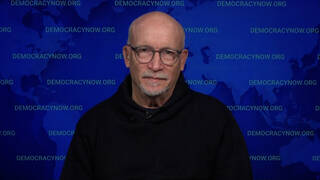
For more on the latest, we’re joined by Bob Hennelly. He’s the award-winning investigative journalist, general manager of WBAI Pacifica Radio in New York, also host of What’s Going On! Labor Monday, and has been covering the protests at Delaney Hall. His new piece for Salon is titled “Escalating tensions at Newark migrant prison draws ire of lawmakers.”
Bob, if you can go through the weekend, with the New Jersey governor, who actually has called for Delaney Hall to be shut down, calling out New Jersey state troopers? And take us through the weekend, right through the state of exception or emergency that the Newark mayor has now imposed.
BOB HENNELLY: So, I do think we do have to introduce one element here that in your comprehensive lead-in you didn’t include, which was the decision by the Trump administration last week with Secretary Mullin threatening to actually close the international arrival function at Newark Liberty Airport right as the World Cup is about to start, and both the — all the states in this region have invested heavily in that.
Also, what is most disturbing, perhaps, is that anyone who’s been around for a while — and I have the fortune and privilege to be in that category — you have to recall that in 1967 the deployment during what has been called the rebellion in Newark, with the state police and National Guard and the same kind of freelance vibe — it’s gotten actually disturbing — resulted in the death of 27 people. And the subsequent report by the Lilly Commission, which was convened by Governor Hughes, much like the Kerner Commission, found that, actually, the state police and National Guard extended the period of time of the civil unrest, contributing to the length of chaos, because they actually targeted Black businesses for destruction. I’m not suggesting that happened here, but it is disturbing that it’s such an ahistorical response.
And what it does do is make the conflict and the police violence — which, of course, the likes of the New York Post and 770, that’s what they want — takes us off the heroism of the detainees, who have written these three letters, I said last time I was lucky enough to be on with you, where they’ve written something that I think that historians will say is equivalent to the Declaration of Independence, because they so vividly describe the way they’ve been deprived of all the basic human rights that we’ve come to associate with this nation, and we know, from speaking with scholars, they enjoy. And yet we have a period of lawlessness in this country, where the Trump administration is just systematically ignoring writ of habeas corpuses that have been issued by Article III courts.
And I just think it’s also foreseeable. You do know, because you covered it when it happened, back in May of 2025, Mayor Baraka was taken off the street by masked federal agents. I recall this all the time, because this is when it really started. And Bonnie Watson Coleman, congresswoman, 80 pounds when wet, and Representative McIver, Representative Menendez, all wrapped around, in the tradition of nonviolent self- — the Gandhi-esque tradition, to slow down the process of these masked agents taking the elected mayor of New Jersey’s largest city into custody.
Now, at that point, I submit, that’s when the state of New Jersey, under the prior administration, needed to stand up a protective corridor for the humanitarian work that’s going on there. And that’s the upset here, is that unintended — folks who were well-intentioned, who see this, what happened in Minneapolis with the assassination of Renee Good and Alex Pretti, they come there ready to engage, with the helmet on, gas masks, and what they may not know is that there’s a very fragile humanitarian effort, which, of course, I’m not surprised your reporter captured with Sally there, where they were — when things are calm, individuals are released, who have been detained or imprisoned. And it’s so important that they be encircled by the beloved community, not by a pool of reporters or protesters, that they be cared for, that they end up — and you know, you may know this area, that part of Ironbound is an industrial area. And so, they’re literally dumped on the sidewalk, no means to connect with their family. And with these aid workers, this faith-based community enterprise, that’s been going on since the winter of 2025, before people knew what Delaney Hall was, that gets fractured when there’s not the disciplined, nonviolent protest going on outside. And so, these folks don’t get the advantage of being debriefed. First, they may not get released. And second, many of them don’t have legal counsel. They’re denied the interaction with a social worker, the ability to have resources to get on with their life and to continue to fight for their freedom.
AMY GOODMAN: And, Bob, if you can explain what the state of exception is that Mayor Baraka has imposed, and then the labor groups that came out —
BOB HENNELLY: Sure.
AMY GOODMAN: — yesterday, Sunday, around 4:00?
BOB HENNELLY: Right, so, and this, of course, has a historic irony. Amiri Baraka is the late poet and cultural leader, was one of the key leaders in Newark at the time of the insurrection and had been beaten by the New York police. His son is Mayor Ras Baraka. Mayor Baraka does not impose this kind of thing, like a curfew, without having, I’d say, some reasonable concern. It does — it’s only in the area around Ironbound, this distinct area of Ironbound, because Ironbound itself is diverse. There’s a part of Ironbound that is a rich cultural music community, residential community, and then there’s a part of it that’s industrial. So, that, you need to understand that.
The union turnout was underreported. I’m so glad you mentioned it. HPAE, the nurses’ union in New Jersey, 32BJ SEIU, they do see the labor connection here, because, remember, as we spoke last time, these inmates are getting a dollar a day, while the head of GEO, a private corporation, is getting over $11 million. So, there’s actually — and I’m wondering: At what point does America corrections unions stand up and say, “Listen, this isn’t good, across the board”? And that’s — we are seeing labor step up and seeing the connection between this fundamental civil liberties question.
AMY GOODMAN: Bob Hennelly, I want to thank you for being with us. We’re going to continue to follow what’s going on at Delaney Hall. Bob Hennelly, award-winning investigative journalist, broadcast and print, for more than 40 years, general manager of WBAI Pacifica Radio, which is doing wall-to-wall coverage of what’s happening at Delaney. He’s host of What’s Going On! Labor Monday.
Up next, Oscar-nominated director Julie Cohen and former Wall Street Journal reporter Paul Barrett on the De-ICE Citizens Bank campaign. Stay with us.
[break]
AMY GOODMAN: “Nterini,” “My Friend,” by the Malian singer Fatoumata Diawara, performed in Democracy Now! years ago.




 Top
Top
Media Options