







 Watch Full Show

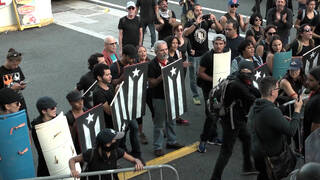
In cities across the country, from Los Angeles to Chicago to Minneapolis, residents have taken to the streets to oppose the militarized immigration sweeps, enforcement tactics and violence of ICE and Border Patrol under President Trump’s second term. A new ProPublica and Frontline investigation looks at law enforcement’s heavy-handed response to these protests, resulting in legally dubious charges that later unravel.
“The Department of Justice was labeling the people who were in the streets as domestic terrorists, as agitators, as extremists. They were rounding them up in large numbers,” says A.C. Thompson, investigative reporter with ProPublica and correspondent for PBS’s Frontline documentary series. “So, we looked at 300 arrests in these various cities and found that more than a third of them had collapsed.”
Related Story
 StoryJun 20, 2025I Was Detained, Deported from L.A. Airport for My Reporting on Gaza Campus Protests: Australian Writer
Transcript
AMY GOODMAN: As we continue now to look at President Trump’s immigration crackdown, we turn to an in-depth investigation into the law enforcement response to protesters. In cities across the country, from Los Angeles to Chicago to Minneapolis, residents took to the streets to oppose the militarized immigration sweeps, enforcement tactics and violence by ICE and Border Patrol agents.
The investigation by A.C. Thompson for ProPublica is headlined “Caught in the Crackdown: As Arrests at Anti-ICE Protests Piled Up, Prosecutions Crumbled.” The accompanying Frontline documentary is Caught in the Crackdown. This is the trailer.
JOE FRYER: Immigration officials conducted several raids and arrested dozens of people.
NARRATOR: An investigation into the Trump administration’s monthslong crackdown.
A.C. THOMPSON: Are you encountering a lot of resistance?
GREG BOVINO: Most I’ve ever seen.
NARRATOR: The pushback.
MAYOR JACOB FREY: They are creating the emergency and the crisis that we then need to deal with.
COLE SHERIDAN: I’m asking, “Who’s detaining me?”
PROTESTER: People live here!
NARRATOR: And the fallout.
TOM HOMAN: President Trump and I, along with others in the administration, have recognized that certain improvements could and should be made.
AMY GOODMAN: That was the trailer for the new ProPublica-Frontline film, Caught in the Crackdown. In a minute, we’ll be joined by the investigative reporter A.C. Thompson to discuss what they found when they looked into the tactics, the arrests, the legal cases and impact of these protests. But first, another clip. This scene is from Minneapolis shortly after Renee Good was shot and killed by ICE officer Jonathan Ross.
A.C. THOMPSON: We were reporting in the neighborhood where Renee Good had been killed.
PROTESTER 1: Go home!
PROTESTER 2: You don’t need gas masks and more guns.
PROTESTER 3: What is that about?
A.C. THOMPSON: Agents were surrounding and questioning a man.
PROTESTER 4: Take your guns home! We don’t want guns in our neighborhoods!
PROTESTER 2: They don’t need that [bleep] hardware. It’s ridiculous.
A.C. THOMPSON: People were coming out of their houses.
PROTESTER 3: Get the [bleep] out! You don’t belong here!
A.C. THOMPSON: The agents started to leave.
PROTESTER 5: Get the [bleep] out of here! Move out! You heard them!
PROTESTER 6: Bye!
A.C. THOMPSON: One protester was pepper-sprayed in the face at close range.
PROTESTER 7: That’s not necessary! You’re [bleep] wrecking cars! Get the [bleep] out of here!
A.C. THOMPSON: I spoke with the man they were questioning, Christian Molina. He said the officers had rammed his vehicle.
CHRISTIAN MOLINA: They hit my car for no reason, man. They hit me.
A.C. THOMPSON: What happened?
CHRISTIAN MOLINA: They followed me for no reason and hit my car. They looked at me, and they decided to pull me over for no reason. Do you believe that?
A.C. THOMPSON: That Ford SUV?
CHRISTIAN MOLINA: I’m a U.S. citizen.
A.C. THOMPSON: Suddenly…
Oh, here. Careful.
ICE AGENT 1: Move back!
A.C. THOMPSON: Someone threw a snowball in the direction of the agents.
ICE AGENT 1: Move back!
A.C. THOMPSON: One of them tossed a tear gas canister into the crowd.
PROTESTER 7: You’re tear-gassing a [bleep] neighborhood!
PROTESTER 8: It’s peaceful!
PROTESTER 7: People live here!
ICE AGENT 1: Back it up!
A.C. THOMPSON: An agent pepper-sprayed protesters and a news photographer up close. Another fired pepper balls into the crowd. I was hit three times.
I got shot repeatedly with pepper balls.
CAMERA OPERATOR: Fix your hat. Fix your hat.
PROTESTER 7: This isn’t a [bleep] war zone! This is a [bleep] neighborhood!
PROTESTER 9: I was in the car, and they threw [bleep] underneath the [bleep] car. Yes!
PROTESTER 10: I can’t see!
PROTESTER 11: Shame on you!
PROTESTER 12: Hey! Ahh! I need help. I need —
A.C. THOMPSON: As they left, an agent shot pepper spray from his window. It hit my colleagues in the face.
You need this?
CAMERA OPERATOR: Yes.
A.C. THOMPSON: Here. Give me the camera. Give me the camera. Give me the —
PROTESTER 13: Water!
PROTESTER 14: I got water!
PROTESTER 15: Water!
PROTESTER 16: Anybody need an eye wash?
CAMERA OPERATOR: Was that spray? Did they just spray from a moving van?
A.C. THOMPSON: In the months I’d been covering this story, I had seen the same pattern everywhere we went: federal agents using weapons like tear gas and pepper spray against protesters and bystanders. The courts would try to rein them in, but they’d move on to the next city and do the same things. On local TV, Bovino was unapologetic.
GREG BOVINO: We’re here to conduct a Title 8 mission. It won’t stop. Despite rioters, agitators and vast amounts of violence against federal officers, we’re not going to stop.
AMY GOODMAN: There’s also a scene from the Frontline documentary where A.C. Thompson shows the same footage from Minneapolis to former law enforcement officials, first Christy Lopez, who spent years investigating law enforcement misconduct for the Justice Department’s Civil Rights Division.
A.C. THOMPSON: I showed footage from the scene to Christy Lopez.
PROTESTER 7: You’re tear-gassing a [bleep] neighborhood!
PROTESTER 8: It’s peaceful!
PROTESTER 7: People live here!
CHRISTY LOPEZ: We see just use of excessive force after use of excessive force. In no scenario is it OK to be pepper-spraying people as you’re leaving the scene. It’s just they’re mad, they’re scared. You know, they’re able to get away with it, so they’re just using the power they have to use force against people.
AMY GOODMAN: Then A.C. Thompson shows the footage to Chris Magnus, a former head of Customs and Border Protection, who once oversaw Bovino. Magnus also served as a police chief in multiple cities.
CHRIS MAGNUS: Pretty awful. You know, I mean, one of the things in policing when it comes to use of force, it’s proportionality. Is the force really proportional to what you’re — what you’re receiving or what you’re dealing with? People may well get under your skin under a lot of circumstances. You don’t like it, but professionals don’t react to it.
AMY GOODMAN: Those were clips from the new ProPublica-Frontline documentary, Caught in the Crackdown, now streaming for free on YouTube, PBS.org and the PBS app. The ProPublica investigation by A.C. Thompson is headlined “Caught in the Crackdown: As Arrests at Anti-ICE Protests Piled Up, Prosecutions Crumbled.” When we come back, A.C. Thompson will join us from San Francisco. Stay with us.
[break]
AMY GOODMAN: Vietnamese musician Mai Khôi performing at Joe’s Pub in 2020. This is Democracy Now!, democracynow.org. I’m Amy Goodman in the Bay Area, in Berkeley, and Juan González is in Chicago.
We’ve just been talking about this very important PBS investigative series called Caught in the Crackdown. It is a Frontline-ProPublica piece. A.C. Thompson is the investigative reporter on this.
A.C., if you can just summarize? I mean, you have very dramatic footage here. You were in Minneapolis right after an ICE officer, Jonathan Ross, killed Renee Good. Talk about the protests, from Chicago to Minneapolis to Los Angeles, what people were doing when they were arrested, not to mention brutalized and, in some cases, killed, and then how their prosecutions crumbled.
A.C. THOMPSON: You know, it was fascinating for me to watch from June 2025 in Los Angeles to the fall in Chicago to winter in Minneapolis and following the immigration sweeps led by then-Border Patrol commander Greg Bovino and the rest of the immigration agents, agencies, and looking at the protests that were erupting around the country. It was this situation where there was allegations of a massive surge in assaults on federal agents. The Department of Justice was labeling the people who were in the streets as domestic terrorists, as agitators, as extremists. They were rounding them up in large numbers, arresting people from city to city to city. And then, what we would see after these arrests would happen is, as these cases moved through the court system, the allegations made against the individuals tended to fall apart under scrutiny.
So, we looked at 300 arrests in these various cities and found that more than a third of them had collapsed. Prosecutors had decided to dismiss them. They had refused to even file charges in the first place, or juries acquitted the defendants. And so, the claims that the government was making about this massive surge in assaults, about all these people being terrorists and domestic extremists and all this sort of stuff, it just didn’t match up to the reality that, one, that we were seeing on the ground as we were filming, and, two, what the courts were finding as they looked at the evidence, and prosecutors looked at the evidence, and said, “This is not going to hold up. We’re dismissing this case.”
JUAN GONZÁLEZ: And, A.C., you mentioned Chicago. There were — you report there were 109 arrests there, but prosecutors eventually dropped 75. That’s nearly three-quarters of all the people they arrested. The charges just disappeared?
A.C. THOMPSON: And that’s a conservative — that’s a conservative number, too. I think that number is going to grow in time as we get more evidence about exactly what’s happened. But, yeah, the vast bulk of the arrests in Chicago have been dropped by prosecutors. And the handful of cases that are still going on are still working through the system, but there seem to be some problems with some of those, as well.
Experts told us — law enforcement experts, former Department of Justice civil rights personnel said, “Look, this looks like a pattern and practice of bad arrests, of unjustified arrests.” And that looks like what we’re seeing across the country. When you have arrest after arrest that doesn’t hold up, that prosecutors don’t have faith in the evidence, that juries don’t have faith in the evidence, that’s telling you that this is sort of more than just your normal, run-of-the-mill police effort. These are bad arrests.
JUAN GONZÁLEZ: And how do these compare to the normal rates for U.S. attorneys or federal authorities in criminal cases?
A.C. THOMPSON: I mean, that’s what stands out so much — right? — is, in federal court, federal prosecutors win more than 90% of their cases. Very few are dismissed. They lose very, very few at trial. They are incredibly successful. This wave of arrests, stemming from the immigration sweeps and the protests against them, they’ve been very unsuccessful with. They’re having problems in city after city trying to do these cases. And that means, you know, that is a reflection of, in all likelihood, unjustified arrests being made by Border Patrol agents, ICE agents, other federal agents that, frankly, don’t normally deal with protests, with crowds, with these kinds of situations that they’ve been thrust into over the past year.
AMY GOODMAN: A.C. Thompson, we want to thank you for being with us, investigative reporter with ProPublica and the PBS series Frontline. His new documentary, Caught in the Crackdown, is streaming on YouTube, PBS.org and the PBS app. We thank you for being with us. He’s talking to us from San Francisco.
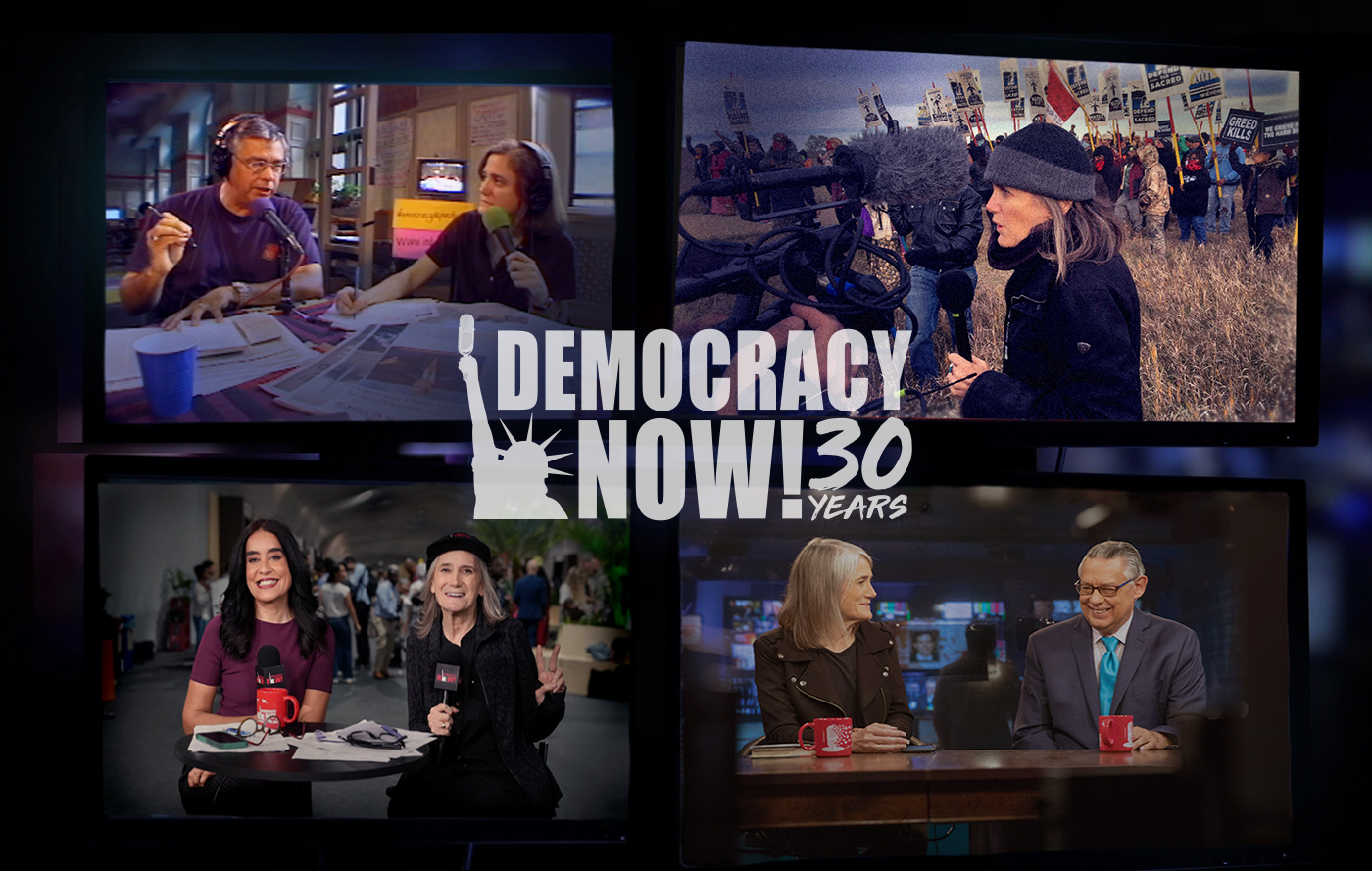
I’m in the Bay Area, too. We’ll be at Tower Theatre in Sacramento tonight at 7:00 for the theatrical premiere of Steal This Story, Please!, about Democracy Now! I’ll be doing the Q&A with the director Tia Lessin after the film.



 Top
Top
Media Options