






 Watch Full Show

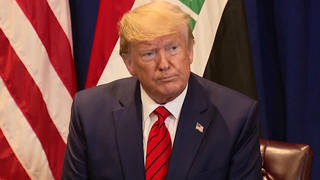
As President Trump threatens Iran, Venezuela, Mexico, Greenland and more, renowned historian Alfred McCoy says the United States is “an empire in decline,” following a predictable pattern of militarism abroad and political instability at home as it loses power and influence on the world stage. “American politics become increasingly contorted and irrational,” says McCoy. “I think the thing to do is to realize that we are an empire in decline, … and it will continue for another decade or two, until American power finally slips away.”
McCoy just published his latest book, Cold War on Five Continents: A Global History of Empire and Espionage, on the impact of U.S.-Soviet imperial proxy wars in Africa, Asia and Latin America.
Related Story
 StorySep 25, 2019Trump Lashes Out at Iran, China & Venezuela in Nationalist Address to U.N. General Assembly
Transcript
AMY GOODMAN: This is Democracy Now!, democracynow.org, The War and Peace Report. I’m Amy Goodman, with Juan González.
As President Trump threatens Iran, Venezuela, Mexico, Greenland and more, we spend the rest of the hour with the renowned historian Alfred McCoy. His new book, Cold War on Five Continents: A Global History of Empire and Espionage. And his recent article, “Ending the American Dream by 2029?” McCoy is a history professor at University of Wisconsin-Madison.
We welcome you back to Democracy Now! In your book, you describe the 1953 coup in Iran as an act whose consequences were measured across decades, leading directly to the 1979 revolution. What are your thoughts on witnessing this escalating Trump threats against Iran, saying the U.S. may possibly intervene militarily there, Professor McCoy?
ALFRED McCOY: Thank you, Amy.
The United States is an empire in decline. And if you look back over the past hundred years, the lessons of history are pretty clear. Declining empires suffer from two things. One, they suffer from micro — what’s called micro-militarism abroad. They send troops abroad, in their flailing decline, thinking that some form of military intervention will recapture the global power that is slipping away from their hands. And then, domestically, the other thing they suffer from, every single declining empire over the past hundred years — the Soviet Empire, British Empire, the Spanish, all the rest — they suffer from coups. And, of course, we had our coup on January 6, 2001.
So, as American politics become increasingly contorted and irrational, I think the thing to do is to realize that we are an empire in decline, and we are writhing in this kind of irrationality, particularly in the international realm. And it will continue for another decade or two, until the power, American power, finally slips away.
JUAN GONZÁLEZ: And, Professor McCoy, in terms of this declining empire, the Trump administration — President Trump has said he wants to increase military spending by 50%, from $1 trillion to $1.5 trillion. How does this fit into the flailing of a declining empire, as you talk — as you mentioned? And also, this attempt to reassert control over the Western Hemisphere, to create essentially a fortress of the Western Hemisphere against the rest of the world, the likelihood of that succeeding?
ALFRED McCOY: Good question, Juan. First of all, the United States has been, for over a century now, dominant in the Western Hemisphere, at least North America. And even with reduced global influence, the United States does have a capacity to exercise military force in the hemisphere. Whether that will produce good relations with our Latin American neighbors is highly questionable.
But to turn to your question about this retreat from the world into the Western Hemisphere, that’s effectively a near-disastrous decision. Right now we are in a new Cold War, a Cold War between Moscow, Beijing and Washington. And the object of the new Cold War, just as it was for the old Cold War, is dominance, control over the vast Eurasian land mass. The way the United States won the Cold War — and we did win it, hands down — was that we encircled the vast Eurasian continent with an Iron Curtain, and we defended that Iron Curtain by rings of steel — naval armadas, aircraft and, above all, military alliances, the NATO alliances on the western end of Eurasia and five bilateral military alliances with Japan, South Korea, Taiwan, Philippines and Australia on the eastern end of Eurasia. And Washington simply sat back, with the Sino-Soviet bloc contained behind what was called the Iron Curtain, and waited for a blunder.
And the Soviet Union, like many declining empires, engaged in this micro-militarism. It invaded and occupied Afghanistan in 1979. And by the time the Red Army withdrew 10 years later bloody and battered, it was incapable and unwilling to intervene when Eastern Europe, the satellite nations, broke away, and the Soviet republics — the Soviet Union broke apart. And that was the end of the Soviet Union, and that was the end of the Cold War.
So, clearly, maintaining a position in Eurasia, particularly in Western Europe, is critical to U.S. geopolitical positioning in this new Cold War. And Trump’s retreat from Europe, his damaging of NATO, threatening Greenland — and if that happens, the prime minister of Denmark, a foundation member of NATO, has said that that’s pretty much the end of NATO. So, in many ways, Trump is damaging the U.S. position in Western Europe. And that constitutes almost a unilateral surrender, in geopolitical terms, in the midst of this new Cold War. So, the retreat to the Western Hemisphere simply makes no sense. And the implications of this for the world are quite considerable, because both Russia and China are expanding their dominance over this vast Eurasian land mass, and that threatens the stability of the entire international system of law, trade and diplomacy.
JUAN GONZÁLEZ: Well, you mentioned Russia and China. In your recent piece, “Ending the American Dream by 2029?” you talk about China’s electric vehicle production, which already is 70% of the global total, how that could make the U.S. auto industry, which was for most of the post-World War II period the mainstay of the American economy, almost obsolete. Could you talk about the significance of that?
ALFRED McCOY: Sure. Right now — well, first of all, every major empire over the last 500 years has been synonymous with conquering or developing a new form of energy. For the Spanish, it was slavery, maximizing the energy output of the human body through cruel plantation slavery. For the British, it was the coal-fired revolution in steam power. For the United States, it was oil power.
And we are now in the midst of a green energy revolution, switching to alternative energy, solar and wind power, particularly solar. And China is absolutely dominant in every aspect of this green energy revolution. And so, since imperial power, global hegemony, is synonymous with energy innovation, China’s dominance in this sector is going to be a key factor in its rising global hegemony, displacing the United States as the world’s preeminent power.
China already dominates the production of solar panels and solar panel components, and they’re now turning that into this very important consumer durable, automobiles. And China’s production of automobiles is extraordinary. They can produce a quick-charging, long-range electrical vehicle and sell it for $9,000. You can’t get a second-hand Honda for $9,000 in the United States anymore. That’s an extraordinary price. And they have a fleet of ships that are custom-built. And their factories are robotic factories, all robotic factories, barely touched by a human hand, are cranking out cars literally by the millions. They are heading for the ports, where specifically constructed ships are crossing to world markets. So they’re building robotic plants around the world. China is capturing the global auto market, and this is the cutting edge of Chinese global power and energy innovation.
So, the United States is, in fact, retreating from the world economy and the world in two realms: one, a misuse of our military power, and a gross miscalculation in terms of energy policy. And the two together, I believe, will serve as kind of accelerants for a U.S. decline in the global arena.
AMY GOODMAN: I mean, it’s very interesting. A federal court in the United States has just ruled that President Trump cannot single-handedly stop offshore wind farms off the coast of the United States, as he tries to completely move away from renewables and back to oil, which brings us to Venezuela, where after he had the Venezuelan president and his wife abducted, in the news conference he repeated dozens of times, in his reasoning — he talked about oil. Now, I wanted to go to Mexican President Claudia Sheinbaum on Monday speaking with President Trump after he threatened U.S. military intervention, he said, to combat drug cartels in Mexico.
PRESIDENT CLAUDIA SHEINBAUM: [translated] President Donald Trump and I talked about the joint work done in security. There are important results from the joint collaboration. For example, the fentanyl crossings have reduced by 50% in Mexico and the U.S. How is that measured? By the fentanyl seizures they do on the other side of the border. So, CBP, which is a U.S. agency, makes public the amount of fentanyl seized on the other side of the border, and it has reduced by 50% in a year.
AMY GOODMAN: So, if you could talk about, back to Latin America, when it comes to Mexico, when it comes to Cuba, clearly setting his sights on Cuba, some say carrying out Marco Rubio, the Cuban American secretary of state’s wishes, that Venezuela is even a route to take down the Cuban government, now forbidding Venezuela from selling any oil to Cuba, which could very well further destabilize it? Talk about what’s happening there.
ALFRED McCOY: OK. If you look at last November, the Trump administration released what’s called the National Security Strategy, the NSS, document. And in this, Trump is very clear that the U.S. is going to reorient its military forces from a global position, essentially pull out of Europe, abandon the U.S. position on the vast Eurasian land mass, and relocate its forces into Latin America and achieve absolute dominance over Latin America.
The U.S. still has formidable military power, tremendous economic resources. And when we concentrate that on the southern border, on our southern neighbors, we can be, as we have been since the 1890s, absolutely dominant in the Caribbean. OK? And, you know, from 1898 until, really, 1933, the United States exercised gunboat diplomacy in the Caribbean. Theodore Roosevelt sent the Navy to block Colombian forces and forced the secession of Panama and its creation as an independent state so we can build the canal. The U.S. forces shuttled in and out of the Caribbean for the next 30 years. It wasn’t until the Franklin Roosevelt administration announced a “Good Neighbor” policy that we stopped that.
But that’s the Trump policy. We’re returning to this gunboat diplomacy and this intervention. And frankly, we have sufficient power to do that. That will, of course, just as it did the last time, produce an enormous nationalist, anti-imperialist reaction in Latin America and undercut our serious, long-term and diplomatic relationships with our Latin American neighbors. And China is already the dominant economic trade partner in much of Latin America. And I think, over the long term, that will rouse hostility, increase China’s presence and increase diplomatic ties between China and Latin America. So, it’ll be short-term dominance and control for a long-term loss of influence and power.
JUAN GONZÁLEZ: We only have about 30 seconds, but the constant use of the United States of the “war on drugs” as a means to impose its will on Latin America?
ALFRED McCOY: Yeah, Juan, the war on drugs, since President Nixon declared it back in 1972, has been a monumental failure. It’s a very simple law of supply and demand. You attack supply, whether you’re sinking drug boats in the Caribbean or you’re trying to fumigate, defoliate crops in the hills. So, when you attack supply, all you do is you reduce supply, you raise price, and that’s incentive for growers to produce more drugs. And the logic of that has produced a tenfold increase in the supply of illicit narcotics since the drug war began over 50 years ago. So, it’s a — it’s what I call the stimulus of prohibition.
AMY GOODMAN: Alfred McCoy, we’re going to have to leave —
ALFRED McCOY: The way to deal —
AMY GOODMAN: We’re going to have to leave it there, but I’m going to encourage people to read your article and your new book, history professor at University of Wisconsin-Madison, his first book, Politics of Heroin: CIA Complicity in the Global Drug Trade. His new book is Cold War on Five Continents. I’m Amy Goodman, with Juan González. Thanks for joining us.



 Top
Top
Media Options