






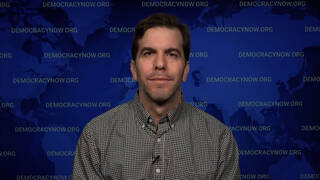





Guests
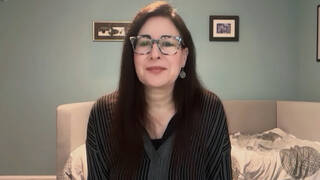
- Ondi Timonerdirector of All the Walls Came Down.
- Heavenly Hughescommunity organizer and founder of My TRIBE Rise.
Watch Part 2 of our interview about All the Walls Came Down, a new short documentary by filmmaker Ondi Timoner that looks back at the devastating 2025 fires in Los Angeles, which destroyed Timoner’s home and left the historically Black community of Altadena in ruins. The film, shortlisted for an Academy Award, follows community organizer Heavenly Hughes as residents confront the aftermath of the fires and organize to rebuild their town.
Transcript
AMY GOODMAN: This is Democracy Now!, democracynow.org, The War and Peace Report. I’m Amy Goodman, as we continue with Part 2 at our look at the new Oscar-shortlisted documentary All the Walls Came Down. It’s about last year’s devastating fires in Los Angeles and focuses on the historically Black city of Altadena, left in ruins. The film was directed by Ondi Timoner. In this clip, Ondi returns to her destroyed home with her wife Morgan.
ONDI TIMONER: What’s happening with the house?
RANELL WORMLEY: They’re saying that they’re going to do a foreclosure, 26th the August.
ONDI TIMONER: What?
RANELL WORMLEY: Yeah. So, all these months that I’ve been trying to get them to tell me something, nobody could ever tell me anything, just sending me to different departments.
ONDI TIMONER: I’m so sorry that you’re dealing with all this. Can’t believe they can take your property and sell it.
RANELL WORMLEY: It’s just been a whirlwind, Ondi.
ONDI TIMONER: And you’ve got your family you need to take care of, but you don’t know what to do.
RANELL WORMLEY: And I got my family. That’s why I had kind of started saying, you know, “I’ll just sell it.”
ONDI TIMONER: But what about if we can get you to stay? Wouldn’t you prefer to stay in the lot?
RANELL WORMLEY: Yeah, but I don’t have the money to rebuild it.
ONDI TIMONER: But the power company does.
HEAVENLY HUGHES: Oh my goodness, we have a special guest here. Our Congresswoman Judy Chu is in the house.
REP. JUDY CHU: Look at all these incredible resources that are here. This is so fantastic. Foothill Family, Young & Healthy. Thank you, My TRIBE Rise, for bringing together the community.
RANELL WORMLEY: I had a question. I was affected by the fire.
REP. JUDY CHU: Yeah.
RANELL WORMLEY: My mom had a reverse mortgage on the home.
DEMETRIUS GRAY: Reverse mortgages are the scourge of the Earth.
REP. JUDY CHU: Yeah.
DEMETRIUS GRAY: They’re all seniors. Not one young person under the age of 65 that has a reverse. And the level of interest, it’s above credit card rate. So, I’m like —
REP. JUDY CHU: Really?
DEMETRIUS GRAY: There are about 300-and-some-odd reverse mortgages in Altadena, which is an overrepresentation nationally.
REP. JUDY CHU: Oh my god!
DEMETRIUS GRAY: Which HUD has already acknowledged.
REP. JUDY CHU: OK.
DEMETRIUS GRAY: We need some help from Congress to say, “Hey, she shouldn’t be foreclosed on under these circumstances.”
REP. JUDY CHU: Yeah, we really need to do something.
DAVID TIMONER: Especially with a pending lawsuit where there’s a lot of plaintiffs who are due to get money, there really should be a moratorium on foreclosures.
REP. JUDY CHU: We’ll try to do whatever we can, including making them be embarrassed about what’s happening.
RANELL WORMLEY: Yeah.
DEMETRIUS GRAY: Yeah.
REP. JUDY CHU: Yeah.
DEMETRIUS GRAY: That’s right.
AMY GOODMAN: That’s an excerpt from _All the Walls Came Down.
We’re joined now by the film’s award-winning director, Ondi Timoner, and Altadena community activist Heavenly Hughes. Her organization is written right there on her T-shirt, My TRIBE Rise.
So, this isn’t just a story that you’re documenting of other people that you are very touched by. It’s your own life. You were where when you learned your house burned down, Ondi?
ONDI TIMONER: I was in Europe, in Budapest, and actually with Morgan. And we couldn’t get any news, updating the Watch Duty app constantly. We knew that the family had evacuated to Altadena, because Eaton Canyon, where my mom lives, was already gone. And so, we thought — they thought that it would be calmer in Altadena, so they went to my house. And so we were updating the app, just trying to find out what happened.
AMY GOODMAN: And it’s the Watch Duty app?
ONDI TIMONER: Yeah, everybody downloaded that app, and it was giving up-to-date information. So, I finally —
AMY GOODMAN: Up to date from?
ONDI TIMONER: From first responders. So, it never got updated.
AMY GOODMAN: Because?
ONDI TIMONER: In fact, days afterwards, it still said my house was standing.
AMY GOODMAN: Because there were no —
ONDI TIMONER: Because there were no fire trucks, and there were no evacuation orders.
But I was filming a movie about the Holocaust, that I’m still making right now, about the last Nazi to stand trial. And I had an interview with a Holocaust survivor in the morning in Vienna. And the production company said, “Well, your house burned down. Do you want to cancel?” And I said, “I can’t cancel on this survivor, but if I’m not doing my best work, I’ll cancel the rest of the shoot.” But I went there, and he opened his arms, and he said, “I’m so sorry for what you’ve been through.” And his father had been murdered by a lethal injection to the heart when he was 6 in Stutthof concentration camp. And I said, “Are you kidding me? It’s nothing compared to what you’ve been through.”
And it was such perspective and so heartening to actually create something new out of the ash. I mean, even like — even though the town was on fire, that I just kept shooting. And while I was shooting, I was thinking, “I should probably film when I get home. There is no home left, but if we don’t shoot, we won’t be able to tell the story.” So, that’s how we did it, and that’s why we did it.
And so, people volunteered, and cameras came, and we started shooting. And then my nephew Eli, who produced the film with me, Eli Timoner, he started shooting, came back from New York, came home to help his father, whose house burned down. My brother’s house also burned down. And it’s sort of a family affair. We shot for 71 days straight. We found Heavenly. And that was really finding the silver lining that made it worth making a film. And then, yeah, after finding out that my neighbors were being foreclosed on, we realized we have to finish this film immediately and get the message out.
AMY GOODMAN: It was your across-the-street neighbor Randy who let you know your house burned down?
ONDI TIMONER: Yes, yeah. He’s been there for — since 1970. He’s absolutely a dear, dear friend. And he — another neighbor, who was next to him, who’s a former firefighter, stayed to the last minute trying to hose down his house, and watched his house and our house burn down. So he knew our house burned down. But we had to hear that from neighbors. I mean, neighbors carried neighbors through flames. It was really the only way that people survived. And 19 people died, basically, on our street.
AMY GOODMAN: I want to go to this point that there were no firefighters in Altadena, and it goes to the history of Altadena, this Black community. And talk about, Heavenly, why Altadena is this — what? It’s the second-largest percentage of Black homeownership in the United States.
HEAVENLY HUGHES: Exactly. And West Side Altadena is where Negroes were able to purchase property. Literally, in certain areas of Altadena and Pasadena, on the deeds, it would say, “You cannot sell to Negroes.” So, real estate agents only showed property in West Side Altadena and Northwest Pasadena. And so, that’s where my parents purchased, was in West Side Altadena.
Growing up, I didn’t really understand redlining. I just know I’m around a lot of Black community members who were like family. It was a very intimate community. We helped care for one another. That’s what I — what we knew. So, yes, it has — after understanding history, you know, as you grow up and you learn all these things about history, redlining, and why we are in certain areas in the community, it is not a surprise to us that there were no emergency vehicles to come and save our community.
AMY GOODMAN: Compare it to Palisades.
HEAVENLY HUGHES: Actually, all the emergency response vehicles, that’s where they were. They were all sent to Palisades. Even the emergency response vehicles that were supposed to come to Altadena, they were all sent to Palisades, because we do know the Palisades Fire started earlier in the day. Yet, even when it was a decision that could have been made by the chief Los Angeles County Fire Department to send support and help to Altadena, it was never sent. We had to save ourselves. As Ondi mentioned earlier, we were pulling our own neighbors. That’s what was happening. I was calling neighbors. I was calling all of the seniors that I know: “Just be prepared to run.”
AMY GOODMAN: Because you were living in Pasadena at the time.
HEAVENLY HUGHES: I was in Pasadena at my daughter’s house at that time of the fire. So I just started making calls.
AMY GOODMAN: How many fire trucks were outside fighting fires, not in Altadena, but right there? What was the number? Forty-nine?
ONDI TIMONER: I think something — yeah, well, over 40 trucks.
AMY GOODMAN: Where were they?
ONDI TIMONER: They were on the west side. They were in Santa Monica or Palisades and Malibu. Yeah.
HEAVENLY HUGHES: They never made it to Altadena.
ONDI TIMONER: They never came. Yeah, they never came. They never came for days after, Amy. So, even if they had come a day or two after, we might have been able to salvage some things, but everything burned like a fireplace at the end of the night, you know, just kept burning. They didn’t even turn the gas off.
AMY GOODMAN: For days.
ONDI TIMONER: For days, for a week, for a week. And my brother didn’t even have news on his house for a week.
AMY GOODMAN: So, what color was the fire, if the gas was —
HEAVENLY HUGHES: Yeah, that’s what — I’m so glad you asked that, because I don’t know if people really understand. Our city of Altadena burned for weeks. And it continued to burn because they did not, of course — as Ondi mentioned earlier, they did not turn off the electricity, nor did they turn off the gas. So, neighbors who tried to stay in the area to see if they can fight the fire, they were letting us know that — because those were the responses that we were getting, is our neighbors telling us, “It’s burning up here, and it’s like blue fires due to the fact that the gas is not turned off.”
AMY GOODMAN: So, like, when we turn on our gas burners —
HEAVENLY HUGHES: Yes, exactly.
AMY GOODMAN: — it’s blue.
HEAVENLY HUGHES: Exactly.
ONDI TIMONER: Yeah.
AMY GOODMAN: And why didn’t they turn off the gas and the electricity?
ONDI TIMONER: It’s just total neglect. I mean, we’re demanding an investigation at this point.
HEAVENLY HUGHES: Yes.
ONDI TIMONER: I don’t know if you saw the Rose Parade, but the coalition had a big banner saying, “We demand an investigation.” The attorney general needs to investigate this. We still don’t have any answers.
HEAVENLY HUGHES: I want to make it really clear that as — one of the coalition that My TRIBE Rise is a part of is called Altadena for Accountability. And we are putting pressure on the attorney general, on Newsom. And it’s really the — our Congress. They have to put a recovery plan in action. They have the California disaster recovery plan, that’s about 25 years old. It is not even set to support our community, who we are this day. And so, changes need to be made accordingly to have the response that we need to save people, to save lives. As you’ve heard, it was 19 people, and out of those 19 people who died, it was 80% were Black people.
AMY GOODMAN: I want to go to another clip of All the Walls Came Down. By the way, you can see the whole short documentary on the Los Angeles Times website. But if you can set up Ranell Wormley, one of the people you focus on, Ondi, in this film?
ONDI TIMONER: Sure. So, you know, I lived there for 15 years, raised my son there. And Morgan and I would walk our dogs around the neighborhood. And I have a husky named Bellatrix. And the Wormley children love Bellatrix, and so they would always, you know, call out and wave. They lived on Olive Street, couple blocks down. We always waved, but we never really knew each other. And then the walls came down. It was literally like our one-siloed lives evaporated overnight, dissolved, and now we’re standing there, and we know each other, except that we’re all in very different circumstances. So, I met the Wormleys living in a Travelodge. And Ranell is, you know, well into her seventies. And —
AMY GOODMAN: Travelodge because of the fire.
ONDI TIMONER: Yeah. And her daughter, La Porsche, who has diabetes, is sleeping on the floor, so that the two kids can be in the bed. And their school burned down. And they’re just living like, you know, everybody in that motel was — you know, roadside motel, really kind of a dingy place — were all people who were victims of this fire. And I was just horrified by the circumstances of my neighbors. And we really became family over this period of time.
And so, I saw her outside of a My TRIBE Rise power lunch, because we were filming a lot of Heavenly’s lunches. And I had seen Congresswoman Judy Chu inside speaking, which was awesome to see. And then I go outside, and I see Ranell standing there. And I’m, “Oh my gosh! Ranell, how are you?” And she says, “Actually, we’re going to be foreclosed on.” And she said, “I’ve been calling the bank for months, and they will not give me any information. And now they’re giving me two weeks, and they’re going to sell our land.”
AMY GOODMAN: Which bank is this?
ONDI TIMONER: Something — Long something. I forget the name.
AMY GOODMAN: OK, let’s go to the clip, All the Walls Came Down.
RANELL WORMLEY: That’s why I had kind of started saying, you know, “I’ll just sell it.”
ONDI TIMONER: But what about if we can get you to stay? Wouldn’t you prefer to stay in the lot?
RANELL WORMLEY: Yeah, but I don’t have the money to rebuild it.
ONDI TIMONER: But the power company does.
HEAVENLY HUGHES: Oh my goodness, we have a special guest here. Our Congresswoman Judy Chu is in the house.
REP. JUDY CHU: Look at all these incredible resources that are here. This is so fantastic. Foothill Family, Young & Healthy. Thank you, My TRIBE Rise, for bringing together the community.
RANELL WORMLEY: I had a question. I was affected by the fire.
REP. JUDY CHU: Yeah.
RANELL WORMLEY: My mom had a reverse mortgage on the home.
DEMETRIUS GRAY: Reverse mortgages are the scourge of the Earth.
REP. JUDY CHU: Yeah.
DEMETRIUS GRAY: They’re all seniors. Not one young person under the age of 65 that has a reverse. And the level of interest, it’s above credit card rate. So, I’m like —
REP. JUDY CHU: Really?
DEMETRIUS GRAY: There are about 300-and-some-odd reverse mortgages in Altadena, which is an overrepresentation nationally.
REP. JUDY CHU: Oh my god!
DEMETRIUS GRAY: Which HUD has already acknowledged.
REP. JUDY CHU: OK.
DEMETRIUS GRAY: We need some help from Congress to say, “Hey, she shouldn’t be foreclosed on under these circumstances.”
REP. JUDY CHU: Yeah, we really need to do something.
DAVID TIMONER: Especially with a pending lawsuit where there’s a lot of plaintiffs who are due to get money, there really should be a moratorium on foreclosures.
REP. JUDY CHU: We’ll try to do whatever we can, including making them be embarrassed about what’s happening.
RANELL WORMLEY: Yeah.
DEMETRIUS GRAY: Yeah.
REP. JUDY CHU: Yeah.
DEMETRIUS GRAY: That’s right.
AMY GOODMAN: So, that was a clip from All the Walls Came Down. And we were seeing the story of Ranell Wormley, and you focus on Ranell. And you saw her outside the power lunch that Heavenly Hughes, our guest today, with My TRIBE Rise, holding these power lunches. Explain what she was explaining to California Congressmember Judy Chu.
ONDI TIMONER: So, her mother worked really, really hard to purchase this home and raise the family in this home, and was sold a reverse mortgage. So, that means that Ranell has no rights to the property and owed $600,000. Where was she supposed to come up with that money? She’s barely making it from day to day. They didn’t even have a fork. You know, they had to buy everything new. So, she —
AMY GOODMAN: And she’s living in the Travelodge.
ONDI TIMONER: Yeah, she had just moved to a temporary housing that they managed to get, after, actually, more racism. They’ve been pushed out a couple times of housing. And that was another thing we were starting to cover. But she finally did lock into a house, an apartment. And, you know, I visited her there, and then that’s when she told me of the $600,000 that they owed. And I went to Heavenly, and we were working on trying to figure out how to get her that money. But in this moment, she was going to be foreclosed on, and there was nothing to be done about it, absolutely nothing to be done about it, until Judy Chu’s office actually called and told them to stand down, and they forgave —
AMY GOODMAN: The bank.
ONDI TIMONER: Yes. After Ranell brought the case to Judy, to Representative Judy Chu, she had her office call and tell them to stand down, and they forgave — they forgave the entire loan. And now with the help of My TRIBE Rise, her home is being rebuilt at no cost.
AMY GOODMAN: So, explain these reverse mortgages. And who has them, Heavenly?
HEAVENLY HUGHES: Yeah, in Altadena is 286 reverse mortgages. And to me, that’s also predatorial, because it was focused on senior Black women. Most of them were single women raising children. And the reason why we call it predatorial is because they basically take all your equity. You work so hard to buy, purchase, I’ll say, property, to build wealth within the community. And they offer you this sum of money each month. But really, all they’re doing is taking your equity. You won’t be able to pass it down to your children and things of that sort. So, it’s, to me, stealing our equity, stealing our property.
AMY GOODMAN: Let’s go to another clip from All the Walls Came Down, when community members, including our guest, Heavenly Hughes, and the musician Aloe Blacc try to question the county supervisor, Kathryn Barger, about her response to the Altadena Fire.
HEAVENLY HUGHES: Who has the letter?
VOICE ON PHONE: We do.
HEAVENLY HUGHES: OK, I’ll be right there.
MASTER OF CEREMONIES: I want to introduce you to the hardest-working elected official for the recovery of Altadena, Supervisor Kathryn Barber.
CROWD: Three! Two! One! Yay!
ALOE BLACC: Supervisor Barger, we’d like to submit to you this letter. It’s about some of the requests we’d like to see in improving your response to the Altadena Fire, Supervisor Barger.
KATHRYN BARGER: This is not the time. This is not the time.
ALOE BLACC: We got that on tape. We appreciate that she’s here for the kids, but how do you celebrate at a park when you’re looking over at disaster? Let’s also spend money on rebuilding the neighborhood.
HEAVENLY HUGHES: Hello, Kathryn. Hi. Excuse me. How are you?
KATHRYN BARGER: How are you?
AIDE 1: Excuse me, ma’am!
HEAVENLY HUGHES: Excuse me.
AIDE 1: With all due respect —
HEAVENLY HUGHES: May I ask a quick question?
KATHRYN BARGER: Not today.
AIDE 1: With all due respect, this is not the time.
KATHRYN BARGER: Not today. No, Heavenly, not —
HEAVENLY HUGHES: We’re just asking for —
KATHRYN BARGER: Heavenly, not today. Not today.
AIDE 1: We heard. We heard. We heard. We heard. Thank you.
KATHRYN BARGER: Today, I’m — I’m —
AIDE 2: This is a private tour.
KATHRYN BARGER: Not today. No, I know Heavenly.
HEAVENLY HUGHES: Isn’t it for community?
AIDE 2: No, this is a closed tour. No.
HEAVENLY HUGHES: I’m thankful about the park, but there’s a lot of community members who are saying we might have to start sleeping at the park because we are unhoused. We don’t — we’re sleeping in our cars still. So, we came to meet the supervisor where she’s at, because we have not been able to contact her. So, there was no disruption about the park. I think that how you just came up me was wrong, because this has been my park for over 49 years, and you just hurt my feelings.
Now I’m fired up. So, we’re going to be meeting y’all for real where y’all at, everywhere y’all at. If I’m seeing all these people still sleeping in cars, still sleeping on couches, maybe we need to see where money can go to really help the people.
AMY GOODMAN: So, that’s Heavenly Hughes, wearing a different T-shirt than she has on today. Today, it’s “My TRIBE Rise.” There, it’s “Altadena, not for sale.” Explain who the county supervisor is, who Kathryn Barger is. She clearly knows you.
HEAVENLY HUGHES: Yeah. So, she is the Los Angeles County supervisor over District 5, which includes Altadena, also Pasadena. She is our elected official who we go to to express what we’re going through, what type of help we need.
In that particular day, it just seems like she was not being culturally sensitive to what was happening in our community. This was about four months after this catastrophe, where the homes all around this park were ashes. And these were community members, survivors of those homes around the park, who were there to say, “Why are we investing $5 million into this park at this time? And why are we doing these photo ops as if everything is OK? And we have people still sleeping in their cars. We have people living in the convention center.” I don’t know if you all know about Red Cross putting thousands of people at this convention center, and it was a disaster there, as well. So, we just was trying to express to her that “You’re being nonresponsive. You need to respond to survivors.” As I watched this clip right now, it brought tears to my eyes. It was very hard to see right now, because I remember that moment.
AMY GOODMAN: So, they poured millions of dollars into this park, and they’re showing the park. Is it to increase property values to sell the property already of people holding, in the debris, signs that call for accountability?
HEAVENLY HUGHES: Exactly. We saw who was invited to the park that day. It was not the community that has been here for 30,40 years. It seems like they were intentionally inviting people to see that this land is available for purchase. And land has been purchased since then. I felt like it was intentionally inviting people to see what has happened, and not really caring for the community and what they’re going through and that we want to preserve, we want to resettle back in Altadena. We don’t want our community to be sold to the highest bidder.
AMY GOODMAN: We talked in Part 1 about the electric company admitting responsibility and having a multibillion-dollar fund. Why isn’t it going out to the people whose homes burnt down?
ONDI TIMONER: I can’t really answer that question. I don’t know. But I know that we are facing a massive crisis right now. The Department of Angels has said that 61% of people who lost their homes are going to be homeless in the next two months. So, it needs to get advanced. I mean, I think the first billion has to come from Southern California Edison, and they just don’t want to. They want to make interest on that money probably, and so they’re dragging their feet. But they need to release that money now. And then the rest is going to be filled in by the fund, as I understand it.
AMY GOODMAN: And where do the senators stand? What are they doing, Senator Schiff, Senator Padilla? You’ve got Attorney General Bonta. You’ve got the governor of California. For example, on a moratorium on foreclosures, what are they saying?
ONDI TIMONER: I don’t — I don’t think they’ve said anything. And I think that what — I mean, why we made this film as fast as we did is to really bring the story of Altadena to the world and to make sure that we make enough noise to get some accountability happening right now. I mean, this is neglect, and it’s corporate greed. Yes, it’s climate disaster, as well. It is — as I say in the film, we might be the first climate refugees that most people in Los Angeles know, and it’s the first time that it’s come to roost in our town to such a level. And both sides of L.A. burned that night so massively. It’s the costliest fire in U.S. history. But at this point, we are being neglected in Altadena, and this corporate neglect cannot continue. It’s true crime. It’s literally a true crime story, right now what’s happening.
AMY GOODMAN: Because?
ONDI TIMONER: Because people are sleeping in their cars and dying, and people are committing suicide. And Heavenly Hughes and other leaders in the community are working day in, day out to try to hold people on their generational land. I mean, we’re watching a gentrification process happen at a speed I think that we’ve probably never witnessed before.
AMY GOODMAN: Can you, Heavenly, talk about bridge loans?
HEAVENLY HUGHES: Yes. We’re doing bridge financing. I just want to just go back quickly to something, because I have to give credit where credit is due. I’ll have to say Assemblymember John Harabedian, Senator Sasha Pérez and also Congresswoman Judy Chu, they have been active with actions to support our community. I know John Harabedian did put — it’s A.B. — I have to — 792, I believe, but don’t quote me. But he put something in, in regards to our mortgages, to kind of put a stop to this compound interest that was going on. I forget —
ONDI TIMONER: To do — to extend a forbearance program.
HEAVENLY HUGHES: To extend, mm-hmm.
ONDI TIMONER: The issue right now is that we’re losing that period of time. For a lot of people, the forbearance is up. State Farm is not paying a lot of — you know, when you own your own home, you don’t have to have insurance. A lot of people didn’t have —
AMY GOODMAN: Explain that.
HEAVENLY HUGHES: [inaudible] million, too.
AMY GOODMAN: Because a lot of people might not understand that.
ONDI TIMONER: Yes, so, a lot of — so, we had — you know, 80% of Black families owned their own homes in Altadena. Eighty percent. And so they didn’t have to have insurance.
HEAVENLY HUGHES:Right.
ONDI TIMONER: And when you’re — you’ve got multiple paychecks just to keep life happening, you’re not paying for insurance, you know? And the fire had never come down the hill before this, so they didn’t think they needed it. And so, now they have no safety net. They’ve exhausted their retirement and their savings. And we’re facing a massive crisis right now. And —
HEAVENLY HUGHES: And on top of that, we’ll add that many people were dropped. Insurance — for four months before the fire, insurance companies just started dropping, specifically in West Side Altadena, started dropping their insurance policies.
ONDI TIMONER: Even the last day of the year of 2024, right before, days before the fire, a number of people, like Rupert García, who you see in the film, his neighbor was dropped. And so, then they have just nothing. They have nothing, no way to stay, and no way to live.
AMY GOODMAN: I wanted to go back to the historic nature of your community and turn to science fiction writer Octavia Butler. She was born in Pasadena, grew up in the predominantly Black neighborhoods of Pasadena and Altadena. She writes about a post-apocalyptic Earth heavily affected by climate in her book The Parable of the Sower. In 2005, like 20 years ago, Democracy Now! did one of the last interviews with Octavia before she died. She’s buried in Altadena.
OCTAVIA BUTLER: I wrote the two Parable books back in the '90s. And they are books about, as I said, what happens because we don't trouble to correct some of the problems that we’re brewing for ourselves right now. Global warming is one of those problems. And I was aware of it back in the ’80s. I was reading books about it. And a lot of people were seeing it as politics, as something very iffy, as something they could ignore because nothing was going to come of it tomorrow.
That and the fact that I think I was paying a lot of attention to education because a lot of my friends were teachers, and the politics of education was getting scarier, it seemed to me. We were getting to that point where we were thinking more about the building of prisons than of schools and libraries. And I remember while I was working on the novels, my hometown, Pasadena, had a bond issue that they passed to aid libraries, and I was so happy that it passed, because so often these things don’t. And they had closed a lot of branch libraries and were able to reopen them. So, not everybody was going in the wrong direction, but a lot of the country still was. And what I wanted to write was a novel of someone who was coming up with solutions of a sort.
AMY GOODMAN: That’s Octavia Butler. She’s buried in Altadena, grew up in parts of Altadena. She’s talking about, you know, her dystopian novels, the Parable books. And when I heard you speak, Ondi, you talked about your experience in Altadena, that you are, too, climate refugees.
ONDI TIMONER: Yeah, I mean, we are now, but we — you know, what happened that night is the walls literally came down, and we realized that this town, we all love it so much. You know, we all came to it and stayed there because we love it, and it was so unique. And at this point, we have to desperately preserve it. But it is — I mean, it’s undeniable climate disaster, what’s happening right now. And we might really be just the first. It’s going to happen again. And it’s going to happen here in New York with flooding. It’s going to happen all over the world.
So, I feel like what you see happen in All the Walls Came Down is we come together as a community. And right now, as we’re rebuilding, we have block captains. My brother’s a block captain on his block. I feel like that’s the message of the film. Really, my intention is to not only tell the story of Altadena, but to warn everybody that you need to have a strong community now, because I grew up thinking, if I pay my taxes, a fire truck will come. That’s just not the case, you know. And the fact is, even if they do come, oftentimes, I think, with the level of climate disaster now, they’re not going to be able to fight it. I mean, there were no — there was no water in Altadena for days. I mean, there wasn’t water in the hydrants. So —
AMY GOODMAN: But there was electricity flowing and gas flowing.
ONDI TIMONER: Yeah.
HEAVENLY HUGHES: Imagine.
ONDI TIMONER: So, there’s a failure here, that we’re being naive if we think it’s not going to happen again.
AMY GOODMAN: I mean, this feeling of love in the community just imbues the whole film. You also have a program, Adopt a Survivor, Heavenly?
HEAVENLY HUGHES: Yes, we have the bridge financing program called Adopt a Survivor. With that program, we’re able to provide funding to help pay for the mortgage, the rents, because we have to understand that people are still paying mortgage on land they can’t live on and also paying rent and all these additional costs. I mean, one family called us last month and said, “We’re paying $10,000 a month to be able just to sustain our land and our recent housing.”
So, I want to say “thank you” again to Ondi, to Eli for producing this film. It’s been a tool and a vessel to share the message of what is happening in Altadena, what can be done to support preserving and protecting. I love the words that Octavia Butler said. It says what you touch, you change. And this film is touching so many lives. Every time I see it, it touches my life again and again. And we’re hoping that it touches many lives to start action. And when we’re talking about action, we’re talking about empowering community, building community now, because it takes us, our own communities, to serve and save one another. So, again, thank you so much for having us here to share this message of All the Walls Came Down, that created such a beautiful community behind this film. Yeah.
AMY GOODMAN: In addition to Octavia Butler, it’s an abolitionist community that built here.
HEAVENLY HUGHES: Yes.
ONDI TIMONER: Yeah. So, I would regularly take a walk, a hike, up Brown Mountain. And just actually only a few years ago, they finally made it an official site, a historical site. And that was a fight, actually, to make that happen. But Owen Brown’s grave is marked there. Owen was the son of John Brown of the liberators at Harpers Ferry, which really kicked off the Civil War. And so, John was killed in that, but Owen survived, and he went on the run, and he was a fugitive for 20 years of the U.S. government. But he heard that there was a bastion of liberal people in the Altadena area that would protect him, and so he made his way to Altadena. We’re talking 1870s. And those were the first Black families that moved to Altadena. So, it’s a really rich history. And we’re just — you know, we’re not going to stop ’til we make sure to protect as many people as
we can.
AMY GOODMAN: And before we go, FEMA. What role does FEMA play here? And also, people’s homes burned down, some didn’t, but what about other kinds of remediation? I mean, what’s in the land?
ONDI TIMONER: Thank you.
AMY GOODMAN: What’s on people’s lawns?
ONDI TIMONER: That’s a very important, important question. And, you know, I’ve seen the film about you, Steal This Story, Please!, which is an incredible film. And I know that you cough because you covered 9/11 and you were close to the site, and you still cough. And I’m telling you right now, we have a lot of children in Altadena that cannot afford to be exposed to what’s happening there right now. All of those forever chemicals, the lead and arsenic, as well, which our property, we privately tested, and it’s full of that. Yet the Army Corps of Engineers took the first six inches and, for some reason, are not testing what’s below that. They only took six inches of soil off of the — and actually only on the site, not even the yard around the homes. So, there’s so much toxicity there that needs to be remediated for people to have a healthy future if they move back. Yeah.
HEAVENLY HUGHES: I feel like FEMA has not done their part. I don’t know if it’s due to the administration that’s holding back funds. There could have been direct leasing, which would have provided housing for all survivors, and we wouldn’t have had so many cases of people being unhoused, living in their cars, living on couches. We’re asking FEMA to step up and to — FEMA and Cal OES to start now the direct leasing, allowing for survivors to be able to have access to housing at this time.
ONDI TIMONER: And I think we should demand testing, environmental testing —
HEAVENLY HUGHES: Yeah.
ONDI TIMONER: — because it’s the first fire of this magnitude that the government is not — actively not testing, because they don’t want to have to deal with the results, clearly.
AMY GOODMAN: Well, I want to thank you both for being with us, you, Ondi, for making this film, and, Heavenly Hughes, the kind of work that you’ve been doing for years, ever critical now. Heavenly Hughes, a community activist with the group My TRIBE Rise, featured in All the Walls Came Down, directed by Ondi Timoner. It’s been shortlisted for an Oscar, and the full short documentary can be found at the Los Angeles Times website. We’ll link to it at democracynow.org. To see Part 1 of our discussion, go to democracynow.org. I’m Amy Goodman. Thanks for joining us.




 Top
Top
Media Options