











 Watch Full Show

Guests
- Heavenly Hughescommunity organizer and founder of My TRIBE Rise.
- Ondi Timonerdirector of All the Walls Came Down.
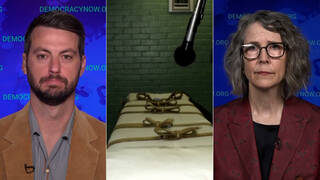
We look at All the Walls Came Down, a new short documentary directed by filmmaker Ondi Timoner that looks back at the devastating 2025 fires in Los Angeles, which destroyed Timoner’s home and left the historically Black community of Altadena in ruins. The film, which has been shortlisted for an Academy Award, follows community organizer Heavenly Hughes as residents confront the aftermath of the fires and organize to rebuild their town.
“We feel like we’re being forced out because of this fire and not really getting the support that we need from our elected officials to be sure to preserve and protect our Black and Brown community,” says Hughes.
Timoner says Southern California Edison, which has taken responsibility for the Eaton Fire, has refused to tap its emergency funds. The utility company needs to “bridge families over so that they’re not pushed off their generational land,” Timoner says. “It’s an urgent situation in our town.”
(Watch Part 2 of this interview.)
Transcript
AMY GOODMAN: This is Democracy Now!, democracynow.org. I’m Amy Goodman.
We end today’s show continuing our look back at last year’s devastating fires in Los Angeles. One year ago, the historic Palisades Fire and Eaton Fire ripped through the region. More than 30 people died, over 100,000 displaced. Some 16,000 buildings and homes were destroyed.
We turn now to the short documentary All the Walls Came Down, directed by filmmaker Ondi Timoner. The fires destroyed her home and left her beloved town of Altadena and its historically Black neighborhood in ruins. The film follows Altadena community activist Heavenly Hughes. It’s been shortlisted for an Oscar. This is the trailer.
ONDI TIMONER: Here it is.
MORGAN DOCTOR: Wow!
ONDI TIMONER: It says “unsafe.” And it says it right there. You see it?
MORGAN DOCTOR: This is how we have to go home now. We’re home in a hazmat outfit.
ONDI TIMONER: There’s no home here.
MORGAN DOCTOR: We got married right here.
WEDDING ATTENDEES: Amen!
RABBI RACHEL TIMONER: Mazel tov!
ONDI TIMONER: Just beyond belief.
MORGAN DOCTOR: Yeah.
ONDI TIMONER: I don’t know if we can live here. Morgan really doesn’t want to live here. But I also don’t want to abandon my community. I mean, Altadena is my community. So I don’t know what to do. What would you do?
LA PORSCHE WORMLEY: We were actually trapped and had to break through my glass doors to even get out the house.
RANDY VANCE: Welcome home, Ondi.
ONDI TIMONER: Randy is my across-the-street neighbor.
RANDY VANCE: I said there’s no way the fire was going to make it all the way to our house.
That’s downtown Altadena!
And it did. This was our family legacy.
HEAVENLY HUGHES: He moved into a Black community, where we are not on the priority list to save our lives. They’ve been wanting to get us out of there for a very long time.
Altadena’s not for sale!
PROTESTERS: Altadena’s not for sale!
HEAVENLY HUGHES: We want to make sure that Supervisor Barger know that we want to be a part of the conversation.
Hi. Excuse me. How are you?
KATHRYN BARGER: How are you?
Not today. No, I know Heavenly.
HEAVENLY HUGHES: There’s a lot of community members who are saying, “We might have to start sleeping at the park because we are unhoused.”
ONDI TIMONER: What’s happening with the house?
RANELL WORMLEY: They’re saying that they’re going to do foreclosures.
ONDI TIMONER: What?
RANELL WORMLEY: Yeah.
RUPERT GARCÍA: I come back here just to remember how to get here and just to know the way back home.
ONDI TIMONER: That’s my bedroom wall right there, my safest space in the world.
SONNY AVICHAL: Altadena, this is the largest debris mission in the 250 years that the Corps of Engineers and the Army has been in existence. And I have 100% confidence that it will rise up again.
AMY GOODMAN: The trailer for All the Walls Came Down. Let’s go to another clip, featuring community activist Heavenly Hughes, founder of the group My TRIBE Rise.
ONDI TIMONER: Despite living next to each other, exchanging occasional hellos and waves from a distance, it’s only after the walls came down, and my neighbors and I are displaced and dispersed, that our bonds of connection truly form.
HEAVENLY HUGHES: We have luncheons where we invite Altadenians throughout the community who’s been impacted by the fire. We call them our power luncheons.
Hello. How are you? Blessings. Good to see you. We gonna talk.
Our last luncheon. I saw probably 20 of my classmates that I graduated from high school with. They come up to me, like, “Thank you so much.” Feels good to be able to serve them.
ONDI TIMONER: Altadena is actually not a city of its own. It’s unincorporated L.A. County. So we only have county services, like the county fire and sheriff. And Kathryn Barger is our only local politician.
HEAVENLY HUGHES: How many of us in here are planning to rebuild? Because we want to keep you encouraged. We want to keep you encouraged that we are going to rebuild. There will be a new Altadena, and we’re going to all be a part of it. Blessings.
AMY GOODMAN: A clip from the Oscar shortlisted film All the Walls Came Down. You can watch the whole thing on the Los Angeles Times website.
We’re joined now by that community activist in Altadena, Heavenly Hughes, and the film’s award-winning director, Ondi Timoner, who lost her home in the fire.
I mean, let’s be clear on what Altadena represents in this country, the second-largest percentage of Black homeownership in the country. Over 9,000 structures burned down, more than 6,000 of them homes. Heavenly, if you can talk about the people who have lost their homes? Sixty percent of the homes were owned by Black families?
HEAVENLY HUGHES: Yes. Well, 60% of ownership within the Black community was homeowners. So, yeah. Thank you so much, of course, for having us here. We truly appreciate. We appreciate keeping the message out about what has happened in Altadena. This catastrophe has been a hardship that we are still struggling to overcome. So, yes, this is a Black community, where we were built, this community of Altadena, through redlining. We all came together in West Side Altadena. And we feel like we’re being forced out because of this fire and not really getting the support that we need from our elected officials to be sure to preserve and protect our Black and Brown community.
AMY GOODMAN: So, what’s happening? I mean, the homes have burned down.
HEAVENLY HUGHES: Right.
AMY GOODMAN: And talk about who has claimed responsibility. Actually, let’s put that question to Ondi.
ONDI TIMONER: You know, this started —
AMY GOODMAN: The electric company.
ONDI TIMONER: Yeah, this is — we found very quickly after the fire that Southern California Edison actually started the fire. They didn’t turn the power off, even though the Palisades and Malibu fire was raging all day with 80-, 90-mile-an-hour winds. And they just couldn’t charge us if they didn’t keep the power on, right? So, they — penny wise, pound foolish, and they just kept it on. And they had a dead line that was supposed to be dormant for years that they were supposed to take down, that they didn’t take down, and it was activated by colliding with a live wire, and the brush that they had not cleaned ignited. And many people caught it on their cameras. They’ve accepted responsibility, but they won’t pay until next year. So we have to get families — we have over 61% of Altadena families are going to face a housing crisis in the next two months. They’re going to lose their homes, because they’ve run out of —
AMY GOODMAN: The petition you have — I saw a screening of this yesterday.
ONDI TIMONER: Yes.
AMY GOODMAN: It says?
ONDI TIMONER: Yeah, so, the petition is to stop the foreclosures, put a moratorium on the foreclosures. Governor Newsom and the Legislature can do that, so that Black and Brown families are not pushed off their land while waiting for the Southern — for the power company to pay.
AMY GOODMAN: How can they possibly be foreclosed on? And who’s buying up the properties, if they are? And, of course, if it’s foreclosed on, though, they won’t be bought from the owners.
HEAVENLY HUGHES: Well, it’s predatorial behavior happening now. I call them vultures. It is the developers who are coming and buying up the land. We’re going through a hardship, so they’re offering money to say, you know, “We can get you out of this hardship, take all of this heaviness.” It’s hard to navigate what to do right now, and so many moving pieces. And so, developers are coming in, offering money. And really, our community members are not as informed to understand that they’re offering pennies on the dollar of what this land is worth. And so, that’s who’s coming —
AMY GOODMAN: Do people have insurance?
HEAVENLY HUGHES: A lot of people were dropped. On West Side Altadena, four months before the fire, many homes, they were dropped. You know, there’s State Farm and other insurance companies. To me, they also are predatory in what’s going on, because they are not paying. Some folks have been paying insurance premiums for 20, 30, 40, even 50 years, and now, when it’s time to pay out, they’re not doing it. They’re not paying out. They’re making people pay first and reimburse. And how are we — if you lost everything, where are you coming up with the money to pay first, when you’ve been paying these premiums for years? So, this is also a hardship.
AMY GOODMAN: We’re going to do a Part 2 of this discussion. But what do you think is the most important takeaway? Ondi, you were making a film. You got a message from your across-the-street neighbor: Your house has burned down.
ONDI TIMONER: Yeah, I was in Europe at the time. And I just thought I — you know, “I have lost everything, but if I don’t film right now, there’d be no way to transform this experience into something meaningful, if there’s a meaning to be found.” And I found that silver lining with the community. The community has come together out of this, and we stand together and demand that Southern California Edison bridge families over so that they’re not pushed off their generational land.
AMY GOODMAN: They have an emergency fund of billions of dollars?
ONDI TIMONER: Billions of dollars. And they just need to advance money now, and that’s part of our petition, as well. So, this is really something that — you know, it’s —
AMY GOODMAN: Ten seconds.
ONDI TIMONER: I need to film extremely fast, because it’s an emergency response. It’s an urgent situation in our town.
AMY GOODMAN: We’re going to continue this discussion and post it online at democracynow.org. I want to thank you, Ondi Timoner, director of All the Walls Came Down. The film, shortlisted for an Oscar, features Heavenly Hughes, who founded My TRIBE Rise. That does it for the show. I’m Amy Goodman. Thanks for joining us.





 Top
Top
Media Options