







 Watch Full Show

Topics
Guests
- Laura GottesdienerPulitzer Prize-winning investigative journalist and senior correspondent in Mexico for Reuters.
- Alexander Aviñaassociate professor of Latin American history at Arizona State University.
Aided by U.S. intelligence, Mexican security forces killed the nation’s most wanted man, the leader of the Jalisco New Generation Cartel, Nemesio Oseguera Cervantes, known as “El Mencho,” on Sunday. At least 70 people were killed in the raid and aftermath as armed groups retaliated in more than a dozen states.
“There’s a real sense in Mexico and beyond that governments need to show the U.S. that they are willing and able to take military action on their own, lest Washington send special forces into the country,” says Reuters correspondent Laura Gottesdiener about the raid and Mexican President Claudia Sheinbaum’s wider crackdown on organized crime. While Sunday’s operation will help Sheinbaum “stave off some of the pressure from Trump,” Latin American historian Alexander Aviña warns that “this is not going to do much in terms of stopping the flow of illicit drugs from Mexico into United States.” Instead, he says, instability within cartel leadership will likely lead to internal power struggles that spill out into local communities. “The burden of this war always falls upon the very bottom of the hierarchy within this political economy,” says Aviña.
Related Story
 StoryAug 12, 2025Trump’s New Secret Directive OKs Military Action in Latin America Under Guise of Drug War
Transcript
AMY GOODMAN: This is Democracy Now!, democracynow.org, The War and Peace Report. I’m Amy Goodman, with Juan González.
We turn now to Mexico, still reeling from a wave of violence following a U.S. intelligence-aided raid killing the powerful drug lord commonly known as “El Mencho” Sunday morning. At least 70 people were killed in the raid targeting Nemesio Oseguera Cervantes, the head of the Jalisco New Generation Cartel, and in ensuing violence as armed groups retaliated in more than a dozen Mexican states. Suspected gang members blocked highways and set cars on fire, buses and businesses, while clashing with security forces.
Mexican President Claudia Sheinbaum said the situation is normalizing, and the U.S. State Department continues to urge American citizens in Mexico to shelter in place amidst ongoing security operations and criminal activity.
Reuters and The New York Times report that the Mexican raid targeting Oseguera, who headed Mexico’s largest cartel, was aided by intelligence from the CIA and a new U.S. military-led task force. Speaking at a news conference on Monday, President Sheinbaum said the United States only played an information-sharing role in the Mexican military attack.
PRESIDENT CLAUDIA SHEINBAUM: [translated] All operations are carried out by federal forces; there is no U.S. participation in the operation. What there is, as we have said here several times, is a great deal of information sharing. The understanding with the United States is based primarily on the exchange of intelligence information. In this case, the U.S. government provided information and even issued an intelligence statement. But the entire operation, from planning onwards, is the responsibility of federal forces, in this case the Ministry of National Defense.
AMY GOODMAN: The surprise raid killing the cartel leader Oseguera — El Mencho — was the biggest Mexican security operation in over a decade and comes amidst rising pressure on Mexico from President Trump to crack down on drug cartels and organized crime in Mexico.
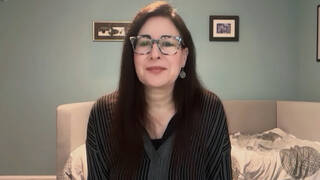
For more, we’re joined by Reuters reporter Laura Gottesdiener in Monterrey, Mexico, part of the Reuters team that won the 2025 Pulitzer Prize for Investigative Reporting for their exposé on lax regulation in the U.S. and abroad that makes fentanyl, one of the world’s deadliest drugs, inexpensive and widely available to users in the United States. Laura Gottesdiener is also a former producer at Democracy Now!
Laura, congratulations on the Pulitzer. We haven’t gotten a chance to congratulate you on the air. But most importantly right now, your piece is so important — you’ve written several in the last few days — as you give background on what has taken place on Sunday morning. Can you explain? The President Claudia Sheinbaum’s predecessor from the Morena party, AMLO, came to power in part because of the public’s frustration with the militarized war on drugs. Can you talk about the significance now of President Sheinbaum’s action?
LAURA GOTTESDIENER: Thank you so much for having me, and hello to the whole control room and Democracy Now! team. Thank you.
Yes, so, this is a very critical moment here in Mexico. The raid was really considered a shock here in Mexico, at least according to the sources that I’ve spoken to. El Mencho, unlike some of the leaders of the Sinaloa Cartel, for example, he was a very shadowy figure. He didn’t call a lot of attention to himself. And he’s been sought by three Mexican administrations, multiple U.S. administrations. So this is somebody who was wanted for a very long time.
Obviously, the timing of the raid, as well, in advance of the World Cup — there are going to be games scheduled to play in Guadalajara — that all makes for a particularly dramatic situation. Obviously, the violence, as well, across parts of Mexico all on the day on Sunday was very dramatic. But as the president emphasized in her morning news conference yesterday, across most of the country the situation is calm, was calm.
The retaliatory wave of violence really was something that showed the breadth of the territorial reach of the Jalisco New Generation Cartel, which El Mencho was the leader of. But the real question remains to be seen whether this kicks off what often happens, which is a fracturing and infighting in a large criminal organization, that then creates a sustained wave of violence that targets, of course, security forces but also civilians all across sectors of society. So, that’s really the concern, whether this is going to create a wave of violence or whether this is something that the Mexican government — they’ve sent some 2,000 troops to Jalisco, the stronghold of the cartel — or if this is something that the Mexican government will be able to control.
It’s also unclear, based on the structure of the Jalisco New Generation Cartel, what exactly the succession plans could be, but also what exactly a fracturing might look like. Unlike with the Sinaloa Cartel, which fractured and has created sort of spectacular and terrible violence in Sinaloa due to the fracturing in 2024, which resulted because of the — which was kicked off because of the capture of El Mayo in the United States, the Jalisco Cartel is a much more sort of decentralized, franchise-based operation. So it is not clear sort of whether there are strong, entrenched rivalries that will result in the sort of unfortunate and terrible ongoing violence that we’re seeing in Sinaloa.
JUAN GONZÁLEZ: And, Laura, I wanted to ask you — Sheinbaum’s predecessor, AMLO, really sought to tamp down this heavy-handed approach to the cartels in Mexico. Could you talk about the difference since Sheinbaum has come in as president in her approach to combating drug trafficking and to what degree U.S. pressure has forced her hand in this?
LAURA GOTTESDIENER: Yes, absolutely. Excellent question, Juan. Thank you so much.
As you know better than almost anyone, this long-running U.S.-backed drug war is a combination of pressure from the United States, as well as efforts by governments, whether Colombia or Mexico — you know, Felipe Calderón obviously declared the war on drugs in Mexico in 2006. And yes, in 2018, López Obrador was elected in a landslide victory for various reasons, also widespread frustration about inequality and injustice in Mexico, but also in large part because of frustration over this drug war and the U.S.-backed drug war, frustration both in terms of U.S. pressure and frustration in terms of the Mexican role leading this drug war.
Unfortunately, there was real mixed results from López Obrador’s efforts to use social programs to combat the insecurity in the country. His social programs, which Sheinbaum has continued and which are widely popular, historically reduced poverty, and that was a huge success for the government. And that is something that the Morena party is continuing to prioritize, not only because it’s popular, but because it is reducing poverty across the country.
Yet at the same time, we saw López Obrador’s administration — the homicide rates ticked down, but many security experts say that the cartels also became more entrenched, expanded to new illicit industries, were able to sort of further control territories. So, it was complicated. And when Sheinbaum came in, which of course comes in the context of U.S. President Donald Trump’s election and then taking office, immediately the Sheinbaum administration stepped up the war against the cartels, deployed forces to Sinaloa, which at the time was both locked in a bloody battle, that continues, but also was the absolute number-one priority for the U.S. government, because the U.S. government blames the Sinaloa Cartel, principally the Los Chapitos faction, for the fentanyl crisis. So that was seen as both important in terms of Mexican security, but, principally, under a lot of U.S. pressure, and a huge priority for the U.S. government.
Since Trump came into office, all of the pressure continues. And I think we have to understand the El Mencho raid in the context of the January 3rd military attack in Caracas, in Venezuela, by the U.S. Special Forces. That sent shockwaves all across the region. And there’s a real sense, in Mexico and beyond, that governments need to show the U.S. that they are willing to take — willing and able to take military action on their own, lest Washington send Special Forces into the country.
So, in general, this raid is being considered, is being seen, as a signal that President Sheinbaum is sending to Washington: We not only can, but will, take these types of unprecedented military operations, but do not send Special Forces into the country. This is a red line in Mexico.
AMY GOODMAN: Laura, can you talk about the new U.S. Joint Interagency Task Force-Counter Cartel that you report played a key role in the Mexican military raid on Sunday?
LAURA GOTTESDIENER: Yeah. My colleague Phil Stewart in Washington interviewed the head of the Joint Interagency Task Force-Counter Cartel ahead of the raid. This is a new task force set up by the Pentagon under President Donald Trump. There’s not that much information available about it. Its mission is to dismantle Mexican cartels and cartels particularly along the U.S.-Mexico border.
I think it’s important to note there have been and continue to be various interagency — you know, Pentagon interagency [units] and, in general, what we’ve seen over many, many years, but accelerated under President Trump, is extensive coordination between U.S. law enforcement and the U.S. intelligence — so-called U.S. intelligence community. That’s the CIA, NSA, you know, the more than a dozen U.S. intelligence agencies.
There is more coordination than ever between the law enforcement and the intelligence agencies side to share information, compile information, get information. And then that is all compiled into what are called these targeting packages — they’re these detailed dossiers. And that is shared with the Mexican government. That’s not new. We’ve seen sort of these targeting packages and information-sharing happening for quite some time under multiple administrations. But it is definitely accelerating under President Trump.
In part, that’s because of the FTO designation, the fact that President Trump, when he came into office, he directed the administration to declare various Mexican cartels as terrorist organizations, including, of course, the Jalisco New Generation Cartel. That unlocks authorities within the U.S. government to use more money, more tools, more resources to get intelligence and then to share intelligence internally.
We’re still all, I think, trying to really understand what the impact of this FTO designation has been internally inside the United States government, because what we can see on the surface is really just a fraction of what’s happening underneath, because most of that space is classified.
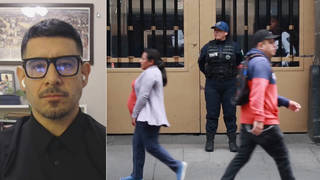
JUAN GONZÁLEZ: I’d like to bring into our discussion another guest, Alexander Aviña, associate professor of Latin American history at Arizona State University, who’s written extensively and researched about capitalism, the U.S.-backed war on drugs and state violence. Professor Aviña, I wanted to ask you — this enormous firepower of the cartels in this raid once again demonstrates the flood of arms that has come into Mexico from the United States. I’m wondering if you could talk about that, why these cartels are so heavily armed?
ALEXANDER AVIÑA: Good morning, Juan. Thank you for having me again.
Yes, there’s been — over the last few years, there has been sustained, really good reporting by Mexican and U.S. journalists that indicate something like 80% to 90% of the weapons that are captured from different drug trafficking organizations come from the United States. Indeed, President Sheinbaum mentioned that, I think, yesterday during her morning press conference, where she said something like 80% of the weapons that they’ve taken from the Jalisco Cartel come from the United States.
There was really excellent reporting earlier this month about one particular U.S. Army-owned ammunition plant in Lake City, Missouri, that makes the 50-caliber ammunition that is designed to take down transport and even light aircraft. And while the U.S. military does use that ammunition, it also sells it to the U.S. domestic market. But there’s very little demand from the U.S. domestic market for bullets the size of cigars, so those bullets actually are being sold to Mexican drug trafficking organizations. And they’re part of this broader flow of weaponry and ammunition that go from north to south that helps — that just represents one driver of the type of violence that we see in Mexico that affects everyday Mexicans on the ground.
JUAN GONZÁLEZ: Yeah, and in terms of the Trump administration’s repeatedly threatening President Sheinbaum, claiming her government wasn’t doing enough to combat drug cartels, what’s your assessment of how the Mexican government has tried to deal with this issue in the past?
ALEXANDER AVIÑA: Yeah, Trump has infamously said things like he personally likes President Sheinbaum, but she’s scared, and the cartels are actually running the country, which is — I mean, as we witnessed on Sunday, that’s patently false. You know, what happened on Sunday is just part of a longer decadeslong approach to drug interdiction that is highly militarized, that focuses on punitive actions, and that in the end only ends up generating more violence and doesn’t do anything to stem the flow of drugs.
So, I think symbolically and politically, it represents a victory for President Sheinbaum. It allows her to assert that she’s doing — quote-unquote, “doing something” about the most powerful drug trafficking organization in Mexico and likely the Americas. It allows her to stave off some of the pressure from Trump — right? — to assert Mexican military power against these criminal organizations.
But we know that this is not going to do much in terms of stopping the flow of illicit drugs from Mexico into the United States. If anything, based on recent past, we know that this is probably going to lead to some sort of internal struggle within this drug trafficking organization, which will only lead to intensified violence on the ground in local communities in the places, in the geographies that it controls. It will also probably embolden rival groups to try to take over territories, production zones and smuggling routes, so that will also intensify the violence on the ground.
And this is just a phenomenon of the so-called war on drugs that the U.S. has led globally since the end of World War II. The burden of this war always falls upon the very bottom of the hierarchy within this political economy, on poor people, on poor peasant farmers, on low-level street dealers, on low-level consumers. And so, what we’re going to see in Mexico, unfortunately, likely, is an intensified violence on the ground, the type that we witnessed yesterday, right? The main victims yesterday were communities across 15 states that suffered something like 250-plus road blockages and attacks by gunmen belonging to this Jalisco Cartel as a way for them to project their power and to kind of terrorize local communities into submission.
AMY GOODMAN: Laura Gottesdiener, your latest piece, that just came out today for Reuters, talks about the cartel and perhaps others putting out fake news accounts of what’s taking place right now, the reaction in Mexico, you’re contending making it look worse than it is, to the attack.
LAURA GOTTESDIENER: Yeah. Thanks, Amy. I completely agree with Alex. I think the roadblocks, the disturbances have a dramatic impact on communities across the country. There is also at the same time a propaganda effort on both these roadblocks but in the digital space. That’s what we were looking at late last night. Because at this point, the Jalisco New Generation Cartel wants to try to create a narrative that the Mexican government is not in control of the country.
There are certainly parts of the country in which the state really does struggle to assert control, provide basic functions, and particularly security. But their goal is beyond that. They want to create, especially in the context of the World Cup and especially in the context of widespread tourism to Mexico, they want to create an international image that there is — that they have more control of the country or that the Mexican government is unable to govern, essentially a crisis of governability.
And so, what we were looking at last night is the way in which AI-generated images and fake news spread across the internet. According to researchers, that was not just unsuspecting people sharing sort of stories to get clicks, but it appears that that was actually part of some version of a coordinated propaganda campaign by organized crime to create this additional space in which they are fighting for the narrative.
The roadblocks were very real disturbances in which they are fighting for the narrative on the streets, but online they were also fighting for the narrative of this question of who governs the country. And so, I think we have to really look at this online space, especially now that AI has become so incredibly ubiquitous, and understand what are crime groups doing in this space and how it is a new terrain of struggle, of propaganda and narrative struggle for them. They’ve used social media for various tactical, communication reasons, fake recruiting, for quite some time. But this is sort of — it appears that this is sort of an escalation of the propaganda war that they wage online.
AMY GOODMAN: Well, I want to thank you, Laura Gottesdiener. Juan, last question?
JUAN GONZÁLEZ: No, I just wanted to ask Professor Aviña what your sense is of how the U.S.-backed war on drugs has impacted this issue of corruption within the Mexican government.
ALEXANDER AVIÑA: Oh, an easy question, Juan. I mean, it’s — you know, corruption is something that’s structural to the international drug game. So it’s not even just corruption that allows for this political economy of narcotics to function within Mexico. And indeed, the rise of this political economy began within the confines of the post-revolutionary authoritarian state that was led by the PRI throughout the 20th century. But this is a feature that characterizes the political economy of illicit narcotics and drugs globally. So, for it to function, it also depends on corruption within the United States government, as well, within different U.S. security forces.
And as we now know and we’ve talked about in the past, we know that since the end of World War II, the U.S. has used the so-called war on drugs as a way to advance geopolitical imperialist ambitions in Latin America. It gave them one more tool to try to exercise control over countries in Latin America through a militarized approach to drug interdiction.
And that hasn’t necessarily changed. We witnessed it at the end of last year with the kidnapping of Venezuelan President Nicolás Maduro, the whole phenomenon of narcoterrorism, and we’re seeing something — we’re going to continue to see this throughout the Trump administration and beyond, whether there’s a Democrat in power. The style and the rhetoric will be different, but the war on drugs will continue to be used as a way to advance U.S. empire in the region.
And again, to stress this point, the burden falls on the poor people in Mexico and on poor people in the United States, and we never get back to the fundamental question of why poor people turn to the economy of illicit drugs in Mexico and why so many Americans, a disproportionate amount relative to the global population, feel the need to turn to illicit drugs to get by on an everyday basis. I think those are some of the more profound questions that we need to keep posing.
AMY GOODMAN: Alexander Aviña, I want to thank you so much for being with us, associate professor of Latin American history at Arizona State University, and Laura Gottesdiener, a Pulitzer Prize-winning investigative journalist based in Monterrey. We’ll link to your recent articles.
This is Democracy Now! Coming up, we speak to longtime war crimes prosecutor Reed Brody about law and accountability, from the International Criminal Court’s hearing on former Filipino President Rodrigo Duterte to the growing fallout from the Epstein files. Stay with us.
[break]
AMY GOODMAN: “Dear Someone” by Lila Downs, performing in our Democracy Now! studio.




 Top
Top
Media Options